For the First Time in Three Years, the Sixth Bitcoin Core Maintainer Emerges

Odaily星球日报Published on 2026-01-14Last updated on 2026-01-14

Abstract

On January 8, Bitcoin Core appointed developer TheCharlatan as its sixth core maintainer, the first such addition since 2023. Core maintainers hold trusted keys and are responsible for merging code into Bitcoin Core repository and signing official releases, ensuring the software’s authenticity and security. There are now six trusted maintainers, including Marco Falke, Gloria Zhao, Ryan Ofsky, Hennadii Stepanov, and Ava Chow. The role of a core maintainer is compared to an "editor" in the development process—they review and approve code contributions but do not have unilateral power to change on-chain rules. Bitcoin upgrades still depend on broader community consensus. TheCharlatan, a computer science graduate from the University of Zurich, has been contributing to Bitcoin Core since 2018 and has over a decade of experience in crypto development. He is known for his work on improving Bitcoin Core’s verification logic and modularization. His appointment was supported by at least 20 Bitcoin Core developers. The article also highlights the historical context of Bitcoin Core maintainers, noting that Satoshi Nakamoto originally held sole maintainer authority, which was later decentralized. Core maintainers are highly trusted individuals within the community, with significant influence over the project’s development direction.

Original | Odaily Planet Daily (@OdailyChina)

Author | Golem (@web 3_golem)

On January 8, the Bitcoin Core team promoted developer TheCharlatan (X: @sedited) to core maintainer, making him the sixth member to hold trusted keys. The other five core maintainers with trusted keys include: Marco Falke (promoted in 2016), Gloria Zhao (promoted in 2022), Ryan Ofsky (promoted in 2023), Hennadii Stepanov (promoted in 2021), and Ava Chow (promoted in 2021).

This appointment marks the first addition of a trusted key holder since 2023. Over the past decade, only 13 people have been granted this permission, highlighting its importance and the strictness of the selection process.

Bitcoin Core Maintainers: The 'Editors' of Bitcoin Developers

Bitcoin Core is currently the primary development and maintenance team for the Bitcoin mainnet. It is responsible for writing, maintaining, testing, and releasing the majority of the full node software, along with accompanying tools and documentation. Bitcoin Core is non-profit and operates mainly on funding from external companies.

The Bitcoin Core development team consists of 41 members who contribute the vast majority of the project's code. Among them, only 6 developers are granted the status of 'Core Maintainer'—they are the only six people in the world with the authority to merge code into Bitcoin Core and sign the released program files (binaries).
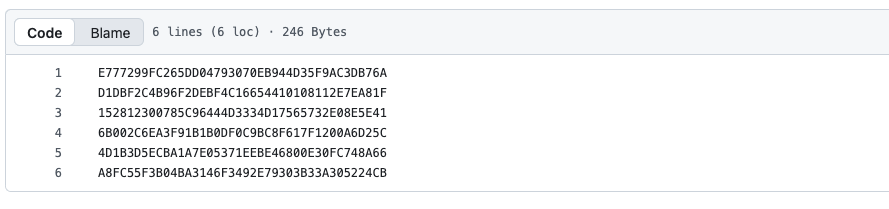
Signatures of the 6 core maintainers

To draw an analogy, Bitcoin Core maintainers are like the 'editors' of the Bitcoin network developers; anyone can contribute code and submit PRs to the codebase, but only the core maintainers have the authority to merge code into the official codebase and sign releases. This is similar to editors reviewing manuscripts, deciding whether developers' code is accepted for publication or returned for modification.

The signatures of Bitcoin Core maintainers ensure security, giving all nodes and users confidence that the release is 'official and unaltered.' However, Bitcoin Core maintainers do not have the direct power to trigger changes to on-chain rules. For example, even if Bitcoin Core maintainers have signed and released program files for a soft fork or hard fork of the Bitcoin network, the actual success of the upgrade depends on adoption and consensus from users and miners, not just the signatures of the Bitcoin Core maintainers.

When Bitcoin was first created, Satoshi Nakamoto was the only core maintainer, with sole authority to change the core codebase. Later, Satoshi passed this privilege to Gavin Andresen, who then passed it to Wladimir van der Laan. This means that for a long time, the power to maintain/change the Bitcoin network code was in the hands of one person. It wasn't until 2022, when Wladimir van der Laan stepped down and became embroiled in litigation with Craig Wright (who claims to be Satoshi Nakamoto), that this power began to be decentralized.

Even so, Bitcoin Core maintainers still play a crucial role. Those who become core maintainers typically have high levels of trust and reputation within the community or have made outstanding contributions to the Bitcoin network.

For example, one core maintainer, Ava Chow, is a transgender female developer. In 2024, when Bitcoin core developer Luke Dashjr wanted to restrict Ordinals transactions at the consensus level, it was she who rejected Luke Dashjr's PR on the grounds of 'no consensus and creating noise,' preventing a potential severe split in the Bitcoin network consensus and becoming an unsung hero.
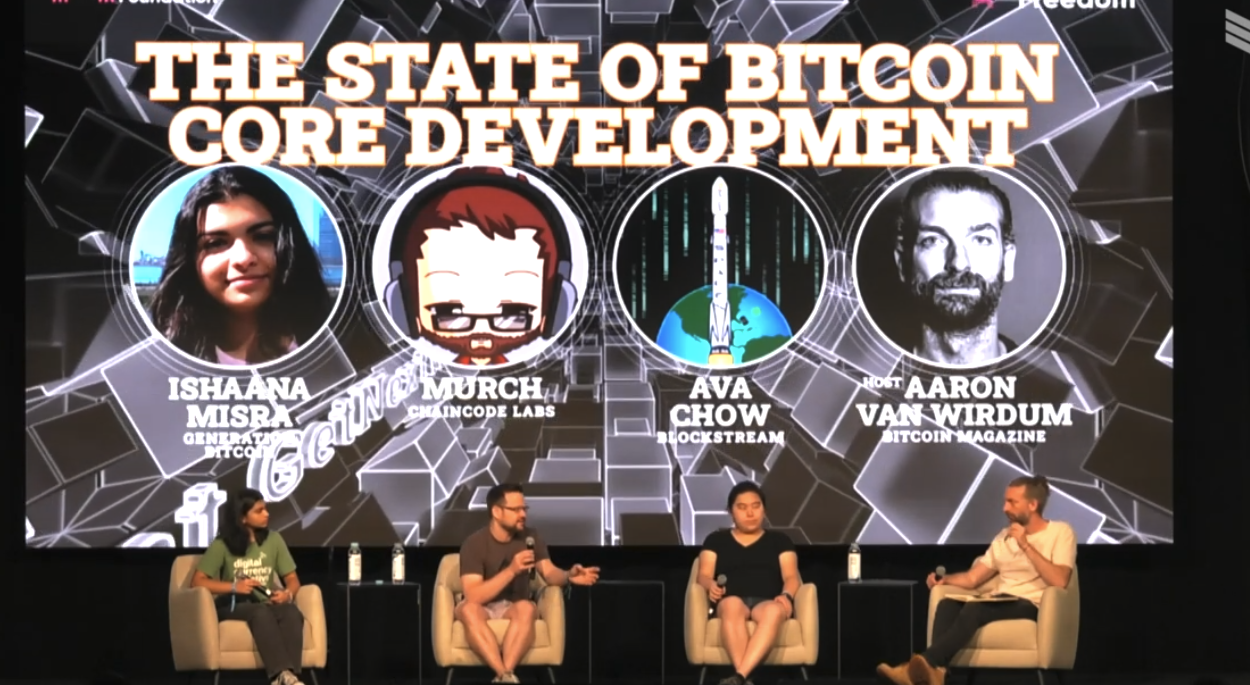
Ava Chow attended Bitcoin 2024 event

For introductions and contributions of other core maintainers, please refer to previous articles(related reading:Who is guarding Satoshi's legacy? A look at the 41-person army behind Bitcoin's trillion-dollar market cap). Next, we will introduce why TheCharlatan became the sixth core maintainer.

TheCharlatan: A Decade of Experience in Crypto Development

TheCharlatan graduated from the University of Zurich with a degree in computer science. He is South African and focuses on reproducibility and the verification logic of Bitcoin Core. In a 2024 blog post, he claimed to have been developing this project for over two years. TheCharlatan's work involves systematically splitting, organizing, and modularizing Bitcoin Core's verification logic, allowing other users to safely reuse it.

TheCharlatan

TheCharlatan is widely popular among Bitcoin Core developers. In the process of promoting him to core maintainer, at least 20 members expressed their approval. When nominating him, glozow praised: 'He is a reliable reviewer with extensive experience in key areas of the codebase, thoughtful about what we deliver to users and developers, and very familiar with the technical consensus process.'
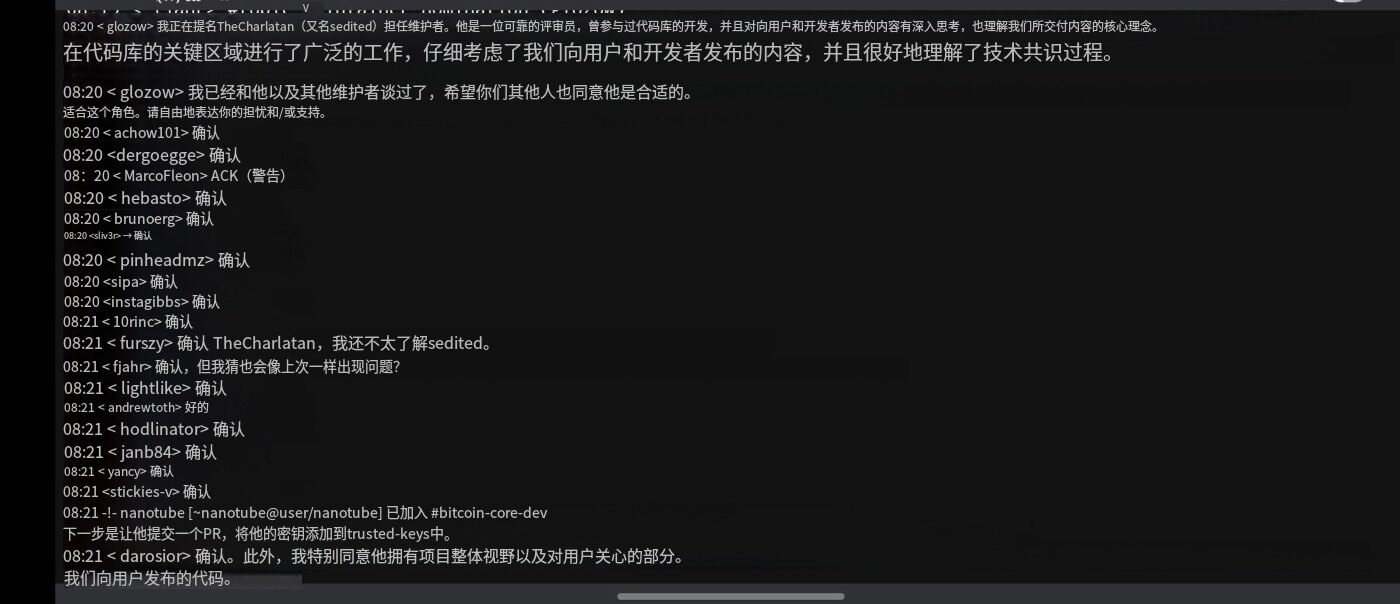
Bitcoin Core core developer group chat content (translated)

According to his GitHub account information, TheCharlatan first started crypto development in 2015 by creating a cryptocurrency price display tool. This tool was a simple Linux desktop widget with built-in price alerts that triggered when set thresholds were reached. His crypto development activities became more frequent after 2017. He began contributing code to Bitcoin Core in 2018, so it can be inferred that TheCharlatan first encountered Bitcoin Core 8 years ago, making him a veteran.

It is also worth noting that in 2021-2022, TheCharlatan contributed to a Farcaster project codebase. This project allowed people to exchange Bitcoin and Monero peer-to-peer with anyone running a Farcaster node.

TheCharlatan does have a 'soft spot' for Monero. In 2020, he researched the potential destruction issues caused by using hardware wallets to transfer Monero and discussed time-lock vulnerabilities in Monero.

Of course, true tech geeks can be somewhat elusive. TheCharlatan often retweets technical posts on platform X but rarely expresses his own opinions (in May 2025, he posted that he hates NFTs even more). However, since June 2025, he has been repeating a tweet every month that says: 'Cash on the internet. No auto-updates.'

I was afraid this might be some kind of secret code among Bitcoin tech geeks or a cultural slogan I wasn't aware of, so I asked AI to explain the meaning of these two sentences. The AI said these two sentences actually express an extreme Bitcoin fundamentalist view:

'True internet-native cash should be as simple, brutal, and immutable as cash. Once you start with automatic updates, governance votes, and frequent rule changes, it's no longer cash; it becomes another centralized/semi-centralized/manipulable 'digital bank account'.'


Trending Cryptos

Related Questions

QWho was recently promoted as the sixth core maintainer of Bitcoin Core with trusted keys?

ATheCharlatan (@sedited) was promoted as the sixth core maintainer of Bitcoin Core on January 8th.

QWhat is the primary responsibility of a Bitcoin Core core maintainer?

ACore maintainers are responsible for merging code into the official Bitcoin Core repository and signing the released program files (binaries) to ensure they are official and unaltered.

QHow many core maintainers with trusted keys are there currently in Bitcoin Core?

AThere are currently six core maintainers with trusted keys in Bitcoin Core.

QWhat significant contribution did Ava Chow make as a core maintainer?

AAva Chow rejected Luke Dashjr's PR to limit Ordinals transactions at the consensus level, preventing a potential severe split in the Bitcoin network consensus.

QHow long has TheCharlatan been contributing to Bitcoin Core development?

ATheCharlatan has been contributing to Bitcoin Core since 2018, making it approximately 8 years of involvement as of the article's context.

Related Reads

Wall Street's Most Famous 'Cassandra' Now Has His Sights Set on Nvidia

Michael Burry, the famed "Big Short" investor, has once again captured Wall Street's attention with a series of short positions against major tech and semiconductor stocks, most notably Nvidia. In late June and July, through his "Cassandra Unchained" newsletter, Burry disclosed short bets against Nvidia, Tesla, Applied Materials, Caterpillar, the SOXX semiconductor ETF, and later, Micron Technology. His core thesis revolves around potential distortions in the AI infrastructure boom, specifically questioning whether extended depreciation schedules (e.g., 6 years vs. a realistic 2-3 years for AI chips) by cloud giants like Microsoft and Google artificially inflate profits. He also raises concerns about possible "off-balance-sheet circular financing," where chip demand might be propped up by vendor-backed funding to clients. Nvidia's stock experienced volatility following these disclosures, briefly dipping but largely holding near Burry's reported entry points, leaving his positions roughly flat or slightly underwater as of late July. This move is part of a pattern for Burry, whose track record since his legendary 2008 bet is mixed. He has faced notable losses, such as on Tesla in 2021, while scoring on broader market turns like the 2020 pandemic crash. His methodology focuses intensely on free cash flow and scrutinizing original financial documents to spot overvaluation and structural risks, but it often struggles with timing the market. The article contrasts Burry's stance with other prominent investors. Steve Eisman, another "Big Short" figure, is not shorting Nvidia, citing strong fundamentals but expressing nervousness about sustainability. Jim Chanos agrees with the broad "accounting mismatch" concern—comparing it to the dot-com bubble—but targets financial leverage in private equity firms rather than the chip stocks themselves. While Nvidia's short interest remains relatively low at 1.3-1.4% of float, the massive stock size means absolute short losses have been significant, exceeding $5 billion earlier this year. The piece concludes that for ordinary investors, the key takeaway is not replicating specific short bets but learning from the critical frameworks these investors use: questioning rosy accounting, identifying structural vulnerabilities, and maintaining skepticism during market euphoria, even if pinpointing the exact catalyst for a downturn remains elusive.

marsbit24m ago

Wall Street's Most Famous 'Cassandra' Now Has His Sights Set on Nvidia

marsbit24m ago

Weekly Selection丨Epic Stock Market Volatility, Changxin Tech's IPO Reshapes Storage Landscape, Saylor Aims to Re-Anchor STRC Around September 8th

PANews Weekly Digest: Market Turmoil, Tech Breakthroughs, and Crypto Developments. The week saw significant volatility across global markets. South Korea's KOSPI index experienced extreme turbulence, including multiple trading halts, largely driven by sharp declines in AI hardware stocks like SK Hynix. In contrast, China's Changxin Xinqiao (CXC) achieved a landmark IPO with a market cap surpassing 4 trillion yuan, marking a major success for the domestic DRAM industry after a decade of losses. In the crypto and Web3 space, several key narratives emerged. AI is driving demand for new infrastructure, with projects like AI agent wallets and programmable payments gaining traction, attracting interest from firms like Coinbase. The Bitcoin mining sector is pivoting, with companies like MARA focusing on energy management as electricity becomes a core AI-era asset. Meanwhile, the RWA (Real World Assets) sector faces a "utilization puzzle," with hundreds of billions in on-chain assets remaining dormant. Notable market movements included a historic single-day surge of over 17% for the KOSPI index and a significant migration of $16.5 billion in staked ETH within the Lido ecosystem. Michael Saylor announced a target to re-peg the STRC stablecoin around September 8th. Other highlights include discussions on Ethereum's ambitious 2030 roadmap for scaling and privacy, analysis showing high protocol revenues not always translating to token price gains, and warnings from Citi about potential extreme commodity price shocks by late 2026.

marsbit30m ago

Weekly Selection丨Epic Stock Market Volatility, Changxin Tech's IPO Reshapes Storage Landscape, Saylor Aims to Re-Anchor STRC Around September 8th

marsbit30m ago

When the Market Begins to Question AI Capex: A Full Analysis of Q2 Earnings Reports from Five Tech Giants

In late July 2026, five major US tech giants—Alphabet, Intel, Microsoft, Meta, and Apple—released their Q2 earnings reports. While all companies exceeded revenue and profit expectations, driven by strong AI-related business growth, investor reactions diverged sharply due to concerns over escalating AI capital expenditures (capex) and their impact on free cash flow. Alphabet reported strong revenue growth and a surging cloud business, but its stock fell after announcing a doubled year-on-year capex and negative quarterly free cash flow for the first time. Intel posted its strongest revenue growth in over 15 years, but its stock experienced volatile trading after significantly raising its full-year capex guidance. Microsoft saw its stock surge after beating estimates and, crucially, lowering its capex forecast while projecting positive free cash flow. Meta faced the most severe sell-off as its profits declined despite revenue beats, with free cash flow plunging over 90% and its capex guidance raised. Apple reported record June-quarter results, but its stock plummeted after providing Q4 revenue guidance that fell short of expectations, citing supply chain constraints and forex headwinds. The overall takeaway is that the market's focus has shifted from validating AI demand to scrutinizing the timeline for returns on massive AI investments. Companies demonstrating a clearer path to managing capex and preserving free cash flow, like Microsoft, were rewarded, while those signaling continued aggressive spending faced investor skepticism.

Odaily星球日报39m ago

When the Market Begins to Question AI Capex: A Full Analysis of Q2 Earnings Reports from Five Tech Giants

Odaily星球日报39m ago

a16z: From Companies to DAOs, DUNA May Become the Next Generation Organizational Form

This article, "From Companies to DAOs: How DUNA Could Become the Next Organizational Form," traces the 500-year evolution of business collaboration. It begins with medieval structures like the *commenda* and Florentine *compagnia*, which exposed partners to personal risk. The modern corporation, exemplified by the Dutch East India Company (VOC), was a revolutionary leap, enabling large-scale, capital-intensive ventures by offering limited liability and reducing coordination costs. However, corporations introduced new challenges like principal-agent problems and bureaucratic overhead. The piece argues that software and internet-native protocols are now reducing these traditional overheads. Decentralized Autonomous Organizations (DAOs) emerged as a new model for coordination without centralized management. Yet, DAOs face a significant legal vacuum: they lack legal recognition, leaving members exposed to unlimited personal liability, and their tokens are vulnerable to being classified as securities under unclear regulations (e.g., the Howey Test). This has forced projects into suboptimal workarounds like offshore foundations. The article identifies the Decentralized Unincorporated Nonprofit Association (DUNA) as a potential solution. Recently legalized in states like Wyoming, the DUNA provides a legal wrapper for decentralized networks. It grants key protections—legal personality, limited liability, and perpetual existence—to a group without imposing a traditional hierarchical management structure. This allows token-holder communities to govern, hold assets, and contract as a single legal entity, aligning with their decentralized nature. While DUNA doesn't solve all governance challenges or magically resolve securities law questions, it represents a crucial step. It fills the legal recognition gap, offering a native legal form for internet-scale, decentralized collaboration and extending the separation of personal risk from organizational venture into a new domain.

marsbit1h ago

a16z: From Companies to DAOs, DUNA May Become the Next Generation Organizational Form

marsbit1h ago

2026 Mid-Year Report On-Chain RWA: Tokenized Stock Market Cap Doubles in a Year, But 90% of Rights Are Hollow Shells

The 2026 Mid-Year Report on On-Chain RWA highlights a significant growth in tokenized stock market capitalization, which nearly doubled from $951 million in March to $1.89 billion by July. However, the report reveals a fundamental contradiction in this "layer 2.5" ecosystem: products with the strongest legal foundation (like regulated U.S. infrastructure) lack liquidity and distribution, while freely tradable offshored wrapper products often lack substantive ownership rights. The increase is driven largely by a few products (SECZ, FGRS, STRCx) and platforms (Ondo, xStocks, Securitize collectively hold over 85% share). While distributed value across networks like Ethereum, Solana, and BNB Chain has grown, the market remains fragmented. Products referencing the same underlying asset (e.g., Apple stock) are distinct legal liabilities with different intermediaries and jurisdictional rules, offering varying degrees of legal claim. The report cautions that headline numbers are misleading, as they reflect changes in distributed token value—driven by issuance, conversions, and price movements—not pure investor inflows. True "canonical shares" with legal ownership, wide wallet distribution, institutional liquidity, and independent on-chain price discovery do not yet exist at scale. Tokenized treasuries show stronger product-market fit, and ETFs may be easier to scale than single stocks. The core takeaway is a trade-off: legal certainty versus liquidity and composability.

marsbit2h ago

2026 Mid-Year Report On-Chain RWA: Tokenized Stock Market Cap Doubles in a Year, But 90% of Rights Are Hollow Shells

marsbit2h ago

Trading

Spot

Hot Articles

What is $BITCOIN

DIGITAL GOLD ($BITCOIN): A Comprehensive Analysis Introduction to DIGITAL GOLD ($BITCOIN) DIGITAL GOLD ($BITCOIN) is a blockchain-based project operating on the Solana network, which aims to combine the characteristics of traditional precious metals with the innovation of decentralized technologies. While it shares a name with Bitcoin, often referred to as “digital gold” due to its perception as a store of value, DIGITAL GOLD is a separate token designed to create a unique ecosystem within the Web3 landscape. Its goal is to position itself as a viable alternative digital asset, although specifics regarding its applications and functionalities are still developing. What is DIGITAL GOLD ($BITCOIN)? DIGITAL GOLD ($BITCOIN) is a cryptocurrency token explicitly designed for use on the Solana blockchain. In contrast to Bitcoin, which provides a widely recognized value storage role, this token appears to focus on broader applications and characteristics. Notable aspects include: Blockchain Infrastructure: The token is built on the Solana blockchain, known for its capacity to handle high-speed and low-cost transactions. Supply Dynamics: DIGITAL GOLD has a maximum supply capped at 100 quadrillion tokens (100P $BITCOIN), although details regarding its circulating supply are currently undisclosed. Utility: While precise functionalities are not explicitly outlined, there are indications that the token could be utilized for various applications, potentially involving decentralized applications (dApps) or asset tokenization strategies. Who is the Creator of DIGITAL GOLD ($BITCOIN)? At present, the identity of the creators and development team behind DIGITAL GOLD ($BITCOIN) remains unknown. This situation is typical among many innovative projects within the blockchain space, particularly those aligning with decentralized finance and meme coin phenomena. While such anonymity may foster a community-driven culture, it intensifies concerns about governance and accountability. Who are the Investors of DIGITAL GOLD ($BITCOIN)? The available information indicates that DIGITAL GOLD ($BITCOIN) does not have any known institutional backers or prominent venture capital investments. The project seems to operate on a peer-to-peer model focused on community support and adoption rather than traditional funding routes. Its activity and liquidity are primarily situated on decentralized exchanges (DEXs), such as PumpSwap, rather than established centralized trading platforms, further highlighting its grassroots approach. How DIGITAL GOLD ($BITCOIN) Works The operational mechanics of DIGITAL GOLD ($BITCOIN) can be elaborated on based on its blockchain design and network attributes: Consensus Mechanism: By leveraging Solana’s unique proof-of-history (PoH) combined with a proof-of-stake (PoS) model, the project ensures efficient transaction validation contributing to the network's high performance. Tokenomics: While specific deflationary mechanisms have not been extensively detailed, the vast maximum token supply implies that it may cater to microtransactions or niche use cases that are still to be defined. Interoperability: There exists the potential for integration with Solana’s broader ecosystem, including various decentralized finance (DeFi) platforms. However, the details regarding specific integrations remain unspecified. Timeline of Key Events Here is a timeline that highlights significant milestones concerning DIGITAL GOLD ($BITCOIN): 2023: The initial deployment of the token occurs on the Solana blockchain, marked by its contract address. 2024: DIGITAL GOLD gains visibility as it becomes available for trading on decentralized exchanges like PumpSwap, allowing users to trade it against SOL. 2025: The project witnesses sporadic trading activity and potential interest in community-led engagements, although no noteworthy partnerships or technical advancements have been documented as of yet. Critical Analysis Strengths Scalability: The underlying Solana infrastructure supports high transaction volumes, which could enhance the utility of $BITCOIN in various transaction scenarios. Accessibility: The potential low trading price per token could attract retail investors, facilitating wider participation due to fractional ownership opportunities. Risks Lack of Transparency: The absence of publicly known backers, developers, or an audit process may yield skepticism regarding the project's sustainability and trustworthiness. Market Volatility: The trading activity is heavily reliant on speculative behavior, which can result in significant price volatility and uncertainty for investors. Conclusion DIGITAL GOLD ($BITCOIN) emerges as an intriguing yet ambiguous project within the rapidly evolving Solana ecosystem. While it attempts to leverage the “digital gold” narrative, its departure from Bitcoin's established role as a store of value underscores the need for a clearer differentiation of its intended utility and governance structure. Future acceptance and adoption will likely depend on addressing the current opacity and defining its operational and economic strategies more explicitly. Note: This report encompasses synthesised information available as of October 2023, and developments may have transpired beyond the research period.

1.3k Total ViewsPublished 2025.05.13Updated 2025.05.13

What is $BITCOIN

Discussions

Welcome to the HTX Community. Here, you can stay informed about the latest platform developments and gain access to professional market insights. Users' opinions on the price of BTC (BTC) are presented below.

活动图片