Florida Lawmakers Revive Strategic Bitcoin Reserve Efforts With New Proposal

bitcoinistPublished on 2026-01-09Last updated on 2026-01-09

Abstract

Florida state representative John Snyder introduced House Bill 1039 to establish a state-run Strategic Cryptocurrency Reserve focused on Bitcoin. The reserve aims to hedge against inflation and enhance economic security for residents. It would be managed by the State Chief Financial Officer (CFO) and funded through legislative appropriations, dedicated revenue, and investment earnings. Only cryptocurrencies with a 24-month average market cap of at least $500 billion qualify—currently only Bitcoin meets this criterion. The bill follows previous unsuccessful legislative efforts to create a Bitcoin reserve in Florida. If passed, Florida would join states like Texas and Arizona in adopting a state Bitcoin reserve strategy.

A Florida lawmaker is attempting to revive the state’s previous efforts to establish and manage a Strategic Bitcoin Reserve (SBR) to protect its residents against inflation and enhance economic security.

A New Strategic Bitcoin Reserve Proposal

On Wednesday, Florida House of Representatives member John Snyder introduced House Bill 1039 (HB 1039) to create and administer a state-run Strategic Cryptocurrency Reserve focused on Bitcoin (BTC).

According to the legislation, the strategic reserve would be established as “a special fund outside the State Treasury” to serve “hedge against inflation and economic volatility” and the “public purpose of providing enhanced financial security to residents of this state.”
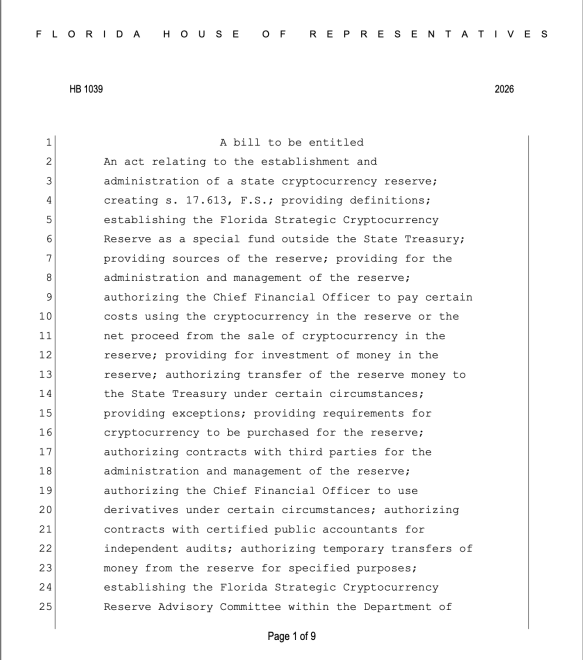
Text for House Bill 1039. Source: flsenate.gov 

Notably, the bill states that “to be eligible to be purchased for the reserve, a cryptocurrency must have an average market capitalization of at least $500 billion over the most recent 24-month period.” Under this condition, only Bitcoin, with its $1 trillion market capitalization, meets the requirements.

Based on this, Florida’s reserve would consist of “money transferred or deposited to the credit of the reserve by legislative appropriation, (...) Revenue that the Legislature by general law dedicates for deposit to the credit of the reserve, (...) Cryptocurrency purchased using money in or received by the reserve, (...) Investment earnings and interest or rewards earned on assets in the reserve.”

In addition, the reserve would be custodied and managed by Florida’s Chief Financial Officer (CFO), who will be able to “acquire, exchange, sell, supervise, manage or retain any kind of investments” that a prudent investor would manage, under “the purposes, terms, distribution requirements, and other circumstances then prevailing for the reserve.”

The CFO would be allowed to establish contracts with one or more third-party entities for the administration and management of the reserve, including technology providers for a secure custody solution, a qualified custodian, and liquidity providers that facilitate the purchase and sales of the reserve’s assets.

Moreover, HB 1039 would launch the “Florida Strategic Cryptocurrency Reserve Advisory Committee” within the Department of Financial Affairs. The committee would be composed of five members, including the CFO, who would serve as the chairman, and four other individuals appointed by the CFO.

Florida’s SBR Push

Representative Snyder’s proposal follows previous attempts to establish a Strategic Bitcoin Reserve in Florida. Over the past year, some lawmakers joined the global SBR momentum and introduced multiple bills to create and manage a state-run crypto reserve.

As reported by Bitcoinist, the Florida Blockchain Business Association (FBBA) proposed the state’s first Bitcoin Reserve at the end of 2024, seeking to allocate a small percentage of its $185.7 billion pension fund to BTC.

Samuel Armes, head of the FBBA, suggested that the state could use 1% of its pension fund, around $1.85 billion, to invest in Bitcoin as part of Florida’s push to launch a crypto-based strategic reserve.

In February 2025, Senator Joe Gruters introduced Senate Bill 550 (SB 550) to allow the state’s CFO to invest up to 10% of public funds in the flagship crypto. Similarly, Representative Webster Barnaby introduced House Bill 487 (HB 487) in April 2025 to allow Florida’s CFO and the State Board of Administration to invest up to 10% of certain state funds in Bitcoin, as a strategy to protect against inflation and enhance economic security.

Nonetheless, both bills died in the first half of the year after failing to obtain a majority vote in their respective committee hearings. Last October, Representative Barnaby filed House Bill 183 (HB 183) with a revised and “more flexible” text to revive Florida’s SBR efforts.

If HB 1039 passes the state’s Senate and House votes and is signed into law, Florida would join Arizona, New Hampshire, and Texas as the few states to have enacted a Strategic Bitcoin Reserve.
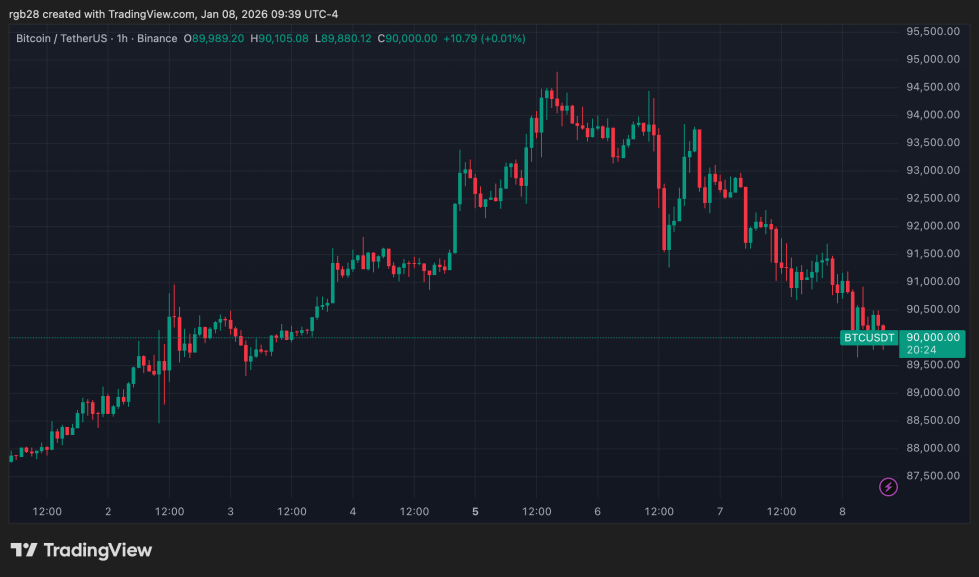
Bitcoin trades at $90,000 in the one-week chart. Source: BTCUSDT on TradingView


Related Questions

QWhat is the main purpose of Florida's proposed House Bill 1039 (HB 1039)?

AThe main purpose of HB 1039 is to create and administer a state-run Strategic Cryptocurrency Reserve focused on Bitcoin, serving as a hedge against inflation and economic volatility to provide enhanced financial security to the state's residents.

QWhich cryptocurrency currently meets the eligibility criteria for the proposed reserve, and what is that criteria?

ABitcoin (BTC) is the only cryptocurrency that meets the eligibility criteria, which requires an average market capitalization of at least $500 billion over the most recent 24-month period. Bitcoin's market capitalization is approximately $1 trillion.

QWho would be responsible for the custody and management of the Strategic Cryptocurrency Reserve?

AFlorida's Chief Financial Officer (CFO) would be responsible for the custody and management of the reserve, with the authority to acquire, exchange, sell, supervise, manage, or retain investments, and to establish contracts with third-party entities for administration.

QWhat previous attempts were made to establish a Bitcoin reserve in Florida before HB 1039?

APrevious attempts included a proposal from the Florida Blockchain Business Association (FBBA) to allocate 1% of the state's pension fund to Bitcoin, Senate Bill 550 (SB 550) to allow investing up to 10% of public funds in BTC, and House Bill 487 (HB 487) with a similar 10% investment allowance. These bills failed to pass committee hearings.

QWhich other U.S. states have already enacted a Strategic Bitcoin Reserve, as mentioned in the article?

AIf passed, Florida would join Arizona, New Hampshire, and Texas as the few states that have enacted a Strategic Bitcoin Reserve.

Related Reads

Fu Peng's First Public Speech in 2026: What Exactly Are Crypto Assets? Why Did I Join the Crypto Asset Industry?

Fu Peng, a renowned macroeconomist and now Chief Economist at New火 Group, delivered his first public speech of 2026 at the Hong Kong Web3 Festival. He explained his perspective on crypto assets and why he joined the industry, framing it within the context of macroeconomic trends and financial evolution. Fu emphasized that crypto assets are transitioning from an early, belief-driven phase to a mature, institutionally integrated asset class. He drew parallels to the 1970s-80s, when technological advances (like computing) revolutionized traditional finance, leading to the rise of FICC (Fixed Income, Currencies, and Commodities). Similarly, current advancements in AI, data, and blockchain are reshaping finance, with crypto assets becoming part of a new "FICC + C" (C for Crypto) framework. He noted that institutional capital, including traditional hedge funds, avoided early crypto due to its speculative nature but are now engaging as regulatory clarity emerges (e.g., stablecoin laws, CFTC classifying crypto as a commodity). Fu predicted that 2025-2026 marks a turning point where crypto becomes a standardized, financially viable asset for diversified portfolios, akin to commodities or derivatives in traditional finance. Fu defined Bitcoin not as "digital gold" in a simplistic sense but as a value-preserving, financially tradable asset. He highlighted that crypto's future lies in regulated, institutional adoption, moving away from retail-dominated trading. His entry into crypto signals this maturation, where traditional finance integrates crypto into mainstream asset management.

marsbit10m ago

Fu Peng's First Public Speech in 2026: What Exactly Are Crypto Assets? Why Did I Join the Crypto Asset Industry?

marsbit10m ago

Justin Sun Sues Trump Family: What $75 Million Bought Was Only a Blacklist

Justin Sun, founder of Tron, has filed a lawsuit in federal court against World Liberty Financial (WLF), alleging he was made the "primary target of a fraudulent scheme" after investing $75 million. Sun claims the investment secured him an advisor title and WLFI tokens, which were later frozen by WLF, causing "hundreds of millions in losses." The dispute began in late 2024 when Sun's investment helped revive WLF's struggling token sale, which ultimately raised $550 million. Shortly after, the SEC dropped its lawsuit against Sun following Donald Trump's inauguration. However, relations soured when Sun refused WLF's demands for additional funding. In August 2025, WLF added a "blacklist" function to its smart contract, allowing it to unilaterally freeze tokens. Sun's holdings, worth approximately $107 million, were frozen, and he was threatened with token destruction. The lawsuit highlights WLF's structure, which directs 75% of token sale profits to the Trump family, who had earned $1 billion by December 2025. WLF's CEO is Zach Witkoff, son of U.S. Middle East envoy Steve Witkoff. The project faces scrutiny for opaque operations, including a controversial loan arrangement on the Dolomite platform, co-founded by a WLF advisor. Despite Sun's history with the SEC, the case underscores centralization risks within DeFi, as WLF controls governance and holds powers to freeze assets arbitrarily. Sun's tokens remain frozen as legal proceedings begin.

marsbit17m ago

Justin Sun Sues Trump Family: What $75 Million Bought Was Only a Blacklist

marsbit17m ago

$500 to Buy OpenAI Stock: Silicon Valley's Most Respectable Liquidity Invitation

Silicon Valley's largest venture capital platform, AngelList, has launched a new fund called USVC, allowing U.S. retail investors to buy into high-profile AI companies like OpenAI, Anthropic, and xAI with a minimum investment of $500—no accredited investor status required. Promoted by AngelList co-founder Naval Ravikant, the fund is framed as an opportunity for ordinary people to access high-growth private tech investments traditionally reserved for VCs. However, critics argue it functions more like an exit vehicle for early insiders. USVC acquires shares not through primary rounds but largely via secondary transactions—purchasing stakes from early investors, VC funds, and employees looking to cash out at peak valuations. With companies like xAI heavily weighted in the portfolio, the fund effectively channels retail money into providing liquidity for insiders who entered at much lower valuations. The fund’s structure raises concerns: shares are illiquid, with no secondary market, and buybacks are limited and discretionary. The actual annual fee reaches 3.61%, far above the advertised 1% management fee. This model parallels the "low float, high fully diluted valuation" strategy seen in crypto, where early investors profit by selling to latecomers at inflated prices. The timing—alongside similar moves by platforms like Robinhood—suggests that Silicon Valley’s sudden interest in retail inclusion may be less about democratizing access and more about securing exits for insiders.

marsbit48m ago

$500 to Buy OpenAI Stock: Silicon Valley's Most Respectable Liquidity Invitation

marsbit48m ago

Trading

Spot
Futures

Hot Articles

What is $BITCOIN

DIGITAL GOLD ($BITCOIN): A Comprehensive Analysis Introduction to DIGITAL GOLD ($BITCOIN) DIGITAL GOLD ($BITCOIN) is a blockchain-based project operating on the Solana network, which aims to combine the characteristics of traditional precious metals with the innovation of decentralized technologies. While it shares a name with Bitcoin, often referred to as “digital gold” due to its perception as a store of value, DIGITAL GOLD is a separate token designed to create a unique ecosystem within the Web3 landscape. Its goal is to position itself as a viable alternative digital asset, although specifics regarding its applications and functionalities are still developing. What is DIGITAL GOLD ($BITCOIN)? DIGITAL GOLD ($BITCOIN) is a cryptocurrency token explicitly designed for use on the Solana blockchain. In contrast to Bitcoin, which provides a widely recognized value storage role, this token appears to focus on broader applications and characteristics. Notable aspects include: Blockchain Infrastructure: The token is built on the Solana blockchain, known for its capacity to handle high-speed and low-cost transactions. Supply Dynamics: DIGITAL GOLD has a maximum supply capped at 100 quadrillion tokens (100P $BITCOIN), although details regarding its circulating supply are currently undisclosed. Utility: While precise functionalities are not explicitly outlined, there are indications that the token could be utilized for various applications, potentially involving decentralized applications (dApps) or asset tokenization strategies. Who is the Creator of DIGITAL GOLD ($BITCOIN)? At present, the identity of the creators and development team behind DIGITAL GOLD ($BITCOIN) remains unknown. This situation is typical among many innovative projects within the blockchain space, particularly those aligning with decentralized finance and meme coin phenomena. While such anonymity may foster a community-driven culture, it intensifies concerns about governance and accountability. Who are the Investors of DIGITAL GOLD ($BITCOIN)? The available information indicates that DIGITAL GOLD ($BITCOIN) does not have any known institutional backers or prominent venture capital investments. The project seems to operate on a peer-to-peer model focused on community support and adoption rather than traditional funding routes. Its activity and liquidity are primarily situated on decentralized exchanges (DEXs), such as PumpSwap, rather than established centralized trading platforms, further highlighting its grassroots approach. How DIGITAL GOLD ($BITCOIN) Works The operational mechanics of DIGITAL GOLD ($BITCOIN) can be elaborated on based on its blockchain design and network attributes: Consensus Mechanism: By leveraging Solana’s unique proof-of-history (PoH) combined with a proof-of-stake (PoS) model, the project ensures efficient transaction validation contributing to the network's high performance. Tokenomics: While specific deflationary mechanisms have not been extensively detailed, the vast maximum token supply implies that it may cater to microtransactions or niche use cases that are still to be defined. Interoperability: There exists the potential for integration with Solana’s broader ecosystem, including various decentralized finance (DeFi) platforms. However, the details regarding specific integrations remain unspecified. Timeline of Key Events Here is a timeline that highlights significant milestones concerning DIGITAL GOLD ($BITCOIN): 2023: The initial deployment of the token occurs on the Solana blockchain, marked by its contract address. 2024: DIGITAL GOLD gains visibility as it becomes available for trading on decentralized exchanges like PumpSwap, allowing users to trade it against SOL. 2025: The project witnesses sporadic trading activity and potential interest in community-led engagements, although no noteworthy partnerships or technical advancements have been documented as of yet. Critical Analysis Strengths Scalability: The underlying Solana infrastructure supports high transaction volumes, which could enhance the utility of $BITCOIN in various transaction scenarios. Accessibility: The potential low trading price per token could attract retail investors, facilitating wider participation due to fractional ownership opportunities. Risks Lack of Transparency: The absence of publicly known backers, developers, or an audit process may yield skepticism regarding the project's sustainability and trustworthiness. Market Volatility: The trading activity is heavily reliant on speculative behavior, which can result in significant price volatility and uncertainty for investors. Conclusion DIGITAL GOLD ($BITCOIN) emerges as an intriguing yet ambiguous project within the rapidly evolving Solana ecosystem. While it attempts to leverage the “digital gold” narrative, its departure from Bitcoin's established role as a store of value underscores the need for a clearer differentiation of its intended utility and governance structure. Future acceptance and adoption will likely depend on addressing the current opacity and defining its operational and economic strategies more explicitly. Note: This report encompasses synthesised information available as of October 2023, and developments may have transpired beyond the research period.

363 Total ViewsPublished 2025.05.13Updated 2025.05.13

What is $BITCOIN

Discussions

Welcome to the HTX Community. Here, you can stay informed about the latest platform developments and gain access to professional market insights. Users' opinions on the price of BTC (BTC) are presented below.

活动图片