Five Counterparty Risk Architectures: A Settlement-Layer Methodology for Classifying TradFi Models in Crypto Exchanges

marsbitPublished on 2026-05-12Last updated on 2026-05-12

Abstract

**Summary:** This companion piece reframes the five TradFi-on-crypto exchange architectures, previously classified by "architectural fingerprint," through the lens of counterparty risk. The core question is: whose balance sheet bears the loss first in a stress scenario, and has it historically done so? Each of the five models corresponds to a distinct risk holder with its own documented failure modes. * **Model 1 (Stablecoin-Settled CEX Perpetuals):** Risk is held by the stablecoin issuer (e.g., reserve composition, bank connectivity) and the CEX's own book. History includes Tether's banking disconnections (2017) and reserve misrepresentations (CFTC 2021 Order). * **Model 2 (CFD Brokers):** Risk resides on the broker's balance sheet (B-book model). Regulatory differences (e.g., ESMA's mandatory negative balance protection vs. Mauritius FSC's lack thereof) define loss allocation rules, as seen in the 2015 SNB event (Alpari UK insolvency). * **Model 3 (Off-Chain Custody & Transfer Agent Chain):** Risk lies with the off-chain custodian/platform. User asset recovery depends on Terms of Use and corporate structure, exemplified by the Celsius bankruptcy ruling (2023) where Earn Account assets were deemed property of the estate. * **Model 4 (DEX Perpetual Protocols):** No single balance sheet bears risk. Loss absorption relies on a protocol's insurance fund and Auto-Deleveraging (ADL) mechanism, as demonstrated in the GMX V1 (2022) and dYdX v3 YFI (2023) incidents. * **Mo...

Release Date: May 10, 2026

Executive Summary

This companion piece builds upon the research report "Crypto Exchange TradFi Expansion: A Five-Model Taxonomy" published by Bitbase Research on April 23, 2026 (referred to as the "preceding work"). The data cut-off date for this companion piece is consistent with the preceding work, which is April 23, 2026.

The preceding work presented five TradFi-on-crypto architectures as "architectural fingerprints," each integrating multiple dimensions such as settlement, margin, regulation, distribution, and asset structure. This companion piece elevates the "counterparty risk holder" dimension from within these fingerprints to the main analytical axis, providing a second systematic reading of the same set of architectures.

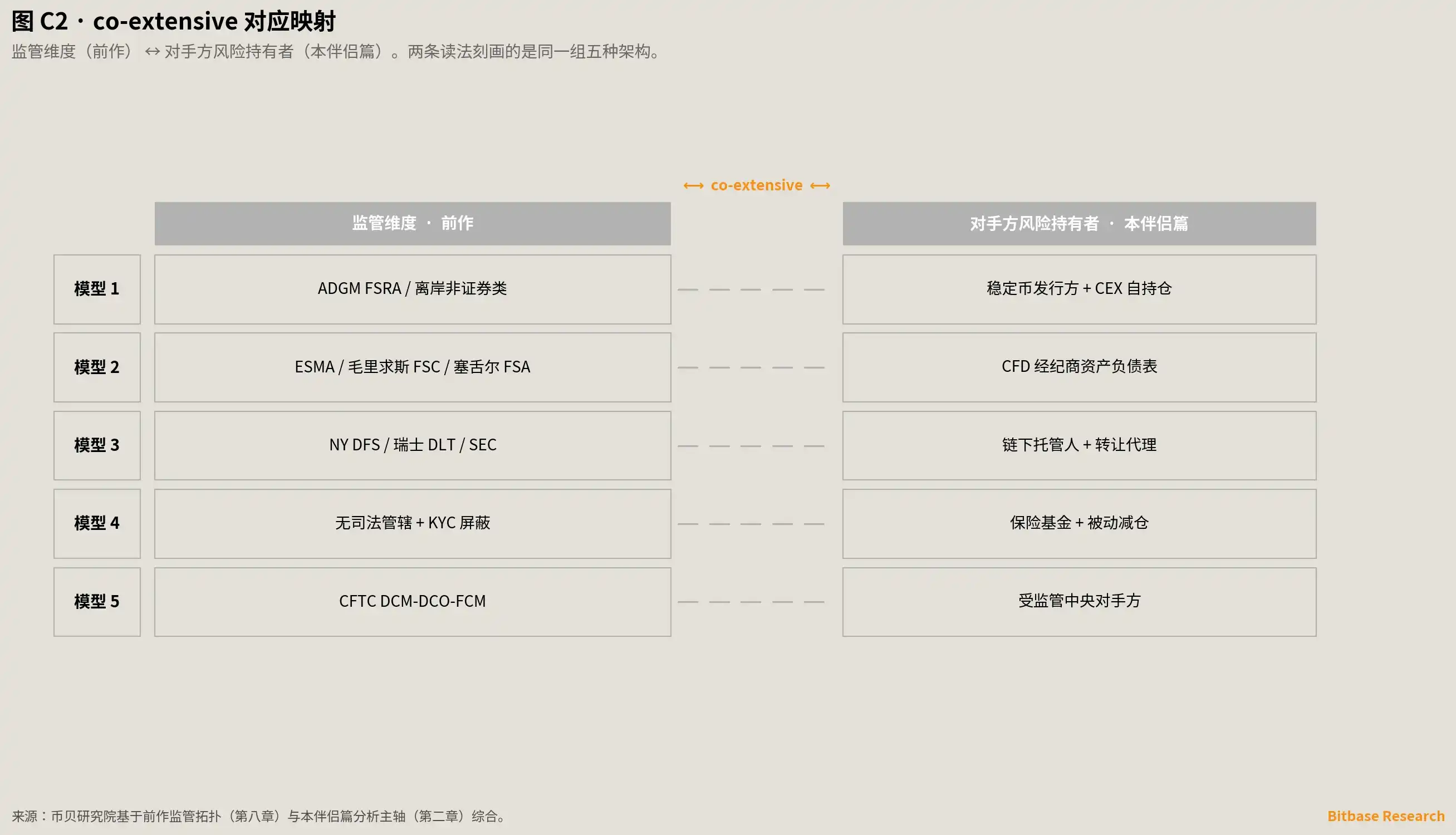
The two readings are co-extensive: they describe the same set of structural solutions, not two different sample sets. The order of Models 1 through 5 corresponds exactly across both readings, as each architectural fingerprint's multidimensional combination implies a specific counterparty structure, and vice versa. The value of the settlement-layer methodology lies in translating abstract, multi-dimensional juxtapositions into an observable problem closer to the root cause. This problem is: in a stress scenario, whose balance sheet absorbs the loss first, and whether that balance sheet has historically ever absorbed such losses.

This companion piece maps each of the five architectures defined in the preceding work back to a set of verifiable historical failure modes:

  • Stablecoin Issuer Trust Cycle

  • CFD Broker Balance Sheet

  • Off-Chain Custody & Transfer Agent Chain

  • DEX Insurance Fund & Auto-Deleveraging Mechanism

  • Unconventional Tools of Regulated Central Counterparties Under Extreme Market Conditions

Each failure mode corresponds to an independent list of observable signals. This companion piece does not predict which architecture will fail; it only describes the structural indicators that need to be monitored for each architecture.

This companion piece is not a revision of the preceding work. The preceding work is a published research product, and its publication is a commitment benchmark. This piece is a methodological extension of the preceding work; they exist in parallel.

Chapter 1: Why Write a Settlement-Layer Companion Piece

The preceding work defined five architectures by presenting five independent "architectural fingerprints," each integrating multiple dimensions such as settlement, margin, regulation, distribution, and asset structure, but these dimensions themselves were not explicitly prioritized or arranged in an upstream-downstream manner. This presentation left methodological room for subsequent re-readings that elevate a single dimension to a primary position.

This companion piece was inspired by an observation from a reader in public LinkedIn discussions from late April to early May 2026. This reader's perspective—that the five architectures represent different answers to the question "who holds the counterparty risk," and that the counterparty risk dimension in the preceding work's fingerprints played the role of the root cause most clearly differentiated by the five architectures—sharpened our reading of our own report. We adopt this perspective, elevating the counterparty risk dimension from the architectural fingerprints to the main analytical axis; but we make one calibration: we read the relationship between the settlement-layer perspective and the regulatory dimension as co-extensive, not upstream-downstream; the specific argument is detailed in Chapter 3.

We chose to publicly materialize this methodological dimension in the form of a companion piece, rather than merging it into a future Deep Dive main piece or the Q4 2026 Signal Tracking Composite Report. The reason is genre purity: future Deep Dive main pieces should take on new topics; the Q4 Signal Tracking Composite Report should strictly respond to the three reversal signals defined in Chapter 9 of the preceding work, without mixing in new analytical dimensions; a companion piece is the more appropriate intermediate genre. Bitbase Research uses this companion piece as the public materialization of this methodological dimension.

Chapter 2: The Five Counterparty Risk Holders

The five architectures from the preceding work can be summarized according to their architectural fingerprints as follows. Model 1: Offshore or non-explicitly securities-regulated CEXs offering USDT-settled perpetuals (stablecoin-settled perpetuals). Model 2: CFD brokers regulated by ESMA or similar jurisdictions. Model 3: Off-chain custodied RWA issuers regulated under securities or trust law. Model 4: DEX perpetual protocols without a regulated entity at the protocol layer. Model 5: Central Counterparty (CCP) within a CFTC-licensed DCM-DCO-FCM architecture.
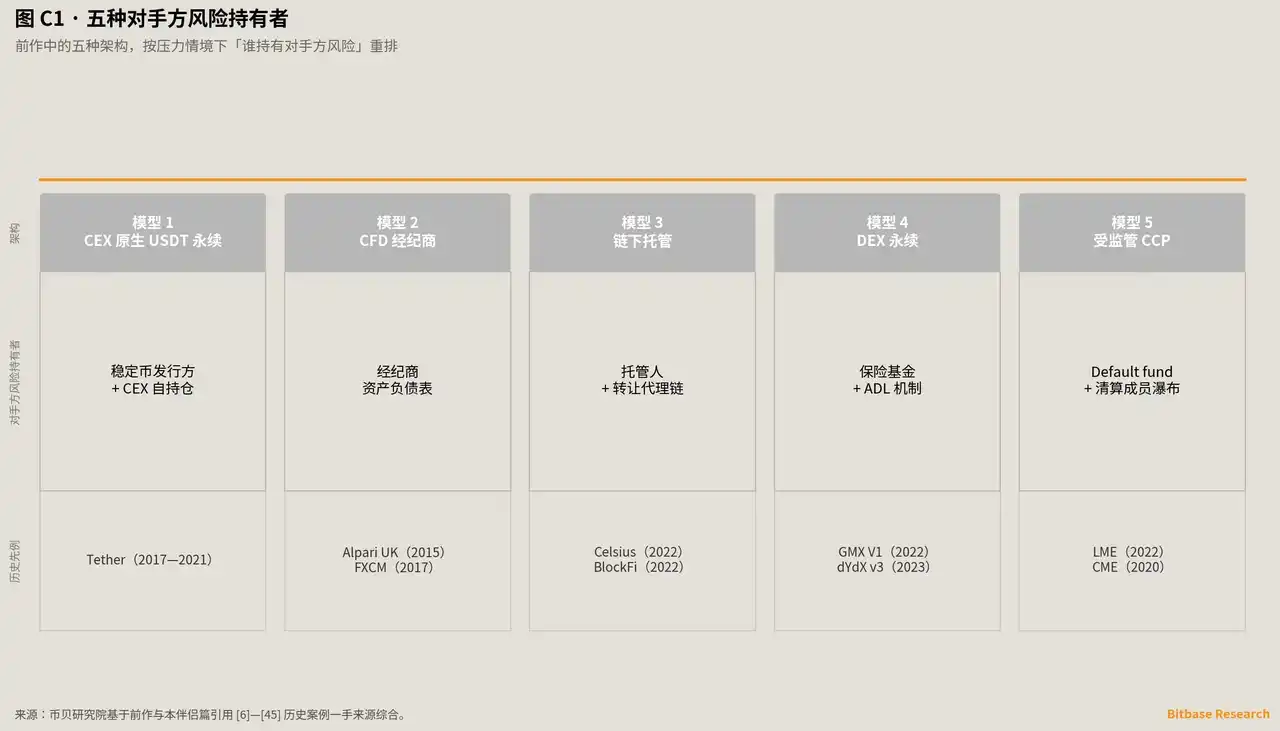
Rearranging the same set of architectures by settlement layer yields a juxtaposition of counterparty risk holders.

Model 1: Stablecoin Issuer and CEX Proprietary Book. The end-user's ultimate counterparty is twofold. The first is the stablecoin issuer: the composition of its reserve assets, its susceptibility to a run, and its connectivity to the banking system determine whether USDT can maintain its 1:1 peg under stress. The second is the CEX's proprietary book: its solvency as the counterparty to stablecoin-settled perpetual contracts determines whether users can close positions and withdraw funds in a tail event. Both counterparties have a history of defaults that can be concretely characterized by regulatory documents in the chain of historical events.

Model 2: CFD Broker Balance Sheet. In the B-book business model of CFDs, the broker is not an intermediary but the user's direct counterparty—the broker internalizes client orders on its own balance sheet, profiting from client losses. When jurisdiction regulations (e.g., ESMA) mandate negative balance protection, the broker's balance sheet must absorb losses exceeding client margin in a tail event; when jurisdiction regulations do not mandate it (e.g., Mauritius FSC), losses can be passed back to the client, creating a negative balance. In the settlement-layer view, the difference between these two jurisdictions is a different allocation rule for B-book risk.

Model 3: Off-Chain Custodian and Transfer Agent Chain. Tokenized RWAs and crypto yield accounts share the same settlement-layer structure: off-chain holding + user agreement terms. The balance sheet, corporate governance, and Terms of Use language of the off-chain holder collectively determine whether users can reclaim assets upon default. This structure is distributed among multiple regulated entities in the institutionalized path (e.g., BlackRock BUIDL custodied by BNY Mellon, with Securitize as the SEC-registered transfer agent); in the crypto yield account path (Celsius, BlockFi), it is concentrated within a single company, and its Terms of Use may explicitly stipulate transfer of ownership.

Model 4: DEX Insurance Fund and Auto-Deleveraging (ADL) Mechanism. DEX perpetual protocols lack a traditional CCP-style clearing membership system and regulated, multi-layered prefunded buffers. Solvency under stress is determined jointly by the insurance fund and ADL: the insurance fund is a prefunded protocol-level reserve; when it is insufficient, ADL forces the liquidation of a portion of profitable counterparty positions to restore overall solvency. Losses are ultimately borne by protocol participants according to the rules, not by an entity with a balance sheet.

Model 5: Regulated Central Counterparty. The CFTC-licensed DCM-DCO-FCM architecture is the most institutionalized solution at the settlement layer: default fund, hierarchical loss-sharing obligations among clearing members, multi-layered prefunded resources, independent governance, compliance with CPMI-IOSCO Principles for Financial Market Infrastructures (PFMI). But "highest institutionalization" does not equal "un-stress-testable." When extreme market conditions cause the default fund to be excessively consumed within a single day, CCPs still have a history of actually activating two categories of unconventional tools: mass cancellation and negative-pricing structural rule changes.

The loss allocation rules under stress for the five counterparty structures are structurally non-interchangeable—this is the root cause this companion piece aims to uncover.

Chapter 3: Why It's Not an Upstream-Downstream Relationship

This section contains the most critical methodological argument of this companion piece.

The initial hypothesis in the LinkedIn discussion was: the regulatory dimension is superficial (downstream), counterparty risk is the root cause (upstream), and the multi-dimensional juxtaposition in the preceding work's fingerprints did not explicitly prioritize this causal relationship. We do not adopt this upstream-downstream relationship because it cannot hold at the historical institutional choice level.

Examine the specific differences between ESMA jurisdictions and Mauritius FSC jurisdictions. On May 22, 2018, ESMA adopted Decision (EU) 2018/796 (based on MiFIR Article 40), effective August 1, 2018, imposing across the EU for retail clients: tiered leverage caps, a 50% margin close-out rule, per-account negative balance protection, prohibition of any promotional incentives, and standardized risk warnings [1][2]. Mauritius FSC does not mandate negative balance protection, nor does it mandate a client compensation scheme akin to the FCA FSCS [3]. This jurisdictional difference is itself a structural choice: ESMA's institutional choice is to compel the broker's balance sheet to absorb losses exceeding client margin in a tail event; Mauritius FSC's institutional choice is to allow such losses to be passed back to the client.

In other words, "regulatory dimension differences" and "counterparty risk allocation differences" are not two ends of a causal chain. They are two expressions of the same institutional choice. The DCM-DCO-FCM three-tier architecture adopted by the CFTC under Dodd-Frank Title VII (7 U.S.C. § 1a et seq., passed in 2010) is itself the institutionalized product of the choice to have "a central counterparty hold the risk," responding to the G-20 commitment in September 2009 that "all standardized OTC derivative contracts should be traded on exchanges or electronic trading platforms, where appropriate, and cleared through central counterparties by end-2012" [4]. The CFTC's final adoption in 2012 of the Legal Segregation, Operational Commingling (LSOC) rule eliminated "fellow customer risk"—if an FCM client defaults, the DCO cannot touch the assets of other non-defaulting clients [5]. This set of rules is a jurisdictional choice and also a counterparty structure choice; one cannot be placed "upstream" of the other.

The specific meaning of co-extensive: any counterparty structure identified here directly corresponds to the multi-dimensional combination of one of the architectural fingerprints in the preceding work, and vice versa. The two readings have no difference in classification boundaries; the difference lies only in the reading—the settlement-layer perspective is closer to the root-cause question of "whose balance sheet absorbs the loss first in a tail event."
Chapter 4: Failure Mode 1: Stablecoin Issuer Trust Cycle

Model 1 architecture has two layers of counterparty risk: the stablecoin issuer and the CEX proprietary book. Tether's history is a case chain with relatively rich, verifiable depth for the stablecoin issuer trust risk layer.

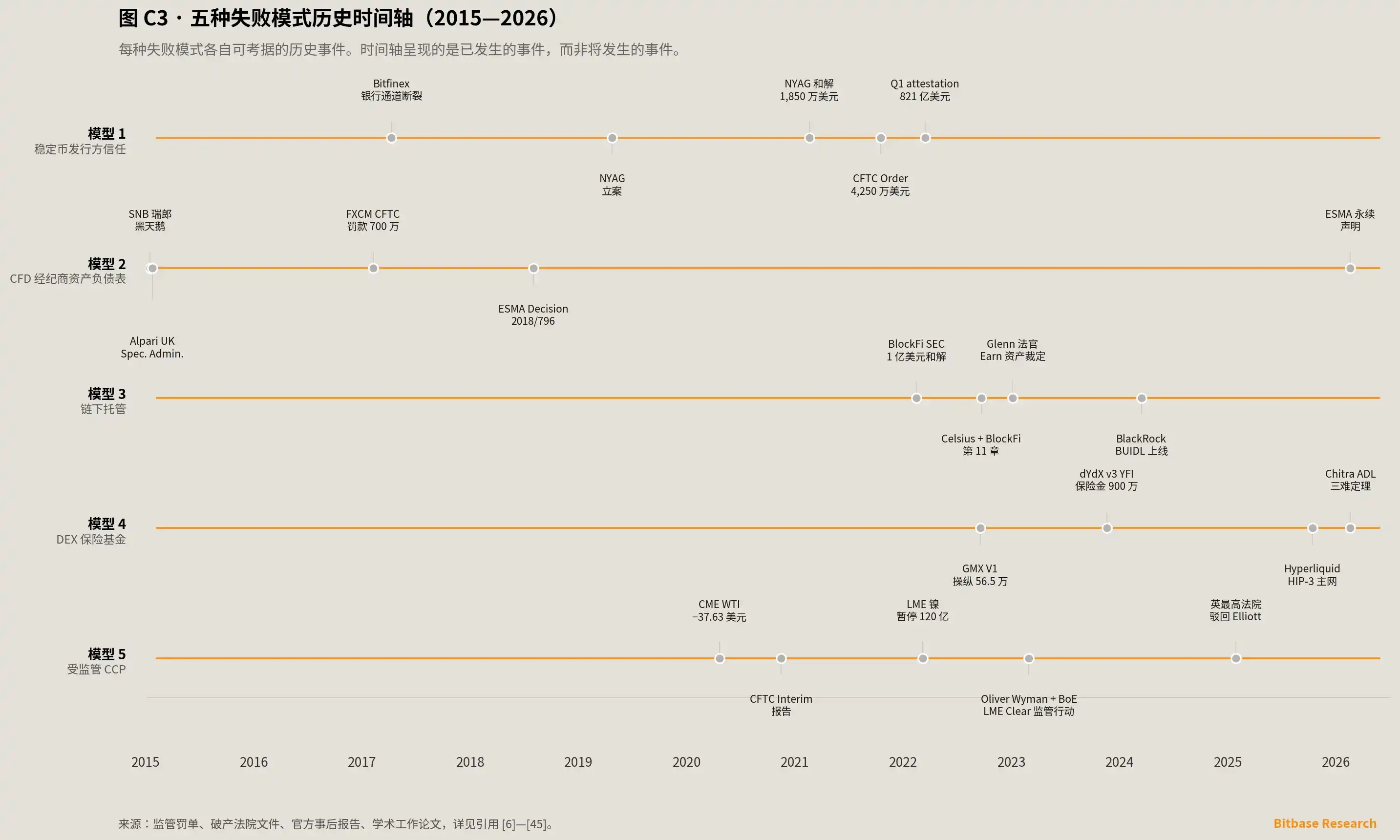
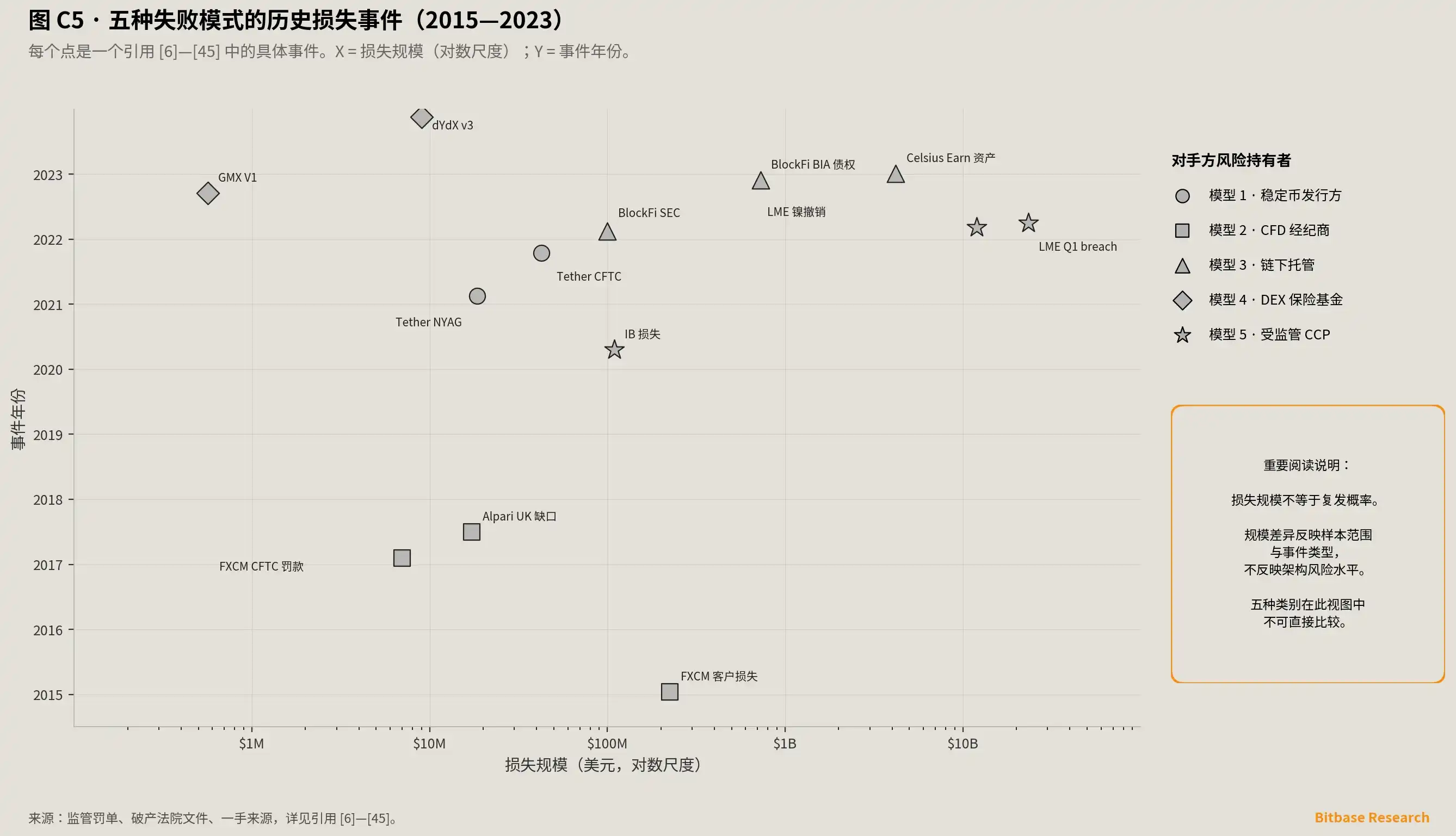
2017 Bitfinex Banking Corridor Rupture. Wells Fargo ceased processing outgoing USD wire transfers for Bitfinex and Tether from four Taiwanese correspondent banks (KGI Bank, First Commercial Bank, Hwatai Commercial Bank, Taishin Bank) around late March 2017 [6]. Bitfinex and Tether filed a lawsuit against Wells Fargo in the U.S. District Court for the Northern District of California (N.D. Cal.) on April 5, 2017, alleging Intentional Interference with Contractual Relations, seeking an injunction and damages exceeding $75,000; the lawsuit was voluntarily dismissed on April 12, 2017 [7]. Subsequent NYAG investigation revealed that from mid-2017 onward, Tether had lost banking access entirely for a period, thereafter holding cash in a trust account in the name of its General Counsel; NYAG documents record that this account balance "never exceeded $61.5 million," while USDT circulation had reached hundreds of millions [8].

2018–2019 Crypto Capital Loss Incident. NYAG documents specifically record: Bitfinex transferred approximately $850 million of commingled client and corporate funds to the Panama-registered payment processor Crypto Capital Corp. without a written contract; this fund was frozen by authorities in multiple countries starting in the summer of 2018 [8]. Bitfinex arranged a "$700 million transfer from Tether reserves to Bitfinex's balance sheet" to fill the gap. The NYAG filed In re James v. iFinex, Inc., Index No. 450545/2019 on April 25, 2019 [8].

February 17, 2021 NYAG Settlement. The Settlement Agreement between the NYAG and iFinex/Tether became effective on February 18, 2021, announced publicly on February 23, 2021. Terms included: an $18.5 million fine, cessation of any trading activity within New York State, and quarterly disclosure of Tether's reserve composition for a two-year period [8][9]. Tether and Bitfinex explicitly "neither admit nor deny" the NYAG's factual findings in the agreement.

October 15, 2021 CFTC Order. In the Matter of Tether Holdings Limited et al. (CFTC Press Release 8450-21) and In the Matter of iFinex Inc., BFXNA Inc., and BFXWW Inc. were issued on the same day [10]. The CFTC found: during at least the period from June 1, 2016, to February 25, 2019, Tether's representations did not match its actual reserves; during a 26-month sample period, Tether's actual dollar reserves backed USDT circulation only 27.6% of the days; Tether's reserves included unsecured receivables and non-fiat assets [10]. The CFTC imposed a $41 million penalty on Tether and a $1.5 million penalty on Bitfinex [10].

Reserve Structure Evolution and Commercial Paper Exposure. Tether's Q1 2022 attestation disclosed the composition of its $82.1 billion reserves [11]. Federal Reserve IFDP Working Paper No. 1334, Stablecoins: Growth Potential and Impact on Banking, discusses a potential stress scenario involving the transmission effect on short-term funding markets from the sale of short-term credit instruments during a stablecoin run scenario [12].

Settlement-Layer Conclusion. In Model 1 architecture, the user's ultimate counterparty is twofold: the susceptibility of the stablecoin issuer's reserve assets to a run, and the solvency of the CEX's proprietary book on perpetual contracts. Both have a history of defaults that can be concretely characterized by regulatory documents in the historical event chain.

Chapter 5: Failure Mode 2: CFD Broker Balance Sheet

The counterparty in Model 2 architecture is the CFD broker itself. When a tail event exceeds client margin, the solvency of the broker's balance sheet is the root cause of user risk.

January 15, 2015 Swiss Franc Black Swan Event. The Swiss National Bank (SNB) unilaterally announced at 09:30 GMT on January 15, 2015, the removal of the EUR/CHF floor of 1.20, which had been in effect since September 6, 2011. EUR/CHF plunged to a low of around 0.7710 within minutes, closing at 1.0472 for the day, a daily drop of 12.74%; USD/CHF fell to as low as 0.7462 [13].

Alpari (UK) Ltd Entering Special Administration. Alpari (UK) Ltd announced insolvency the day after the SNB decision (January 16, 2015) and was placed into the Special Administration Regime by order of the UK High Court on January 19, 2015, with KPMG LLP's Richard Heis, Samantha Bewick, and Mark Firmin appointed as Joint Special Administrators [14]. KPMG reports indicated approximately 99.8% (by value) of clients ultimately received funds through the Claims Portal, with final distributions not completed until June 2017; LeapRate reported a client shortfall of about $17.3 million during the final distribution phase [15].

FXCM and the February 6, 2017 CFTC Order. On January 15, 2015, FXCM incurred approximately $225 million in losses for the company due to client negative balances resulting from the CHF gap. It accepted a $300 million emergency loan from Leucadia the next day [16]. Two years later, the CFTC and NFA issued simultaneous settlement documents: In the Matter of Forex Capital Markets, LLC, FXCM Holdings, LLC, Dror Niv, William Ahdout (CFTC Press Release pr7528-17, February 6, 2017) [17]. The CFTC found that from September 4, 2009, through 2014, FXCM, while falsely claiming a "No Dealing Desk" agency model, actually routed order flow to the market maker Effex Capital, with which it had undisclosed affiliation and profit-sharing; NFA subsequently disclosed that FXCM received approximately $77 million in "order flow rebates" from Effex between 2010 and 2014 [17]. Outcome: CFTC penalty of $7 million; FXCM, FXCM Holdings, Niv, and Ahdout permanently banned from CFTC registration or association with registered entities [17]. FXCM's U.S. client accounts were sold to Gain Capital; the parent company FXCM Inc. was renamed Global Brokerage, Inc., and shareholders later filed Shipco Transport Inc. v. Global Brokerage, Inc., Niv, Ahdout (S.D.N.Y.), which ultimately settled for $6.5 million in 2023 [18].

ESMA Decision (EU) 2018/796 and the Institutionalization of B-book Constraints. ESMA adopted Decision (EU) 2018/796 on May 22, 2018 [1]. Supporting document ESMA35-43-1000 cites NCA survey data showing that in major EU jurisdictions, the proportion of retail investor CFD accounts in a loss-making state ranged approximately from 74% to 89%; specific page numbers and table references are based on publicly available ESMA documents [1]. A public statement issued by ESMA in February 2026 further explicitly brought "perpetual futures/contracts" into the scope of existing CFD product intervention measures [2].

Mauritius FSC as an Offshore Path. Mauritius FSC issues licenses to full-service investment dealers under legal frameworks such as the Securities Act 2005, Financial Services Act 2007, and AML/CFT Act 2009, typically allowing retail leverage of up to 1:500 to 1:2000; negative balance protection is not a mandatory obligation for the FSC [3].

Settlement-Layer Conclusion. In Model 2 architecture, the user's counterparty is the CFD broker itself. ESMA's negative balance protection rule forces losses exceeding client margin to be absorbed by the broker's balance sheet; Mauritius FSC does not mandate this rule, allowing losses to be passed back to the client. In the settlement-layer view, the difference between these two jurisdictions is a different allocation rule for B-book risk.

Chapter 6: Failure Mode 3: Off-Chain Custody and Transfer Agent Chain

In Model 3 architecture, counterparty risk resides off-chain. The balance sheet, corporate governance, and Terms of Use language of the off-chain holder collectively determine whether users can reclaim assets upon default.

Important clarification: The Celsius and BlockFi cases discussed in this section belong to the "crypto yield account" form, which is significantly different in institutionalization level from tokenized RWAs (e.g., BlackRock BUIDL). This companion piece places them under Model 3 because they share the same settlement-layer structure—off-chain holding + transfer agent chain.

Celsius Network (In re Celsius Network LLC, Bankr. S.D.N.Y. Case No. 22-10964 (MG)). Celsius Network LLC and affiliated entities filed for Chapter 11 in the U.S. Bankruptcy Court for the Southern District of New York on July 13, 2022. CoinDesk reported the next day that Celsius's balance sheet showed a hole of approximately $1.2 billion [19]; subsequent disclosures indicated liabilities to customers of about $4.7 billion [20]. The Earn Account was the largest product, accounting for about 77% of platform assets, valued at approximately $4.2 billion.

The court appointed Shoba Pillay (partner at Jenner & Block) as Examiner on September 29, 2022; Pillay submitted two core reports: the Interim Report (Doc 1411, November 19, 2022) and the Final Report (Doc 1956, January 31, 2023, 476 pages) [21]. A core conclusion of the Final Report was: Celsius operated a business materially different from what it marketed and sold to customers; Celsius spent approximately $558 million cumulatively purchasing CEL tokens in the market, being the only material buyer of CEL at virtually any point; founder Mashinsky personally profited about $68.7 million from selling CEL [21].

The most decisive ruling for the settlement layer came from Chief Judge Martin Glenn's Memorandum Opinion and Order Regarding Ownership of Earn Account Assets (ECF Doc. No. 1822) dated January 4, 2023: based on language in Celsius's various Terms of Use versions stating "grant Celsius ... all right and title to such Digital Assets, including ownership rights," crypto assets in Earn Accounts transferred to Celsius at the moment of deposit; as of the Petition Date (July 13, 2022), they became property of the bankruptcy estate [22]. Earn customers thus became unsecured creditors. This ruling meant that approximately 600,000 Earn account holders had no ownership claim to $4.2 billion in assets, only a right to recover according to the bankruptcy priority sequence [22].

BlockFi (In re BlockFi Inc. et al., Bankr. D.N.J. Case No. 22-19361 (MBK)). BlockFi filed for Chapter 11 on November 28, 2022 (while its Bermuda subsidiary BlockFi International Ltd. filed for liquidation). At filing: creditors exceeded 100,000; the largest unsecured creditor was Ankura Trust Company (representing BlockFi Interest Account clients), approximately $729 million; the second largest was FTX, approximately $275 million (corresponding to part of a $400 million revolving credit facility FTX provided to BlockFi in July 2022) [23]. BlockFi's bankruptcy was the first wave of contagion following FTX's collapse; the legal nature of its client assets was highly isomorphic to Celsius's.

Prior to bankruptcy, on February 14, 2022, BlockFi reached a landmark first-of-its-kind settlement with the SEC (In the Matter of BlockFi Lending LLC, SEC Admin. Proc. File No. 3-20700, Securities Act Release No. 33-11029): BlockFi agreed to pay $100 million ($50 million to the SEC, $50 million to 32 state regulators coordinated by NASAA) and cease selling BIAs to new U.S. clients [24].

Institutionalized RWA Tokenization: Risk Displacement, Not Elimination. Tokenized RWAs split Model 3's settlement-layer risk across multiple parties. Taking BlackRock BUIDL as an example (launched on Ethereum in March 2024, later expanding to Polygon, Arbitrum, Optimism, Avalanche, Aptos): BlackRock Financial Management acts as fund manager; Securitize, LLC (SEC-registered transfer agent) handles tokenization, whitelisting, transfer agency, and issuance; The Bank of New York Mellon acts as custodian for cash and securities; PricewaterhouseCoopers provides independent auditing [25]. BIS Bulletin No. 115 (published 2025) notes that ownership of BUIDL and WisdomTree WTGXX-like TMMFs is highly concentrated—approximately 90% of BUIDL holdings are concentrated in four wallet addresses [26].

In the settlement-layer view, this structure does not eliminate Model 3 counterparty risk; it distributes it across three parties: BNY Mellon (custodial failure risk), Securitize (transfer agent record-keeping failure risk), and the SPV legal wrapper (bankruptcy remoteness risk under BVI legal environment).

Settlement-Layer Conclusion. In Model 3 architecture, counterparty risk is off-chain, and the off-chain holder's balance sheet, corporate governance, Terms of Use language, and transfer agent records are the actual determinants of whether users can reclaim assets. The Celsius and BlockFi cases demonstrate the bankruptcy law outcome when "crypto yield accounts" explicitly transfer ownership to the platform at the user agreement level; BUIDL-like institutionalized paths demonstrate the same off-chain holding structure under a different risk allocation involving regulated multi-party collaboration.

One point that requires explicit separation: Crypto yield accounts and tokenized RWAs share the same settlement-layer structure (off-chain holding + transfer agent chain), but they differ significantly in institutionalization aspects such as governance, independent custody, registered transfer agents, independent auditing, and SPV legal wrappers. The failure modes listed in this section apply to the structural constraint of "explicit ownership transfer to a single company at the user agreement level"; the specific failure modes under stress for BUIDL-like institutionalized paths currently have no verifiable historical precedent, so they cannot be extrapolated from the Celsius/BlockFi judgments. The specific failure modes for BUIDL-like paths remain open observation items, noted in the Model 3 watchlist in Chapter 9 under the item concerning "bankruptcy precedents for tokenized RWAs in BVI, Cayman, Liechtenstein, and other SPV legal environments."

Chapter 7: Failure Mode 4: DEX Insurance Fund and Auto-Deleveraging

In Model 4 architecture, the ability to absorb counterparty risk under stress is essentially determined by the insurance fund size, ADL trigger rules, and oracle design. Two historical incidents involving GMX and dYdX demonstrate that insurance funds can be depleted not only due to contract vulnerabilities but also by being deliberately "drained" due to the protocol design itself.

Structural Differences Between DEX Insurance Funds and CCP Default Funds. The CPMI-IOSCO Principles for Financial Market Infrastructures (PFMI, published April 2012, 24 principles and 5 responsibilities) require CCPs to maintain prefunded resources (default fund) that "cover extreme but plausible market conditions," a clear default waterfall, and recovery and orderly wind-down plans [27]. Insurance funds in DEX perpetual protocols bear structural similarity but lack the multi-layered prefunded buffers, hierarchical loss-sharing obligations among clearing members, and independent governance required by PFMI. When the insurance fund is insufficient, DEX perpetual protocols typically employ ADL (Auto-Deleveraging), forcing the liquidation of a portion of profitable counterparty positions to restore overall solvency. Tarun Chitra's Autodeleveraging: Impossibilities and Optimization (arXiv:2512.01112, v1 submitted November 30, 2025, v3 revised February 16, 2026) posits a trilemma for ADL mechanisms: no single ADL strategy can simultaneously satisfy exchange solvency, revenue, and trader fairness [28].

GMX V1 Price Manipulation Event in AVAX/USD Market (September 18, 2022). GMX is a DEX perpetual protocol deployed on Arbitrum and Avalanche. Its core design is: LPs provide GLP (a basket of BTC/ETH/AVAX/stablecoins) to act as market makers; traders trade at the Chainlink oracle price (zero slippage, zero price impact). Starting at 01:15:31 UTC on September 18, 2022, a trader, in 5 cycles, each time opened a large position in the GMX AVAX/USD market with approximately $4-5 million in size, simultaneously manipulated the AVAX spot price on centralized exchanges, and then closed positions for profit. On-chain analysis by Joshua Lim (then Head of Derivatives at Genesis Trading) showed the first cycle profit was about $158,000, with total profits around $565,000 (borne by GLP holders) [29]. GMX set the AVAX/USD long open position limit to $2 million and short limit to $1 million that day [29]. The nature of the event was not a smart contract vulnerability but an exploitability inherent in GMX's design of "zero price impact + single oracle price feed" under large directional positions.

dYdX v3 Insurance Fund Drain Event in YFI Market (November 17–18, 2023). Starting around November 1, 2023, YFI saw highly concentrated long position accumulation—data shared publicly by dYdX founder Antonio Juliano showed YFI open interest on dYdX v3 rose from $800,000 to $67 million within days [30]. Between November 17 and 18, 2023, the YFI price fell approximately 40% to 43% cumulatively within hours. The attacker attempted to close positions but largely failed due to liquidity drying up, ultimately triggering automatic liquidation with positions entering negative equity, absorbed by the insurance fund: the dYdX v3 insurance fund paid out approximately $9 million, about 40% of the v3 insurance fund, leaving $13.5 million [31]. dYdX's official Post Mortem on SUSHI and YFI Incident noted: dYdX v3's design, under oracle manipulation risk, makes the insurance fund the ultimate bearer of losses; this is fundamentally different from the multi-layered waterfall in traditional CCPs consisting of clearing members, default fund, and CCP's own capital upon default [32].

Settlement-Layer Conclusion. In Model 4 architecture, users do not face a counterparty with a balance sheet but a protocol-level loss allocation mechanism consisting of an insurance fund and ADL rules. The robustness of this mechanism depends on oracle design, liquidity parameters, and trigger rules, not on the solvency of any external entity.

Chapter 8: Failure Mode 5: Unconventional Tools of CCPs Under Extreme Market Conditions

Model 5 architecture is the most institutionalized solution at the settlement layer, but history also shows that CCPs are not "infallible" under stress. This section presents two historical precedents that have occurred: mass cancellation and negative-pricing structural rule change.

Institutional Origin: Dodd-Frank Title VII. Title VII of the Dodd-Frank Wall Street Reform and Consumer Protection Act (7 U.S.C. § 1a et seq.), passed in 2010, responded to the G-20 commitment in September 2009 regarding central clearing of OTC derivatives. Its core structural product is the three-tier architecture: DCM (Designated Contract Market) as the execution venue, DCO (Derivatives Clearing Organization) as the central counterparty, and FCM (Futures Commission Merchant) as the intermediary and clearing member between clients and the DCO [4]. The CFTC's final adoption of the LSOC rule in 2012 eliminated "fellow customer risk" [5].

March 2022 LME Nickel Contract Suspension and Cancellation of Trades. LME three-month nickel closed at $50,300/ton on March 4, 2022; at $48,078/ton on March 7; and surged to $101,365/ton within hours of opening on March 8. The LME suspended trading at 08:15 GMT on March 8 and decided at 12:05 GMT to cancel all nickel trades executed after 00:00 GMT that day, with cancelled trades totaling approximately $12 billion [33]. The market remained suspended until resuming on March 16.

Regulatory response: the FCA, PRA, and Bank of England issued a joint statement on April 4, 2022, launching a review [34]; the LME commissioned an independent review by Oliver Wyman, with the Final Report published on January 10, 2023 [35]. On March 3, 2023, the Bank of England publicly announced Bank of England announces supervisory action on LME Clear, identifying shortcomings in LME Clear's governance, management, and risk management across multiple areas and, under section 166 of the Financial Services and Markets Act 2000, appointing a skilled person to oversee LME Clear's remediation on an ongoing basis [36]. The FCA announced the same day that it had commenced an enforcement investigation against the LME—the first time UK regulators publicly announced enforcement action against an exchange [37].

Settlement-layer data (based on Office of Financial Research Working Paper No. 24-09) shows: in Q1 2022, LME Clear's cumulative margin breach amount was $23.3 billion, two orders of magnitude higher than previous quarters; the single largest account breach was $2 billion, itself exceeding LME Clear's $1.1 billion default fund; variation margin calls on March 3, 4, and 7 contributed about 65% of the excess breach volume [38]. These figures illustrate: even with LME Clear's institutionalized default waterfall, the single-day maximum breach in the nickel event had already rendered the default fund insufficient. The LME therefore chose to invoke Trading Rule 22 to cancel executed trades—an unconventional tool for a CCP when the default fund is insufficient.

Legal challenge: Elliott Associates and Jane Street Global Trading filed for Judicial Review in 2022, arguing the LME's decision breached its public law obligations as a Recognised Investment Exchange and violated the right to "peaceful enjoyment of possessions" under the Human Rights Act 1998; combined claims amounted to approximately $472 million [39]. The Divisional Court dismissed all claims on November 29, 2023; the Court of Appeal upheld the ruling on October 7, 2024; the UK Supreme Court refused permission to appeal on January 29, 2025 [39][40]. The core of the court's view was: the LME has expert discretionary space in judging a "disorderly market," and the cancellation power granted by Trading Rule 22 is a legitimate market maintenance tool compatible with MiFID II [40].

April 20, 2020 CME WTI May Futures Contract Negative Price Settlement. The CME NYMEX WTI May contract (CL, May 2020) opened at $17.73/barrel on April 20, 2020, with a settlement price of −$37.63/barrel at 2:30 p.m. New York time, having intraday traded as low as −$40.32/barrel [41]. This was the day before contract expiration. The E-mini WTI (QM) and ICE Europe's cash-settled WTI, referencing the CL settlement price, also settled at −$37.63 [41].

Preceding rule changes: CME issued Testing Opportunities in CME's "New Release" Environment for Negative Prices and Strikes for Certain NYMEX Energy Contracts (Clearing Advisory Chadv20-160) regarding supporting negative prices on April 8, 2020; it had previously notified CFTC staff on April 1, 2020, and issued multiple public notices on April 3, 8, 13, and 15 [42]. The CFTC issued an Interim Staff Report on NYMEX WTI Crude Contract Trading on and around April 20, 2020 in November 2020 (CFTC Press Release 8315-20) [43].

Broker loss example: Interactive Brokers incurred losses that day as the company covered margin for some clients holding long positions in May QM/WTI that settled negative, with an estimated maximum loss of approximately $109.3 million [44]. The CFTC penalized Interactive Brokers $1.75 million in 2021 (CFTC Press Release 8432-21), finding its electronic trading system was not configured pre-April 20 to recognize negative prices and did not correctly enforce internal minimum margin requirements pre-trade, resulting in approximately $82.57 million in initial client losses [45].

Settlement-Layer Conclusion. Model 5 is the most institutionalized architecture at the settlement layer, but history also shows that CCPs are not "infallible" under stress: mass cancellation (LME) and negative-pricing structural rule change (CME) are two unconventional tools CCPs have employed when default funds are insufficient or contracts face physical delivery collapse. The settlement-layer question is not "will Model 5 fail" but "are the tools Model 5 activates under stress anticipated and priced by market participants."
Chapter 9: Five Watchlists

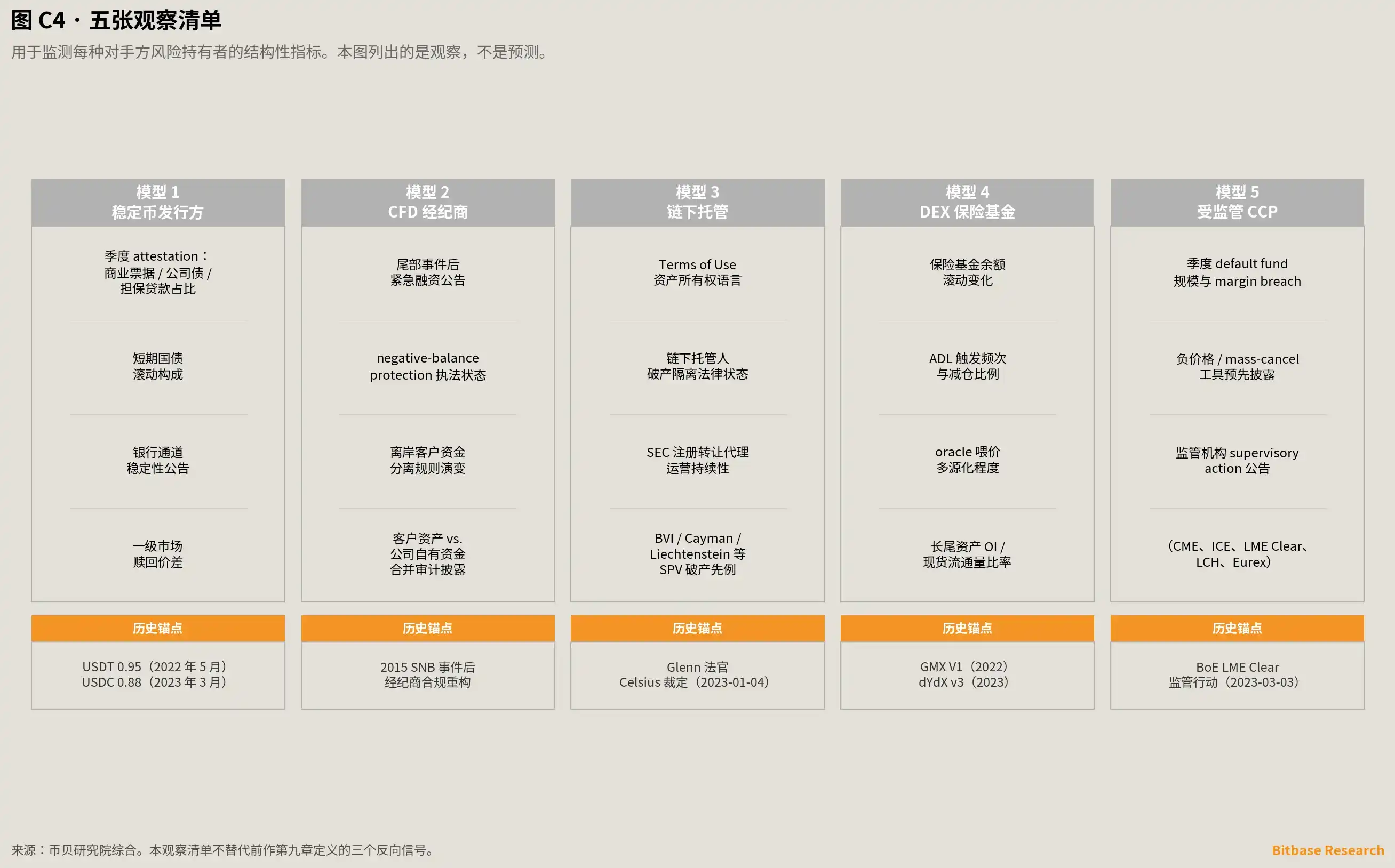
This section lists the structural indicators that need to be monitored for each of the five counterparty risk holders. This is not a prediction of which architecture will fail but provides the observable signals corresponding to the historical failure modes of each architecture. The Q4 2026 Signal Tracking Composite Report should continue to strictly respond to the three reversal signals defined in Chapter 9 of the preceding work; the five watchlists proposed here are a new observation dimension that can be incorporated into ongoing tracking as supplementary signals in a Market Insights issue following the Q4 report.

Model 1: Stablecoin Issuer. Monitor: The proportion of commercial paper, corporate bonds, secured loans in the reserve composition in major stablecoin issuers' quarterly attestation reports; rolling changes in the proportion of short-term Treasury holdings; stability announcements regarding the issuer's banking corridors (USD on/off-ramp paths); the spread and frequency of primary market redemptions for major stablecoins against the dollar. Two historical baselines for primary market redemption pressure: during the May-June 2022 LUNA/UST collapse, USDT briefly traded at a discount to around $0.95 [46]; during the March 2023 SVB incident, USDC briefly depegged to around $0.88 before recovering within days [47].

Model 2: CFD Broker Balance Sheet. Monitor: Emergency financing announcements from major B-book brokers following tail events; enforcement status of negative balance protection by jurisdictional regulators; evolution of client money segregation rules in offshore jurisdictions like Mauritius FSC, Seychelles FSA; consolidated audit disclosures of major brokers' client assets vs. company proprietary funds. The historical baseline is the compliance restructuring of multiple brokers within 6 to 24 months following the 2015 SNB event.

Model 3: Off-Chain Custodian and Transfer Agent Chain. Monitor: Specific language regarding asset ownership in the Terms of Use of crypto yield account providers; the legal status of bankruptcy remoteness declarations by off-chain custodians (BNY Mellon, State Street, etc.); operational continuity of SEC-registered transfer agents; bankruptcy precedents for tokenized RWAs in BVI, Cayman, Liechtenstein, and other SPV legal environments. Chief Judge Glenn's January 4, 2023, ruling on Earn assets in Celsius is the historical anchor for this watchlist item [22].

Model 4: DEX Insurance Fund and ADL. Monitor: Rolling changes in the insurance fund balance of major DEX perpetual protocols; frequency of ADL triggers and the proportion of positions force-liquidated post-trigger; degree of multi-source oracle price feeds and open position limits on single oracles; the ratio of open interest on DEX perpetuals for long-tail assets (YFI, SUSHI-type) relative to their spot circulating supply. Both GMX V1 and dYdX v3 events occurred on long-tail assets [29][32].

Model 5: Regulated CCP. Monitor: Quarterly default fund size and margin breach disclosures from major CCPs (CME, ICE, LME Clear, LCH, Eurex Clearing); CCPs' pre-emptive disclosure of tools for negative prices, mass cancellation, forced liquidation in contract rules; announcements of supervisory actions by CCP regulators (CFTC, Bank of England PRA, ECB) regarding CCP governance and risk management. The precedent of LME Clear being placed under a skilled person for remediation oversight by the Bank of England on March 3, 2023, is the historical anchor for this watchlist item [36].

The five watchlists do not constitute investment advice or specific probability estimates of future events. They are structural indicators intended to classify new stress events back into existing failure modes, rather than treating each event as unprecedented.
Methodology and Disclosure Statement

Research Scope and Limitations. This companion piece builds upon the five TradFi-on-crypto architectures defined in the preceding work, elevating the "counterparty risk holder" dimension from within the architectural fingerprints to the main analytical axis. This report does not construct new architecture classifications, predict which architecture will fail first or ultimately, assess the specific solvency probability of any single issuer or exchange under stress, nor expand into unit economics comparisons at the exchange level or financial modeling of single issuers across the five architectures. Each architecture's failure modes occurred under different market structures, macroeconomic environments, and regulatory maturity levels, and do not constitute an extrapolatable failure probability ranking. This companion piece does not treat the FTX collapse (November 11, 2022) as a single archetypal case, as FTX's architectural hybridity (exchange + Alameda proprietary market maker + client fund misappropriation) gave it partial characteristics across Model 1, Model 3, and Model 4; FTX is mentioned in this report only in the context of BlockFi's related exposure.
Data Timeliness. The historical case data, regulatory documents, bankruptcy court filings, official post-mortem reports, and official academic working papers cited in this report are based on publicly available information as of April 23, 2026. The data cut-off date for this companion piece is consistent with the preceding work to maintain comparability. New events occurring between the publication of the preceding work and the writing of this piece are not incorporated into the analysis, to avoid conflict with the mandate of the Q4 2026 Signal Tracking Composite Report. Readers should treat this report as an analysis of a specific point-in-time snapshot.

Research Independence. This report was independently authored by Bitbase Research. Its analytical conclusions are based on publicly available primary sources and the independent judgment of the research team. The "five counterparty risk holders" analytical axis adopted is a research construct and not an official classification by any regulatory or standard-setting body. The specific institutional names mentioned in this report (including Tether, Bitfinex, Wells Fargo, Crypto Capital Corp., FXCM, Alpari UK, KPMG, Leucadia, Effex Capital, Gain Capital, Celsius Network, BlockFi, Ankura Trust Company, Jenner & Block, BlackRock, Securitize, BNY Mellon, PricewaterhouseCoopers, WisdomTree, Hashnote, Ondo, GMX, dYdX, SUSHI, YFI, Genesis Trading, Chainlink, LME, LME Clear, CME, CME Group, ICE, ICE Europe, LCH, Eurex Clearing, Oliver Wyman, Elliott Associates, Jane Street Global Trading, Interactive Brokers) are included solely as objective references for describing the industry landscape. Inclusion does not constitute endorsement, and omission does not constitute a negative signal.

Conflict of Interest Disclosure. Bitbase operates a centralized exchange that may offer products falling within the scope of Model 1 (CEX-native stablecoin-settled perpetual contracts) analyzed in this report. Readers should take this fact into account when interpreting this report's analysis of Model 1 and its comparison with the other four models. The analytical framework in this report is independent of any specific product development plans; this report makes no statements regarding any existing or upcoming specific products from Bitbase. The report's arguments and watchlists apply symmetrically to all five models, including the one potentially occupied by Bitbase.

Tools and Generative Assistance. This report used large language models as research assistance tools during the stages of data collection, cross-source fact-checking, structured argumentation, and initial draft writing. All primary data, regulatory documents, bankruptcy court filings, attestation reports, and market indicators have been manually verified against original sources. Specific numbers, direct quotations from regulators and judges, case numbers, ECF document numbers, and Press Release numbers have been manually traced back to primary sources by human effort. The central thesis and core judgments were independently made by Bitbase Research team members. The self-critical review paragraphs were human-authored. We acknowledge the inherent risk of errors in AI-assisted research, particularly in long-tail data processing, which we have mitigated through multiple rounds of fact-checking but cannot entirely eliminate. The methodological dimension of this companion piece was inspired by an observation from a reader in public LinkedIn discussions from late April to early May 2026; we do not name the reader but have documented the source and first appearance date in an internal Editorial Note.

Non-Investment Advice Disclaimer. This report does not constitute investment advice, a recommendation to buy/sell/hold any financial instrument, nor a solicitation for any financial product or service. The five counterparty risk architectures and five watchlists identified are a research framework, not an investment portfolio construction methodology, and make no representations regarding the expected returns, risks, or suitability of any product within any architecture. Readers should consult independent, licensed financial, legal, and tax advisors before taking any action based on any information in this report. Trading crypto assets carries substantial risk, including but not limited to market volatility, liquidity risk, technical risk, regulatory risk, and the potential for total loss of principal.

Forward-Looking Statement Risk. Statements in this report regarding the evolution of stablecoin issuer reserves, jurisdictional regulatory paths for CFD brokers, institutionalization of off-chain custody and transfer agency, DEX insurance fund and ADL design, and the activation of tools by regulated CCPs under stress are forward-looking and subject to uncertainty. Regulatory outcomes depend on rulemaking processes, enforcement decisions, and political developments, which are not within the control of any single entity. Readers should treat forward-looking statements as judgments conditioned on publicly available information as of April 23, 2026, subject to revision.

Signal Tracking. The five watchlists proposed in this companion piece do not replace the three reversal signals defined in Chapter 9 of the preceding work. Bitbase Research commits to publishing a "Signal Tracking" follow-up report in Q4 2026, re-examining the then-available data against the three reversal signals defined in Chapter 9 of the preceding work. The five watchlists listed in this companion piece, as a new observation dimension, can be incorporated into ongoing tracking as supplementary signals in a Market Insights issue following that composite report.


Related Questions

QWhat is the core problem examined in this companion piece, from the perspective of the settlement layer?

AThe core problem is: in a stress scenario, whose balance sheet absorbs losses first, and whether that balance sheet has a documented history of actually absorbing losses.

QAccording to the article, what are the two final counterparties for users in Model 1 architecture?

AThe two final counterparties are: 1) The stablecoin issuer (e.g., Tether), whose reserve composition and bank connectivity determine peg stability under stress; and 2) The CEX's own trading book, whose solvency determines a user's ability to close positions and withdraw in a tail event.

QWhy does the article argue that the regulatory dimension and counterparty risk allocation are co-extensive, not in an upstream-downstream relationship?

ABecause they are two expressions of the same institutional choice. For example, ESMA's mandatory negative balance protection rule directly dictates that a CFD broker's balance sheet absorbs losses exceeding client margins, while the Mauritius FSC's lack of such a rule allows losses to be passed back to clients. The regulatory rule *is* the counterparty risk allocation rule.

QWhat key legal ruling determined the fate of assets in Celsius Network's Earn Accounts during its bankruptcy?

AChief Judge Martin Glenn's January 4, 2023, Memorandum Opinion and Order ruled that based on Celsius's Terms of Use language granting it 'all right and title' to deposited digital assets, the assets in Earn Accounts became Celsius's property upon deposit. Therefore, at the Petition Date, they became part of the bankruptcy estate, and Earn account holders were treated as unsecured creditors.

QWhat are the two 'non-typical tools' that a highly institutionalized CCP (Model 5) has historically used under extreme stress, as detailed in the article?

AThe two non-typical tools are: 1) Mass cancellation of executed trades (exemplified by LME's cancellation of nickel trades on March 8, 2022), and 2) Negative-pricing structural rule changes (exemplified by CME's rule change to allow negative pricing for WTI oil futures ahead of the April 20, 2020, settlement).

Related Reads

Claude Code Introduces Dynamic Workflows: Enabling AI to Form Teams and Collaborate

Claude Code introduces dynamic workflows, enabling AI to coordinate teams of specialized agents for complex tasks. This transforms Claude from a code assistant into a programmable workbench. Workflows address key limitations of single-agent systems: agentic laziness (premature task completion), self-preferential bias (favoring own outputs), and goal drift (losing sight of original objectives). The system allows Claude to dynamically create execution frameworks using JavaScript. It can split tasks, dispatch parallel agents for isolated work (e.g., in separate worktrees), implement adversarial validation, run tournaments, and synthesize results. This multi-agent approach is valuable for tasks requiring deep research, factual verification, code migration, root cause analysis, large-scale triage, and qualitative sorting. Key patterns include: classify-and-route, fan-out-and-synthesize, adversarial verification, generate-and-filter, tournaments, and loop-until-done. While token usage is higher, workflows excel where tasks resemble programming—needing problem decomposition, isolated context, hypothesis testing, and handling many details. They extend Claude Code's utility beyond technical work to areas like business plan review, resume screening, and naming brainstorm. The feature is not a universal solution but points to a future where AI tool competitiveness depends on organizing reliable, reusable, and auditable execution flows for complex goals.

marsbit42m ago

Claude Code Introduces Dynamic Workflows: Enabling AI to Form Teams and Collaborate

marsbit42m ago

Hyperliquid, Wall Street's 24/7 Trading Convenience Store

Hyperliquid: The 24/7 Trading "Convenience Store" for Wall Street Hyperliquid, a decentralized cryptocurrency exchange, has become a go-to platform for Wall Street traders seeking to trade around the clock, especially during traditional market closures. Founded by Jeff Yan, a former quantitative trader, after the FTX collapse, the platform emphasizes user self-custody of assets. It offers a wide range of perpetual contracts—leveraged derivatives with no expiry—on assets from Bitcoin and crude oil to the S&P 500 and even pre-IPO companies like SpaceX. A notable example involves a hedge fund trader who capitalized on geopolitical news over a weekend, securing a 243% return on oil derivatives before markets reopened. The platform, run by just 11 employees, generated approximately $800 million in revenue last year, and its native token HYPE has seen significant growth. Its rise highlights the merging of traditional finance and crypto. While U.S. users are currently restricted, recent CFTC rule changes could open access. The platform is known for its transparency, having processed $10 billion in liquidations during a market crash while competitors faltered. Regulators warn of the high risks and complexity of perpetual contracts for retail investors. Key to its appeal is a strong community culture, direct engagement with founders, and a simple interface. Despite rules against VPN use, it attracts global users with its permissionless approach. Hyperliquid plans to expand into prediction markets and options, aiming to eventually host all financial activity.

marsbit42m ago

Hyperliquid, Wall Street's 24/7 Trading Convenience Store

marsbit42m ago

Who Funds the Agents?

**Summary: Who Funds AI Agents?** OpenAI recently shut down a feature allowing AI agents to shop for users, highlighting the challenge of creating a secure and regulated environment for agent-driven transactions. While payment infrastructure exists, a crucial governance layer—defining spending limits, fraud detection, tax handling, and return policies—is largely missing. The potential is enormous: AI agents already processed $73M across 176M transactions last year, with McKinsey forecasting this could grow to $3-5T in global consumer commerce by 2030. The core competition isn't just about processing payments, which can be very cheap (especially with crypto-based settlement), but about controlling the rules that govern agent spending. Key players like Stripe and Coinbase are racing to dominate this governance layer. Stripe's acquisition of wallet provider Privy allows it to set spending policies, identity checks, and human-in-the-loop approvals directly at the wallet level. Similarly, Coinbase's stack, including its x402 protocol and AgentKit, embeds governance rules. This vertical integration across settlement, wallet, and governance layers is becoming the dominant strategy. Control over the governance layer is where significant future value lies. If agents handle trillions in transactions, even a small fee for managing compliance, fraud prevention, and policy enforcement could generate billions in annual revenue. The companies that successfully integrate across the payment stack will capture value from idle agent balances, transaction fees, and governance services, positioning themselves as the foundational banks of the AI agent economy.

marsbit1h ago

Who Funds the Agents?

marsbit1h ago

Trading

Spot
Futures

Hot Articles

What is LINON

Linde plc Tokenized Stock (Ondo): Revolutionizing Traditional Equity Access Through Blockchain Innovation The emergence of Linde plc Tokenized Stock (Ondo), represented by the ticker $LINON, signifies a monumental shift in the fusion of traditional financial structures and decentralized finance (DeFi). This innovative financial instrument showcases the tremendous potential of blockchain technology to democratize access to traditional equity markets while ensuring the security and regulatory compliance necessary for institutional-grade financial products. Through Ondo Finance's pioneering tokenization platform, $LINON provides a seamless pathway for global investors to engage with one of the world's leading industrial gas companies, Linde plc, creating a blockchain-native representation of the underlying equity. Introduction to Linde plc Tokenized Stock The landscape of financial markets is witnessing a groundbreaking transformation through the tokenization of real-world assets. Linde plc Tokenized Stock (Ondo) epitomizes this revolutionary approach by bridging the gap between conventional stock ownership and blockchain-enabled financial infrastructure. The $LINON token allows investors to gain exposure to one of the prominent industrial companies worldwide through decentralized technology. Operating within Ondo Finance's comprehensive ecosystem, $LINON symbolizes a practical application of tokenization technology that enhances accessibility, efficiency, and global connectivity in traditional financial markets. By leveraging blockchain infrastructure, this tokenized stock enables international investors to participate in U.S. equity markets, overcoming traditional barriers associated with cross-border investing. The significance of $LINON goes beyond technological innovation; it represents a fundamental shift in asset structuring, distribution, and trading in the digital age. This tokenized stock maintains all the economic benefits associated with traditional Linde plc shares while offering improved liquidity, programmable compliance features, and seamless integration with decentralized finance protocols. The development of $LINON indicates a growing acceptance of blockchain technology as a viable means for traditional finance, exemplifying how even well-established assets like Linde plc can integrate into blockchain systems. This approach preserves the core attributes that appeal to investors while introducing advanced capabilities that enhance the overall investment proposition. Project Overview and Objectives Linde plc Tokenized Stock (Ondo) encapsulates a strategic effort to democratize access to traditional equity markets through advanced blockchain technologies. The primary objective of $LINON is to provide approved global investors seamless access to the economic exposure associated with Linde plc shares, furthering an effort to create a more inclusive financial ecosystem. Beyond the digital representation of traditional assets, $LINON endeavors to eliminate barriers of geography and time zones that limit investor participation. Its design ensures that blockchain technology can elevate traditional investment vehicles without undermining the security or compliance requirements expected by investors. Key goals of the project include enhanced liquidity provision, programmable compliance mechanisms, and interoperability with other blockchain networks. Each $LINON token is fortified by actual Linde plc securities housed at U.S.-registered broker-dealers, allowing holders to reap economic advantages akin to traditional stockholders, such as dividend reinvestment. Furthermore, $LINON aims to establish new industry standards for institutional-grade tokenized securities, paving the way for traditional assets to embrace blockchain technology while remaining compliant with regulatory frameworks. By associating itself with a company as reputable as Linde plc, the project opens avenues for exploring tokenized equities catering to both conservative institutional players and daring retail investors. Project Creator and Development Team The vision for Linde plc Tokenized Stock (Ondo) comes from Nathan Allman, founder and CEO of Ondo Finance. His background in traditional finance coupled with expertise in blockchain technology positions him uniquely to navigate the complexities of asset tokenization. Allman's academic journey began at Brown University, focusing on Economics and Biology, equipping him with valuable analytical skills. His time at Goldman Sachs in the Digital Assets division strengthened his understanding of the interplay between financial institutions and emerging technologies, laying the groundwork for his later endeavors in alternative investment strategies. Under Allman's guidance, Ondo Finance has emerged as a leader in asset tokenization, launching $LINON as a flagship example of the company's larger mission towards revolutionizing traditional financial systems using blockchain technology. His commitment to leveraging blockchain for creating institutional-grade financial products has shaped the landscape of real-world asset tokenization. Investment and Funding Structure The growth of Ondo Finance, the platform powering Linde plc Tokenized Stock (Ondo), is bolstered by robust financial backing from prestigious venture capital firms and strategic investors. This strong investment foundation underpins the development of the key infrastructure essential for compliant tokenized securities like $LINON. In August 2021, Ondo Finance secured $4 million in seed funding led by a major venture capital firm, which enabled the company to commence platform development and establish the necessary regulatory processes for tokenizing real-world assets. This early investment cemented Ondo Finance's credibility within the industry. The Series A funding round followed, garnering $20 million with participation from renowned firms committed to transformative technology companies. This backing demonstrated substantial institutional confidence in Ondo Finance's vision, allowing it to hone its approach to asset tokenization through mechanisms that ensure compliance and accessibility. Noteworthy contributors, including institutional investors and experienced partners, have added significant value to Ondo Finance’s development efforts. Their involvement underscores the confidence across sectors in Ondo Finance's approach to bridging traditional finance with blockchain innovations. Technical Infrastructure and Innovation The technical architecture that underpins Linde plc Tokenized Stock (Ondo) represents a sophisticated melding of traditional finance systems and cutting-edge blockchain technology. The architecture's foundation is built on the Ethereum network, renowned for its security and programmability—both critical for intricate financial instruments. The $LINON tokenization process comprises creating a blockchain-native representation of Linde plc shares that preserves economic benefits while augmenting investor capabilities. Each token corresponds to actual shares held at U.S.-registered broker-dealers, creating a compliant custody structure that legitimizes the asset's existence and value. Automated compliance systems are integrated into the tokenization process, managing critical components such as know-your-customer (KYC) verification and anti-money laundering (AML) protocols. This incorporation of programmable compliance empowers $LINON to uphold regulatory standards essential for institutional proliferation. Cross-chain interoperability characterizes the advanced technical features of $LINON. While initially deployed on Ethereum, the framework is designed for expansion to other networks such as Solana and BNB Chain. This adaptability enhances liquidity and accessibility, allowing investors to select their preferred blockchain ecosystems. Historical Timeline and Development Crafting the history of Linde plc Tokenized Stock (Ondo) unfolds in parallel with the evolution of Ondo Finance's tokenization platform. The timeline's inception dates back to March 2021 when Nathan Allman laid the foundations for creating institutional-grade financial products on blockchain infrastructure. The initial funding round in August 2021 provided crucial resources for developing the platform and establishing partnerships necessary for effective tokenization. By January 2023, Ondo Finance launched its tokenized treasury products, establishing mechanisms that would facilitate future tokenized equities such as $LINON. A pivotal milestone arose in February 2025 when Ondo Chain—a Layer 1 blockchain designed specifically for asset tokenization—was introduced. This infrastructure enhances capabilities vital for institutional markets, demonstrating Ondo Finance's long-term commitment to tokenization. Subsequently, the launch of Ondo Global Markets in September 2025 marked the official debut of $LINON. This milestone showcased the successful transition from development to active trading, enabling investors around the world to access American financial markets seamlessly. Ongoing development plans include a targeted expansion of available tokenized assets to over 1,000 by the end of 2025, pointing to a bright future for Ondo Finance's ecosystem and its mission to broaden tokenized equity accessibility. Regulatory Compliance and Legal Framework The legal architecture governing Linde plc Tokenized Stock (Ondo) emphasizes a sophisticated approach to regulatory compliance, allowing tokenized securities to be implemented within a blockchain-based framework. The legal structure governing $LINON spans multiple jurisdictions while maintaining a robust legal footing. Compliance systems ensure that only eligible investors can access the token, enforced through automated verification that aligns with international regulations. This innovative regulatory technology promises real-time enforcement of complex requirements, considerably enhancing efficiency in operating within the regulatory landscape. The custody framework undergirding $LINON ensures that the underlying shares are securely held at U.S.-registered broker-dealers, complying with necessary regulations while delivering blockchain-driven access to investors. The token maintains its economic equivalency and security through this carefully structured custody arrangement. KYC and AML compliance systems are embedded within the smart contract architecture, ensuring integrity and adherence to regulatory practices while fostering transparency for investors. The jurisdictional restrictions mark a commitment to navigating the evolving landscape of international securities laws. Market Impact and Industry Significance The advent of Linde plc Tokenized Stock (Ondo) holds profound implications for the broader financial landscape, symbolizing a clear shift towards blockchain-enabled markets. $LINON serves as a proof-of-concept for integrating traditional companies into blockchain ecosystems, showcasing the potential benefits such as broader accessibility and improved efficiency. The market's response to $LINON indicates a growing acceptance of tokenization among institutional investors, contributing to the emergence of an expanding sector wherein traditional assets can be interconnected with blockchain innovations. The success of $LINON further solidifies market confidence, indicating an overarching shift towards recognizing asset tokenization as a transformative force in finance. Future Development and Expansion Plans The future trajectory for Linde plc Tokenized Stock (Ondo) centers around the expansion of the tokenization ecosystem and enhanced infrastructure supporting blockchain-enabled financial services. Plans for cross-chain integration usher in new opportunities for liquidity and flexibility within the investment framework, with existing capabilities poised for continuous enhancement. With the introduction of Ondo Chain, Ondo Finance aims to transition $LINON to an optimized blockchain environment specifically designed for asset tokenization. This new infrastructure heralds exciting prospects for the development of institutional-grade financial products, ensuring ongoing compatibility with contemporary investment strategies. Further integration with decentralized finance protocols signifies a commitment to empowering $LINON holders through advanced financial strategies. The anticipated expansion of available tokenized assets promises to broaden investor access, enhancing the utility and appeal of the platform. In alignment with ambitions for regulatory expansion, ongoing efforts to secure approvals for new jurisdictions will enhance investor access, further positioning $LINON at the forefront of the burgeoning tokenization market. Conclusion Linde plc Tokenized Stock (Ondo), as represented by the $LINON token, stands at the intersection of traditional finance and blockchain innovation. It embodies a transformative milestone in how financial assets are structured, distributed, and engaged within modern investment ecosystems. The technical sophistication behind $LINON, combined with its regulatory compliance framework, illustrates that asset tokenization can improve financial infrastructure rather than simply digitizing existing products. This pioneering effort not only enhances investor access to U.S. equity markets but also signifies an evolution of how traditional financial services can integrate blockchain technology. As the asset tokenization market grows exponentially, with prospects suggesting significant valuation increases, $LINON paves the way for a future where tokenized securities become standard fixtures in the financial landscape. The trajectory of $LINON will undoubtedly influence how traditional finance adapts to a transformed, blockchain-powered world.

3.1k Total ViewsPublished 2025.12.05Updated 2025.12.05

What is LINON

What is CRMON

Salesforce Tokenized Stock (Ondo): Revolutionising Traditional Equity Access Through Blockchain Innovation The emergence of Salesforce Tokenized Stock (CRMON) marks a pivotal advancement in integrating traditional financial markets with blockchain technology. This innovative approach offers investors unprecedented access to equity exposure through tokenisation. Developed by Ondo Finance, CRMON provides tokenholders with economic exposure equivalent to holding Salesforce stock (CRM) while automatically reinvesting dividends. This effectively bridges the gap between conventional equity markets and decentralised finance (DeFi). Introduction and Comprehensive Overview of Salesforce Tokenized Stock In recent years, the financial landscape has dramatically transformed due to blockchain technology, fundamentally altering how investors access and interact with traditional assets. The development of Salesforce Tokenized Stock (CRMON) is a prime example of this evolution, representing a sophisticated fusion of conventional equity markets with cutting-edge distributed ledger technology. CRMON is a tokenised version of Salesforce stock, emerging from the innovative work of Ondo Finance, a leading platform in the real-world asset tokenisation sector that positions itself as a bridge between traditional finance and decentralised systems. Designed to provide tokenholders with economic exposure that mirrors the performance of the underlying Salesforce stock, CRMON incorporates automatic dividend reinvestment mechanisms. This eliminates many traditional barriers associated with international equity investment, such as complex brokerage relationships, currency conversion challenges, and restricted trading hours. The tokenisation process reimagines stock ownership as a blockchain-native asset while maintaining its economic equivalence with the underlying security, offering enhanced portability and integration capabilities within decentralised finance ecosystems. CRMON transcends its individual utility as an investment instrument to represent a fundamental shift in how financial markets can operate in an increasingly digital world. By maintaining full backing through U.S.-registered broker-dealers and implementing robust compliance frameworks, CRMON demonstrates that tokenised securities can achieve the regulatory standards necessary for institutional adoption while delivering the technological advantages of blockchain infrastructure. Understanding Tokenized Real-World Assets and CRMON's Strategic Position Tokenised real-world assets signify one of the most significant innovations in modern finance, fundamentally reimagining how traditional securities are represented, traded, and utilised within digital ecosystems. CRMON operates as a tokenised equity instrument correlating directly with Salesforce stock while optimising accessibility and efficiency. This aligns with Ondo Finance's broader mission to democratise access to institutional-grade financial products through innovative tokenisation strategies. The tokenisation process guarantees complete economic equivalence with the underlying Salesforce equity. Each CRMON token represents a proportional claim on Salesforce stock held by qualified custodians, with dividend payments automatically reinvested to maintain continuous exposure to total return performance. This structure simplifies dividend management and ensures that tokenholders receive the full economic benefit of their equity exposure, encompassing both capital appreciation and income generation. Ondo Finance's strategy in tokenising Salesforce stock demonstrates its expertise in creating compliant, institutional-grade products that meet traditional financial markets' stringent requirements. The platform’s focus on merging regulatory compliance with blockchain benefits positions it at the forefront of decentralised finance, captivating both institutional and retail investors seeking blockchain-native solutions. The Technology and Innovation Framework Behind CRMON The technological infrastructure supporting CRMON integrates blockchain technology with traditional financial mechanisms, delivering institutional-grade security and compliance while maintaining the operational advantages of decentralised systems. Built on the Ethereum blockchain, CRMON utilises robust smart contract capabilities to ensure transparent, secure operations. The smart contract architecture incorporates layered security and compliance mechanisms, enabling automated compliance checks and real-time asset backing verification. Integration with oracle services maintains accurate pricing and dividend information, ensuring CRMON reflects the underlying Salesforce stock's accurate performance. This architecture delivers automated dividend reinvestments and other corporate actions, eliminating manual processing requirements and directly enhancing tokenholder benefits. Ondo Finance ensures CRMON's security structure includes daily third-party verification of holdings, independent collateral agents, and a multiple-layer custody system through partnerships with established financial institutions. This framework safeguards tokenholder interests against operational risks while providing robust asset backing. The user interface enhances integration capabilities, allowing seamless interaction between CRMON and various decentralised finance protocols, as well as cryptocurrency exchanges. This interoperability enables users to leverage their tokenised equity across multiple platforms, creating sophisticated investment strategies that marry traditional equity characteristics with blockchain-native innovation. Leadership and Corporate Structure of Ondo Finance The leadership team behind CRMON and Ondo Finance blends expertise from traditional finance and blockchain technology, presenting a robust combination of skills essential for successfully bridging conventional markets with decentralised finance. Nathan Allman, the founder and CEO, emerged from a distinguished financial background before establishing Ondo Finance in 2021. Allman's experience includes notable roles at major financial institutions, including significant contributions to developing cryptocurrency market services. His insights into regulatory compliance were paramount in developing products like CRMON that successfully unify traditional securities with blockchain technology. With a team of professionals boasting substantial experience in both conventional finance and blockchain sectors, Ondo Finance's leadership comprises diverse expertise that covers every aspect of tokenised asset development. Justin Schmidt serves as President and COO, contributing unique operational expertise, while Chris Tyrell brings essential compliance knowledge. Investment Landscape and Funding History The investment landscape surrounding Ondo Finance reflects significant institutional confidence in its mission to tokenise real-world assets. The company has raised substantial funds through various investment rounds, attracting leading venture capital firms and strategic investors that recognise the transformative potential of tokenised securities like CRMON. Notably, Ondo Finance completed a successful Series A funding round in 2022, led by well-known venture capital firms. This funding success validates Ondo Finance's innovative approach to creating compliant, institutional-grade tokenised products. In total, Ondo Finance has successfully secured substantial funding, raising significant capital for product development and market expansion, including a noteworthy token sale that reinforced its governance structure through the establishment of the ONDO token. The diverse composition of investors reflects broad market confidence in Ondo Finance's business model, demonstrating support from both traditional and blockchain-native organisations. Operational Mechanics and Technical Implementation The operational framework supporting CRMON exemplifies sophisticated integration of traditional financial mechanisms with blockchain technology. The technical implementation introduces multiple layers of security, compliance, and operational efficiency to meet institutional standards while enhancing accessibility. The tokenisation process begins by acquiring actual Salesforce stock through U.S.-registered broker-dealers, ensuring each CRMON token maintains direct correlation with the underlying equity performance. Smart contracts automate operational processes, including dividend reinvestment and corporate action processing, facilitating a streamlined user experience. The Minting and redemption processes allow authorised participants to manage CRMON tokens effectively. During U.S. trading hours, institutions can mint new tokens by depositing stablecoins that are used to purchase corresponding Salesforce equity. This structure maintains a tight correlation with underlying assets, enhancing liquidity and price discovery. Additionally, the infrastructure supports twenty-four-hour token transfer capabilities, providing CRMON holders with operations outside traditional market hours. This represents a significant advantage over conventional securities ownership, thus promoting integration with decentralised finance applications. Plans for cross-chain compatibility through partnerships signal further ambitions for CRMON's market reach. By expanding to other blockchain networks, Ondo Finance aims to enhance accessibility and user engagement with tokenised equity products. Timeline and Historical Development of Tokenized Equity Innovation The timeline of CRMON's development and Ondo Finance's broader tokenised capabilities demonstrates a systematic innovation process beginning with the company's founding in 2021. 2021: Ondo Finance is founded by Nathan Allman and co-founders, launching initial products focused on structured vault offerings on the Ethereum blockchain. 2022: The company completes substantial funding rounds—both equity and token sales—totaling significant capital and launching initial tokenised U.S. Treasury products. 2023-2024: Ondo Finance experiences substantial growth, establishing partnerships with major financial institutions while expanding its product offerings beyond fixed-income securities. February 2025: Ondo Global Markets is announced, marking the transition into equity tokenisation with plans for accessing over one hundred U.S. stocks and ETFs. September 2025: The official launch of Ondo Global Markets includes CRMON alongside other tokenised equity offerings, marking a significant evolution in Ondo Finance's product ecosystem. This timeline highlights the organisation's rapid growth and its capability to adapt its technological and compliance frameworks to accommodate different asset classes effectively while maintaining security and regulatory integrity. Regulatory Framework and Compliance Approach Ondo Finance's regulatory framework showcases a sophisticated compliance strategy, essential for achieving institutional adoption in the tokenised securities market. The company's strong partnerships with U.S.-registered broker-dealers promote adherence to Securities and Exchange Commission regulations and apply robust investor protections. Acquisitions, such as Oasis Pro—a registered broker-dealer—significantly enhance Ondo Finance's compliance capabilities, ensuring thorough alignment with existing regulatory structures. The company employs independent verification procedures that foster transparency, aiming for a solid performance standards reputation. Furthermore, Ondo Finance's commitment extends to international regulatory compliance, ensuring token access remains restricted to eligible investors while adhering to pertinent cross-border securities regulations. Comprehensive attention to tax implications and reporting requirements fortifies the security and compliance landscape of CRMON, ensuring that investor obligations remain manageable. Future Prospects and Market Positioning The forward-looking landscape for CRMON and Ondo Finance illustrates substantial growth opportunities driven by institutional adoption of blockchain technology and escalating demand for efficient alternatives to conventional securities ownership. Market projections indicate the tokenised asset sector could value multiple trillion dollars by 2030. With plans to scale CRMON offerings significantly and integrate it with a dedicated blockchain infrastructure—Ondo Chain—Ondo Finance aims to elevate its institutional-grade tokenised asset operations. Additionally, the development of strategic partnerships enhances distribution capabilities while establishing the company's credibility in the financial market. Furthermore, the integration of tokenised equity with decentralised finance protocols offers new potential for innovative financial products and strategies previously impossible with traditional securities. These factors underscore CRMON's positioning to effectively capture increased market share and deliver innovative solutions for international investment exposure. Conclusion Salesforce Tokenized Stock (CRMON) symbolises a transformative development within financial markets, successfully bridging traditional equity ownership with blockchain technology to create unprecedented accessibility for global investors. Through Ondo Finance's sophisticated tokenisation framework, CRMON provides complete economic exposure to Salesforce equity performance while enhancing operational advantages that exceed traditional ownership. The launch of CRMON reflects the broader evolution of financial markets towards blockchain infrastructures that maintain regulatory compliance while delivering increased efficiency. Ondo Finance's extensive approach to regulatory adherence, institutional-grade security, and technological innovation solidifies CRMON as a model for future tokenised securities, delivering access previously unattainable in conventional brokerage structures. As the tokenised asset sector continues to develop, CRMON is well-positioned to address historical inefficiencies in capital markets while providing investors with innovative solutions for accessing traditional securities. The outlook for CRMON looks exceptionally promising, supported by ambitious expansion plans, technological innovations, and strategic partnerships, thereby representing a pioneering model of modern financial infrastructure evolving through blockchain integration.

3.2k Total ViewsPublished 2025.12.05Updated 2025.12.05

What is CRMON

What is SHOPON

Shopify Tokenized Stock (Ondo): A Comprehensive Analysis of Real-World Asset Tokenization in Web3 This article delves into the Shopify Tokenized Stock (Ondo), recognised by its ticker symbol $SHOPON, exploring its implications at the intersection of traditional finance and blockchain technology. As a part of Ondo Finance's tokenized securities platform, Shopify’s tokenized stock exemplifies advancements in democratizing access to global capital markets through innovative digital assets. Introduction and Overview of Shopify Tokenized Stock (Ondo) Shopify Tokenized Stock (Ondo), or $SHOPON, portrays a pivotal innovation in the realm of tokenized securities, allowing investors to gain economic exposure akin to directly owning shares of Shopify Inc. This token, developed under the umbrella of Ondo Finance, not only provides investors with the ability to hold digital representations of the company’s stock but also integrates features such as automatic reinvestment of dividends. This advancement represents a substantial shift in the landscape of decentralized finance (DeFi), linking conventional equity markets with blockchain solutions designed to enhance accessibility, transparency, and liquidity. By eliminating geographical barriers and enabling 24/7 trading capabilities, $SHOPON is positioned as a bridge connecting traditional financial instruments and the emerging Web3 ecosystem. What is Shopify Tokenized Stock (Ondo), $SHOPON? The $SHOPON token serves as a digital manifestation of Shopify Inc.'s shares, engineered to provide a direct correlation to the underlying asset's performance. Through the utilization of blockchain technology, the token gives holders a mechanism to participate in the economic benefits associated with equity ownership, including capital appreciation and dividend distribution. The unique aspect of $SHOPON lies in its automatic dividend reinvestment mechanism, which allows returns to compound without necessitating active management by the investor. This feature inherently enhances its attractiveness as an investment vehicle, particularly for individuals seeking passive income growth alongside exposure to high-performing equities. The tokenization process is facilitated by the custody of actual Shopify shares through regulated intermediaries, ensuring that every $SHOPON token is verifiably backed by real equity. This structure empowers investors with the dual advantages of both traditional financial characteristics and the innovative benefits tied to blockchain technology. Who is the Creator of Shopify Tokenized Stock (Ondo)? The creator of Shopify Tokenized Stock (Ondo), Nathan Allman, is an experienced figure in the finance sector, formerly associated with Goldman Sachs. His rich background includes significant expertise in digital asset development, bridging the gap between traditional finance and cryptocurrencies. Allman’s educational journey, marked by studies at Brown University, provided him with a deep understanding of economics and biology, equipping him with analytical skills that inform his strategic vision. In 2021, he founded Ondo Finance, committing to developing tokenized securities that meet institutional-grade standards while leveraging blockchain's transformative capabilities. Under Allman's leadership, Ondo Finance has focused on creating compliant and innovative financial products that empower a diverse investor base. Who are the Investors of Shopify Tokenized Stock (Ondo)? The investment landscape surrounding Shopify Tokenized Stock (Ondo) is notably robust, underpinned by significant institutional support. Primarily, Pantera Capital stands out as a strategic partner through the Ondo Catalyst initiative, a $250 million commitment aimed at accelerating the development of on-chain capital markets. This partnership not only signifies institutional confidence in the potential of tokenized assets but also reinforces Ondo Finance's operational capabilities and market positioning. The funding pathways have included earlier rounds that amassed millions in seed funding and further structural investments, solidifying relationships with both venture capital firms and private investors. Moreover, the financial framework is complemented by strategic partnerships with established financial institutions and technology companies, enhancing Ondo’s infrastructure and operational expertise. How Does Shopify Tokenized Stock (Ondo), $SHOPON Work? At the core of $SHOPON's operational framework is a sophisticated system integrating traditional finance mechanisms with blockchain technology. The custody of actual Shopify shares ensures that token holders retain authentic economic exposure, safeguarding their investments in line with recognized legal structures. The smart contracts employed in managing $SHOPON handle various functions, including automatic dividend reinvestment and ownership transfer, offering instant settlement and increased liquidity, marking a significant departure from conventional trading systems plagued by multi-day settlement delays. By providing interoperability with other decentralized finance applications, $SHOPON empowers holders with potentially lucrative opportunities for advanced investment strategies, including lending and automated market making. This complex integration presents a unique value proposition, catering to both traditional and crypto-native investors. The innovative structure of $SHOPON also allows for real-time settlements and transactions documented on the blockchain, delivering unparalleled transparency and security—a major advancement over standard equity trading practices. Timeline of Shopify Tokenized Stock (Ondo) March 2021: Nathan Allman establishes Ondo Finance, initially focusing on decentralized finance yield optimization. August 2021: Completion of a $4 million seed funding round led by Pantera Capital. January 2023: Launch of initial tokenized treasury security products, laying the groundwork for future equity tokenization. July 2025: Announcement of the Ondo Catalyst initiative, a strategic investment program valued at $250 million, aimed at propelling the development of tokenization in capital markets. September 3, 2025: Launch of Ondo Global Markets featuring over 100 tokenized U.S. stocks and ETFs, including $SHOPON. Technical Implementation and Blockchain Infrastructure Shopify Tokenized Stock (Ondo) operates on a technical architectural framework that marries blockchain protocols with traditional financial custody arrangements. The ecosystem leverages Ethereum's smart contract capabilities, providing seamless transaction management while ensuring compliance with regulatory standards through established financial custodians. Central to this architecture are security measures and transparent transaction records that affirm the legitimacy of each tokenholder's economic stake. With automated features managed by intricate smart contracts, $SHOPON not only streamlines ownership transfers but also allows for the tactical reinvestment of dividends—a hallmark of modern investment strategies. Moreover, the incorporation of LayerZero technology facilitates cross-chain interoperability, making $SHOPON accessible across multiple blockchain environments while preserving its functional robustness. This forward-thinking technical design positions $SHOPON as an adaptable asset within the larger DeFi milieu. Regulatory Framework and Compliance Architecture $SHOPON's regulatory framework is built upon the meticulous navigation of existing financial regulations that govern securities. The custody arrangements for the underlying Shopify shares are managed by U.S.-regulated broker-dealers, ensuring compliance and protection for investors. By maintaining a separation between the blockchain tokenization process and traditional custody, $SHOPON adheres to legal requirements while offering innovative functionalities that challenge conventional constraints. This dual-layered compliance approach enhances investor confidence and underscores Ondo Finance's commitment to regulatory integrity. Notably, the availability of $SHOPON is tailored to international investors from regions such as Asia-Pacific, Europe, and Africa, as regulatory parameters in the U.S. and U.K. present challenges in accessing tokenized securities. Market Access and Global Distribution Strategy The distribution strategy of $SHOPON is keenly designed to optimize global access while conforming to regulatory standards. The platform aims to establish comprehensive coverage for eligible investors across multiple regions, effectively dismantling traditional barriers through the implementation of blockchain technology. Integration with various cryptocurrency wallets and exchanges also promotes user-friendliness and accessibility, establishing a streamlined experience for investors to manage their holdings. Moreover, the 24/7 trading capabilities afforded by the tokenized model allow participants to react promptly to market shifts, fundamentally transforming how global equities are accessed and traded. Technology Integration and Cross-Chain Functionality The remarkable technological underpinnings of $SHOPON propagate its multi-chain functionality, set to expand its reach beyond Ethereum to networks such as Solana and BNB Chain. Such cross-chain capabilities allow users flexibility when navigating between blockchains, concurrently leveraging distinct network attributes to optimize their trading experience. LayerZero serves as the backbone for ensuring decentralized transfers between networks while providing the requisite security and speed, quintessential for maintaining investor trust. This comprehensive interoperability illustrates $SHOPON's commitment to being a versatile, user-centric asset in the evolving investment landscape. Ecosystem Integration and DeFi Compatibility Incorporating $SHOPON into broader DeFi protocols signifies its potential beyond traditional stock ownership. Token holders can leverage their holdings for various sophisticated strategies and applications, enhancing investment returns and liquidity management. By establishing a presence in lending protocols and automated trading systems, $SHOPON effectively democratizes access to advanced financial strategies previously limited to institutional investors. Such integration contributes to a more competitive and dynamic financial landscape, where individual investors can capitalize on tools typically reserved for larger entities. Risk Management and Security Framework Security remains paramount in the operational infrastructure of $SHOPON. The tokenization framework employs multiple layers of protection—beginning with regulated custody of the underlying Shopify shares. The operational protocols establish rigorous auditing, key management, and transaction monitoring standards, thus safeguarding against potential vulnerabilities. Moreover, meticulous adherence to evolving regulatory requirements provides an extra layer of security, fortifying investor protections and institutional compliance. Market Impact and Industry Implications The introduction of Shopify Tokenized Stock (Ondo) heralds a transformative shift in how financial markets operate, emphasizing the potential of tokenized securities to reshape traditional investment paradigms. The successful integration of $SHOPON encapsulates the efficiencies inherent in blockchain technology and opens avenues for new user demographics previously barred from extensive market participation. The impact extends beyond the immediate benefits to token holders, indicating broader trends that may challenge the status quo of investment services, particularly in addressing geographic restrictions and operational costs typically associated with traditional brokerage platforms. Undeniably, $SHOPON encapsulates the potential for traditional institutions to innovate further, leveraging the increasing demand for seamless blockchain access to complement existing financial infrastructure. Future Development Roadmap and Strategic Vision As Ondo Finance looks forward, the trajectory of $SHOPON rests on ambitious goals aimed at broadening the spectrum of available tokenized assets significantly. Over the next few years, plans are in place to expand to more than 1,000 tokenized securities, further enhancing market participation and investment options for individuals worldwide. Continued integration with traditional financial actors, development of specialized institutional products, and enhancements in automated trading capabilities will ensure that $SHOPON maintains its position at the forefront of financial innovation. Regulatory collaboration will also remain a focal point, establishing a framework that not only supports the compliance requirements but also promotes a healthy environment for tokenized asset proliferation. Conclusion and Market Significance In summary, Shopify Tokenized Stock (Ondo), represented by the ticker $SHOPON, is more than merely a tokenized equity offering; it embodies the innovation possible when traditional finance collides with modern blockchain applications. With a robust technical architecture, a commitment to compliance, and a clear strategic vision, $SHOPON exemplifies the potential for tokenized assets to enhance liquidity, accessibility, and functionality in capital markets. As the global investment landscape evolves, the transformative implications of $SHOPON extend beyond individual investors to revolutionize how financial instruments are perceived, traded, and utilized within both traditional and decentralized frameworks.

3.2k Total ViewsPublished 2025.12.05Updated 2025.12.05

What is SHOPON

Discussions

Welcome to the HTX Community. Here, you can stay informed about the latest platform developments and gain access to professional market insights. Users' opinions on the price of LAYER (LAYER) are presented below.

活动图片