Figure Technology files ‘second IPO’ to bring native equity issuance to Solana

cointelegraphPublished on 2025-12-12Last updated on 2025-12-12

Abstract

Figure Technology, a blockchain-based financial services firm, has filed for a second public offering with the SEC to issue native equity directly on the Solana blockchain. This initiative, announced at the Solana Breakpoint conference, aims to expand DeFi use cases by enabling on-chain trading through Figure’s alternative trading system rather than traditional exchanges. The tokenized equity would allow investors to use the asset in DeFi protocols for lending or borrowing. Beyond its own shares, Figure plans to facilitate native equity issuance for other companies within the Solana ecosystem. The announcement highlights Solana’s growing role in tokenized assets, with industry experts noting its competitive advantages in speed and throughput for real-world asset tokenization.

Figure Technology, a blockchain-based financial services company focused on tokenized assets and lending, has filed for a second public offering aimed at issuing native equity directly on a public blockchain. The move, which follows the company’s recent Nasdaq listing, is designed to expand decentralized finance (DeFi) use cases on Solana.

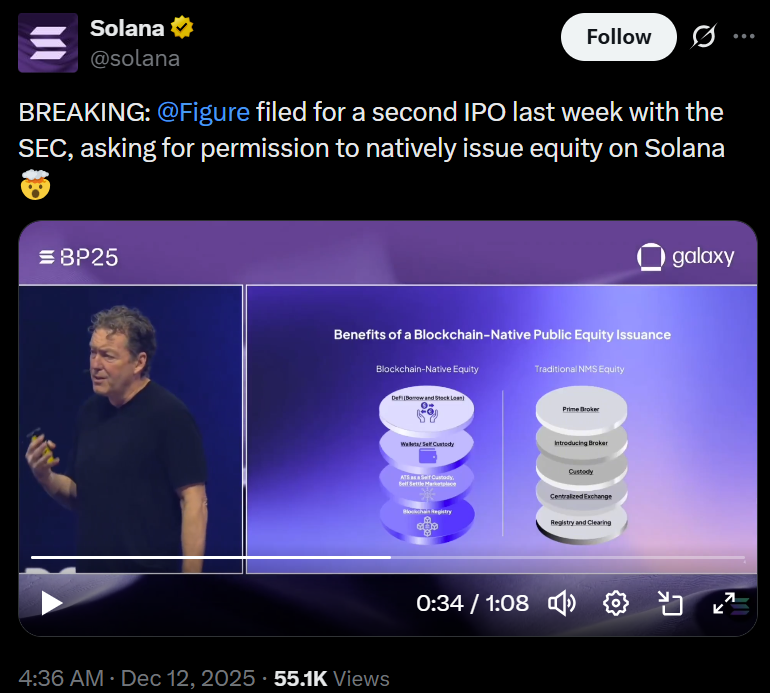
Speaking at the Solana Breakpoint conference, Figure executive chairman Mike Cagney said the company has submitted a filing with the US Securities and Exchange Commission (SEC) to launch what he described as “a new version of Figure equity on a public blockchain,” specifically Solana.

Cagney said the blockchain-native equity would not trade on traditional exchanges such as Nasdaq or the New York Stock Exchange, nor would it rely on introducing brokers like Robinhood or prime brokers such as Goldman Sachs.
Source: Solana

Instead, the security would be issued and traded natively onchain via Figure’s alternative trading system, which he characterized as “effectively a decentralized exchange.”

By issuing equity directly on Solana, investors would be able to take the tokenized security into DeFi protocols, where it could be borrowed against or lent out, Cagney said.

He added that the company’s broader goal extends beyond tokenizing its own shares, with plans to support native equity issuance for other companies directly within the Solana ecosystem:

“One of the focus points that we have is not only bringing that equity over to the Solana ecosystem but allowing for native Solana equity issuance as well.”

Related: Figure Technology boosts IPO size, total deal could reach $800M

Tokenization on Solana is gaining momentum

Already one of the largest public blockchains by activity, Solana is increasingly emerging as a hub for tokenized assets, with its share of the real-world asset (RWA) market expanding steadily over the past year.

While Ethereum continues to dominate tokenization today, Solana is likely to become the financial industry’s preferred network for stablecoins and tokenized assets over time, according to Matt Hougan, chief investment officer at Bitwise.

As Wall Street evaluates the long-term viability of tokenized assets, attention is expected to shift toward blockchains that offer high speed, throughput and fast transaction finality, areas where Solana holds a competitive advantage over many rival networks, Hougan said.

Research from RedStone identified Solana as a “high-performance challenger” in the RWA space, particularly in tokenized US Treasury markets.
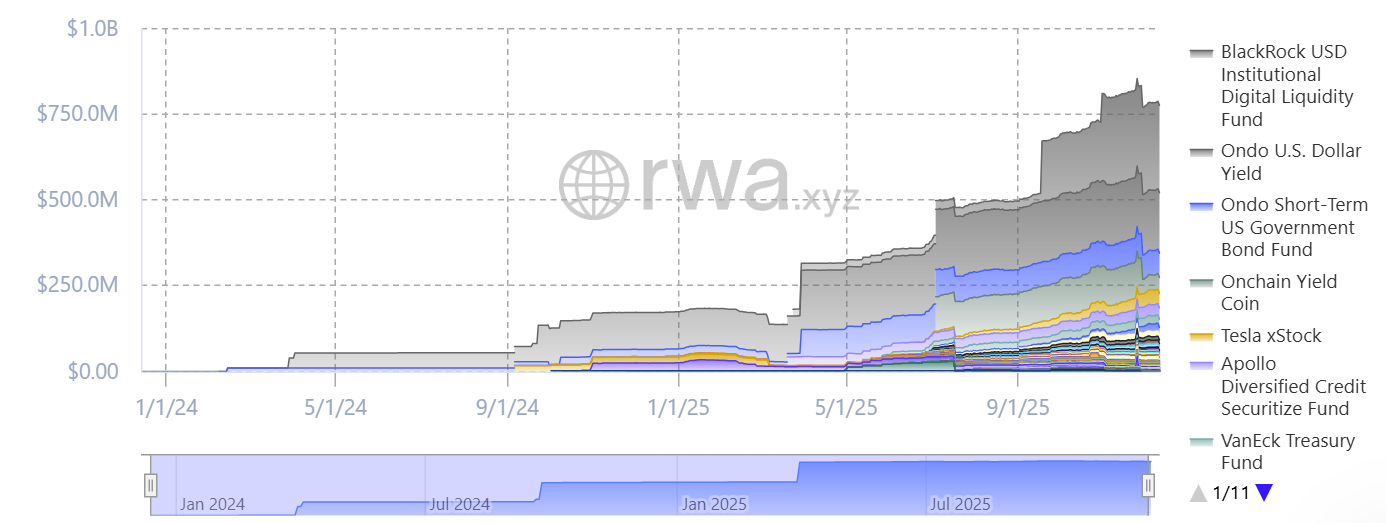
Solana’s RWA metrics, excluding stablecoins. Source: RWA.xyz

Related: Scaramucci predicts ‘exponential opportunity’ for crypto at LONGITUDE

Trending Cryptos

Related Reads

STRC Major De-pegging's First Financial Report, How Will Strategy Repair Its Capital Flywheel?

Bitcoin treasury company Strategy released its Q2 2026 earnings report on July 31. Despite a 6.9% year-over-year revenue increase to $122 million, the company recorded a net loss of $8.22 billion, largely due to $8.32 billion in unrealized losses from Bitcoin price fluctuations. As of quarter-end, Strategy holds 843,775 BTC with an average cost of $75,000 per coin, and Bitcoin per share increased. The report highlights a critical shift in Strategy's capital model following the de-pegging of its key financing tool, STRC (Strategic Coin), which fell below its $100 target. Management's top priority is restoring STRC to its target value, aiming for a recovery by September 8. They rule out discounted STRC issuances and plan to maintain its dividend yield at 12%, instead focusing on bolstering its $3.75 billion cash reserve. Strategy has moved from a one-way "buy-and-hold" Bitcoin strategy to active capital management. This new approach, part of its "Digital Credit Capital Framework," involves flexibly managing its balance sheet across four elements: BTC, USD cash, common stock (MSTR), and digital credit securities like STRC. This allows for BTC monetization (having sold $218.4 million in BTC so far), strategic repurchases of discounted securities, and debt optimization, as seen with a $1.5 billion convertible bond buyback. The company's future hinges on two key tests: successfully re-pegging STRC to restore market confidence in its digital credit system, and a long-term recovery in Bitcoin's price to ultimately support its growth thesis.

marsbit34m ago

STRC Major De-pegging's First Financial Report, How Will Strategy Repair Its Capital Flywheel?

marsbit34m ago

STRC's First Financial Report Post-Depegging, How is Strategy Restoring the Capital Flywheel?

On July 31, 2026, Bitcoin treasury company Strategy released its Q2 financial report. Despite a 6.9% year-over-year increase in revenue to $122 million, the company recorded a substantial net loss of $8.22 billion, primarily due to $8.32 billion in unrealized losses from Bitcoin holdings. While Strategy's core Bitcoin strategy remains intact—its holdings grew 11% to 843,775 BTC—the company is undergoing a fundamental shift in its capital model. Following the de-pegging of its key financing tool, the STRCoin (STRC), from its $100 target in May, Strategy has pivoted from a one-directional "raise funds, buy Bitcoin" cycle to a more dynamic, multi-asset capital management approach. A key part of this new framework is the "Monetization Program," through which Strategy has sold approximately $218.4 million worth of BTC to bolster liquidity. The company's top priority is repairing STRC's peg, committing not to issue discounted shares until it returns to its target range. It has initiated a $1 billion buyback program for discounted digital credit securities, having repurchased $28.9 million face value of STRC so far. Management aims to restore the peg around September 8, 2026. Strategy now actively manages a matrix of assets: Bitcoin (for accumulation or strategic sales), USD cash reserves (now at $3.75 billion), common stock (MSTR), and digital credit securities like STRC. This allows for tactical moves like repurchasing discounted debt or equity to capture value. The future success of Strategy's "capital flywheel" hinges on two factors: the short-term ability to successfully re-peg STRC to restore market confidence in its digital credit system, and the long-term price trajectory of Bitcoin, upon which its entire investment thesis ultimately depends.

Odaily星球日报39m ago

STRC's First Financial Report Post-Depegging, How is Strategy Restoring the Capital Flywheel?

Odaily星球日报39m ago

With Two Consecutive Quarters of Losses, Coinbase Must Rely on Paths Beyond Trading

Coinbase posted its second consecutive quarterly net loss of $359 million on $1.22 billion in revenue for Q2, highlighting its vulnerability to crypto market cycles where weaker prices and lower volatility reduce user trading. However, the report also reveals a strategic shift in its business model. Despite a 25% quarter-over-quarter decline in global spot trading volume, Coinbase increased its market share to a company-record 10.3%. This suggests its position as a compliant U.S. on-ramp is strengthening even in a cooler market. A key development is the diversification of revenue streams. Transaction revenue fell to $599 million, nearly equaling subscription and services revenue of $555 million. Stablecoin services, generating $292 million, are becoming a crucial revenue "floor." This income, derived from interest on the $20 billion average USDC balance held on its platform, is less tied to daily trading activity. Furthermore, while spot trading volume dropped significantly, derivatives volume held steady at $1.03 trillion. Coinbase is pushing to integrate spot, stablecoin, and derivatives liquidity to create a more interconnected and sticky ecosystem for users. The GAAP net loss includes non-cash expenses like stock-based compensation and crypto asset valuation changes. Its adjusted EBITDA remained positive at $208 million for the 14th straight quarter, indicating core operations can cover ongoing costs. The company is also reducing expenses to manage the downturn. The central question moving forward is whether Coinbase's growing market share, stablecoin revenues, and expanding product integration can sufficiently offset the inherent cyclicality of its core trading business during future market contractions.

marsbit54m ago

With Two Consecutive Quarters of Losses, Coinbase Must Rely on Paths Beyond Trading

marsbit54m ago

Trading

Spot

Hot Articles

Discussions

Welcome to the HTX Community. Here, you can stay informed about the latest platform developments and gain access to professional market insights. Users' opinions on the price of SOL (SOL) are presented below.

活动图片