Facing Competition from Fomo, Why is Pump.fun Spending Heavily to 'Poach' and Compete for Trading Volume?

marsbitPublished on 2026-08-13Last updated on 2026-08-13

Abstract

In the competitive meme coin market, Pump.fun and Fomo are battling for dominance in speculative trading. Fomo has seen rapid growth on Robinhood Chain by socializing trading—allowing users to follow traders, view portfolios, and copy trades. However, as Solana remains the core hub for such activity, Pump.fun, which provides much of the underlying infrastructure for platforms like Fomo, is now aggressively moving to capture the front-end user market directly. Pump.fun is employing tactics like offering lucrative contracts to poach top traders from Fomo and implementing a zero-fee front-end policy—subsidies possible due to its profitable bond curve and PumpSwap mechanisms. This creates a complex dynamic where the two are partners in infrastructure but direct competitors for users. The conflict highlights a trend of established crypto infrastructure projects vertically integrating to control consumer-facing applications, similar to Uniswap's moves on Robinhood Chain. The article suggests the ultimate winner may hinge on *trust*. While Fomo promotes transparency, the inherent risk in social trading is that traders can manipulate signals. Pump.fun's aggressive tactics, including the alleged poaching, have also impacted its reputation. The platform that best ensures the authenticity of trading signals and maintains user trust will likely prevail.

Written by: David Christopher

Compiled by: Saoirse, Foresight News

The meme coin battlefield is filled with smoke, as Pump.fun and Fomo vie for industry dominance.

Over the past few weeks, another titan clash has unfolded in the crypto industry: Pump versus Fomo. The arena for their competition is the most widespread product in the crypto market—speculative trading.

Fomo has proven well how quality consumer-facing experiences can shape a trading product. It has socialized, publicized, and trackable trading: users can follow traders, view their holdings, copy trades or take the opposite position, and observe the complete trading process in real-time.

This product design has driven rapid platform growth. Riding the wave of renewed market speculation, Fomo became a core battleground for the meme coin frenzy on Robinhood Chain, with weekly platform fees and trader numbers surging accordingly.
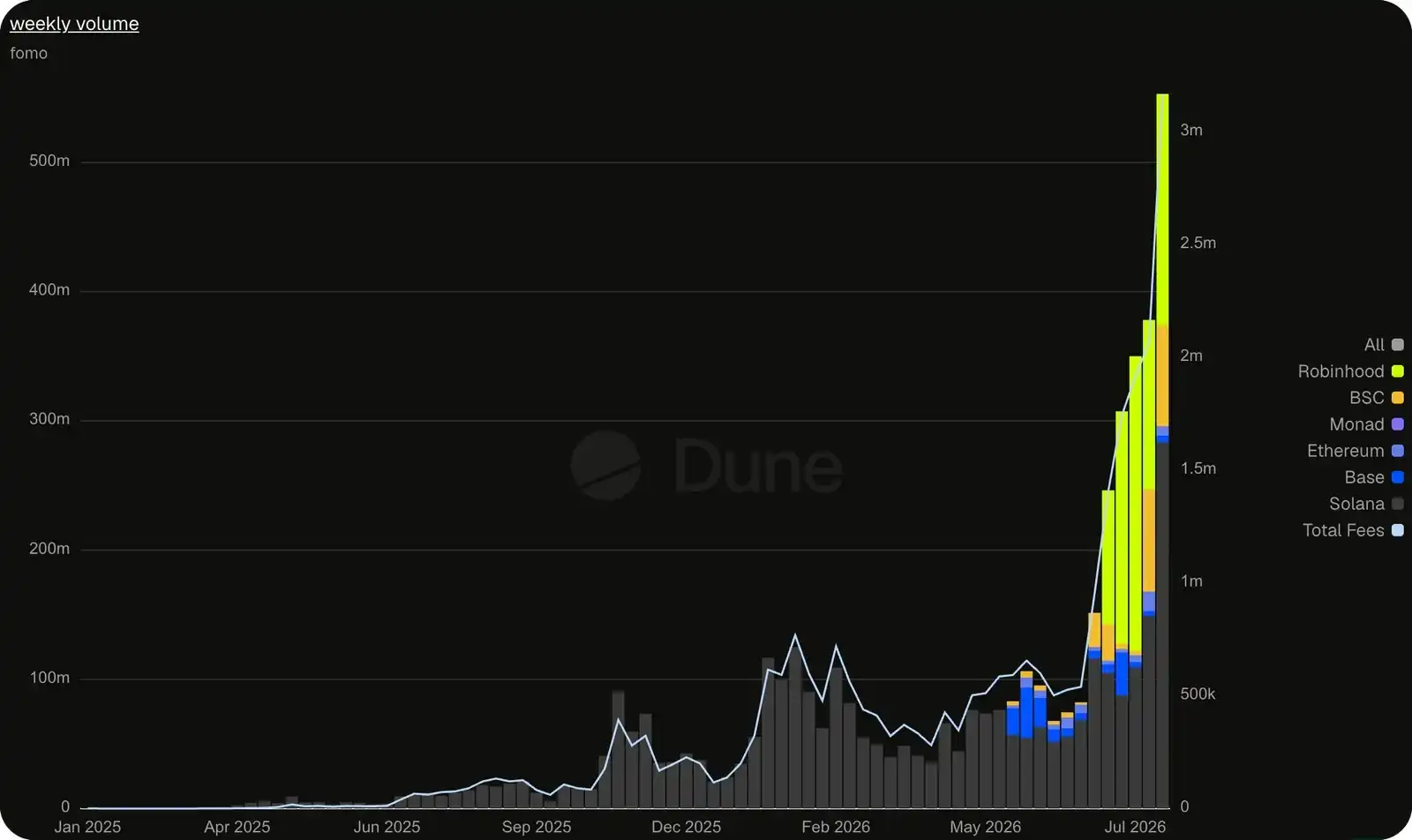
This Dune chart shows Fomo's weekly trading volume: starting with slow growth in early 2025, experiencing an explosive surge after May 2026, with Robinhood Chain being the core driver of volume growth, while total platform fees simultaneously hit record highs.

However, Solana remains the stronghold of speculative trading in the crypto market, and Pump.fun sits at the heart of this arena, unwilling to share the market pie.

Fomo relies on the underlying infrastructure from Pump.fun, achieving rapid growth with a superior front-end interface, essentially acting as a middleman between Solana's speculative infrastructure and the average speculative user. The term 'middleman' here is not derogatory. Fomo has built a product that meets user needs, and the platform's continuous generation of fees proves users are willing to pay for this experience.

But ultimately, most of the features built by Fomo could theoretically be replicated by Pump.fun. We are witnessing this now: Pump.fun is continuously adding numerous social features to its own application, striving to become the 'homepage' for speculative trading.

This creates a delicate dynamic between the two platforms: partners at the underlying infrastructure layer, yet direct competitors in the user-facing market. Fomo holds user traffic, while the infrastructure supporting trade execution mostly belongs to Pump.fun.

Now, Pump.fun wants to capture both the infrastructure and the consumer-facing market layers.

To achieve this goal, Pump.fun is going all out. It is reportedly offering conditions, with contracts worth tens of thousands of dollars per month, to poach top traders from Fomo and attract them to move their trading activities to Pump.fun. This action is not illegal, nor even an industry scandal. Essentially, it's a well-funded platform spending money to attract core users who bring their own traffic.

Beyond this, Pump.fun has also introduced a zero-fee policy for its front-end. It can afford this subsidy because the platform already profits from mechanisms like its bonding curve and PumpSwap; this front-end subsidy model is something Fomo cannot replicate.

Many market participants criticize Fomo for charging fees as a result, but this view misses the core question: what exactly are users paying for?

Users pay for the entire accompanying trading experience: finding traders worth following, viewing their holdings, tracking trade profits, receiving market alerts, and completing all operations through an interface that significantly lowers the barrier to cryptocurrency actions.

Transaction fees are Fomo's core revenue source; the entire user experience is its main business. Pump.fun can offer similar features for free because its underlying business already provides stable income.

In my view, there are two key points worth considering in this matter.

First, this is yet another classic case: mature crypto infrastructure projects are beginning vertical integration upward, competing for end-user traffic. A similar drama is unfolding with Uniswap on Robinhood Chain. After becoming the core on-chain trading infrastructure, Uniswap is promoting its own launchpad, no longer merely serving as an underlying tool for other platforms. Pump.fun is employing the same strategy on Solana: having already captured the underlying infrastructure for speculative trading, it now wants to further control the consumer-facing layer for ordinary users.

Second, I believe the key to the ultimate outcome between Pump.fun and Fomo lies in trust.

Due to its central position in the meme speculation arena, regardless of objectivity, Pump.fun's reputation within the crypto community is mixed. And the rumors of the platform heavily incentivizing trader poaching further damage its image.

In contrast, Fomo launched later, carries less historical baggage, and its product was designed from the outset to make trading behavior more transparent and traceable, focusing on social trading.

But the value of social trading depends entirely on the credibility of the signals traders provide. A trader can publicly buy with one wallet and quietly sell with another; build a position in advance, promote it publicly, and then dump the holdings on followers. While blockchain enables on-chain data transparency, it cannot guarantee that traders themselves are trustworthy.

Ultimately, where users choose to trade depends on which platform can maximize the authenticity of the information displayed. Once traders collude, use multiple hidden wallets to obscure transactions, and harvest their followers, users will lose trust in trading signals. After trust collapses, the value of the social trading layer that both platforms are fiercely competing for will also vanish.

It remains to be seen what measures both platforms will take to maintain user trust going forward.


Trending Cryptos

Related Questions

QWhat are the main strategies that Pump.fun is using to compete with Fomo for trading traffic?

APump.fun is employing two main strategies to compete with Fomo. First, it is reportedly offering lucrative contracts, worth tens of thousands of dollars per month, to attract top traders from Fomo to migrate their trading activity to Pump.fun. Second, it has introduced a zero-fee policy for its front-end interface, a subsidy it can afford due to profits from its underlying infrastructure like bonding curves and PumpSwap, which Fomo cannot replicate as its core revenue comes from transaction fees.

QWhat is the fundamental difference in the business models of Pump.fun and Fomo that allows Pump.fun to offer a zero-fee front-end?

AThe fundamental difference lies in their primary revenue sources. Pump.fun's core business and profitability come from its underlying infrastructure, such as the bonding curve mechanism and PumpSwap, which facilitate token creation and trading. This allows it to subsidize its front-end by offering zero fees. In contrast, Fomo's main business and revenue stream is its user-facing platform and the associated trading experience; transaction fees are essential for its operation, as it does not have the same foundational infrastructure profits to offset such costs.

QAccording to the article, what broader trend in the crypto industry does the competition between Pump.fun and Fomo represent?

AThe competition represents a trend of vertical integration, where mature crypto infrastructure projects begin moving upstream to capture end-user traffic and control the consumer-facing layer. Similar dynamics are seen with Uniswap on Robinhood Chain, which, after becoming core on-chain trading infrastructure, started promoting its own launchpad instead of just serving as a backend tool for other platforms. Pump.fun is following the same playbook on Solana.

QWhat is identified as the ultimate deciding factor for which platform, Pump.fun or Fomo, will win in the long run?

AThe article identifies user trust as the ultimate deciding factor. The value of social trading, which Fomo emphasizes and Pump.fun is replicating, depends entirely on the credibility of the signals traders provide. If traders engage in manipulative practices (like wash trading or hidden wallets), user trust will erode. The platform that can best ensure the authenticity of the information and trading signals displayed will likely gain a decisive advantage.

QHow does Fomo's product design differentiate it in the meme coin trading space, and what is a potential vulnerability of this model?

AFomo differentiates itself by socializing, publicizing, and making trading trackable. Its product allows users to follow traders, view their portfolios, copy trades (or trade against them), and observe the entire trading process in real-time. This superior front-end experience drove its rapid growth. A potential vulnerability of this social trading model is its dependence on trader trustworthiness. The transparency of blockchain data does not prevent traders from acting dishonestly (e.g., using multiple wallets to hide true positions), which could lead to a collapse in user trust and devalue the platform's core offering.

Related Reads

Embodied AI Companies Have Yet to Learn How to Spend Money | TMTpost In-depth

Embodied AI companies in China are facing unprecedented challenges in capital management after a wave of massive funding. The industry, seen as the ultimate carrier for AI, attracted approximately 43.8 billion RMB in the first half of 2026 alone, creating a landscape where even small startups hold billions in cash. However, this influx has exposed a critical gap: many founders—often scientists and engineers—lack experience in deploying such large sums effectively. The article highlights contrasting and often problematic approaches to spending. Some companies practice extreme frugality, drastically limiting R&D, marketing, and even basic operational costs to extend their financial runway, sometimes resorting to living off investment income. This "wait-it-out" strategy, while conserving cash, risks stifling innovation, causing talent drain, and missing crucial product development windows. In one case, excessive cost-cutting led to catastrophic data loss. Conversely, other firms spend recklessly. Examples include a company secretly paying 100 million RMB for ineffective TV exposure, jeopardizing its IPO plans, and others funding multiple unproven product lines simultaneously or creating deceptive demos to attract further investment. The cautionary tale of Vicarious Surgical, which burned through over $100 million on an overly complex proprietary arm before failing, is cited. A core issue is the immense and often opaque cost structure. High salaries for scarce AI talent, exorbitant compute costs for training models (especially "embodied brains" or world models), and the colossal expense of acquiring high-quality robotic training data create financial black holes. Estimates suggest collecting 1 million hours of usable data could cost over 1.6 billion RMB, with most collected data being unusable. This lack of transparency extends to investors, who struggle to verify how funds are actually spent. There are reports of companies maintaining separate internal accounts, engaging in circular "data trading" to artificially boost revenue, and general obfuscation around R&D burn rates. In response, some investors are taking unprecedented control, embedding their own financial personnel to approve even minor expenses. The sector is at a crossroads. While capital continues to flow due to China's strategic advantage in supply chains and engineering, the fundamental question has shifted from securing funding to learning how to spend it wisely. The industry must now master the difficult discipline of allocating vast resources to drive genuine technological progress and sustainable business models, or risk a significant reckoning when the investment tide eventually recedes.

marsbit18m ago

Embodied AI Companies Have Yet to Learn How to Spend Money | TMTpost In-depth

marsbit18m ago

Trading

Spot

Hot Articles

Discussions

Welcome to the HTX Community. Here, you can stay informed about the latest platform developments and gain access to professional market insights. Users' opinions on the price of MEME (MEME) are presented below.

活动图片