Everyone is MicroStrategy: When JPMorgan Starts Accepting BTC as Collateral, Will You Still Sell Your Coins?

marsbitPublished on 2025-12-10Last updated on 2025-12-10

Abstract

The article discusses a major shift on Wall Street, where major banks like JPMorgan, Citi, and Bank of America have reportedly begun accepting Bitcoin as collateral for cash loans. This move, revealed by MicroStrategy's Michael Saylor, signifies Bitcoin's evolution into a "pristine collateral" asset, comparable to U.S. Treasuries or gold. It allows holders to access liquidity without selling their Bitcoin, avoiding capital gains taxes and maintaining exposure to potential price appreciation. This development effectively democratizes the "Buy, Borrow, Die" strategy previously accessible only to large institutions and the ultra-wealthy. It is framed as a critical step in Bitcoin's monetary evolution, enabling credit creation. A "credit flywheel" is described: rising BTC prices increase collateral value, allowing for larger loans, which can be used to purchase more assets, potentially driving prices higher. This shift also suggests a weakening of restrictive regulations like the SEC's SAB 121, transferring power from crypto-native exchanges to traditional financial institutions. The article concludes with a warning about the risks of leverage, as price drops could trigger mass, forced liquidations. It offers advice for investors: adopt a "debt mindset" to use loans for expenses while holding assets, cautiously manage loan-to-value ratios to avoid margin calls, and watch for a resurgence of regulated, compliant CeFi platforms.

Why sell your coins when you can borrow money?

This mantra, once only circulated among crypto whales, has now become the official creed of Wall Street's big six banks.
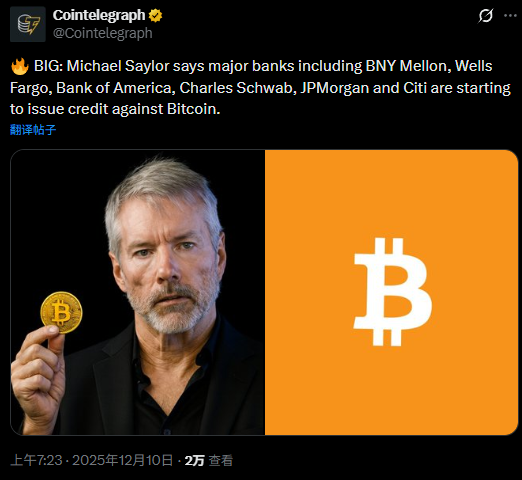
According to MicroStrategy founder Michael Saylor, top financial institutions including JPMorgan, Citi, and Bank of America have quietly launched a revolutionary business: accepting Bitcoin as collateral to provide clients with fiat currency loans.

Don't underestimate this news that didn't make the headlines. If the approval of ETFs meant Bitcoin entered Wall Street's stock accounts, then "accepting collateral" means Bitcoin has entered the core of Wall Street's balance sheets.

This is a qualitative change in monetary nature: Bitcoin is no longer just a chip for trading; it has officially gained the status of "Pristine Collateral," on par with U.S. Treasury bonds and gold. From now on, Bitcoin holders can obtain liquidity without selling a single Satoshi.

A "buy, don't sell" credit flywheel is slowly turning.


Everyone is MicroStrategy

Over the past four years, Michael Saylor has stunned the world with an almost insane strategy: issue debt to buy coins, use coins as collateral to buy more coins, issue more debt, buy more coins.

This "stepping on your own feet to spiral upwards"玩法 had one huge barrier to entry—you had to be a publicly listed company or a billionaire with an extremely high credit rating to borrow money at low interest rates. Ordinary institutions and high-net-worth individuals who wanted to exchange Bitcoin for cash often had to turn to DeFi protocols (facing the risk of contract hacks) or second-tier lending platforms (facing the risk of misuse like FTX), with high interest rates and full of uncertainty.

Now, Wall Street has broken down this barrier.

When JPMorgan and Citi start accepting BTC as collateral, it means they have standardized, productized, and合规化 Saylor's strategy.

Imagine this scenario: a family office holding 1000 BTC, which previously needed $10 million for周转, had to sell part of its Bitcoin, not only paying high capital gains taxes but also losing future upside potential. Now, it only needs to抵押 its Bitcoin to the bank to get $10 million in cash.

  • Tax-wise: A loan is not income, so it is not taxable.
  • Asset-wise: Ownership of the Bitcoin remains in its hands, and it still enjoys the benefits of price appreciation.

This is the common strategy for the wealthy class: "Buy, Borrow, Die." When this strategy is普及 by Wall Street to the entire crypto market, the logic of Bitcoin selling pressure will be completely rewritten: In this market, true diamond hands will no longer need to sell coins.


Credit Expansion: Fiat Flows In Like Water

From a macro perspective, this is also the most critical step in Bitcoin's monetization process: Credit Creation.

In the modern financial system, money is not only printed by central banks but also loaned out by commercial banks. When banks accept real estate as collateral to loan out dollars, real estate participates in the credit expansion of the dollar; when banks accept Bitcoin as collateral to loan out dollars, Bitcoin effectively becomes the anchor for the issuance of "shadow dollars."

This means the flood barrier between the Bitcoin system and the fiat system has been blown open.

In the past, pushing up the Bitcoin price required real "net inflows" of capital. Now, through抵押借贷, Bitcoin itself can create new purchasing power. You抵押 BTC to borrow dollars, and then you can use those dollars to buy more BTC (or buy a house, buy stocks).

This forms a positive Credit Flywheel: Coin price rises ->抵押物 value increases -> Loanable amount increases -> Loan out more fiat -> Buy more assets -> Coin price continues to rise.

As long as Bitcoin's long-term volatility remains controllable within the banks' risk models, this flywheel will introduce astronomical levels of fiat liquidity. This is a more ferocious catalyst than ETF inflows because ETFs are linear capital accumulation, while credit is exponential expansion with leverage.


Regulatory Acquiescence and the Demise of SAB 121

The fact that the big six banks dare to do this is itself a huge political signal.

Remember, the SEC's SAB 121 (Staff Accounting Bulletin No. 121) was once a tight curse. It required banks that custody crypto assets to record those assets on their balance sheets as liabilities, which greatly increased the banks' capital pressure and effectively prohibited banks from engaging in crypto custody.

Now, the fact that Wall Street giants are collectively launching抵押借贷 businesses indicates that SAB 121 is practically dead in terms of implementation, or that banks have found ways to circumvent the regulation (or obtained regulatory exemptions).

This is not surprising. When Bitcoin ETF规模突破千亿美元, Bitcoin has become too big to ignore. Rather than letting these high-value assets flow to crypto-native companies like Coinbase, it's better for "Old Money" to firmly control them through custody and credit业务.

This is a transfer of power. The pricing power and liquidity control of Bitcoin are shifting from exchanges like Binance to the headquarters of JPMorgan in Manhattan.


Risk: The Cruelty of Deleveraging

Of course, the flywheel can spin forward, but it can also reverse.

When we incorporate Bitcoin into the traditional credit system, we also expose Bitcoin to the risks of traditional debt crises.

Although "never selling coins" sounds beautiful, borrowing comes with a清算线 (Margin Call). When the Bitcoin price experiences a sharp correction of 30% or more, the banks' risk control systems will be more冷酷无情 than any DeFi protocol. They will forcibly sell the抵押品 to recover the loan.

This kind of credit-driven rise is often accompanied by an even more brutal deleveraging process. The future Bitcoin market might see reduced volatility due to institutional involvement, but once a systemic crash occurs, its chain reaction will no longer be confined to the crypto circle but could spill over into traditional financial markets.


Investor Survival Guide

Facing this new "creditized" cycle, how should ordinary investors respond?

Learn "Debt Thinking":

  • Your goal used to be "accumulate more coins," then sell them for U.S. dollars when the price rose.
  • Your future goal should be "accumulate more high-quality assets (BTC)," establish a good credit history, learn to use low-interest loans like the wealthy to cover living expenses, and retain the appreciation rights of your assets.

Beware the "Leverage死神":

  • Wall Street can play the "borrowing flywheel" because they have unlimited margin and hedging tools.
  • If ordinary retail investors imitate Saylor's循环抵押 (using抵押 BTC to buy more BTC), be sure to control the Loan-to-Value ratio (LTV). Bitcoin is still a highly volatile asset. It is recommended that LTV never exceed 30%-40%, leaving yourself a safety cushion of more than 50% for price drops. Don't fall to forced liquidation just before dawn.

Pay Attention to the "Return of CeFi":

  • As banks enter the game, centralized lending (CeFi) will experience a second spring, but the protagonists this time are not Celsius or BlockFi, but compliant licensed institutions. Pay attention to those crypto wealth management platforms that have打通 fiat on/off ramps and have deep cooperation with banks, as they might be the new红利入口.


Related Questions

QWhat revolutionary service have top financial institutions like JPMorgan and Citibank started offering, according to the article?

AThey have started accepting Bitcoin as collateral to provide fiat currency loans to clients.

QHow does using Bitcoin as collateral for loans instead of selling it benefit holders from a tax and asset perspective?

ABorrowing against Bitcoin is not considered taxable income, so no taxes are incurred, and the borrower retains ownership of the Bitcoin, allowing them to benefit from any price appreciation.

QWhat is the 'Buy, Borrow, Die' strategy mentioned in the article, and how does it relate to Bitcoin?

AIt is a strategy where individuals buy assets (like Bitcoin), borrow against them for liquidity without selling, and hold the assets indefinitely to avoid capital gains taxes and benefit from long-term appreciation. Wall Street is now making this strategy accessible for Bitcoin holders.

QWhat significant regulatory hurdle (SAB 121) did banks overcome to offer Bitcoin collateralized loans, and what does its bypassing signify?

ASAB 121 required banks to hold crypto assets as liabilities on their balance sheets, increasing capital requirements. Its effective bypassing indicates regulatory acceptance or exemption, allowing traditional banks to integrate Bitcoin into their financial services.

QWhat major risk does the article associate with using Bitcoin in the traditional credit system, particularly during a market downturn?

AThe risk is a brutal deleveraging process where a sharp Bitcoin price drop (e.g., 30%+) triggers margin calls, leading to forced liquidation of collateral by banks, which could cause a systemic crash affecting both crypto and traditional markets.

Related Reads

A 120,000 Yuan Tombstone or 399 Yuan AI Immortality: Which Would You Choose?

"The 'Deathcare Moutai' Fushouyuan, once a highly profitable cemetery operator, has halted trading amid a severe crisis, with its net profit plummeting by 52.8% in 2024. This reflects a broader trend of people rejecting expensive traditional burials, as average grave prices in China have soared to over ¥120,000. In response, the industry is pivoting to digital alternatives, with companies like Fushouyuan offering AI-powered memorial services, such as virtual farewell halls and AI-generated recreations of the deceased. Simultaneously, a low-cost, unregulated AI 'resurrection' industry has emerged online, with services priced as low as ¥399. These often use open-source tools to create crude digital avatars from photos and voice clips, exploiting vulnerable individuals, particularly bereaved parents who have lost their only child. However, these services raise significant ethical and legal concerns, including data privacy risks and potential use in scams. Academic studies warn that such AI companions may exacerbate grief, leading to prolonged mourning disorders and emotional dependency, rather than providing genuine comfort. While regulations are being drafted to manage digital human services, the deep emotional drive to 'reconnect' with loved ones often overshadows rational concerns. Ultimately, the article questions whether digital immortality truly preserves memory or merely offers a commercialized illusion, emphasizing that no technology can replace the real, irreplaceable loss of a human life."

marsbit4m ago

A 120,000 Yuan Tombstone or 399 Yuan AI Immortality: Which Would You Choose?

marsbit4m ago

Anthropic Starts Poaching Scientists? $27K Weekly Onsite Stipend to Fix Claude's Expert-Level Errors

Anthropic has launched a new STEM Fellow program, offering $3,800 per week for a three-month, in-person residency in San Francisco. The role targets experts from science, technology, engineering, and mathematics (STEM) fields—machine learning experience is helpful but not required. Instead, Anthropic values scientific judgment and a willingness to learn quickly. Fellows will work with Claude models and internal tools under the guidance of an Anthropic researcher. Example projects include a materials scientist identifying errors in Claude’s reasoning or a climate scientist integrating atmospheric modeling software with Claude. The goal is to have experts "tell Claude where it's wrong" and improve its scientific capabilities. This initiative is part of Anthropic’s broader strategy to strengthen its scientific ecosystem, following earlier programs like the AI Safety Fellows and AI for Science programs. The company acknowledges that current AI models, while powerful, still produce high-confidence errors and lack end-to-end research autonomy. The program aims to embed domain expertise directly into model development, turning scientists into "high-level reviewers" for AI. Anthropic CEO Dario Amodei has previously emphasized AI’s potential to accelerate scientific breakthroughs, particularly in biology and healthcare. The company believes that the next phase of AI competition will depend not on scaling parameters, but on integrating human expertise to refine model accuracy and reliability.

marsbit55m ago

Anthropic Starts Poaching Scientists? $27K Weekly Onsite Stipend to Fix Claude's Expert-Level Errors

marsbit55m ago

Trading

Spot
Futures

Hot Articles

What is $BITCOIN

DIGITAL GOLD ($BITCOIN): A Comprehensive Analysis Introduction to DIGITAL GOLD ($BITCOIN) DIGITAL GOLD ($BITCOIN) is a blockchain-based project operating on the Solana network, which aims to combine the characteristics of traditional precious metals with the innovation of decentralized technologies. While it shares a name with Bitcoin, often referred to as “digital gold” due to its perception as a store of value, DIGITAL GOLD is a separate token designed to create a unique ecosystem within the Web3 landscape. Its goal is to position itself as a viable alternative digital asset, although specifics regarding its applications and functionalities are still developing. What is DIGITAL GOLD ($BITCOIN)? DIGITAL GOLD ($BITCOIN) is a cryptocurrency token explicitly designed for use on the Solana blockchain. In contrast to Bitcoin, which provides a widely recognized value storage role, this token appears to focus on broader applications and characteristics. Notable aspects include: Blockchain Infrastructure: The token is built on the Solana blockchain, known for its capacity to handle high-speed and low-cost transactions. Supply Dynamics: DIGITAL GOLD has a maximum supply capped at 100 quadrillion tokens (100P $BITCOIN), although details regarding its circulating supply are currently undisclosed. Utility: While precise functionalities are not explicitly outlined, there are indications that the token could be utilized for various applications, potentially involving decentralized applications (dApps) or asset tokenization strategies. Who is the Creator of DIGITAL GOLD ($BITCOIN)? At present, the identity of the creators and development team behind DIGITAL GOLD ($BITCOIN) remains unknown. This situation is typical among many innovative projects within the blockchain space, particularly those aligning with decentralized finance and meme coin phenomena. While such anonymity may foster a community-driven culture, it intensifies concerns about governance and accountability. Who are the Investors of DIGITAL GOLD ($BITCOIN)? The available information indicates that DIGITAL GOLD ($BITCOIN) does not have any known institutional backers or prominent venture capital investments. The project seems to operate on a peer-to-peer model focused on community support and adoption rather than traditional funding routes. Its activity and liquidity are primarily situated on decentralized exchanges (DEXs), such as PumpSwap, rather than established centralized trading platforms, further highlighting its grassroots approach. How DIGITAL GOLD ($BITCOIN) Works The operational mechanics of DIGITAL GOLD ($BITCOIN) can be elaborated on based on its blockchain design and network attributes: Consensus Mechanism: By leveraging Solana’s unique proof-of-history (PoH) combined with a proof-of-stake (PoS) model, the project ensures efficient transaction validation contributing to the network's high performance. Tokenomics: While specific deflationary mechanisms have not been extensively detailed, the vast maximum token supply implies that it may cater to microtransactions or niche use cases that are still to be defined. Interoperability: There exists the potential for integration with Solana’s broader ecosystem, including various decentralized finance (DeFi) platforms. However, the details regarding specific integrations remain unspecified. Timeline of Key Events Here is a timeline that highlights significant milestones concerning DIGITAL GOLD ($BITCOIN): 2023: The initial deployment of the token occurs on the Solana blockchain, marked by its contract address. 2024: DIGITAL GOLD gains visibility as it becomes available for trading on decentralized exchanges like PumpSwap, allowing users to trade it against SOL. 2025: The project witnesses sporadic trading activity and potential interest in community-led engagements, although no noteworthy partnerships or technical advancements have been documented as of yet. Critical Analysis Strengths Scalability: The underlying Solana infrastructure supports high transaction volumes, which could enhance the utility of $BITCOIN in various transaction scenarios. Accessibility: The potential low trading price per token could attract retail investors, facilitating wider participation due to fractional ownership opportunities. Risks Lack of Transparency: The absence of publicly known backers, developers, or an audit process may yield skepticism regarding the project's sustainability and trustworthiness. Market Volatility: The trading activity is heavily reliant on speculative behavior, which can result in significant price volatility and uncertainty for investors. Conclusion DIGITAL GOLD ($BITCOIN) emerges as an intriguing yet ambiguous project within the rapidly evolving Solana ecosystem. While it attempts to leverage the “digital gold” narrative, its departure from Bitcoin's established role as a store of value underscores the need for a clearer differentiation of its intended utility and governance structure. Future acceptance and adoption will likely depend on addressing the current opacity and defining its operational and economic strategies more explicitly. Note: This report encompasses synthesised information available as of October 2023, and developments may have transpired beyond the research period.

363 Total ViewsPublished 2025.05.13Updated 2025.05.13

What is $BITCOIN

Discussions

Welcome to the HTX Community. Here, you can stay informed about the latest platform developments and gain access to professional market insights. Users' opinions on the price of BTC (BTC) are presented below.

活动图片