Ethereum Vs. Solana: Why BlackRock’s Former Crypto Head Is Betting On ETH

bitcoinistPublished on 2026-01-27Last updated on 2026-01-27

Abstract

In a comparison between Ethereum and Solana, Joseph Chalom, former BlackRock digital assets head and current SharpLink CEO, argues that Ethereum is the clear choice for high-value institutional use cases. He emphasizes that while Solana offers speed and low fees, Ethereum’s superior trust, security, and liquidity make it the preferred platform for serious financial applications like asset tokenization and large-scale settlements. Chalom points to market data showing that over 65% of stablecoin and tokenized asset activity occurs on Ethereum—roughly ten times more than on Solana—and notes this gap is widening. He acknowledges Solana’s strengths in areas like memecoins and gaming, where lower security and higher speed are acceptable. However, for institutional-grade applications requiring reliability, he states that "people are voting with their feet" by building on Ethereum. Notably, SharpLink itself holds significant Ethereum reserves, with public records showing around 864,840 ETH (approx. $2.5B).

SharpLink CEO Joseph Chalom, who previously led BlackRock’s digital assets strategy, framed the Ethereum-versus-Solana debate as a mismatch between narrative and actual institutional behavior: TradFi firms may praise speed and low fees, but the highest-value financial use cases are gravitating to networks optimized for trust, security, and liquidity.

Why Ethereum Beats Solana

Speaking with CoinDesk’s Jennifer Sanasie on Jan. 26, Chalom said he would avoid positioning his view as opinion and instead point to what he called observable market signals. “Maybe I’ll just share facts,” he said. “The fact is that Ethereum has been around for 10 years. It’s the secure, trusted, and liquid ecosystem. And I talk about both the layer 1 mainnet as well as the long set of layer 2s who help do that rollup strategy.”

That longevity, in his telling, matters because institutions aren’t selecting chains the way consumers pick apps. They’re selecting settlement rails for moving money, tokenizing assets, and representing ownership, workflows where operational failure and security assumptions are existential. Solana, Chalom acknowledged, has carved out a reputation for performance. But he drew a hard line on reliability. “Solana has been fast and cheap but it has not been secure. It has had downtime,” he said, arguing that downtime risk is disqualifying for “high value projects.”

Chalom’s thesis is that when the use case is “tokenizing assets” and “moving money,” the decision criteria compress into three buckets. “The real institutions who care only about three things,” he said, are “trust, security, and liquidity.” On that basis, he argued, “they’re building on Ethereum for high value projects,” adding: “It’s happening on Ethereum.”

He also anchored the comparison in stablecoin and tokenized-asset activity, citing a sharp share gap as evidence of where the market is allocating serious volume. “More than 65% of stablecoins and tokenized assets are happening there,” Chalom said, describing that as “10x what you see on Salana.” He reinforced the directional claim immediately after: “Ethereum leads in high quality assets in DeFi, tokenization, and stable coins by a factor of 10 to one over Salana. And that gap is only getting larger.”

Still, Chalom did not argue for a single-chain world. Instead, he mapped Ethereum and Solana to different product surfaces based on security tolerance. “I do think there’s a role for cheap, fast, less secure chains,” he said, and suggested Solana’s comparative advantage shows up where finality speed and cost trump institutional-grade assurances. “I think Solana will win in the memecoin, maybe the gaming space where actually security matters a lot less and speed matters more.”

The subtext is a segmentation story: Ethereum as the default rail for high-value, regulated, reputation-sensitive flows; Solana as the venue for high-throughput consumer and speculative activity where users accept different risk tradeoffs. Chalom insisted this is not about persuasion so much as migration patterns. “It’s not my perspective,” he said. “People are voting with their feet.”

Notably, SharpLink Gaming (Nasdaq: SBET) has emerged as one of the largest corporate ETH holders, with public trackers putting its holdings at roughly 864,840 ETH (about $2.5B at recent marks).

At press time, ETH traded at $2,921.
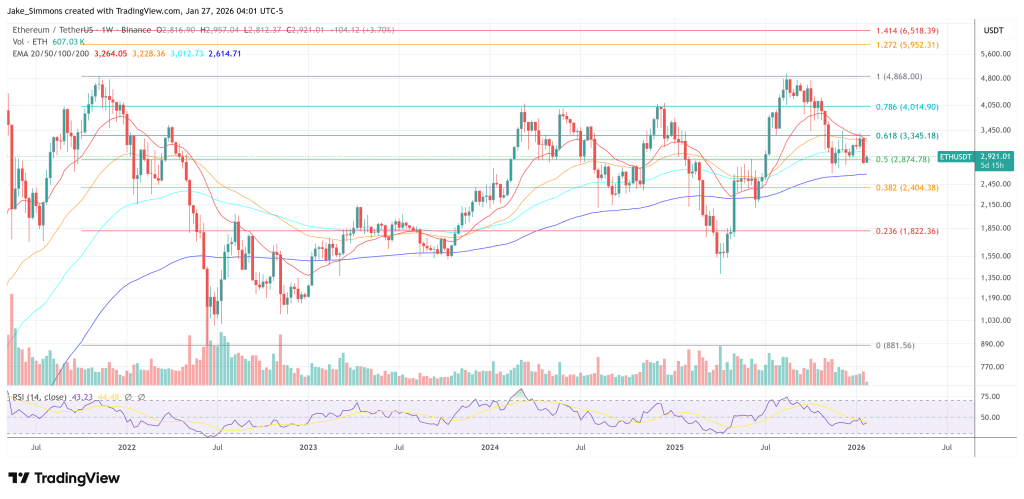
ETH recover back above the 0.5 Fib, 1-week chart | Source: ETHUSDT on TradingView.com

Trending Cryptos

Related Questions

QAccording to Joseph Chalom, what are the three key criteria that institutions prioritize when selecting a blockchain for high-value projects?

ATrust, security, and liquidity.

QWhat percentage of stablecoins and tokenized assets does Chalom claim are happening on Ethereum, and how does this compare to Solana?

AMore than 65% are on Ethereum, which he describes as 10 times the volume seen on Solana.

QWhat specific use cases does Chalom believe Solana is better suited for, despite its perceived shortcomings in security?

AMemecoin and gaming, where speed and low cost are more important than institutional-grade security.

QHow does Chalom frame the fundamental difference in how institutions choose a blockchain versus how consumers choose applications?

AInstitutions are selecting settlement rails for moving money and tokenizing assets, where operational failure is an existential risk, not just picking apps based on features.

QWhat is the evidence provided in the article that SharpLink Gaming is putting its money behind its thesis on Ethereum?

ASharpLink Gaming is one of the largest corporate ETH holders, with public trackers showing holdings of roughly 864,840 ETH (worth about $2.5 billion).

Related Reads

US Treasury Secretary Bement Claims: The US Will Soon Control 80% of Global Computing Power

U.S. Treasury Secretary Ben Sent proclaimed that America is poised to control 80% of the world's computing power, positioning compute dominance as a core pillar of U.S. economic strategy. Speaking on the Mike Rowe show, he stated the U.S. currently holds 50-60% of global compute share, with expectations to reach 80% soon. He framed this as a strategic competition the U.S. "cannot afford to lose," warning that a rival's lead would grant "unacceptable" strategic leverage, while asserting a current one-year AI lead. This high-level policy endorsement is seen as a direct boost for AI infrastructure investment, benefiting chipmakers like NVIDIA and cloud providers' capex cycles. Sent positioned AI compute, semiconductors, and quantum computing as three pillars of national economic strength and security. He defended AI's societal impact, citing historical tech shifts, and argued AI empowers small businesses without causing net job loss so far. He highlighted government efforts to deepen public-private AI cybersecurity cooperation. For investors, the statement signals sustained U.S. policy support for AI infrastructure. However, analysts urge caution, noting "compute share" lacks a standard public metric; the 80% figure is a forecast, not audited data. They recommend focusing on tangible indicators like physical capacity expansion and power infrastructure, with future semiconductor and cloud reports providing key verification data.

marsbit2m ago

US Treasury Secretary Bement Claims: The US Will Soon Control 80% of Global Computing Power

marsbit2m ago

France Cracks Down Hard on Polymarket, 30 Countries Follow, Forcing EU to Redefine Prediction Markets

French gambling regulator ANJ has ordered nationwide ISP blocking of Polymarket, a crypto-based prediction market platform, escalating a four-year regulatory battle. ANJ classified it as illegal gambling rather than an unlicensed crypto exchange, focusing on consumer harm instead of financial market risks. This distinction carries significant legal implications and may influence other EU regulators. Despite a 2024 ban on financial transactions, Similarweb data showed over 205,000 unique French visitors in June 2026, prompting the site-blocking order. Investigations cite alleged weather data manipulation affecting contracts and a trader ("Fredi9999") suspected of manipulating odds for the 2024 US election. ANJ justifies the ban by highlighting the platform's lack of mandatory consumer protection features like betting limits and self-exclusion tools. Over 30 countries have restricted Polymarket. As the largest EU economy, France's move sets a potential precedent. Its classification conflicts with the EU's MiCA framework, which treats such markets as crypto assets. If adopted EU-wide, this could lead to blanket bans under gambling laws, diverging from the financial regulatory path taken by compliant platforms like US-based Kalshi. The effectiveness of France's block and the outcome of related legal cases will be closely watched by other EU members.

Foresight News21m ago

France Cracks Down Hard on Polymarket, 30 Countries Follow, Forcing EU to Redefine Prediction Markets

Foresight News21m ago

Trading

Spot

Hot Articles

Discussions

Welcome to the HTX Community. Here, you can stay informed about the latest platform developments and gain access to professional market insights. Users' opinions on the price of ETH (ETH) are presented below.

活动图片