Ethereum Unveils Post-Quantum Security Roadmap For Institutions

bitcoinistPublished on 2026-03-24Last updated on 2026-03-24

Abstract

Ethereum has publicly formalized its post-quantum security roadmap, targeting a critical threat to its cryptographic foundations. Presented at the Institutional Ethereum Forum, researcher Will Corcoran outlined the risks quantum computers pose to elliptic-curve cryptography, which secures validator attestations, transactions, and wallet signatures. The core challenge is not just replacing signatures but managing the trade-offs: the proposed hash-based scheme, LeanSig, is significantly larger than current BLS signatures, threatening bandwidth and decentralization if naively implemented. Ethereum's solution pairs LeanSig with a STARK-based aggregation engine called Lean Multisig to compress signature data, making it viable. With a cryptographically relevant quantum computer estimated by 2032, Ethereum is targeting key upgrades for its 2029 hard fork. The effort, involving extensive research and testing, is positioned to set a new industry standard for all proof-of-stake blockchains facing this unavoidable scaling problem.

Ethereum is beginning to formalize its post-quantum security push in public. ETH Foundation researcher Will Corcoran used a presentation at the Institutional Ethereum Forum in New York to lay out both the threat model and the protocol work already underway. The effort matters well beyond ETH, he argued, because the core bottleneck is not unique to one chain: every proof-of-stake network built on today’s cryptographic assumptions will eventually face the same scaling problem.

Alongside the talk, the Ethereum Foundation launched pq.ethereum.org, a new portal that packages the project’s roadmap, technical resources, FAQs for institutions, and a registration form for a post-quantum retreat in Cambridge in October 2026. Corcoran framed the site as a way to consolidate years of research and answer what he described as growing inbound interest from institutions asking how Ethereum plans to prepare for a future in which quantum computers can break elliptic-curve cryptography.

Ethereum Eyes Post-Quantum Industry Standard

That future is still projected to be years away, but Corcoran said Ethereum is already working against a tight window. He pointed to current estimates for “Q-Day”: the arrival of a cryptographically relevant quantum computer, clustering around 2032, while the current roadmap targets key post-quantum components for the protocol’s “L” or “M” fork, roughly around 2029.

The presentation’s core argument was that post-quantum security cannot be reduced to a simple signature swap. Ethereum today relies on elliptic-curve cryptography across the stack: validator attestations at the consensus layer, blob proof data at the data layer, and transaction and wallet signatures at the execution layer. If that cryptography is broken, large parts of the network’s security model break with it.

But replacing it introduces a second-order problem. Ethereum’s current BLS signatures are compact and aggregate extremely efficiently: 10,000 signatures still compress to 96 bytes. The proposed post-quantum replacement, a hash-based scheme Corcoran called Lean Sig, is around 3,000 bytes per signature, and naively aggregating them would produce roughly 30 megabytes of data per slot.

That tradeoff is not merely an engineering inconvenience. Corcoran repeatedly tied it back to Ethereum’s decentralization constraint, arguing that bigger signatures would raise bandwidth requirements, reduce the number of viable home validators, and weaken the chain’s security properties. In his telling, the entire design challenge is downstream from that point.

“So making Ethereum post quantum secure isn’t just as simple as swapping out the signature schemes because that one change cascades through everything else,” he said. “Bigger signatures would result in more bandwidth that would result in fewer home validators, less decentralization, and weaker security guarantees. So that one change cascades through everything.”

Ethereum’s proposed answer is a pairing of LeanSig with a proving system called Lean Multisig, which Corcoran described as a STARK-based aggregation engine. Instead of forwarding all of the signatures directly, the system aims to prove that they were verified correctly and compress the output to around 125 kilobytes. He called that roughly 250x compression “the moon math” that makes post-quantum consensus viable on Ethereum.

Corcoran also used the talk to stress that this is no longer a purely theoretical research thread. He said Ethereum is already running devnets with 10 client teams, has shipped four devnets so far, and is building around three-slot finality and four-second slots as a design basis. The broader effort, he added, spans more than eight years of research, about $25 million in funding, and roughly 1,500 contributors across more than 250 organizations and teams.

For Ethereum, the immediate message is that post-quantum readiness is becoming a visible part of its long-range protocol agenda. For the rest of crypto, Corcoran’s claim was broader.

“Really, every proof of stake blockchain faces the same challenge, and that challenge is the ability to aggregate at scale hash based signatures. It’s nonnegotiable,” he said. “When we succeed in shipping LeanSig and LeanMultisig and Lean consensus, we think that this could really become the de facto industry standard.”

At press time, ETH traded at $2,154.
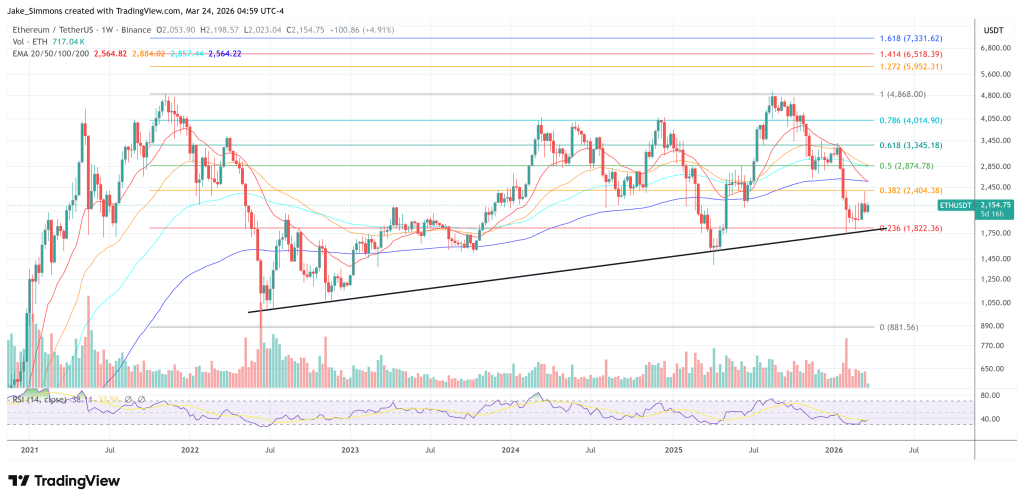
ETH must break above the 0.382 Fib, 1-week chart | Source: ETHUSDT on TradingView.com

Trending Cryptos

Related Questions

QWhat is the main purpose of Ethereum's new portal pq.ethereum.org?

AThe portal pq.ethereum.org packages the project's post-quantum roadmap, technical resources, FAQs for institutions, and a registration form for a post-quantum retreat in Cambridge in October 2026. It serves to consolidate years of research and address growing institutional interest in Ethereum's quantum preparedness.

QWhy can't Ethereum simply swap its current BLS signatures with a post-quantum alternative?

AA simple signature swap is insufficient because the proposed post-quantum replacement, LeanSig, is significantly larger (around 3,000 bytes per signature vs. BLS's 96 bytes for 10,000 signatures). This size increase would drastically raise bandwidth requirements, reduce the number of viable home validators, and weaken the network's decentralization and security.

QWhat is the estimated timeline for 'Q-Day' and how does it relate to Ethereum's development schedule?

ACurrent estimates for 'Q-Day' (the arrival of a cryptographically relevant quantum computer) cluster around 2032. Ethereum's roadmap targets key post-quantum components for its 'L' or 'M' fork, which is roughly scheduled for around 2029.

QWhat two technologies form the core of Ethereum's proposed post-quantum solution?

AThe core technologies are LeanSig, a hash-based signature scheme, and Lean Multisig, a STARK-based aggregation engine that compresses the verification of multiple signatures to around 125 kilobytes, achieving roughly 250x compression.

QAccording to the researcher, why is Ethereum's post-quantum challenge relevant to the broader crypto industry?

AThe researcher argues that every proof-of-stake blockchain faces the same fundamental challenge: the need to aggregate hash-based signatures at scale. He believes that if Ethereum succeeds with its LeanSig and LeanMultisig solution, it could become the de facto industry standard for post-quantum security.

Related Reads

In Conversation with Ray Dalio: We Are Currently in an AI Bubble, with 1% of My Portfolio in Bitcoin

Ray Dalio, founder of Bridgewater Associates, warns in an interview that the current AI boom shows classic bubble characteristics, which could lead to significant economic downturns as seen in past cycles like 1929 or 2000. He explains that speculative enthusiasm, fueled by debt and overvaluation, often precedes a crash when rising rates or taxation force asset sales, causing widespread losses and recession. Dalio also outlines his "Big Cycle" theory, describing an approximate 80-year pattern where widening wealth gaps, massive government deficits, and shifting geopolitical power (like China's rise) create internal conflict and global instability. He emphasizes that we are in a late-cycle, transitional phase where traditional powers like the US and UK face decline. For personal wealth protection, Dalio advises diversification beyond cash into assets like stocks, bonds, real estate, and particularly gold, which he prefers over Bitcoin. While he holds about 1% of his portfolio in Bitcoin as a non-printable hard asset, he views gold as more secure from technological or governmental threats. Regarding AI's impact, Dalio believes it will disproportionately benefit capital owners, worsening inequality by replacing both physical and cognitive labor. He suggests that human intuition and emotional intelligence, combined with AI, will be key for future workers. On taxation, Dalio argues that wealth taxes are impractical and risk triggering asset sell-offs, reducing productive investment. He points to the UK as a cautionary example of debt, low productivity, and political strife. Geopolitically, Dalio foresees a more regionalized world, with the US showing weakness in prolonged conflicts like with Iran, akin to past imperial declines. The ideal outcome, he suggests, is coexisting powerful blocs (e.g., Americas, China-Asia Pacific) without major war.

marsbit55m ago

In Conversation with Ray Dalio: We Are Currently in an AI Bubble, with 1% of My Portfolio in Bitcoin

marsbit55m ago

Daily 7.2 Trillion KRW: Foreign Capital's Record Net Buying on Friday! Wall Street Says Headwinds for Korean Stock Fund Flows Have Subsided

South Korean stock market sees a dramatic shift in fund flows. On July 31, foreign investors made a record net purchase of approximately KRW 7.2 trillion in KOSPI stocks, marking a fundamental reversal from the persistent large-scale net outflows seen in previous months. This contributed to a significant narrowing of foreign net selling in July to KRW 9.8 trillion, down sharply from KRW 48.4 trillion in June and KRW 44.5 trillion in May. Simultaneously, domestic institutional pressure eased. South Korean pension funds and asset managers turned to a net buying position in July, purchasing KRW 1.0 trillion worth of KOSPI shares, contrasting with net sales in May and June. Market volatility is expected to be dampened by new financial regulations. Effective July 31, the Financial Services Commission tightened access for retail investors to single-stock leveraged ETFs by raising the minimum cash deposit requirement. Trading volumes for these products subsequently dropped to about 50% of their monthly average. Citigroup Research maintains its year-end KOSPI target of 10,000 points. The firm cites several supportive factors: the substantial easing of headwinds from capital outflows, a robust fundamental outlook for the semiconductor sector, historically low market valuations, strong economic fundamentals, and the potential for policy support from financial authorities if needed.

marsbit55m ago

Daily 7.2 Trillion KRW: Foreign Capital's Record Net Buying on Friday! Wall Street Says Headwinds for Korean Stock Fund Flows Have Subsided

marsbit55m ago

Thanks to Dice Rolls, Bitcoin Keys Are Stored Offline, But Not Everyone Will Do It

The article discusses using dice rolls to generate secure Bitcoin wallet seeds, providing entropy independent of potentially flawed hardware random number generators. It explains that each fair dice roll offers about 2.585 bits of entropy, with around 50 rolls needed for a standard 12-word seed phrase and 99+ recommended for higher security. This method gained attention after a vulnerability was revealed in some Coldcard hardware wallets, where a faulty firmware RNG (dating back to 2021) compromised generated keys. The analysis notes that while a dice-generated main seed was safe from this specific flaw, other Coldcard functions (like creating paper wallets, backup keys, or passwords) could still be vulnerable if they used the defective RNG. The piece argues that while dice-based entropy is technically robust, the manual process is error-prone, tedious, and unrealistic for most new users, who might make mistakes in recording or inputting rolls. It concludes that while manual entropy generation should remain an option for advanced users, the long-term goal is to develop reliable, user-friendly hardware and software that securely generates randomness without requiring specialized knowledge. Coldcard users are advised to check their firmware version and replace any secondary secrets (like paper wallet keys) created with vulnerable devices, while also considering multi-signature setups with devices from different manufacturers for added security.

cryptonews.ru6h ago

Thanks to Dice Rolls, Bitcoin Keys Are Stored Offline, But Not Everyone Will Do It

cryptonews.ru6h ago

Trading

Spot

Hot Articles

Discussions

Welcome to the HTX Community. Here, you can stay informed about the latest platform developments and gain access to professional market insights. Users' opinions on the price of ETH (ETH) are presented below.

活动图片















