Ethereum sees 745K ETH locked for staking – Will ETH react this time?

ambcryptoPublished on 2025-12-31Last updated on 2025-12-31

Abstract

Ethereum is showing signs of recovery with significant shifts in supply and demand dynamics. Staking inflows turned positive for the first time in six months, with over 745,000 ETH queued for staking compared to only 360,000 awaiting exit. Exchange balances are declining at the fastest rate this cycle, indicating reduced selling pressure. On-chain activity remains strong, with smart contract deployments hitting record highs and Real World Asset (RWA) value on Ethereum reaching nearly $19 billion. Institutional interest is growing. BlackRock’s Spot Ethereum ETF (ETHA) has seen substantial accumulation, with holders heavily leaning long—486 long positions versus just 1 short. Despite cautious market sentiment, firms like Trend Research have increased their exposure, purchasing 46,000 ETH in a single day. From a technical perspective, Ethereum’s price is consolidating below the mid-Bollinger Band with neutral momentum indicators. However, the $2,800–$2,900 zone has held as short-term support, absorbing downward pressure. Broader market trends will likely determine the next significant price move.

Ethereum has been building itself back up.

After a long period of weak price movements and wobbly ETF flows, things are starting to change. Staking inflows have turned positive for the first time in six months, and institutions are making moves.

Supply-demand changes are starting to show

Exchange Balances have fallen at the fastest pace this cycle, while Staking Inflows turned positive for the first time in six months. Over 745,000 ETH are now queued for staking, versus roughly 360,000 ETH waiting to exit.

There is huge confidence in the long-term potential.

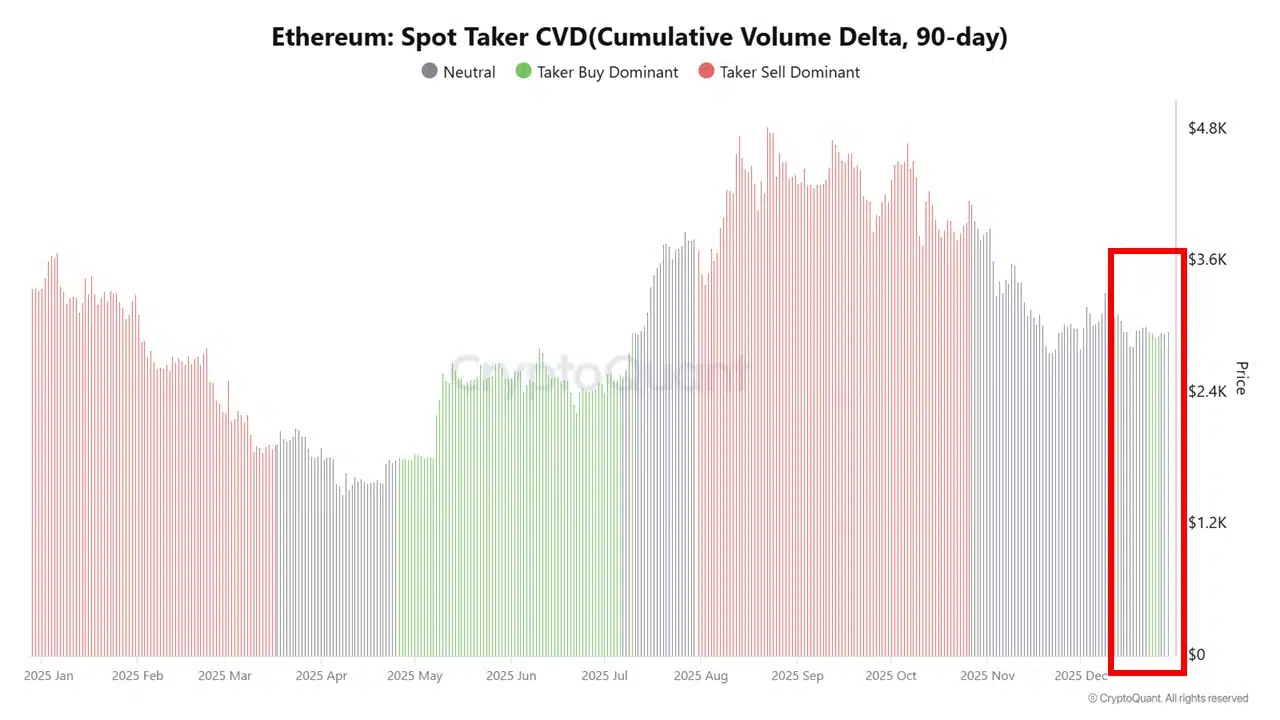
Source: CryptoQuant

The 90-day Spot Taker CVD showed sell pressure falling to neutral territory, so aggressive selling is losing pace.

While ETF flows remained negative, on-chain numbers look different. Smart contract deployments just hit record highs, and RWA value on Ethereum has climbed to nearly $19B.

There’s real usage backing it all.

Big players are ready!

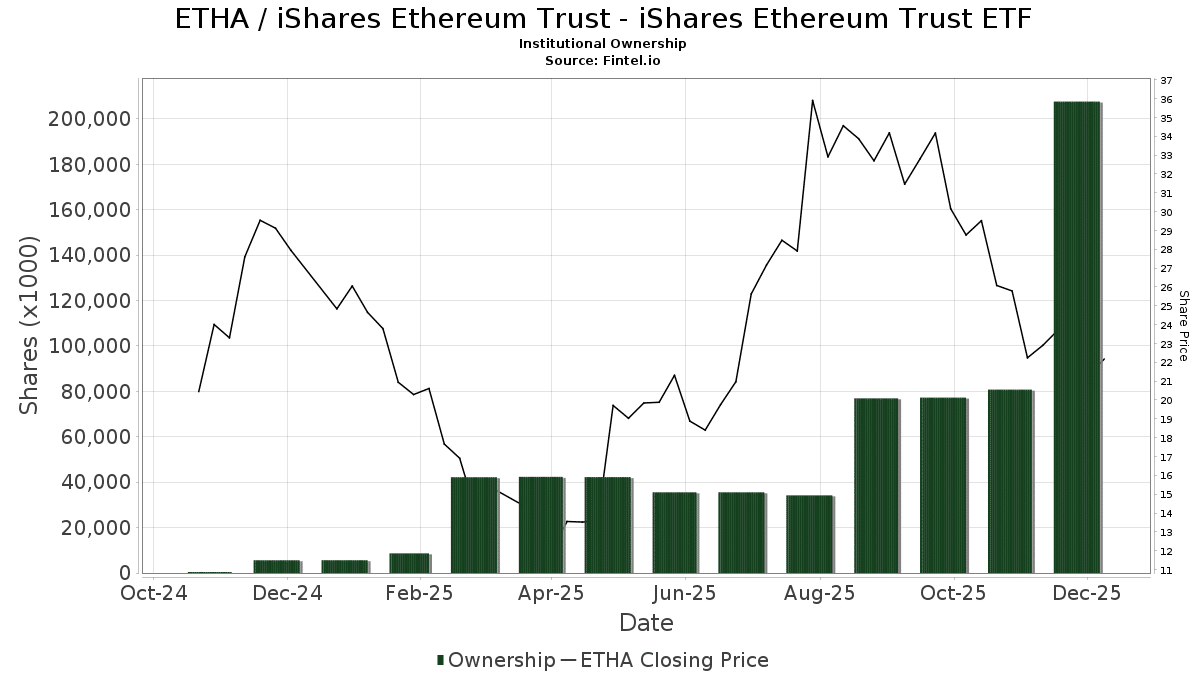
Institutional flows are confirming the stability. Despite weak price action, ETHA (BlackRock’s Spot Ethereum ETF) have been picked up in large numbers.

Source: X

These holders now lean heavily long, with 486 long positions versus just 1 short. This is despite the cautious outlook. There’s been steady growth in ETHA ownership through late 2025.

Source: X

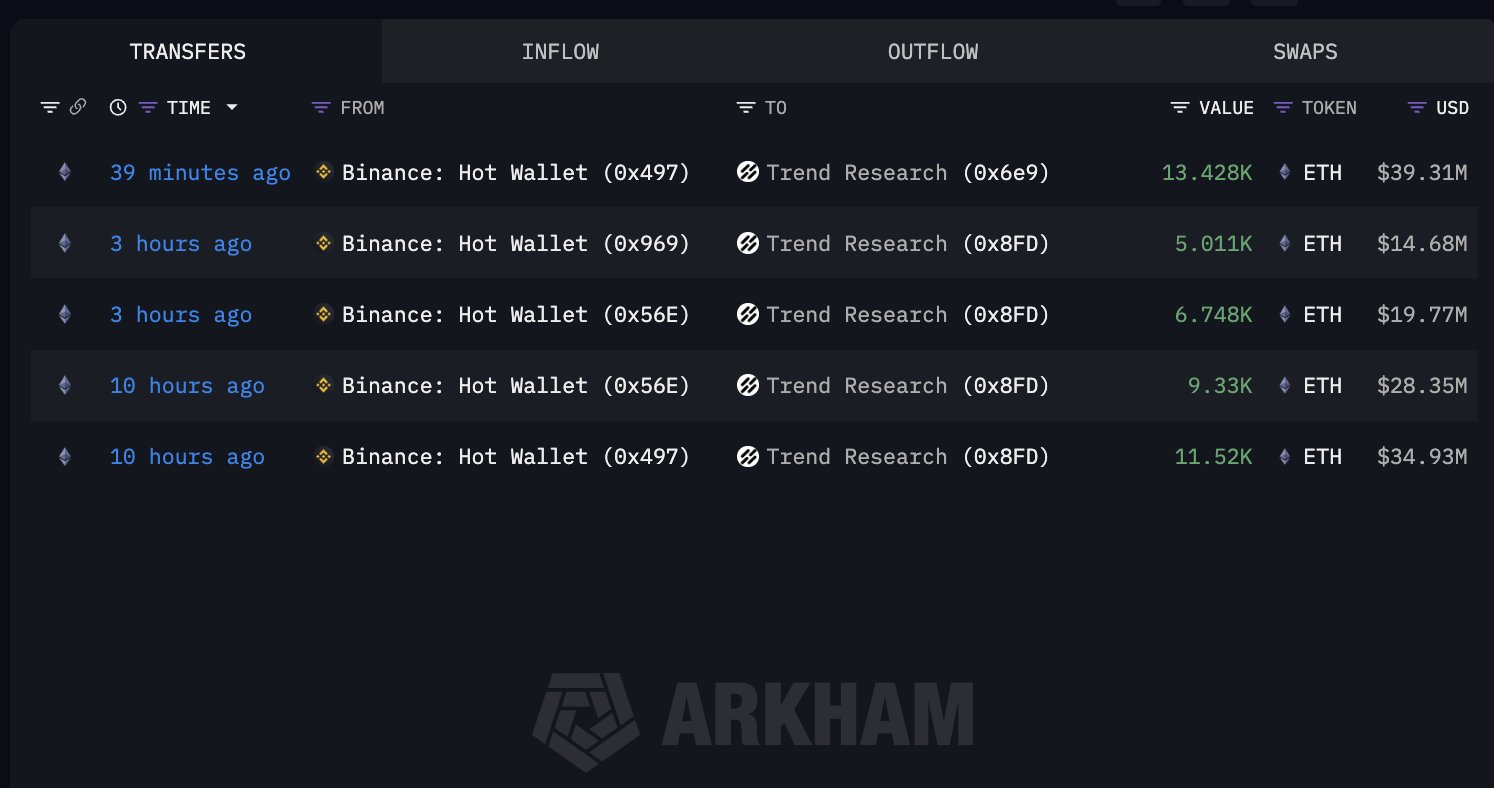
Institutions are increasing exposure while sentiment is still fragile. Case in point: Trend Research bought 46,000 ETH in the past day. Their total ETH exposure is now at 626k ETH.

Ethereum stalls, but the floor holds

Ethereum is perhaps stuck in a compression.

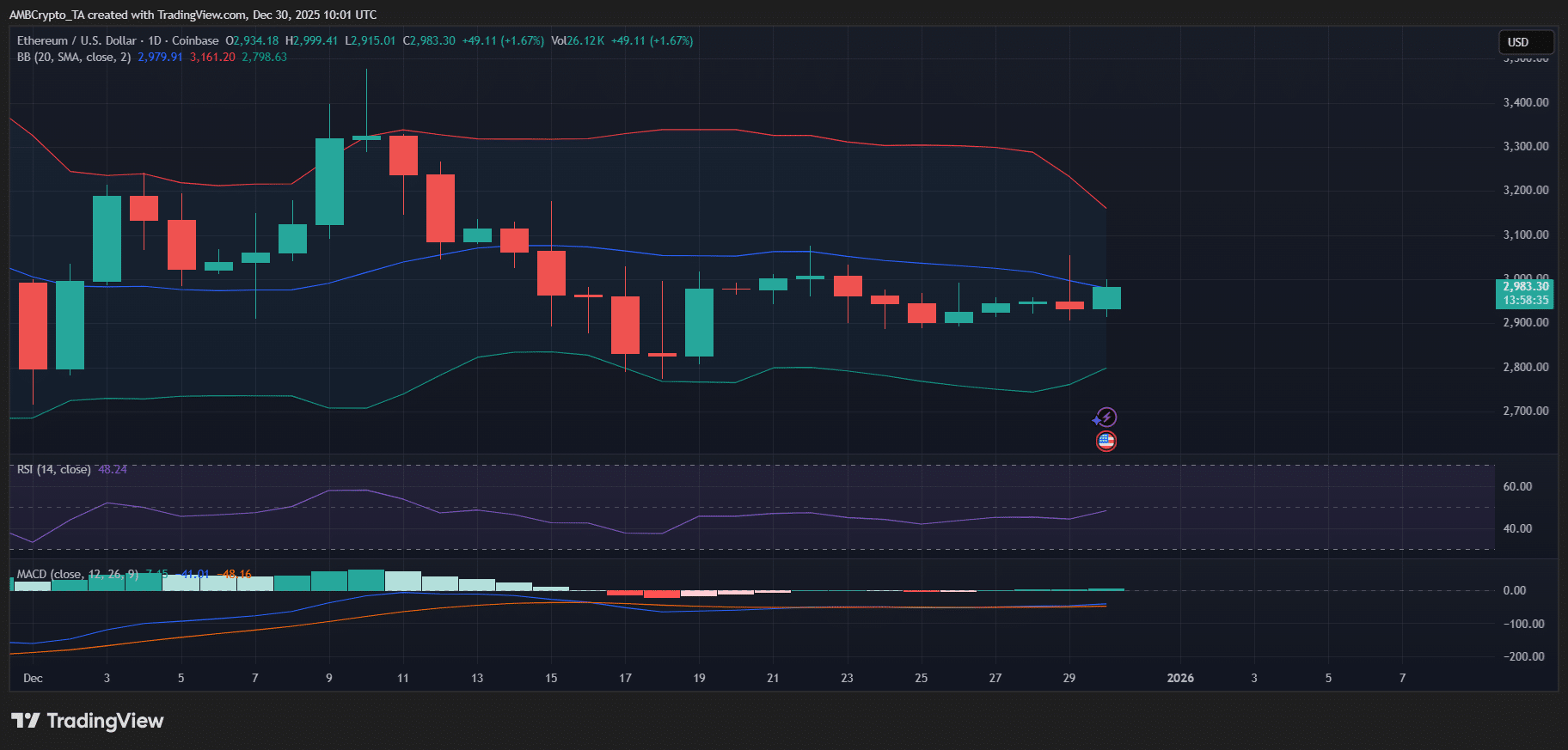
At press time, the price traded sideways just below the mid-Bollinger Band, with no decisive breakout in sight. The RSI showed neutral momentum at the time of writing, with MACD indicating a loss of direction.

Source: TradingView

Importantly, downside attempts have been absorbed above the lower Bollinger Band, keeping the $2,800-$2,900 zone intact as short-term support.

Big moves will likely follow broader market cues, rather than lead them.


Final Thoughts

  • Ethereum’s supply is decreasing; 745K ETH queues for staking and exchange balances fall at cycle-fast rates.
  • ETHA showed 486 long positions versus just 1 short despite weak price moves.
Next: Humanity Protocol rallies 15% – But can demand outrun token dilution?
Share
  • Share
  • Tweet

Trending Cryptos

Related Questions

QWhat is the significance of Ethereum staking inflows turning positive for the first time in six months?

AIt indicates a major shift in market sentiment, showing renewed confidence in Ethereum's long-term potential as investors move assets off exchanges and into staking, reducing immediate selling pressure.

QHow does the current number of ETH queued for staking compare to those waiting to exit?

AThere are over 745,000 ETH queued for staking versus roughly 360,000 ETH waiting to exit, demonstrating that staking demand significantly outweighs withdrawal pressure.

QWhat on-chain metrics support Ethereum's fundamental strength despite weak price action?

ASmart contract deployments have hit record highs, and the value of Real World Assets (RWA) on Ethereum has climbed to nearly $19 billion, indicating robust real-world usage and development activity.

QWhat does the institutional data reveal about large players' positioning on Ethereum?

AInstitutions are heavily long on Ethereum, with BlackRock's Spot Ethereum ETF (ETHA) showing 486 long positions versus just 1 short position, and firms like Trend Research significantly increasing their ETH exposure.

QWhat is the key technical support level for Ethereum's price mentioned in the article?

AThe $2,800-$2,900 zone is acting as short-term support, with downside attempts being absorbed above the lower Bollinger Band, preventing a breakdown.

Related Reads

Observation of Data on the Top Six Cryptocurrency Protocols: Revenue Continues to Grow, So Why Aren't Token Prices Rising?

Despite generating impressive revenue, many top cryptocurrency protocols struggle to translate this success into token price appreciation. This analysis of six major protocols (Aave, Aerodrome, Hyperliquid, Pump, Sky, Uniswap) examines the disconnect, focusing on revenue generation, distribution, and tokenomics. While these protocols collectively earned over $726 million in the first half of 2026, token performance largely lagged due to factors like imbalanced token emissions, unclear value capture mechanisms, and equity-token separations that disadvantage holders. Key findings reveal that not all revenue is equal for token holders. Protocols differ significantly in how they allocate income. Hyperliquid, for instance, directs 100% of its revenue to holders via buybacks and burns, correlating with strong token performance. Others, like Aerodrome, Sky, and Uniswap, showed negative net token flows when accounting for high token emissions used for incentives, offsetting holder benefits. The article highlights two primary value capture methods: buybacks/burns and direct fee distribution (e.g., ve-tokenomics models). The analysis concludes that high revenue alone doesn't guarantee token growth. Investors must scrutinize a protocol's sustainable revenue sources, how that value is shared with token holders, and the associated token release schedules and supply pressures. The future points towards greater alignment between protocol success and tokenholder rewards, but only for projects that seriously address all three pillars: revenue, distribution, and emissions.

marsbit30m ago
Observation of Data on the Top Six Cryptocurrency Protocols: Revenue Continues to Grow, So Why Aren't Token Prices Rising?

marsbit30m ago

September 1st, A Major Chip Price Hike

On July 29, 2026 (US time), Qualcomm reported its Q3 FY2026 (Q2 CY) results. Revenue reached $9.95 billion, up 4% and beating estimates, but net profit fell 25% YoY to $2 billion. The "revenue up, profit down" trend is attributed to rising costs across semiconductor manufacturing, testing, packaging, and materials. In response, CEO Cristiano Amon announced price increases for all chip products, effective September 1, to pass on costs and restore historical profit margins. The stock fell over 5% in after-hours trading due to weaker-than-expected Q4 profit guidance. Qualcomm's core chip business (QCT) revenue was $8.5 billion, down 5% YoY. Handset revenue dropped 20% to $5.09 billion, reflecting a weak global smartphone market with declining shipments. In contrast, Automotive revenue surged 61% to $1.59 billion, marking 23 consecutive quarters of double-digit growth, and IoT revenue grew 9% to $1.83 billion. The licensing division (QTL) revenue was $1.28 billion, down 3%. Facing smartphone headwinds and a reduced component share in future iPhones, Qualcomm is aggressively diversifying. It is betting heavily on the data center AI market, maintaining a target of $5 billion in data center revenue for FY2027. The company completed the acquisition of AI software firm Modular to build an open software platform for generative AI. For Q4 FY2026, Qualcomm forecasts revenue between $9.7B and $10.5B, roughly in line with expectations. However, non-GAAP EPS guidance of $2.05-$2.25 fell short of the $2.36 analyst consensus. Management expects the chip price increases to gradually improve margins after September 1, but near-term profitability pressure from costs and the weak handset market persists.

marsbit30m ago

September 1st, A Major Chip Price Hike

marsbit30m ago

Trading

Spot

Hot Articles

Discussions

Welcome to the HTX Community. Here, you can stay informed about the latest platform developments and gain access to professional market insights. Users' opinions on the price of ETH (ETH) are presented below.

活动图片