Ethereum Reclaims $2,000 as ETF Inflows and Upgrade Roadmap Boost Momentum

bitcoinistPublished on 2026-02-26Last updated on 2026-02-26

Abstract

After weeks of stagnation below $1,900, Ethereum surged past the key $2,000 level, reaching $2,158. This rally was driven by renewed institutional demand, with spot Ethereum ETFs recording over $125 million in inflows, led by Grayscale and Fidelity. On-chain data showed accumulation by large holders, and the Ethereum Foundation announced plans to stake 70,000 ETH, reducing circulating supply. The recovery aligns with a broader crypto market rebound. Beyond price, investor focus is on Ethereum's long-term upgrade roadmap. Co-founder Vitalik Buterin outlined plans to drastically reduce block times and achieve faster transaction finality, alongside implementing quantum-resistant cryptography over the coming years. However, short-term volatility may arise from $893 million in ETH options expiring this week. Traders are watching if ETH can hold above $2,000, with sustained institutional interest and upgrade progress being key to determining if this is a lasting trend reversal.

After weeks stuck below a key psychological level, Ethereum (ETH) surged past $2,000 in a swift rally, pushing prices to $2,158 within a day. The recovery comes after a prolonged period of sideways trading around $1,900 and a broader correction that had pushed ETH more than 60% below its previous peak.

The latest double-digit recovery coincided with a wider cryptocurrency market rebound, with total market capitalization rising by over 4% and Bitcoin also advancing during the same period.
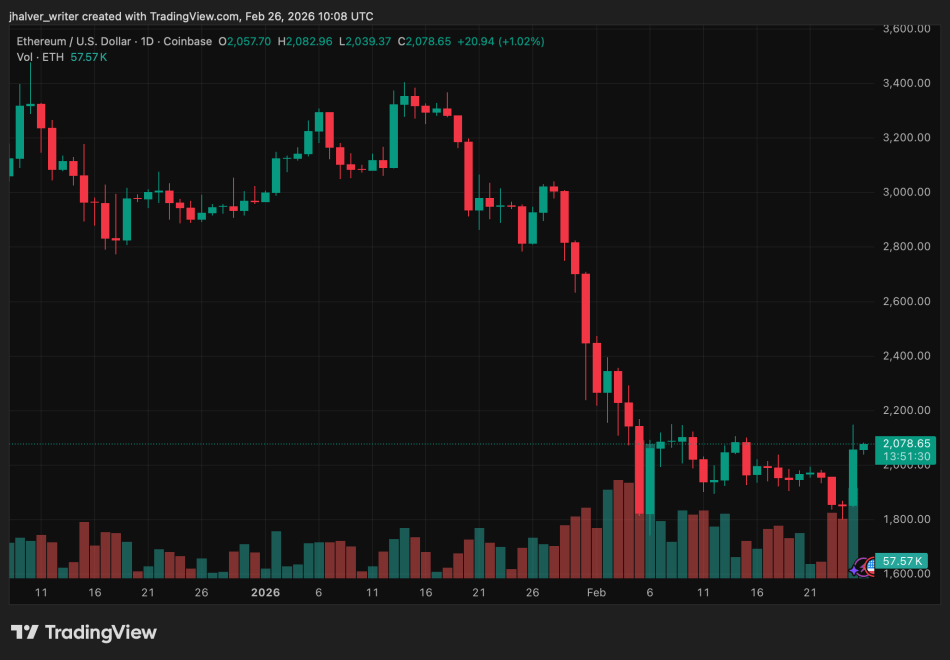
ETH's price trends to the downside on the daily chart. Source: ETHUSD on Tradingview

Ethereum ETF Inflows and Institutional Activity Drive Recovery

Renewed institutional demand helped drive Ethereum’s breakout, as spot ETFs recorded fresh inflows after weeks of outflows. Daily investments topped $20 million in some sessions, with total inflows exceeding $125 million on February 25, led largely by Grayscale and Fidelity products.

On-chain data also pointed to accumulation by large holders. Whale wallets added thousands of ETH while others withdrew significant amounts from exchanges, a pattern often interpreted as long-term positioning rather than short-term trading.

The Ethereum Foundation added another layer of support by announcing plans to stake 70,000 ETH from its treasury. The move reflects a shift toward active reserve management while reducing the circulating supply available on the market.

Technically, momentum indicators turned positive as capital flowed back into the asset. Analysts identified resistance zones between $2,080 and $2,150, while support formed around the psychologically important $2,000 level.

Upgrade Roadmap Signals Faster and More Secure Ethereum

Beyond price action, investor attention has also focused on Ethereum’s long-term development roadmap. Co-founder Vitalik Buterin recently outlined proposals to significantly improve transaction speed and security over the next several years.

The plan includes gradually reducing block slot times from 12 seconds to as low as two seconds, allowing faster transaction processing. Developers are also targeting transaction finality between 6 and 16 seconds, a major reduction from the current confirmation timeframe, which can stretch into minutes.

The roadmap spans multiple protocol upgrades expected through the end of the decade and introduces quantum-resistant cryptography designed to prepare the network for future computing risks. Changes will be implemented gradually to limit disruption and maintain network stability.

Options Expiry Could Increase Short-Term Volatility

Despite improving sentiment, derivatives markets may introduce near-term volatility. Around $893 million worth of ETH options are set to expire this week, with a “max pain” level near $2,200. The put-to-call ratio below 1 suggests traders are leaning toward upside exposure, though expiry mechanics can temporarily influence price direction.

Ethereum’s ability to hold above $2,000 remains the key signal for traders. Sustained institutional inflows and progress on network upgrades could determine whether the latest rally develops into a broader trend reversal or remains a short-term recovery within a larger consolidation phase.

Cover image from ChatGPT, ETHUSD chart on Tradingview

Related Questions

QWhat key price level did Ethereum reclaim and what was the peak price reached during the recent rally?

AEthereum reclaimed the key psychological level of $2,000 and surged to a peak of $2,158 within a day.

QWhat two main catalysts are credited with boosting Ethereum's momentum according to the article?

AThe two main catalysts are renewed inflows into spot Ethereum ETFs and the announcement of a long-term upgrade roadmap for the network.

QHow did the Ethereum Foundation contribute to the positive market sentiment?

AThe Ethereum Foundation announced plans to stake 70,000 ETH from its treasury, which reduces the circulating supply and reflects a shift toward active reserve management.

QWhat are two specific improvements to transaction processing proposed in Ethereum's upgrade roadmap?

AThe roadmap proposes reducing block slot times from 12 seconds to as low as 2 seconds and achieving transaction finality between 6 and 16 seconds, a significant reduction from the current timeframe.

QWhat near-term event could introduce volatility to the ETH price, and what is the 'max pain' level for the expiring options?

AThe expiration of around $893 million worth of ETH options could introduce near-term volatility, with a 'max pain' level near $2,200.

Related Reads

The Value Distribution of Stablecoins

**Summary: The Value Distribution of Stablecoins** The article argues that stablecoins are evolving from mere trading tools into broader channels for dollar access. It divides the stablecoin ecosystem into four layers to analyze how value is distributed: 1. **Issuance Layer:** Mints stablecoins, holds reserve assets, and captures the spread between reserve yield and user costs (e.g., Tether, Circle). This layer currently earns the largest profit margin. 2. **Infrastructure Layer:** Connects stablecoins to the traditional financial system, handling fiat on/off-ramps, banking integration, compliance (KYC/AML), and asset management (e.g., Bridge, BVNK). This is the "unglamorous" but critical work, building the essential bridges between crypto and real-world finance. 3. **Acquiring/Distribution Layer:** Integrates stablecoins into merchant systems, manages payment flows, and provides enterprise financial software (e.g., Stripe, Coinbase). They act as the access point for businesses. 4. **Application Layer:** The end-users and businesses that ultimately use stablecoins for payments, settlements, or as a store of value. They benefit from convenience but have little pricing power. The core thesis is that while the issuance layer currently dominates profits, the often-overlooked **infrastructure layer holds significant long-term potential**. The real challenge and barrier to mass adoption is not the on-chain transfer of stablecoins (which is simple), but the complex "last mile" integration into existing business workflows, banking systems, and regulatory frameworks across different countries. Companies in this layer are currently in a "land grab" phase, investing heavily to build networks, secure bank partnerships, and establish compliance pathways. While their position is currently pressured by the profitable issuers above and distribution platforms below, the article suggests that if stablecoins become a default financial rail for businesses, the infrastructure providers who have done the hard work of integration will ultimately gain strong pricing power and become entrenched, essential players.

marsbit1h ago

The Value Distribution of Stablecoins

marsbit1h ago

The Value Distribution of Stablecoins

The Value Distribution of Stablecoins The article argues that stablecoins are evolving from a mere trading tool into a broad "dollar channel." It analyzes the industry's value chain through four layers: 1. **Issuance Layer (e.g., Tether, Circle):** The top layer that mints stablecoins, holds reserve assets, and captures the thickest interest rate spread. 2. **Infrastructure Layer (e.g., Bridge, BVNK):** Connects stablecoins to the traditional financial system, handling critical but complex "dirty work" like fiat on/off-ramps, banking integration, compliance (KYC/AML), and cross-border settlement. 3. **Acquiring/Distribution Layer (e.g., Stripe, Coinbase):** Embeds stablecoins into merchant systems, manages payment flows, and integrates with enterprise software. 4. **Application Layer:** End-users and businesses that ultimately use stablecoins for payments, settlement, or storing value. The author posits that while the issuance layer currently captures the most profit, the most overlooked and potentially critical layer is infrastructure. The core challenge for stablecoin adoption isn't the on-chain transfer (which is simple), but bridging the gap between blockchain and the real-world financial system. This involves solving practical problems for businesses: fiat conversion, reconciliation, tax handling, and user onboarding. Infrastructure companies are currently in a difficult "land-grab" phase—building networks, securing banking relationships, and achieving compliance country-by-country. They face pressure from both the profitable issuance layer above and distribution platforms below. However, the author suggests this layer is building a crucial moat. Once stablecoins become a default business rail, the infrastructure players who have done the hard work of integration may gain significant, durable value and pricing power.

链捕手1h ago

The Value Distribution of Stablecoins

链捕手1h ago

How to Do Research Well: Deliberately Practice the Real Skills That Matter

No one truly teaches you how to do research. You're often given a desk, a pre-selected problem, and vague instructions to "create something new." Consequently, many people reverse-engineer the job based on visible outputs—papers, posts, announcements—learning only how to *appear* like a researcher rather than how to *become* one. True research capability is built from stacking small, trainable skills, nearly all of which can be developed through deliberate practice. **Pick Your Own Problem:** Most researchers absorb problems from advisors or trends, lacking the underlying reasoning. Choosing a problem you genuinely care about, as John Schulman advises, leads to original work. Develop "taste" like a muscle: predict experiment outcomes, guess paper results from methods, and track which findings remain important over time. **Upgrade Your Inputs:** Relying on shared reading lists (arXiv hot lists, filtered group chats) leads to unoriginal conclusions. Undervalued old literature often holds crucial insights (e.g., MoE, LSTM, backpropagation). Richard Sutton's "The Bitter Lesson" or Claude Shannon's 1952 talk on creative thinking are more predictive than lengthy modern surveys. Breadth matters as much as depth: draw from neuroscience, mechanism design, hardware knowledge, and honest statistics. Read papers directly, especially appendices and limitations sections. **Write Everything Down:** As Paul Graham noted, writing exposes flaws in seemingly mature ideas. Writing is the cheapest defense against self-deception. Following Feynman's principle, Darwin programmatically wrote down facts contradicting his theory to combat memory bias. Maintain a detailed log of hypotheses, setups, predictions, results, and updated understandings. Reviewing past logs fosters essential humility.

marsbit3h ago

How to Do Research Well: Deliberately Practice the Real Skills That Matter

marsbit3h ago

Trading

Spot
Futures

Hot Articles

Discussions

Welcome to the HTX Community. Here, you can stay informed about the latest platform developments and gain access to professional market insights. Users' opinions on the price of ETH (ETH) are presented below.

活动图片