Ethereum price prediction – Is a breakout to $2.1K ahead after ETH shakes out weak hands?

ambcryptoPublished on 2026-03-31Last updated on 2026-03-31

Abstract

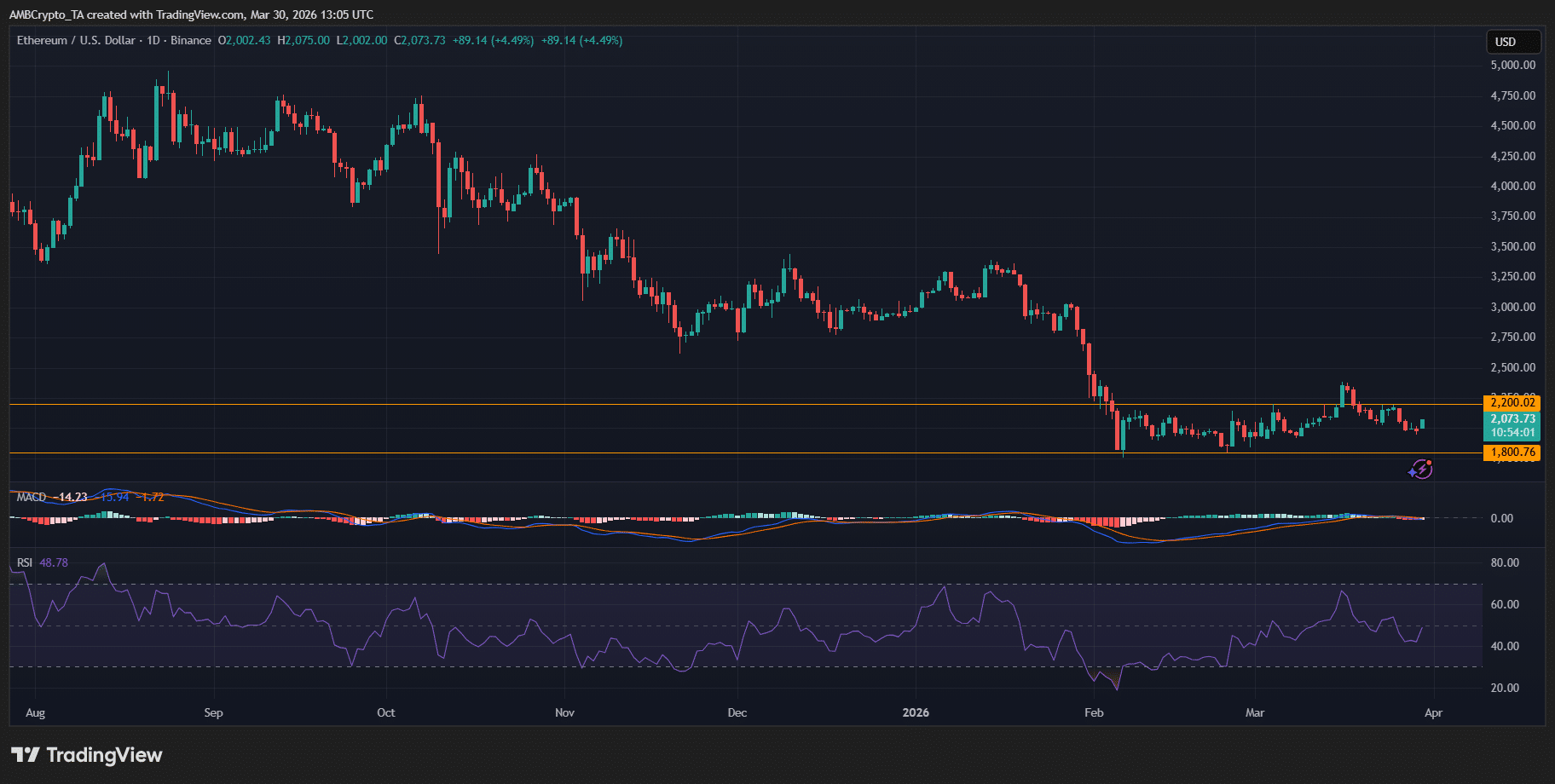
Ethereum's price reclaimed the $2,000 level, signaling a potential shift from selling pressure to recovery, with ETH trading near $2,060 at the time of writing. This move followed a brief breakdown that flushed out weak long positions in the $1,950–$2,050 liquidation zone, reducing immediate selling pressure and triggering a rebound. The price may now target the $2,100–$2,150 range, partly driven by short covering. However, the negative CMF indicates limited capital inflows, suggesting the uptrend is more due to positioning than strong demand. Key support at $2,000 must hold for the recovery to extend; a break below could see a retest of $1,800.

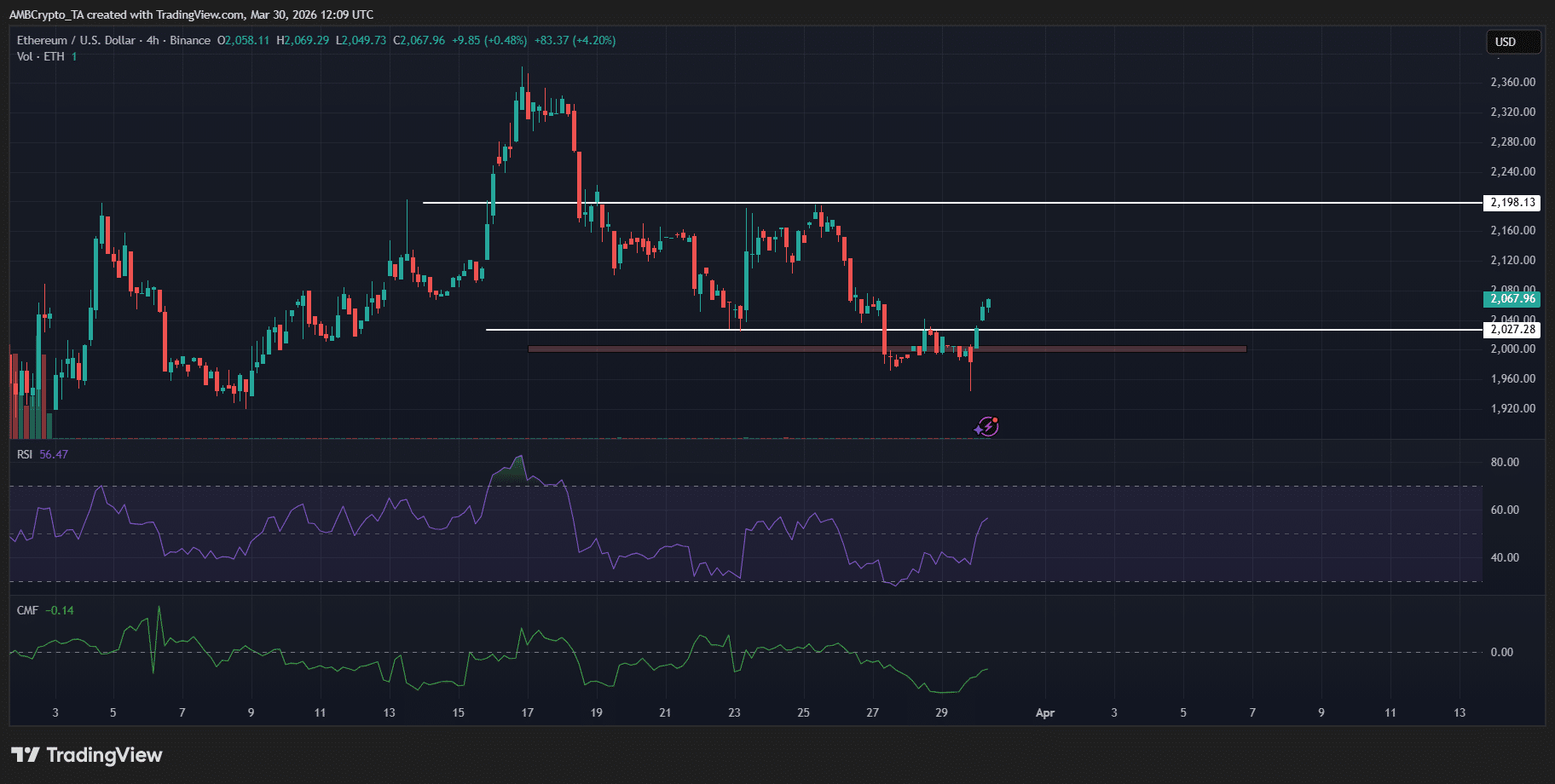
Ethereum’s [ETH] price moved above the $2,000-level following the weekend, highlighting a shift from selling pressure into early recovery. At the time of writing, the altcoin was trading near $2,060, reclaiming the $2,027 support zone after briefly breaking below it.

This move is evidence that buyers stepped in at lower levels. Especially as the breakdown failed to attract sustained selling and instead, triggered a reversal.

With the price stabilizing above this level, ETH might move towards the $2,100–$2,150 range – Its prior resistance range. This push would happen partly because short positions that entered below $2,000 are now closing, adding upward pressure.
Source: ETH/USD on TradingView

At the time of writing, momentum seemed to be improving too, with the RSI near 56 showing room for further upside without overbought conditions. However, the CMF was negative near -0.14 – A sign that capital inflows continue to be limited.

These findings are indicative of a mixed market structure, one where the price rises due to positioning rather than strong demand.

Thanks to the same, while the move may extend in the short term, it could struggle to sustain itself over the long term without stronger spot buying.
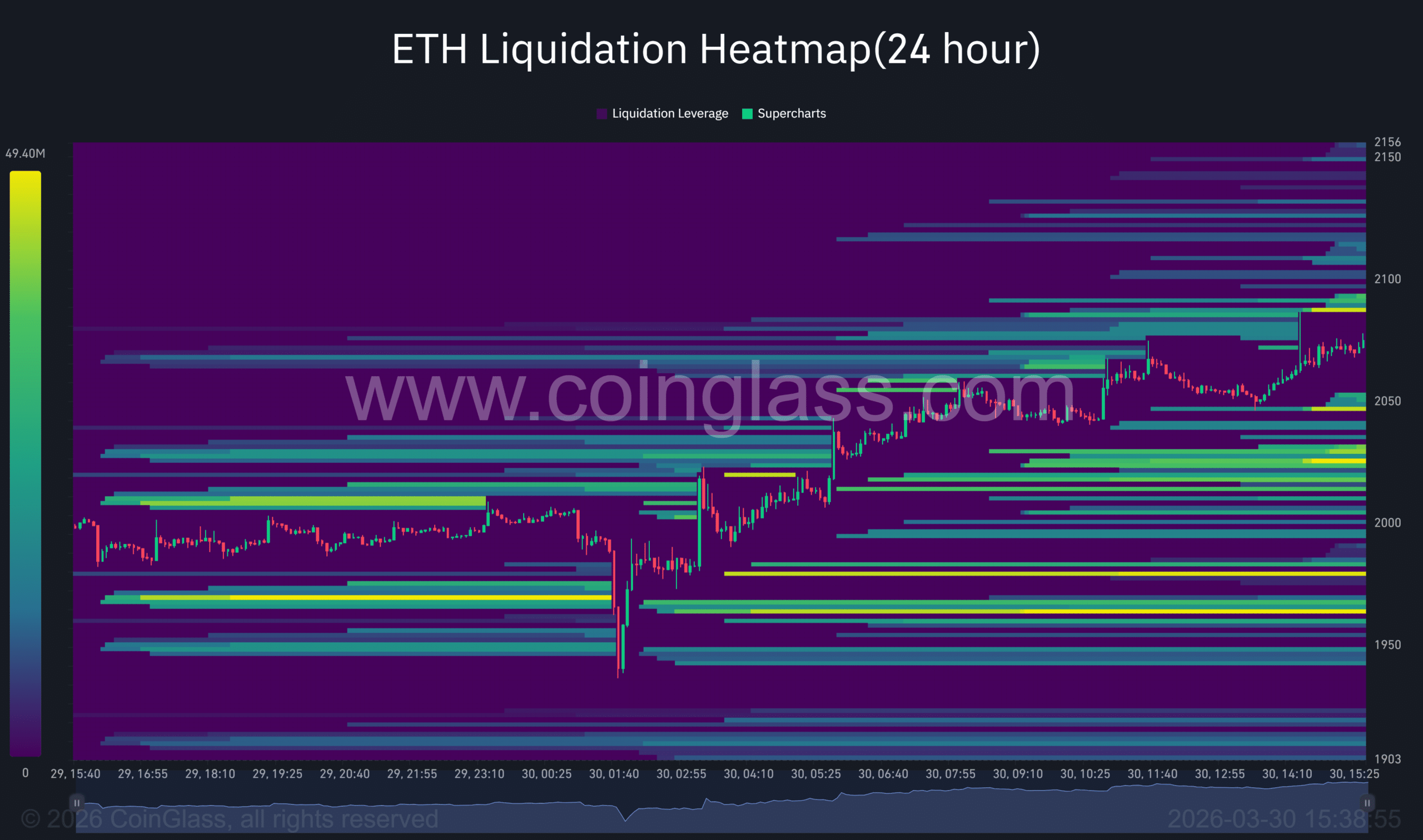
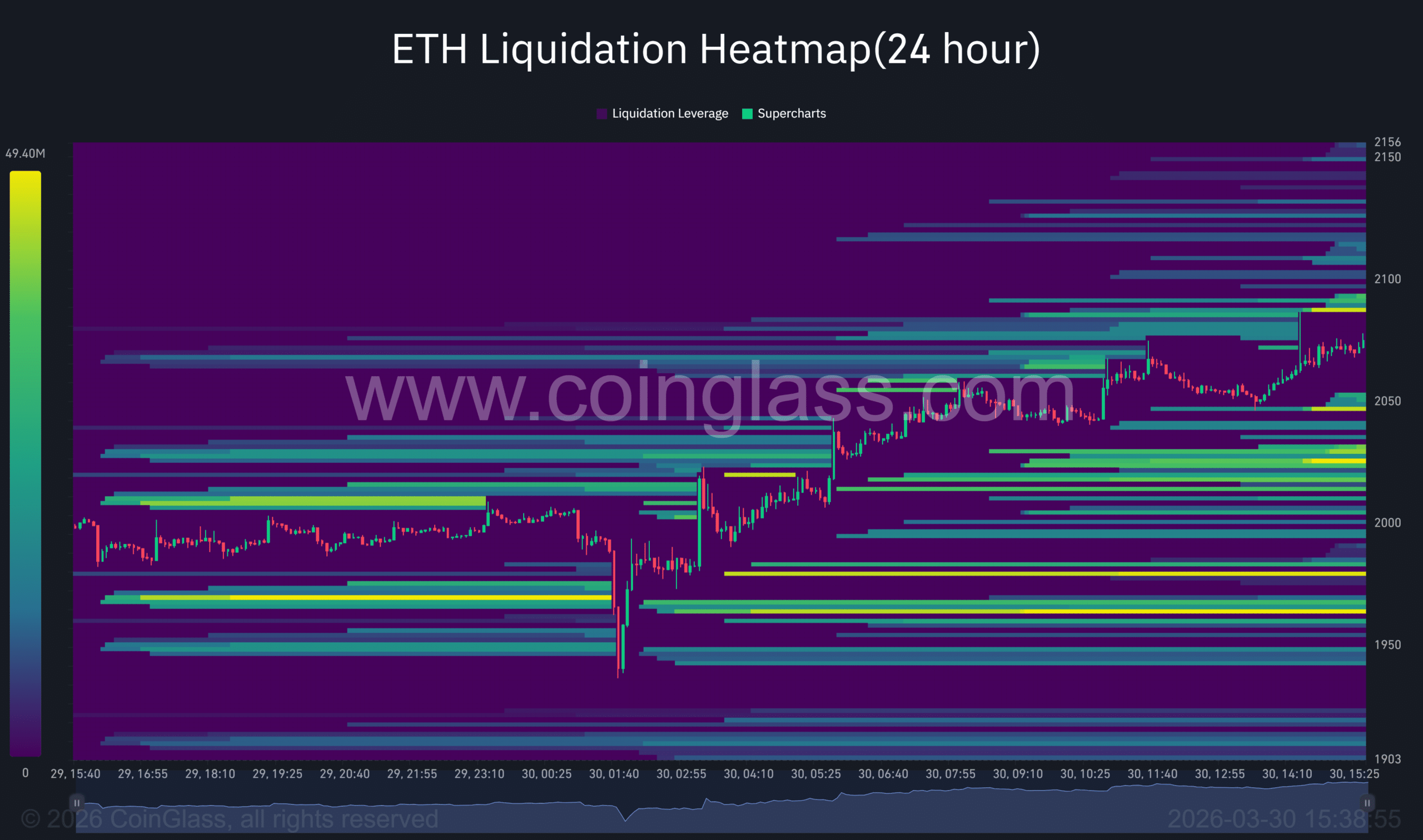
Liquidation flush drives ETH reclaim and squeeze setup

Ethereum’s move above $2,000 began with a sharp breakdown that quickly turned into opportunity.

The price dropped towards $1,930–$1,980, directly into a dense liquidation zone between $1,950 and $2,050, where leveraged longs were forced out. This flush mattered because it removed weak positions, allowing the market to reset and reduce immediate selling pressure.

Source: CoinGlass

As that pressure cleared, the market direction flipped, and the price rebounded sharply back above $2,000, reaching the $2,050–$2,080 range. This recovery happened as short positions began to close while fresh buyers stepped in, turning the earlier sell-off into upward momentum.

At press time, the price was holding near $2,040–$2,060 while new liquidation clusters formed above $2,100. This creates a setup where sustained buying can trigger a short squeeze higher. However, if support weakens, the price may revisit lower liquidity zones, testing whether demand remains strong or not.

ETH defends key trendline as structure shifts towards recovery

Ethereum now sits at a point where the market is testing whether the recent recovery can turn into a sustained move or not.

After bouncing from the $1,800-trendline, the price climbed above $2,050 to illustrate that buyers stepped in where structure matters most. This reaction was important because it confirmed that the broader range might still be intact.

Source: ETH/USD on TradingView

As the price moves towards the $2,100–$2,120 zone, traders should watch how it reacts under pressure. If buyers push through with strong participation, it would mean that demand is returning with intent. However, if the price stalls or is rejected, it would mean that sellers still control higher levels.

At the same time, holding above $2,000 will be key since it would keep short-term momentum stable. If this level holds, recovery can extend itself. However, failure would shift focus back towards $1,800.


Final Summary

  • Ethereum’s [ETH] price reclaimed $2,000 backed by liquidation-driven momentum, but weak inflows might limit sustained upside.
  • A breakout past its resistance would mean trend continuation while rejection risks a move back towards $1,800.

Related Questions

QWhat was Ethereum's price movement over the weekend and what key level did it reclaim?

AEthereum's price moved above the $2,000 level, reclaiming the $2,027 support zone after briefly breaking below it.

QWhat is the significance of the liquidation zone between $1,950 and $2,050 mentioned in the article?

AThis dense liquidation zone forced out leveraged longs, removing weak positions and allowing the market to reset, which reduced immediate selling pressure and enabled the price rebound.

QWhat two technical indicators are mentioned to show mixed market signals for Ethereum?

AThe RSI near 56 shows room for further upside without overbought conditions, while the CMF near -0.14 indicates limited capital inflows.

QWhat are the potential price targets if Ethereum breaks through resistance versus if it gets rejected?

AIf buyers push through with strong participation, ETH could move towards the $2,100-$2,150 range. If rejected, the price risks moving back towards $1,800.

QWhy is holding above the $2,000 level crucial for Ethereum's short-term momentum according to the article?

AHolding above $2,000 is key to maintaining stable short-term momentum. If this level holds, recovery can extend, but failure would shift focus back towards $1,800.

Related Reads

The Merger of Codex and ChatGPT Marks the Beginning of a Major Reshuffle in Programming Tools

OpenAI is shifting its strategic focus from ChatGPT to Codex, merging them along with the browser tool Atlas into a unified desktop super-app. This move signals an internal belief that Codex, originally a programming tool, represents the next evolution of AI more than conversational models like ChatGPT. Over the past year, Codex's weekly active users have surged past 5 million. The key distinction is that while ChatGPT answers questions, Codex executes tasks. Enterprises increasingly value this ability to get work done over simply receiving advice. Consequently, Codex is attracting professionals beyond developers, including analysts, bankers, marketers, and product managers. OpenAI's reorganization and increased investment in Codex stem from recognizing that the future of AI competition lies in execution capabilities, not just conversation. The company is launching role-specific plugins (e.g., for data analysis, sales, design) to transform Codex into a broad knowledge work platform that automates and redefines white-collar workflows. Beyond being a tool, Codex reflects OpenAI's ambition to redefine software. New features like "Sites"—which generates interactive websites from documents—and collaborative "Annotations" aim to create a paradigm where the AI understands the goal and handles the tools and steps, functioning more like a digital colleague than traditional software. The ultimate goal is a unified experience where the user cares only about the completed task.

marsbit4m ago

The Merger of Codex and ChatGPT Marks the Beginning of a Major Reshuffle in Programming Tools

marsbit4m ago

Interpreting Investment Opportunities in the Age of Great Navigation, Invesco Great Wall Fund Releases '2026 Report on Chinese Enterprises Going Global'

Invesco Great Wall Fund has released its "2026 China Corporate Globalization Report," titled "The 'Great Navigation Era' of Chinese Enterprises." The report analyzes the new trends and investment opportunities as Chinese companies expand globally, moving from simple product exports to comprehensive overseas operations involving services, branding, and local production. Driven by factors like trade friction, the pursuit of higher profit margins abroad, and policy support, globalization is becoming essential for Chinese companies. The report outlines an evolution: from early product export ("Globalization 1.0") to the current "Globalization 2.0," characterized by overseas capacity, capital goods investment, consumer brand expansion, and service exports. Chinese firms' competitive advantages are highlighted, including a vast engineer talent pool, low-cost and robust infrastructure, and complete industrial clusters. Specific sectors with significant出海 potential are identified: * **Capital Goods** (e.g., engineering machinery, power equipment): Benefiting from global demand, especially in Belt & Road markets and the AI-driven power grid upgrade cycle. * **Consumer Brands**: Transitioning from cost to brand advantage, leveraging供应链 efficiency. * **Technology & Innovation**: Including AI applications, optical modules within global tech supply chains, and new energy vehicles focusing on local production. * **Pharmaceuticals**: Chinese biotech firms are becoming preferred partners for global pharma, with potential for breakthrough drugs in areas like oncology and weight loss. The report concludes that corporate globalization represents a sustained, core theme for China's capital markets, though companies must navigate challenges like geopolitics and localization.

marsbit16m ago

Interpreting Investment Opportunities in the Age of Great Navigation, Invesco Great Wall Fund Releases '2026 Report on Chinese Enterprises Going Global'

marsbit16m ago

GitHub, Transfixed by AI

On the night of February 9th, GitHub suffered a major outage caused by a simple configuration change—reducing a cache refresh interval from 12 to 2 hours—that triggered a cascade of failures. This was not an isolated event, but part of a broader pattern. In early 2026, GitHub experienced at least 8 major incidents, failing to meet its promised 99.9% availability. These outages stemmed from structural issues: explosive growth in load, tight service coupling, and insufficient protection against abnormal traffic. This unprecedented load is driven by AI Agents. In 2025, GitHub handled ~1 billion commits. By 2026, weekly commits reached 275 million, projecting to ~14 billion for the year—a 14x increase. AI tools like Claude Code now contribute 4.5% of all public repository commits, with weekly submissions surging 25x in just three months. AI-generated pull requests jumped from 4 million to 17 million per month in half a year. Unlike human developers, AI Agents work continuously, generating commits at a scale that overwhelms infrastructure designed for human rhythms. The surge also shattered GitHub's business model. Copilot's flat-rate pricing, based on assisting human developers, became unsustainable as Agentic AI sessions consumed resources worth hundreds of dollars for a few dollars in fees. In response, GitHub imposed usage limits and, by June 1st, shifted to a pay-per-use "AI Credits" system. Facing this new reality, GitHub realized a 10x scaling plan was insufficient. It announced a need to *redesign* its architecture for 30x current scale—decoupling services, adding fault isolation, and improving change management to prevent cascading failures. Other platforms like Stripe and AWS are facing similar challenges with AI Agents. Fundamentally, GitHub is transitioning from a human collaboration platform to an "exhaust pipe" for automated AI workflows. Its detailed post-mortem reports aim to maintain trust during this turbulent rebuild. The February outage was not just a technical glitch, but a signal of the software industry's entry into a new, AI-driven era.

marsbit56m ago

GitHub, Transfixed by AI

marsbit56m ago

Trading

Spot
Futures

Hot Articles

Discussions

Welcome to the HTX Community. Here, you can stay informed about the latest platform developments and gain access to professional market insights. Users' opinions on the price of ETH (ETH) are presented below.

活动图片