Ethereum Network Thrives: Economic Activity Rises While Price Momentum Lags Behind

bitcoinistPublished on 2026-01-12Last updated on 2026-01-12

Abstract

Ethereum's network is demonstrating robust growth in economic activity, despite its price performance occasionally lagging behind riskier assets. Key metrics reveal a divergence, with fundamentals strengthening beneath the surface. Institutional adoption is increasing, with a focus on uptime, liquidity, and compliance, positioning Ethereum as financial infrastructure rather than a speculative asset. Tokenized Real-World Assets (RWAs) are a major growth driver, bringing traditional finance on-chain. Stablecoins on Ethereum have a market cap of ~$190B, tokenized funds total ~$6-7B, commodities exceed $4B, and tokenized stocks are valued at ~$400-500M. This surge suggests Ethereum is becoming the default settlement layer for real assets, with adoption expected to drive future price increases.

Ethereum’s current strength is largely linked to its network performance and activity, which has been demonstrating robust growth. While the leading blockchain has witnessed sharp growth in several key areas, one area is currently standing out, and that is the economic activity on the network.

A Divergence Between Ethereum’s Real Activity And Price

With the broader cryptocurrency landscape evolving, Milk Road, a market expert and trader, has revealed that the Ethereum network is showcasing signs of robust strength. When compared to its recent price performance, the leading network subtly conveys a different narrative.

Despite the fact that ETH’s market value has occasionally fluctuated or even lagged behind riskier assets, the quantity of economic activity being settled on the blockchain has continued to rise. The disparity highlights a crucial aspect of ETH’s current cycle that its fundamentals are strengthening beneath the surface, while market sentiment is not accurately reflecting it.

At the same time, the Ethereum network is being chosen for live deployment by increasing institutional capital. This kind of increases a chain that is becoming less of a speculative asset and more of a financial infrastructure.
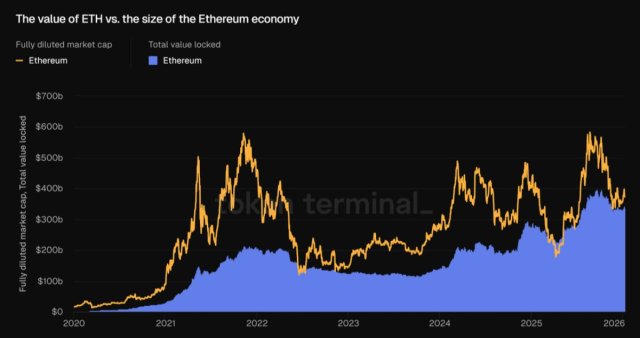
Source: Chart from Milk Road on X

According to Milk Road, these participants are more focused on uptime, liquidity, settlement certainty, and compliance, which narrows the set of viable networks quickly. Meanwhile, the economic weight placed on Ethereum’s base layer becomes significant as more activity occurs on the chain, increasing transaction volume and fee income.

As seen in the past, ETH has had difficulty staying flat for extended periods of time when demand is high. However, the analyst expects the price of ETH to increase as adoption rises.

Real Assets Are Swamping The Network

According to a report from Leon Waidmann, the head of research at On-Chain Foundation, Tokenized Real-World Assets (RWAs) are quickly emerging as one of Ethereum’s key growth drivers. With real-world assets moving into ETH, the development is bringing traditional finance activity on-chain at a fast rate.

This change is more than just buzz as institutional infrastructure, token issuance, and settlement volumes are all growing at the same time, transforming ETH’s status. Data shows that the market cap of stablecoins found on the network is approximately $190 billion, indicating ETH’s growing choice as the major chain for crypto finance.

Meanwhile, the total amount of tokenized funds has reached between $6 billion and $7 billion, and is still growing rapidly. Its tokenized commodities have hit over $4 billion, which appears to be still breaking out to new highs. Furthermore, ETH’s tokenized stocks are valued at around $400 million to $500 million, but this is just the beginning. Such a scenario suggests that tokenization of real-world assets may be the foundation of Ethereum’s next significant adoption phase.

Considering the robust growth in these areas, Waidmann stated that “ETH is becoming the default settlement layer for real assets.” Waidmann’s claims are not based on simple narratives, but on the fact that the network already works at scale.

ETH trading at $3,138 on the 1D chart | Source: ETHUSDT on Tradingview.com

Related Questions

QWhat is the main reason for Ethereum's current strength according to the article?

AEthereum's current strength is largely linked to its robust network performance and growing economic activity, despite its price momentum lagging behind.

QWhat key divergence does the article highlight about Ethereum?

AThe article highlights a divergence between Ethereum's strong network activity and economic growth, and its relatively weaker price performance in the market.

QWhich type of assets are emerging as a key growth driver for Ethereum, as mentioned in the article?

ATokenized Real-World Assets (RWAs) are quickly emerging as one of Ethereum's key growth drivers, bringing traditional finance activity on-chain.

QWhat does the $190 billion market cap of stablecoins on Ethereum indicate?

AThe $190 billion market cap of stablecoins indicates Ethereum's growing status as the major chain for crypto finance and its role as a default settlement layer.

QAccording to the analyst Milk Road, what factors are institutional participants focused on when choosing Ethereum?

AAccording to Milk Road, institutional participants are more focused on uptime, liquidity, settlement certainty, and compliance when choosing Ethereum for deployment.

Related Reads

US Stocks Suffer Worst Plunge Since 2025: Three Triggers Ignite Tech Stock Valuation Reset

The US stock market experienced its most severe sell-off since the 2025 tariff crisis on June 5th, 2025. The Nasdaq Composite plummeted 4.18%, the S&P 500 fell 2.64%, and the Dow Jones dropped 695 points. The panic stemmed from three converging factors. First, Broadcom's earnings report ignited fears of a slowdown in AI growth. While its AI chip revenue surged 143% YoY to $10.8B, its Q3 AI revenue guidance of $16B fell short of the $17.2B consensus. This triggered a massive sector-wide sell-off, with the Philadelphia Semiconductor Index crashing 10.26% and semiconductor stocks losing roughly $1.3 trillion in market value in a single day. Second, a shockingly strong May jobs report crushed hopes for Federal Reserve rate cuts. Non-farm payrolls added 172,000 jobs, doubling expectations. This robust data, combined with persistently high oil prices above $92/barrel due to the ongoing Iran war and blockade of the Strait of Hormuz, drastically increased market expectations for a potential Fed rate hike instead of a cut. Higher interest rates compress the valuations of growth-heavy tech stocks. Third, the prolonged Iran conflict continues to fuel inflationary pressures, complicating the Fed's policy decisions and undermining the "inflation is tamed" narrative. Together, these events challenged the twin pillars of the market rally: the "limitless AI growth" story and expectations for imminent monetary easing. The sell-off spread globally, impacting Asian and European markets and cryptocurrencies. The article posits this is likely a severe "valuation repricing" rather than the end of the AI story. The underlying demand for AI remains strong, but investor expectations for growth speed and the prices they are willing to pay are being recalibrated. Key upcoming factors include the June FOMC meeting, future AI company earnings, and developments in the Iran conflict.

marsbit21m ago

US Stocks Suffer Worst Plunge Since 2025: Three Triggers Ignite Tech Stock Valuation Reset

marsbit21m ago

From Madison Square Garden to Kalshi: Prediction Markets Break into the NBA Finals

From Madison Square Garden to Kalshi: Prediction Markets Break into the NBA Finals Prediction markets are playing a significant role in the 2026 NBA Finals, particularly around the New York Knicks' unexpected 2-0 series lead. Platforms like Kalshi and Polymarket have seen massive trading volumes, exceeding hundreds of millions of dollars on championship and related markets. Their influence extends beyond online trading. Kalshi's official partnership with Madison Square Garden has given it prominent physical branding at the arena. Furthermore, local businesses like The Jeffrey bar are using prediction market contracts to hedge the risk of game-result-based promotions, turning potential losses into manageable costs—a concept similar to the famous "Mattress Mack" strategy from traditional sports betting. These markets differentiate themselves by offering a wider, more entertainment-focused range of "event contracts" beyond typical game outcomes, such as predicting celebrity attendance. They also have broader accessibility across the U.S. compared to age- and location-restricted traditional sportsbooks. However, their rapid integration into sports raises regulatory and ethical questions. The NBA is cautiously engaging, discussing integrity frameworks with regulators like the CFTC. While the league permits minor investments like Giannis Antetokounmpo's stake in Kalshi, it advocates for strict rules to prevent insider trading. Many fans express concern on platforms like Reddit, fearing that the close ties between prediction markets, the league, and players could compromise the game's integrity. The NBA Finals has thus become a high-stakes testing ground, showcasing prediction markets' commercial potential while challenging traditional boundaries between financial trading, entertainment, and gambling.

marsbit2h ago

From Madison Square Garden to Kalshi: Prediction Markets Break into the NBA Finals

marsbit2h ago

Recursive Self-Improvement AI Gains Traction, Google Pours Cold Water, While DeepSeek and Others Approach the Fringes

The term "recursive self-improvement" (RSI), where AI improves itself autonomously, is gaining momentum in the AI industry. Startups like Recursive Superintelligence and projects such as Andrej Karpathy's Auto-Research aim to create systems where AI designs, implements, and validates its own research, moving toward superintelligence. While Google CEO Sundar Pichai cautions that such exponential acceleration is not yet a reality, progress is evident. For instance, Anthropic reported its Claude Code writes nearly 100% of the team's code, though it still lacks true self-direction. Analysts frame RSI development in stages: "adequacy" (systems functioning without humans), "parity" (matching human research quality), and "supremacy" (exceeding human-AI collaboration). Reaching parity could trigger rapid, unpredictable advancement due to AI's continuous operation. In China, companies like DeepSeek and Baidu incorporate self-optimization techniques without explicitly branding them as RSI, focusing on algorithmic efficiency and reinforcement learning. However, challenges remain, including "model collapse" from training on AI-generated data and the immense computational and open-collaboration requirements. Ultimately, RSI represents a trend of increasing automation in AI development, potentially reducing human oversight in the creation process itself.

marsbit2h ago

Recursive Self-Improvement AI Gains Traction, Google Pours Cold Water, While DeepSeek and Others Approach the Fringes

marsbit2h ago

Trading

Spot
Futures

Hot Articles

Discussions

Welcome to the HTX Community. Here, you can stay informed about the latest platform developments and gain access to professional market insights. Users' opinions on the price of ETH (ETH) are presented below.

活动图片















