Ethereum needs simple explanation to see true trustlessness: Buterin

cointelegraphPublished on 2025-12-18Last updated on 2025-12-18

Abstract

Ethereum co-founder Vitalik Buterin emphasizes the need for the blockchain to simplify its protocol to achieve true trustlessness. He argues that if only a small group can understand the system, users must still trust that group, undermining decentralization. Buterin advocates for fewer features to improve accessibility. The article notes that complexity and jargon deter average users, a challenge echoed by other projects like privacy layer INTMAX. Ethereum’s roadmap includes upgrades like smart contract wallets and node accessibility to enhance user experience, alongside educational initiatives to broaden understanding.

The Ethereum blockchain needs to better explain its features to users in order to achieve true trustlessness, a challenge common across blockchain protocols, says its co-founder Vitalik Buterin.

Trustlessness would see a protocol work without the oversight of developers, as it enforces rules automatically with code. However, if a protocol is so complex that only a small group can work on it, then in practice, others still have to trust that group.

Ethereum is already trustless as transactions and smart contracts are enforced by open-source code and a decentralized network of validators, but Buterin said in a X post on Wednesday, the network still needs to improve user understanding.

“An important and underrated form of trustlessness is increasing the number of people who can actually understand the whole protocol from top to bottom. Ethereum needs to get better at this by making the protocol simpler.”

Asked how realistic the notion is, given the tradeoff between technological features and user understanding, Buterin said, “we should be willing to have fewer features sometimes.”
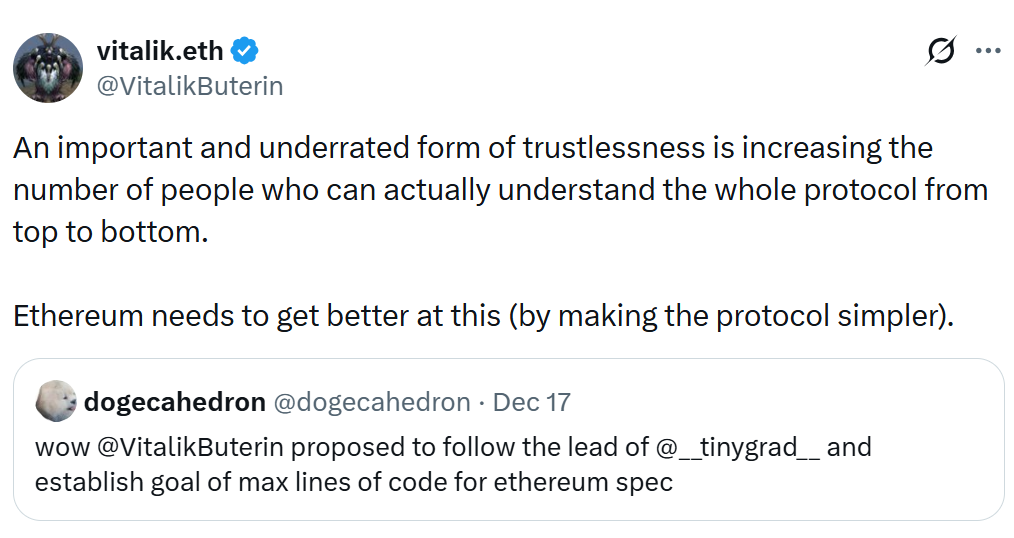
Source: Vitalik Buterin

Last year, crypto executives told Cointelegraph that confusion around crypto storage, regulations, and other factors tech-savvy people take for granted could be keeping average users on the sidelines and away from the technology.

Better understanding needed across all protocols

INTMAX, a privacy layer 2 built on Ethereum, agreed with Buterin, and said the same principle applies to privacy infrastructure.

“If only five people can understand how your privacy protocol works, you haven’t achieved trustlessness, you’ve just changed who you trust. Simple, auditable privacy architecture > complex black boxes,” INTMAX said.

Other remarked that deciphering tech-heavy jargon used by some protocols can feel like a full-time job, or outright repel users from an otherwise promising project.
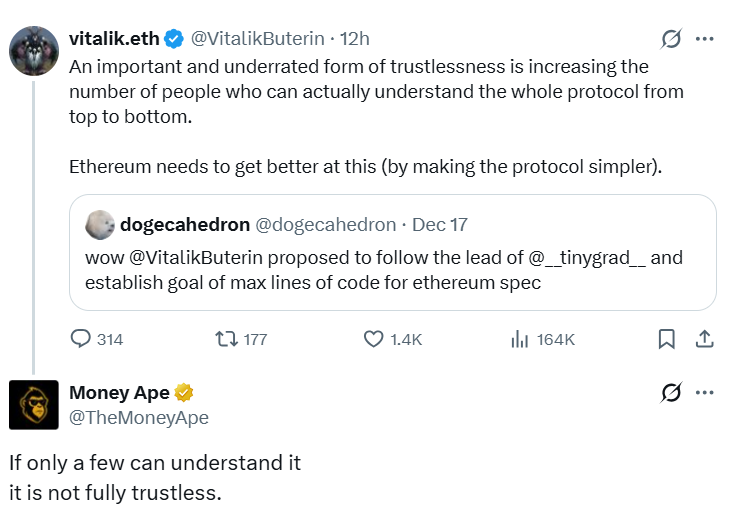
Source: Money Ape

Ethereum aiming for better user experience

Ethereum’s roadmap acknowledges it can still be “too complex to use Ethereum for most people,” and outlines plans to “drastically lower its barriers to entry,” and become “as frictionless as using a traditional Web2 app.”

Related: Ethereum could get faster in January with gas limit rise to 80M

Some of the flagged upgrades aimed at creating a better user experience include smart contract wallets, which streamline complex blockchain details such as gas fees and key management and reducing the barriers to running a node by making them accessible on devices like a phone or browser apps.

The Ethereum Foundation also funds a wide range of educational courses and programs to help people learn more about blockchain development and related technologies.

Magazine: Big questions: Would Bitcoin survive a 10-year power outage?

Trending Cryptos

Related Reads

The Verdict in Choi Tae-won's Divorce Case: Revealing the Inheritance Undercurrent Behind SK Hynix's Trillion-Won Empire

SK Group Chairman Chey Tae-won's high-profile divorce case, involving a record 1.38 trillion won settlement, has drawn attention to the succession plans for Korea's second-largest conglomerate, especially its crown jewel, SK hynix. Unlike traditional chaebol scripts centered on the eldest son, Chey's three children from his marriage to former President Roh Tae-woo's daughter, Roh Soh-yeong, are carving distinct, non-traditional paths. Eldest daughter Chey Yun-jung (b. 1989) is seen as the most evident successor. With a scientific and consulting background, she holds executive roles at SK bioscience and SK Inc.'s growth support department, focusing on future strategy and biopharma. Her marriage is to an AI infrastructure entrepreneur, not a traditional business alliance. Second daughter Chey Min-jung (b. 1991) took a unique route, voluntarily serving as a South Korean naval officer, including an anti-piracy deployment. She later worked on policy and strategy for SK hynix in Washington D.C. before co-founding an AI-driven healthcare startup. She married a former U.S. Marine Corps officer, connecting her to U.S. defense and policy circles—networks crucial for a global semiconductor giant. The only son, Chey In-geun (b. 1995), who studied physics like his father, worked briefly at SK E&S before joining McKinsey. Despite fitting the traditional "heir" profile as the eldest son, he remains silent and holds no public position or shares in SK, suggesting the old succession playbook is obsolete. As SK hynix's valuation soars, becoming a geopolitical asset in the AI era, the heirs' legitimacy is no longer automatic. They must prove themselves in fields like AI biotech, global policy, and strategic consulting. Their marriages also reflect new elite networks in tech and defense, not old political alliances. Their inheritance is the complex challenge of navigating a globalized, tech-driven world, not just a corporate throne.

marsbitYesterday 09:06

The Verdict in Choi Tae-won's Divorce Case: Revealing the Inheritance Undercurrent Behind SK Hynix's Trillion-Won Empire

marsbitYesterday 09:06

From OpenSea to OpenRouter: Is Alex Atallah Repeating His 'Exit at the Peak' Playbook?

From OpenSea to OpenRouter: Is Alex Atallah Repeating His "Exit at the Peak" Playbook? According to the Wall Street Journal, payments giant Stripe is in talks to acquire the AI model aggregation platform OpenRouter in a potential deal valuing the company near $100 billion. This would mark founder Alex Atallah's second creation of a company reaching a $100 billion valuation, following his co-founding of NFT marketplace OpenSea. OpenRouter, founded just over three years ago, has grown rapidly by acting as a unified gateway for developers to access over 400 AI models. It currently has about 10 million users and processes over 200 trillion tokens monthly. While the platform's annualized revenue is around $50 million, its valuation has skyrocketed from $1.3 billion in March 2026. The potential acquisition by Stripe, a company OpenRouter's founder once likened it to, represents a major expansion into AI infrastructure for the payments leader. This move echoes Atallah's previous timing with OpenSea, where he departed before the NFT market's significant downturn. For OpenRouter, selling now may be strategic. Despite its scale, its business model—charging a 5-5.5% fee on AI inference calls—faces pressure from competition, open-source models, and potential price wars among model providers, limiting its profitability narrative for an IPO. A key asset for potential acquirers like Stripe is OpenRouter's vast repository of real-world AI usage data, which offers unique insights into model performance and developer preferences that are difficult to replicate. Whether this potential deal signifies a new valuation benchmark for AI infrastructure or another market peak signal remains to be seen.

链捕手Yesterday 08:42

From OpenSea to OpenRouter: Is Alex Atallah Repeating His 'Exit at the Peak' Playbook?

链捕手Yesterday 08:42

Trading

Spot

Hot Articles

Discussions

Welcome to the HTX Community. Here, you can stay informed about the latest platform developments and gain access to professional market insights. Users' opinions on the price of ETH (ETH) are presented below.

活动图片