Ethereum Just Logged A Historical Level In Its Active Addresses – Here Are The Numbers

bitcoinistPublished on 2026-01-13Last updated on 2026-01-13

Abstract

Ethereum's network is experiencing a dramatic surge in activity, with active addresses reaching a historic peak of over 811,500 (7DMA). This reflects growing adoption and increased on-chain engagement amid market volatility. Additionally, daily transactions have hit a new all-time high of over 2.2 million, significantly surpassing the previous record. Despite this increased usage, transaction fees remain extremely low, with swaps costing around $0.04. These metrics indicate robust network strength and accelerating ecosystem momentum, potentially shaping ETH's next major price move.

Ethereum’s main network is witnessing a dramatic surge in activity, signaling renewed confidence and accelerating momentum across the ecosystem. Aspects like transaction throughput and user engagement appear to have pushed significantly higher over the past few weeks, breaking past prior peaks.

Another Historic Moment For Ethereum Network

Since the beginning of 2026, the Ethereum network has been hitting major milestones that reflect the blockchain’s efficiency and expanding ecosystem. Even in a volatile crypto landscape, ETH’s network usage and adoption have increased sharply, as evidenced by its rapidly growing active wallet addresses.

On-chain data reveals that the network has recently crossed a key threshold in terms of active wallet addresses following a sudden spike. From the report from Joseph Young, a market expert and narrator, the number of active addresses on ETH has surged to the highest level ever in its history.

This spike in user activity and interest signals more than just routine market noise and speculation. It shows growing adoption, increasing on-chain activity, and rekindled conviction in the leading ecosystem in the midst of general market instability.
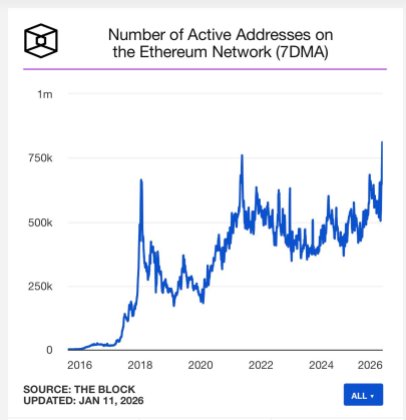
ETH active addresses at new peak | Source: Chart from Joseph Young on X

After delving into the metric, the expert disclosed that the number of active 7DMA wallet addresses on Ethereum is sitting at over 811,500. As active address counts reached historic levels, the network’s fundamentals appear to have started surpassing its price performance. Should this performance hold, it is likely to play a huge role in shaping ETH’s next major move.

The blockchain’s performance extends beyond just massive active wallet addresses. Young added that Ethereum is the most proven network with more than 10 years of track record, underscoring its reliability and robust scalability.

During the period, ETH remained one of the most active and liquid crypto ecosystems by far. With several key updates over the years, such as the Fusaka Upgrade, the ETH network is now scaling faster than it ever did since its launch.

ETH Carry Out More Transactions Than Ever

Given that a significantly high level of transactions is carried out on the network, Ethereum is still showing robust strength and a growing ecosystem. On-chain Foundation head of research, Leon Waidmann, shared a report that reveals that ETH is experiencing a wave of transactions, reaching unprecedented levels.

With over 2.2 million transactions being executed per day, the network has just hit yet another all-time high. The chart shows that the previous peak was positioned at 1.89 million per day, as recorded on January 10, reflecting its rising real-world usage in a period where network fundamentals are gaining robust significance.

While transactions continue to increase, the network’s transaction costs have remained extremely low. Swapping on the blockchain now costs just $0.04, Non-Fungible Token (NFT) sales cost about $0.06, borrowing fees are $0.03, and bridging costs, which are the lowest, are around $0.01.

ETH trading at $3,128 on the 1D chart | Source: ETHUSDT on Tradingview.com

Related Reads

Fu Peng's First Public Speech in 2026: What Exactly Are Crypto Assets? Why Did I Join the Crypto Asset Industry?

Fu Peng, a renowned macroeconomist and now Chief Economist at New火 Group, delivered his first public speech of 2026 at the Hong Kong Web3 Festival. He explained his perspective on crypto assets and why he joined the industry, framing it within the context of macroeconomic trends and financial evolution. Fu emphasized that crypto assets are transitioning from an early, belief-driven phase to a mature, institutionally integrated asset class. He drew parallels to the 1970s-80s, when technological advances (like computing) revolutionized traditional finance, leading to the rise of FICC (Fixed Income, Currencies, and Commodities). Similarly, current advancements in AI, data, and blockchain are reshaping finance, with crypto assets becoming part of a new "FICC + C" (C for Crypto) framework. He noted that institutional capital, including traditional hedge funds, avoided early crypto due to its speculative nature but are now engaging as regulatory clarity emerges (e.g., stablecoin laws, CFTC classifying crypto as a commodity). Fu predicted that 2025-2026 marks a turning point where crypto becomes a standardized, financially viable asset for diversified portfolios, akin to commodities or derivatives in traditional finance. Fu defined Bitcoin not as "digital gold" in a simplistic sense but as a value-preserving, financially tradable asset. He highlighted that crypto's future lies in regulated, institutional adoption, moving away from retail-dominated trading. His entry into crypto signals this maturation, where traditional finance integrates crypto into mainstream asset management.

marsbit6m ago

Fu Peng's First Public Speech in 2026: What Exactly Are Crypto Assets? Why Did I Join the Crypto Asset Industry?

marsbit6m ago

Justin Sun Sues Trump Family: What $75 Million Bought Was Only a Blacklist

Justin Sun, founder of Tron, has filed a lawsuit in federal court against World Liberty Financial (WLF), alleging he was made the "primary target of a fraudulent scheme" after investing $75 million. Sun claims the investment secured him an advisor title and WLFI tokens, which were later frozen by WLF, causing "hundreds of millions in losses." The dispute began in late 2024 when Sun's investment helped revive WLF's struggling token sale, which ultimately raised $550 million. Shortly after, the SEC dropped its lawsuit against Sun following Donald Trump's inauguration. However, relations soured when Sun refused WLF's demands for additional funding. In August 2025, WLF added a "blacklist" function to its smart contract, allowing it to unilaterally freeze tokens. Sun's holdings, worth approximately $107 million, were frozen, and he was threatened with token destruction. The lawsuit highlights WLF's structure, which directs 75% of token sale profits to the Trump family, who had earned $1 billion by December 2025. WLF's CEO is Zach Witkoff, son of U.S. Middle East envoy Steve Witkoff. The project faces scrutiny for opaque operations, including a controversial loan arrangement on the Dolomite platform, co-founded by a WLF advisor. Despite Sun's history with the SEC, the case underscores centralization risks within DeFi, as WLF controls governance and holds powers to freeze assets arbitrarily. Sun's tokens remain frozen as legal proceedings begin.

marsbit14m ago

Justin Sun Sues Trump Family: What $75 Million Bought Was Only a Blacklist

marsbit14m ago

$500 to Buy OpenAI Stock: Silicon Valley's Most Respectable Liquidity Invitation

Silicon Valley's largest venture capital platform, AngelList, has launched a new fund called USVC, allowing U.S. retail investors to buy into high-profile AI companies like OpenAI, Anthropic, and xAI with a minimum investment of $500—no accredited investor status required. Promoted by AngelList co-founder Naval Ravikant, the fund is framed as an opportunity for ordinary people to access high-growth private tech investments traditionally reserved for VCs. However, critics argue it functions more like an exit vehicle for early insiders. USVC acquires shares not through primary rounds but largely via secondary transactions—purchasing stakes from early investors, VC funds, and employees looking to cash out at peak valuations. With companies like xAI heavily weighted in the portfolio, the fund effectively channels retail money into providing liquidity for insiders who entered at much lower valuations. The fund’s structure raises concerns: shares are illiquid, with no secondary market, and buybacks are limited and discretionary. The actual annual fee reaches 3.61%, far above the advertised 1% management fee. This model parallels the "low float, high fully diluted valuation" strategy seen in crypto, where early investors profit by selling to latecomers at inflated prices. The timing—alongside similar moves by platforms like Robinhood—suggests that Silicon Valley’s sudden interest in retail inclusion may be less about democratizing access and more about securing exits for insiders.

marsbit45m ago

$500 to Buy OpenAI Stock: Silicon Valley's Most Respectable Liquidity Invitation

marsbit45m ago

Trading

Spot
Futures

Hot Articles

Discussions

Welcome to the HTX Community. Here, you can stay informed about the latest platform developments and gain access to professional market insights. Users' opinions on the price of ETH (ETH) are presented below.

活动图片















