Ethereum holds $2,100 as supply tightens: Is ETH recovery underway?

ambcryptoPublished on 2026-03-19Last updated on 2026-03-19

Abstract

Ethereum's price is showing signs of stabilization around $2,100, indicating a potential shift from a bearish to a recovery phase. After a sharp decline in February, selling pressure has weakened, with the price forming a consolidation range between $1,900 and $2,300. The emergence of higher lows suggests buyers are stepping in during pullbacks, while failed breakdowns below $1,900 point to possible bear traps. Derivatives data supports this transition, with Funding Rates near neutral and reduced aggressive short pressure. Open Interest has rebounded from $11 billion to $14 billion, indicating new positions rather than forced liquidations. Additionally, the Coinbase Premium Index is recovering toward neutral, signaling fading institutional selling pressure. These factors collectively suggest the market is moving from distribution to early accumulation, with cautious rebuilding of exposure as participants test whether demand can sustain higher price levels.

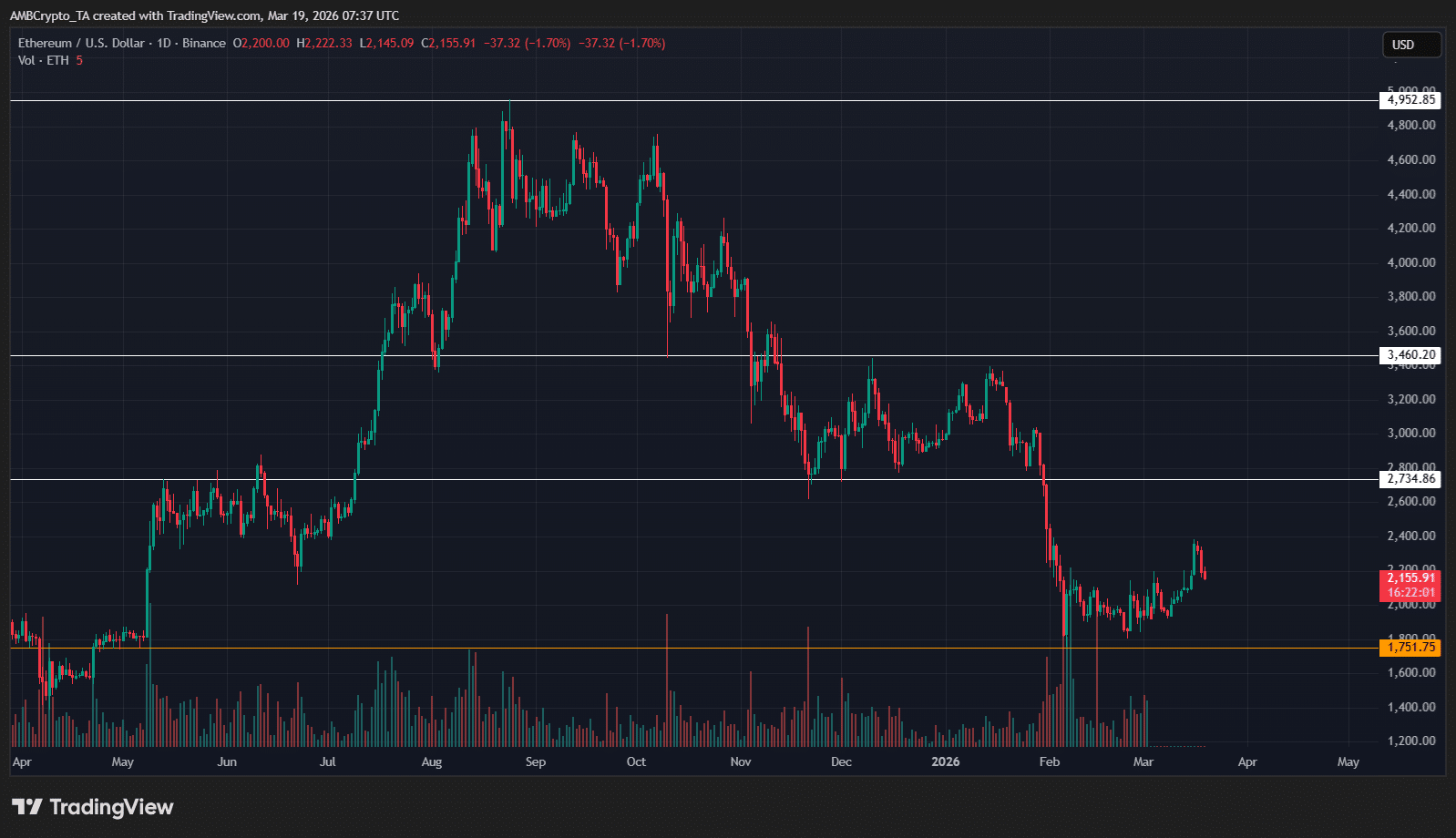
Ethereum’s [ETH] recent price action reflects a transition phase, where prior selling pressure begins to lose momentum while buyers test control. Around $2,155, the price reacts after rebounding from the $1,750 support zone, where demand absorbed earlier sell-offs.

Initially, the sharp February decline showed strong distribution, yet recent sessions reveal a slowdown in downside strength. As candle ranges tighten and impulsive moves fade, volatility compresses, suggesting sellers are weakening.
Source: TradingView

Meanwhile, the price stabilizes between $1,900 and $2,300, forming a clearer consolidation range. Within this structure, higher lows emerge gradually, showing buyers stepping in earlier on each pullback. At the same time, dips below $1,900 fail to extend lower, implying that previous breakdown attempts have failed and may instead be bear traps.

The structure now points to early accumulation, with sustained strength above $2,300 indicating a shift toward recovery.

Ethereum sees cautious rebuild

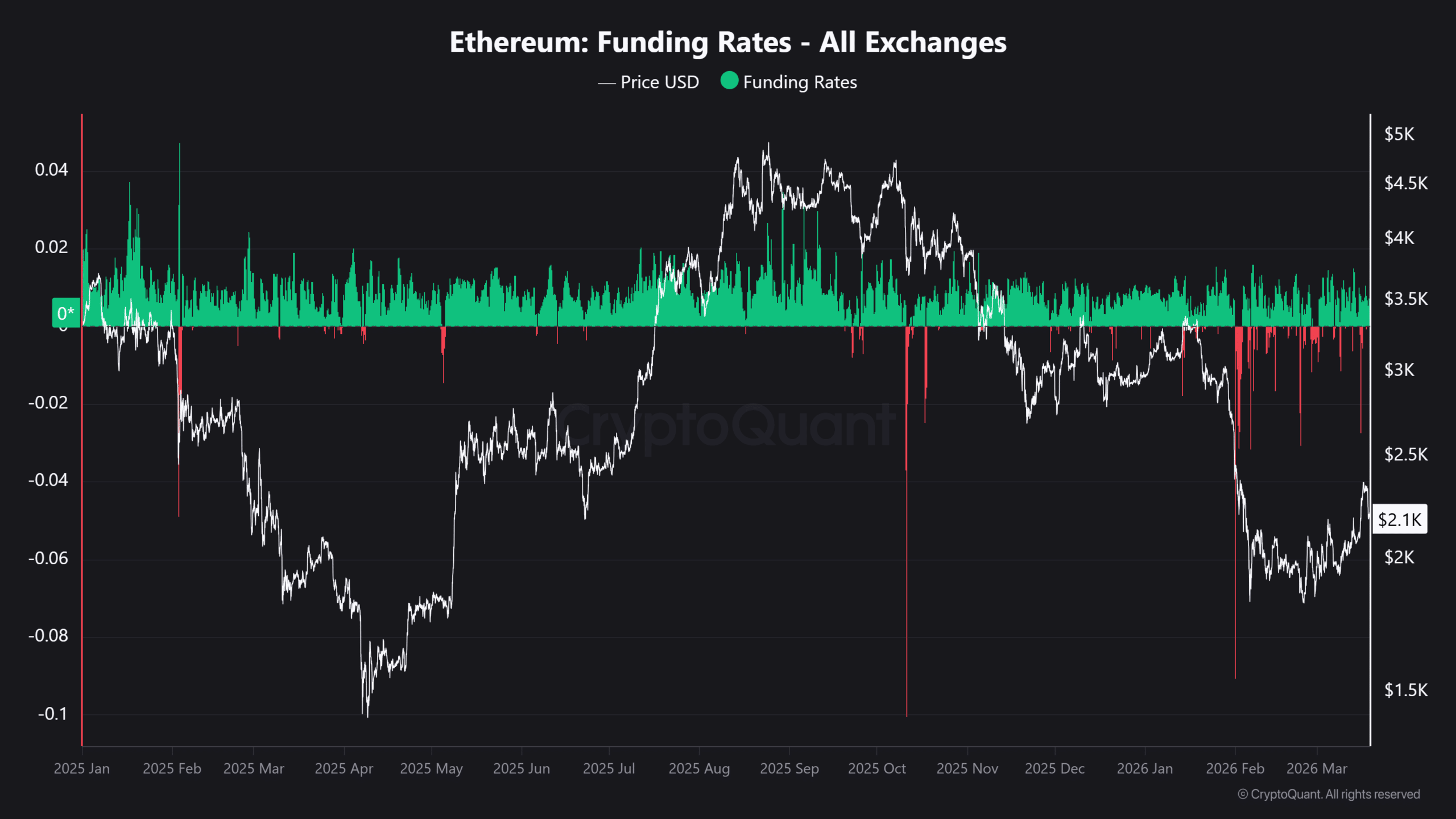
As Ethereum stabilizes near $2,100, derivatives and spot flows point to a shift from capitulation toward early repositioning.

At press time, Funding Rates hovered near neutral after repeated negative spikes, suggesting aggressive short pressure has eased. At the same time, extreme liquidation-driven moves appear less frequent, indicating reduced downside urgency.
Source: CryptoQuant

Meanwhile, Open Interest rebounded toward $14 billion from lows near $11 billion, signaling fresh positions entering rather than forced exits. This gradual rebuild reflects cautious participation rather than aggressive leverage expansion.
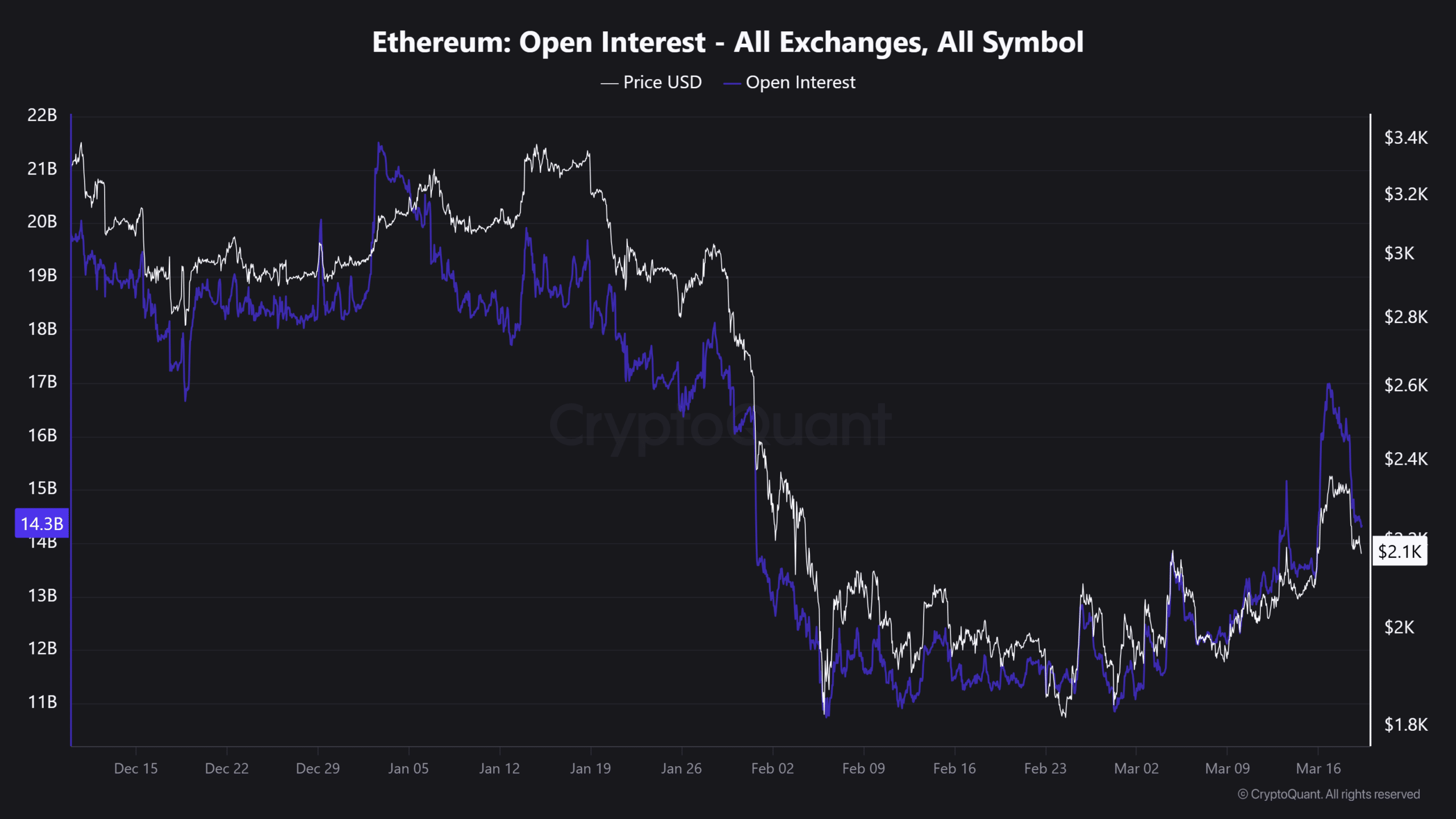
Source: CryptoQuant

In parallel, the Coinbase Premium Index was recovering toward neutral after prolonged negative readings, implying that selling pressure from institutional flows is fading.

Together, these shifts indicates the market is transitioning from distribution into early accumulation, where participants begin rebuilding exposure while testing whether demand can sustain higher levels.


Final Summary

Trending Cryptos

Related Reads

In Jinjiang, Fujian, a Storage Super Unicorn Lies Quiet

In Fujian's Jinjiang, a city known for sportswear, lies a quiet semiconductor giant: Fujian Jinhua Integrated Circuit Co. (JHICC). Once a promising domestic DRAM manufacturer alongside Yangtze Memory and ChangXin Memory Technologies (CXMT), its journey was derailed in 2018 when the U.S. placed it on an Entity List and filed criminal charges for alleged trade secret theft. This halted production for years. A turning point came in February 2024 when a U.S. federal court found JHICC not guilty. However, it had lost crucial time. While CXMT soared to become a top-valued A-share company in 2024, JHICC, with an estimated valuation of 80 billion RMB, was just restarting. Its current output is primarily customized DDR4 chips, not the advanced DDR5/HBM demanded for AI, but it still benefits from the broader memory chip upcycle. JHICC's story is tied to Chen Zhengkun, a veteran engineer who left Micron to lead the venture. Founded in 2016 with state-backed funding, JHICC partnered with Taiwan's UMC to develop DRAM technology. Rapid progress was cut short by the U.S. actions, which Micron initiated, partly due to its heavy reliance on the Chinese market. Post-sanctions, Chen's team worked to rebuild the production line with reduced reliance on U.S. technology. According to its records, JHICC achieved small-scale production and revenue growth under immense pressure. It now focuses on the stable "niche" DRAM market (e.g., TVs, routers) with a monthly capacity of ~40,000 wafers, aiming for 60,000 by 2026. It holds over 1,000 patents but remains on the Entity List. For Jinjiang, investing in JHICC was a bold industrial leap. The local government provided unwavering financial and logistical support during the crisis, helping the company survive. JHICC has become the anchor for a growing local semiconductor cluster. Though its scale lags behind domestic peers, JHICC's persistence symbolizes a hard-won foothold in a global market long dominated by Samsung, SK Hynix, and Micron. Having missed one boom, it seeks a place in the new AI-driven memory supercycle.

marsbit1h ago

In Jinjiang, Fujian, a Storage Super Unicorn Lies Quiet

marsbit1h ago

Trading

Spot

Hot Articles

Discussions

Welcome to the HTX Community. Here, you can stay informed about the latest platform developments and gain access to professional market insights. Users' opinions on the price of ETH (ETH) are presented below.

活动图片














