Ethereum Foundation Maps Path To zkEVM Proofs On Mainnet L1

bitcoinistPublished on 2026-01-16Last updated on 2026-01-16

Abstract

The Ethereum Foundation has outlined a detailed plan to enable Ethereum's mainnet (L1) to validate blocks using zkEVM proofs, reducing the need for validators to re-execute every transaction. The proposal, shared by EF Co-Executive Director Tomasz K. Stańczak, involves engineering work across execution and consensus clients, new proving infrastructure, and security processes. Key milestones include creating a standardized "ExecutionWitness" data structure per block, developing a zkEVM guest program for stateless validation, and updating consensus clients to verify zk proofs during block validation. The plan also emphasizes operational readiness, including proof generation integration, GPU testing, benchmarking, and security measures like reproducible builds and formal threat models. A major dependency is ePBS (enshrined Proposer-Builder Separation), which would extend proof generation time from 1–2 seconds to 6–9 seconds, and is targeted for deployment in mid-2026. If implemented, this would make proof-based validation a practical option on L1, though proving times and operational complexity remain key challenges.

The Ethereum Foundation has published a step-by-step plan to let Ethereum’s main chain validate blocks using zkEVM proofs, reducing the need for validators to re-run every computation themselves. The proposal, shared via X on Jan. 15 by Tomasz K. Stańczak, Co-Executive Director at the Ethereum Foundation, lays out the engineering work needed across Ethereum’s execution and consensus clients, plus new proving infrastructure and security processes.

Ethereum L1 Moves Toward zk Proof-Based Validation

Already in July last year, the Ethereum Foundation announced its “zk-first” approach. Today, Ethereum’s validators typically check a block by re-executing the transactions and comparing results. The plan proposes an alternative: validators could verify a cryptographic proof that the block’s execution was correct.

The document summarizes the intended pipeline in plain terms: an execution client produces a compact “witness” package for a block, a standardized zkEVM program uses that package to generate a proof of correct execution, and consensus clients verify that proof during block validation.

The first milestone is creating an “ExecutionWitness,” a per-block data structure containing the information needed to validate execution without re-running it. The plan calls for a formal witness format in Ethereum’s execution specifications, conformance tests, and a standardized RPC endpoint. It notes that the current debug_executionWitness endpoint is already “being used in production by Optimism’s Kona,” while suggesting a more zk-friendly endpoint may be needed.

A key dependency is adding better tracking of which parts of state a block touches, via Block Level Access Lists (BALs). The document says that as of November 2025, this work was not treated as urgent enough to be backported to earlier forks.

The next milestone is a “zkEVM guest program,” described as stateless validation logic that checks whether a block produces a valid state transition when combined with its witness. The plan emphasizes reproducible builds and compiling to standardized targets so assumptions are explicit and verifiable.

Beyond Ethereum-specific code, the plan aims to standardize the interface between zkVMs and the guest program: common targets, common ways to access precompiles and I/O, and agreed assumptions about how programs are loaded and executed.

On the consensus side, the roadmap calls for changes so consensus clients can accept zk proofs as part of beacon block validation, with accompanying specifications, test vectors, and an internal rollout plan. The document also flags execution payload availability as important, including an approach that could involve “putting the block in blobs.”

The proposal treats proof generation as an operational problem as much as a protocol one. It includes milestones to integrate zkVMs into EF tooling such as Ethproofs and Ere, test GPU setups (including “zkboost”), and track reliability and bottlenecks.

Benchmarking is framed as ongoing work, with explicit goals like measuring witness generation time, proof creation and verification time, and the network impact of proof propagation. Those measurements could feed into future gas repricing proposals for zk-heavy workloads.

Security is also marked as perpetual, with plans for formal specs, monitoring, supply-chain controls like reproducible builds and artifact signing, and a documented trust and threat model. The document proposes a “go/no-go framework” for deciding when proof systems are mature enough for broader use.

One external dependency stands out: ePBS, which the document describes as necessary to give provers more time. Without it, the plan says the prover has “1–2 seconds” to create a proof; with it, “6–9 seconds.” The document adds a two-sentence framing that captures the urgency: “This is not a project that we are working on. However, it is an optimization that we need.” It expects ePBS to be deployed in “Glamsterdam,” targeted for mid-2026.

If these milestones land, Ethereum would be moving toward proof-based validation as a practical option on L1, while the timing and operational complexity of proving remain the gating factors.

At press time, ETH traded at $3,300.
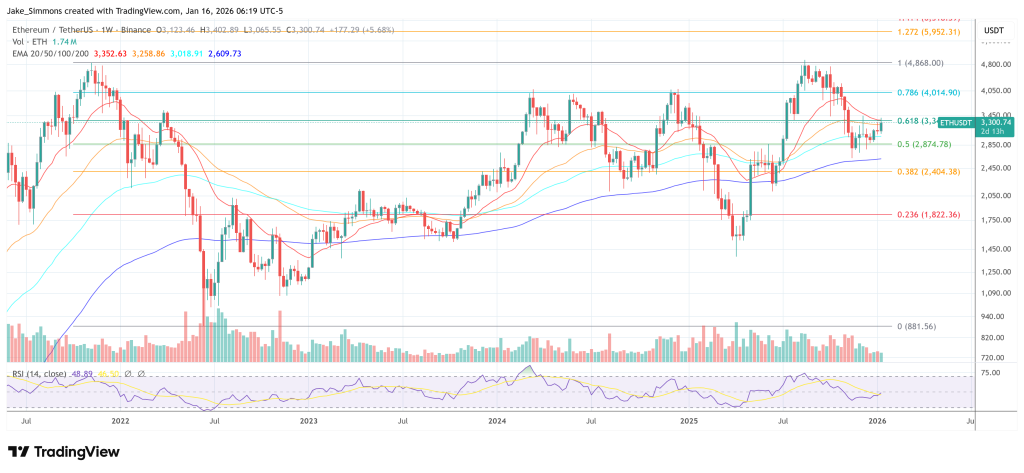
ETH faces the 0.618 Fib, 1-week chart | Source: ETHUSDT on TradingView.com

Related Questions

QWhat is the main goal of the Ethereum Foundation's new proposal regarding zkEVM proofs?

AThe main goal is to enable Ethereum's main chain to validate blocks using zkEVM proofs, reducing the need for validators to re-execute every computation themselves by verifying cryptographic proofs of correct execution instead.

QWhat is an 'ExecutionWitness' as described in the plan?

AAn 'ExecutionWitness' is a per-block data structure that contains the information needed to validate execution without re-running it, including a formal witness format in Ethereum’s execution specifications, conformance tests, and a standardized RPC endpoint.

QWhy is Block Level Access Lists (BALs) important for this proposal?

ABlock Level Access Lists (BALs) are important because they enable better tracking of which parts of the state a block touches, which is a key dependency for generating the execution witness needed for zkEVM proof validation.

QWhat role does ePBS play in the implementation of zkEVM proofs on L1?

AePBS (proposer-builder separation enhancement) is necessary to give provers more time to create proofs, extending the proof creation window from 1-2 seconds to 6-9 seconds, and is considered an essential optimization for the plan.

QHow does the proposal address security concerns related to zkEVM proof validation?

AThe proposal addresses security through formal specifications, monitoring, supply-chain controls like reproducible builds and artifact signing, a documented trust and threat model, and a 'go/no-go framework' to decide when proof systems are mature enough for broader use.

Related Reads

Vitalik's Vision for the Next Evolution of On-Chain Finance: How to Reconstruct DeFi with an 'Options Mindset'?

Vitalik Buterin recently proposed a conceptual shift for DeFi: replacing traditional Collateralized Debt Positions (CDPs) and forced liquidations with an options-based mechanism. This aims to address key vulnerabilities in current DeFi lending. The traditional CDP model, foundational to protocols like MakerDAO and Aave, allows users to borrow against collateral but relies on real-time oracles and triggers sudden, mandatory liquidations during price volatility. This can cause cascading sell-offs, oracle manipulation risks, and significant MEV extraction, exacerbating market stress. Vitalik's alternative envisions splitting an asset like 1 ETH into two complementary components: one offering stable/index-like exposure and the other absorbing the opposite risk/reward. Instead of a hard liquidation threshold, a user's exposure to the target asset would gradually and smoothly deviate (following a near-quadratic curve) as the collateral price moves. The system would primarily depend on "slow oracles" for periodic settlement rather than instant price feeds. Key potential benefits include: the elimination of abrupt, forced liquidations; drastically reduced reliance on vulnerable real-time oracles; and inherent resistance to certain MEV exploits centered on liquidation auctions. The article posits that for Ethereum DeFi to maintain its relevance amid competition from faster, cheaper chains, it must compete on sophisticated financial engineering and robustness—not just transaction speed or yields. The core value proposition should shift towards offering users clearer, more manageable risk structures, greater autonomy, and resilience in extreme scenarios, moving DeFi from high-risk experimentation towards becoming reliable financial infrastructure.

marsbit18m ago

Vitalik's Vision for the Next Evolution of On-Chain Finance: How to Reconstruct DeFi with an 'Options Mindset'?

marsbit18m ago

AI Agent Completely Transforms Web3 Gaming: From the Rugpull Bakery Bot Controversy to the New 2026 Agent Paradigm

This article explores how the AI Agent paradigm is fundamentally transforming Web3 gaming, moving from a disruptive force to a core, legitimized element. It begins with the controversy in the competitive baking game Rugpull Bakery, where automated scripts caused fairness issues. Instead of banning them, the developers integrated AI Agents into the official gameplay by providing technical documentation (skill.md, agent.json), marking a shift towards "Agentic Gaming." The piece outlines three primary implementation models for AI Agents in Web3 games by 2026: 1. **Autonomous Competitors & Economic Entities:** AI Agents act as independent players with unique strategies. Examples include TEN Protocol's poker agents, AI Arena's trainable NFT fighters, and Satoshi Strike Force's "Digital Athletes" trained on player data. The Somnia blockchain is highlighted as a dedicated "Agentic L1" infrastructure supporting this model at scale. 2. **Modular Infrastructure & Programmable Environments:** This model, exemplified by EVE Frontier, allows AI Agents to program game world logic itself. Using "Smart Assemblies" (e.g., Smart Turrets, Smart Gates), Agents can modify shared economic and physical rules on-chain, creating dynamic, player/AI-built worlds. The ERC-8183 standard further enables these automated entities to hire other AI services for complex tasks. 3. **Hybrid Companions & Dynamic Adaptation:** Here, AI serves as a collaborative partner. In Parallel Colony, highly autonomous AI Avatars work alongside human players who provide high-level guidance. Illuvium plans to use AI to make NPCs dynamic and responsive, creating personalized, emergent narratives for each player. The conclusion posits that Web3 gaming has reached a "post-human" inflection point. Blockchains' transparency and programmability, combined with new standards and infrastructure like Somnia, make integrating and governing AI Agents not just viable but essential. The future lies in a symbiotic digital order where players transition from manual laborers to commanders and partners of algorithmic intelligence.

marsbit1h ago

AI Agent Completely Transforms Web3 Gaming: From the Rugpull Bakery Bot Controversy to the New 2026 Agent Paradigm

marsbit1h ago

Trading

Spot
Futures

Hot Articles

Discussions

Welcome to the HTX Community. Here, you can stay informed about the latest platform developments and gain access to professional market insights. Users' opinions on the price of ETH (ETH) are presented below.

活动图片