Ethereum Foundation Maps 2026 Protocol Priorities as Major Upgrades Near

bitcoinistPublished on 2026-02-19Last updated on 2026-02-19

Abstract

The Ethereum Foundation has released its protocol priorities for 2026, outlining a structured roadmap organized into three key tracks: Scale, Improve UX, and Harden the L1. The Scale track, a consolidation of previous initiatives, focuses on increasing the gas limit toward and beyond 100 million, implementing EIP-7928 for block-level access lists, and advancing the scaling components of the upcoming "Glamsterdam" upgrade. This includes enshrined Proposer-Builder Separation (EIP-7732), further blob parameter increases, and progressing zkEVM and long-term state scaling work. The Improve UX track is centered on native account abstraction and interoperability. Key proposals like EIP-7702 aim to make smart contract wallets the default without extra overhead, while the Open Intents Framework seeks to enable seamless cross-L2 interactions. This work is also tied to improving security and migrating toward quantum-resistant signatures. The new Harden the L1 track is described as an insurance policy, focusing on post-quantum readiness, execution-layer safeguards, and enhancing censorship resistance through proposals like EIP-7805 (FOCIL). It also includes critical devnet and testnet coordination. The foundation is targeting the Glamsterdam upgrade for the first half of 2026, bundling these priorities, with another upgrade, Hegotá, planned for later in the year.

The Ethereum Foundation’s protocol track leads published a new “Protocol Priorities Update for 2026” on Feb. 18, outlining how core R&D will be organized this year and what the next upgrade cycle is expected to emphasize.

Ethereum’s Priorities In 2026

The update looks back at 2025 as a high-throughput year for mainnet changes, anchored by two network upgrades. Pectra shipped in May, Fusaka followed in December with PeerDAS on mainnet. Alongside those upgrades, the community increased the mainnet gas limit from 30 million to 60 million, calling it the first significant jump since 2021.

The main change is organizational. “Now that those milestones are behind us, we have the opportunity to think about how we organize our work at a slightly higher level,” the authors wrote. For 2026, Protocol work is grouped into three tracks: Scale, Improve UX, and Harden the L1, each with named leads.

The Scale track, led by Ansgar Dietrichs, Marius van der Wijden, and Raúl Kripalani, merges last year’s “Scale L1” and “Scale Blobs” initiatives into one effort. The foundation frames this as a pragmatic consolidation, because execution capacity, networking, and consensus changes tend to land in the same client code and influence each other.

On the roadmap, the update highlights continued gas limit increases “toward and beyond 100M,” supported by block-level access lists via EIP-7928 and ongoing client benchmarking. It also flags “the scaling components of Glamsterdam,” including enshrined PBS through EIP-7732, repricings, and further blob parameter increases.

Beyond that, the Scale track includes pushing a zkEVM attester client from prototype toward production readiness, and longer-run state scaling work that spans near-term repricing and history expiry through to binary trees and statelessness.

The Improve UX track, led by Barnabé Monnot and Matt Garnett, narrows in on two areas the foundation calls the most leverage for 2026 usability: native account abstraction and interoperability.

On account abstraction, the update positions EIP-7702 as a step toward an endpoint where smart contract wallets become the default without bundlers, relayers, or extra gas overhead. It points to proposals including EIP-7701 and EIP-8141, described as “Frame Transactions,” as work that moves smart account logic deeper into the protocol itself.

That UX roadmap is also tied to security direction. The foundation argues native account abstraction provides a cleaner migration path away from ECDSA-based authentication, and says parallel proposals aim to make quantum-resistant signature verification meaningfully cheaper inside the EVM.

Interoperability work builds on the Open Intents Framework with the stated goal of “seamless, trust-minimized cross-L2 interactions,” supported by faster L1 confirmations and shorter L2 settlement times.

The new Harden the L1 track, led by Fredrik Svantes, Parithosh Jayanthi, and Thomas Thiery, is framed as insurance policy work that preserves Ethereum’s core properties while scaling continues.

The update ties security efforts to Svantes’ Trillion Dollar Security Initiative, including post-quantum readiness and execution-layer safeguards like post-execution transaction assertions and “trustless RPCs.”

On censorship resistance, Thiery’s scope includes FOCIL via EIP-7805 and extensions that touch censorship resistance for blobs, statelessness work labeled VOPS, and the development of measurable censorship-resistance metrics. Jayanthi’s remit covers devnets, testnets, and client interoperability testing, which the foundation says becomes more critical if Ethereum moves into a faster fork cadence.

Looking ahead, the foundation targets Glamsterdam for the first half of 2026, with Hegotá planned later in the year. The stated ambition bundles parallel execution, significantly higher gas limits, enshrined PBS, continued blob scaling, and progress on censorship resistance, native account abstraction, and post-quantum security, with more track-level updates promised as the year unfolds.

At press time, Ethereum traded at $1,968.
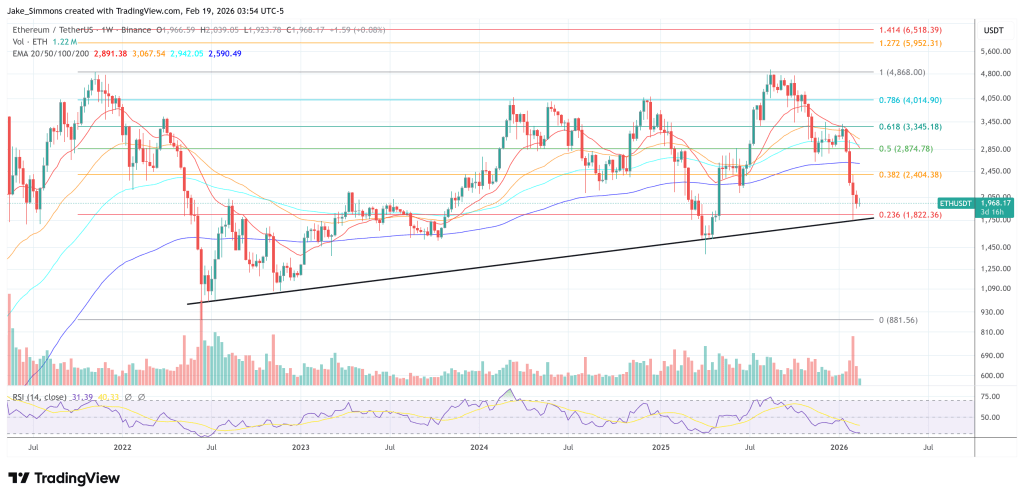
Ethereum remains below the 200-week EMA, 1-week chart | Source: ETHUSDT on TradingView.com

Related Questions

QWhat are the three main tracks for Ethereum's protocol work in 2026 as outlined by the Ethereum Foundation?

AThe three main tracks are: Scale (led by Ansgar Dietrichs, Marius van der Wijden, and Raúl Kripalani), Improve UX (led by Barnabé Monnot and Matt Garnett), and Harden the L1 (led by Fredrik Svantes, Parithosh Jayanthi, and Thomas Thiery).

QWhat is the goal of the mainnet gas limit increases mentioned in the 2026 priorities, and what EIP supports this effort?

AThe goal is to increase the gas limit 'toward and beyond 100M.' This effort is supported by EIP-7928, which introduces block-level access lists.

QAccording to the update, what is EIP-7702 and what long-term goal does it serve for user experience?

AEIP-7702 is a proposal that is a step toward making smart contract wallets the default without requiring bundlers, relayers, or extra gas overhead. It serves the long-term goal of native account abstraction.

QWhat are the two major network upgrades planned for 2026, and when are they targeted?

AThe two major upgrades are Glamsterdam, targeted for the first half of 2026, and Hegotá, planned for later in the year.

QWhich initiative is the new 'Harden the L1' security track tied to, and what are two specific areas of focus within it?

AThe security track is tied to Fredrik Svantes' Trillion Dollar Security Initiative. Two specific areas of focus are post-quantum readiness and execution-layer safeguards like post-execution transaction assertions and 'trustless RPCs'.

Related Reads

How Difficult is Chip Making? A Division Error Costs 475 Million Dollars

How Hard Is It to Make a Chip? A Division Error Cost $475 Million Chip expert Shi Kan, a researcher at the Chinese Academy of Sciences and a popular tech creator, explains the immense challenges of chip development. Chips are foundational to modern technology, but their creation is extraordinarily difficult. The journey from sand to a functional chip involves complex design and manufacturing, but a critical bottleneck is verification—ensuring the design works flawlessly before costly production. A single, undetected bug can have catastrophic consequences, as illustrated by the infamous 1994 Intel Pentium FDIV bug. A flaw in the floating-point division unit forced a recall costing $475 million. Unlike software, chips cannot be easily patched after manufacture, making "first-time success" paramount. However, industry surveys show only 24% of chip projects achieve this; over three-quarters require at least one costly re-spin due to design flaws. Verification has thus become the dominant phase, consuming up to 70% of the design cycle. The core challenge is a "verification impossible triangle" between high performance, good debuggability, and low cost. Exhaustively verifying a modern CPU core could take 15,000 years with software simulation, or 30 years with advanced hardware emulation—timeframes utterly impractical for development. Despite being essential, verification is often seen as unglamorous "dirty work," receiving less academic attention than fields like AI. Shi and his team are tackling this by developing an agile verification research framework called ENCORE, based on FPGA technology, to improve verification efficiency and debug capability. Beyond research, Shi engages in public science communication through long-form video content, aiming to demystify chip technology, AI, and computer science. He argues for the value of pursuing "hard and long-term" endeavors, whether in the meticulous world of chip verification or in creating substantive educational content, believing such sustained effort is likely the right path forward.

marsbit9m ago

How Difficult is Chip Making? A Division Error Costs 475 Million Dollars

marsbit9m ago

Blockchain Has Finally Started to Sail into the Mainstream After 18 Years

Blockchain Finds Its True Path After 18 Years: Becoming the Financial Backbone for AI Agents and Autonomy This analysis explores a pivotal shift in the blockchain and crypto investment landscape, driven by the dominance of AI. Major venture capital firms, including Variant, Paradigm, Haun Ventures, and YZi Labs, are moving beyond pure "crypto" investment theses. They are expanding their focus to AI, robotics, and frontier tech, signaling that blockchain is no longer seen as a standalone sector but as an underlying infrastructure layer. The core argument is that blockchain's killer application may not be user-facing apps, but rather providing the economic rails for the coming wave of AI agents, autonomous robots, and automated systems. Key capabilities like self-custody wallets, programmable stablecoins for micropayments, on-chain identity, and verifiable smart contracts are positioned as essential for a future where machines conduct economic activity. The recent $1.4 billion investment by Tether (via its venture arm) in German robotics company NEURA Robotics exemplifies this, aiming to embed Tether's wallet tools directly into robots for autonomous transactions. While many "AI + Crypto" projects remain superficial, the article concludes that true value lies where crypto is a necessary component—enabling machine-to-machine payments, agent autonomy, verifiable data provenance, and open financial settlement for the AI era. For crypto venture capital, this convergence with AI represents both an adaptation to shifting capital flows and a potential path to unlocking the large-scale, non-speculative utility the industry has long sought.

marsbit30m ago

Blockchain Has Finally Started to Sail into the Mainstream After 18 Years

marsbit30m ago

Blockchain has finally begun sailing toward the main channel after 18 years

After 18 years of development, blockchain technology is beginning to move from a specialized niche into mainstream adoption, according to a recent industry analysis. The shift is reflected in the changing strategies of major crypto venture capital firms, which are expanding their focus beyond pure "digital ownership" towards broader themes like "autonomy." The report highlights that leading VC firms like Variant, Paradigm, Haun Ventures, and YZi Labs are broadening their investment mandates to include not only crypto but also artificial intelligence (AI), robotics, biotech, and other frontier technologies. This reflects a recognition that the isolated "crypto investment" narrative is losing appeal to limited partners (LPs) as capital and attention increasingly flow toward AI and other high-growth tech sectors. A key emerging thesis is that blockchain's most significant future application may not be as a consumer-facing product, but as the underlying economic and settlement infrastructure for the AI era. As AI agents and autonomous systems become more prevalent, they will require programmable, global, and low-cost payment networks (like stablecoins), verifiable digital identities, and secure wallets to manage transactions and assets on behalf of users. The investment by stablecoin issuer Tether into robotics company NEURA, with plans to integrate its wallet technology, is cited as a prime example of this convergence. However, the article cautions that simply labeling projects as "AI + Crypto" is insufficient. True value lies in integrations where blockchain technology is essential—such as enabling machine-to-machine micropayments, verifiable data provenance for AI, or transparent governance for autonomous organizations—rather than being a superficial marketing add-on. In conclusion, while AI currently dominates the tech narrative and capital flows, it may ultimately create the real-world, high-frequency demand that the crypto industry has long sought. For crypto VCs and projects, the path forward is to position blockchain not as a competing sector, but as a critical foundational layer powering autonomy and economic activity in an AI-driven future.

链捕手36m ago

Blockchain has finally begun sailing toward the main channel after 18 years

链捕手36m ago

Y Combinator Co-founder: How to Make a Billion Dollars?

The Y Combinator co-founder argues that becoming a billionaire by founding a successful startup is not only possible but demonstrably achievable without unfair or unethical practices. He disputes a politician's claim to the contrary, using the example of a founder whose company grew at 93% monthly solely through creating a product users loved and recommended. The core mechanism is exponential growth. A conservative 15% monthly growth rate compounds to a 4384x increase over five years, which can easily lead to billion-dollar valuations and founder wealth. The process depends on two key variables: the growth rate and the duration it can be sustained. A high growth rate stems from a great product that users naturally promote, while a long duration requires a large enough market. For aspiring founders, especially young ones, the simplest path is to build something they and their friends genuinely need. Young people's current needs often predict future mass-market trends. He advises against actively "searching" for ideas, as this tends to filter out unconventional but promising ones. Instead, inspiration should come from working on interesting projects with friends, as many iconic companies (e.g., Apple, Facebook) started this way. Ultimately, building a massively valuable startup is not about exploitation but empathy: deeply understanding a user group and building a product that significantly improves their lives. This, powered by exponential growth in a large market, is the legitimate path to immense wealth creation.

Foresight News39m ago

Y Combinator Co-founder: How to Make a Billion Dollars?

Foresight News39m ago

Trading

Spot
Futures

Hot Articles

Discussions

Welcome to the HTX Community. Here, you can stay informed about the latest platform developments and gain access to professional market insights. Users' opinions on the price of ETH (ETH) are presented below.

活动图片