Ethereum Foundation Locks Up More ETH As Staking Activity Intensifies

bitcoinistPublished on 2026-04-01Last updated on 2026-04-01

Abstract

Ethereum Foundation Locks Up More ETH As Staking Activity Intensifies Staking activity on the Ethereum network is gaining significant attention, particularly as large institutional investors increase their participation. A notable development is the Ethereum Foundation's recent move to stake $42.2 million worth of ETH, signaling strong confidence in the network's long-term economics and security. This aligns with founder Vitalik Buterin's statements about changing ETH's direction, a pivot that could redefine the entire ecosystem. Despite bearish market conditions and price volatility, staking participation continues to grow substantially. Nearly 3 million ETH are currently awaiting staking, with an entry queue of around 50 days, while the exit queue has nearly vanished—indicating strong holder confidence. Total ETH staked has now exceeded 38 million, representing over 31% of the entire supply. This trend suggests a classic market disconnection where weakening price action contrasts with strengthening network participation, as supply is being locked away and demand builds.

Staking activity on the Ethereum network is taking the spotlight as the altcoin’s price continues to face heightened volatility. One notable aspect of the development is the significant increase in staking activity among large institutional investors. The most recent staking move triggering a frenzy in the ETH community comes from The Ethereum Foundation.

Major ETH Stake by Ethereum Foundation

With the market still lingering in a bearish state, the frenzy around Ethereum’s price has cooled down and shifted toward a more dynamic trend. However, A recent notable move by the Ethereum Foundation is attracting attention to the staking activity across the ETH network, which appears to be experiencing substantial growth over the past few months.

Crypto commentator and investor Kyle Chasse has taken to X to report a massive staking from the Foundation, which saw $42.2 million worth of ETH being locked away in staking contracts. This development coincides with an increase in staking participation as more holders, especially institutional, decide to lock up their assets in exchange for yield.

By allocating a sizeable portion of ETH to staking, the Ethereum Foundation is showcasing its robust confidence in the network’s economics and security in the long term. With these persistent large ETH staking from The Foundation and other large institutions across the sector, the expert believes that the altcoin could change forever.
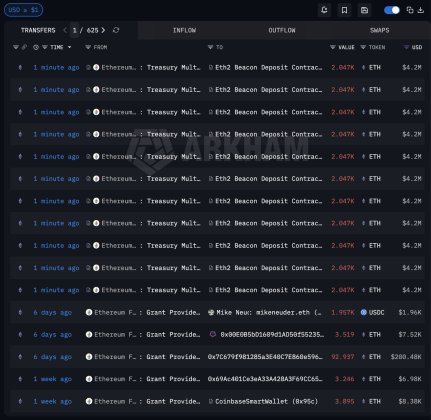
Source: Chart from Kyle Chasse on X

According to the expert, the Foundation made the move as Vitalik Buterin, the founder of Ethereum, gave an open statement about changing ETH’s direction. This revelation from the founder carries major weight since it will reshape the altcoin and its network’s future.

Chasse stated that there is still a lot to build, and a pivot like this is capable of redefining the entire ETH ecosystem. However, this move still poses some real risk if it eventually fails at execution. In the event that the team discovers the right angle and delivers real utility, this plan could go down as one of the most crucial moves in crypto history.

ETH Is Being Locked Away Everywhere

A market expert with the nickname AltCryptoGems has outlined the magnitude of Ethereum staking after multiple moves. While ETH is getting sold on the chart, the leading altcoin is being staked across the sector. Currently, nearly 3 million ETH is sitting around to be staked, with the entry queue now around 50 days.

At the same time, the exit queue has almost vanished as very few are leaving, which indicates a clear imbalance. If confidence were weak, exits would have spiked, causing staking to slow down. However, the opposite is happening as participants are locking ETH for months at a 2.7% yield.

Total ETH staked has now surpassed 38 million, representing over 31% of the entire supply. Meanwhile, this number continues to increase despite declining price action. ETH’s price is demonstrating weakness, but participation is showing strength, a classic disconnection that does not last long. Supply may be getting locked away, but demand is building.

ETH trading at $2,058 on the 1D chart | Source: ETHUSDT on Tradingview.com

Related Questions

QWhat significant action did the Ethereum Foundation recently take regarding ETH?

AThe Ethereum Foundation staked $42.2 million worth of ETH, locking it in staking contracts.

QAccording to the article, what does the Ethereum Foundation's large stake demonstrate?

AIt showcases the Foundation's robust confidence in the Ethereum network's long-term economics and security.

QWhat does the near-vanishing exit queue for ETH staking indicate, according to the expert AltCryptoGems?

AIt indicates a clear imbalance and shows confidence is strong, as very few participants are leaving staking despite the declining price action.

QWhat percentage of the total ETH supply is currently staked?

AOver 31% of the entire ETH supply, which is more than 38 million ETH, is currently staked.

QHow does the article describe the current relationship between ETH's price and staking participation?

AThere is a classic disconnection where ETH's price is demonstrating weakness, but staking participation is showing strength, suggesting that demand is building while supply is being locked away.

Related Reads

Apple's Desired On-Device AI Sees a Dark Horse Emerge: The First Cognitive Model is Born, 4B Matches GPT-5.4

A Chinese company, Tomorrow's Journey (Nextie), has introduced what it is calling the industry's first "cognitive model" for edge devices. Named New Journey Alpha, this 4-billion-parameter model reportedly matches the performance of trillion-parameter giants like GPT-5.4 in group intelligence tasks such as debate and collective decision-making. The development follows Andrej Karpathy's vision of stripping vast factual knowledge from large language models to retain only a smaller "cognitive core" capable of reasoning, planning, and knowing its own limits. This approach directly addresses the soaring computational costs and token expenses hindering AI's widespread deployment, as highlighted by incidents like Amazon shutting down an internal AI tool due to prohibitive costs. Trained via reinforcement learning on a corpus of academic papers from 1800-2020 to enhance generalization, the model enables three key advancements: 1) Improved decision quality in multi-agent systems, 2) Drastically reduced compute costs, allowing for cost-effective cloud or on-device (e.g., MacBook) deployment, and 3) The feasibility of "proactive" AI agents that act autonomously without user prompts, unlocking new commercial possibilities beyond today's reactive models. Built by the former Microsoft Xiaoice team—known for creating a 3.6B model that outperformed a 65B Llama model—the company is now focusing on the multi-agent systems sector, a field gaining significant investor interest. The model's economic impact is profound; by achieving high-level performance with minimal parameters, it fundamentally alters the cost structure of AI services, challenging the prevailing model of ever-larger parameter counts.

marsbit17m ago

Apple's Desired On-Device AI Sees a Dark Horse Emerge: The First Cognitive Model is Born, 4B Matches GPT-5.4

marsbit17m ago

OpenAI's 'Blueprint for the Future': Making AI Beneficial for Every Person on the Planet

A new transformative technology emerges every few generations. OpenAI draws a parallel with the advent of electricity in the 1920s, which initially brought convenience but ultimately enabled unprecedented progress in medicine, engineering, and living standards by empowering people to create new possibilities. AI is poised to recreate this phenomenon. Its true significance lies not in the technology itself, but in what people can achieve with it—from understanding a medical bill or starting a business to aiding scientific discovery. OpenAI believes AI should be universally accessible, allowing everyone to use it according to their own needs. This future, however, is not guaranteed. While transformative tech can centralize power, OpenAI's philosophy is that AI must serve humanity, augmenting human capabilities and broadly distributing its benefits. The company's first commitment is to build AI for human service, aiming to empower the many rather than concentrate power in a few. Safety, alignment with human intent, and oversight are paramount. OpenAI is optimistic about AI's potential to expand human welfare but remains clear-eyed about risks. The goal is to help people achieve more, not to replace them. Full automation is not the desired future; human judgment, values, and direction will become even more critical. OpenAI outlines three core goals: 1. Build automated AI researchers to accelerate and increasingly automate the research process itself, maintaining close human collaboration. The internal projection is that by March 2028, a significant portion of their research will be conducted by AI systems working alongside human researchers. 2. Accelerate economic development by advancing science, boosting productivity, and fostering growth, while ensuring the fruits are widely shared. 3. Provide a personal AGI for everyone on Earth, allowing individuals to benefit from this transformative technology in their own way. The company is entering its third phase, moving from foundational AGI research (Phase 1) to product deployment and learning from real-world use (Phase 2). The current challenge is making advanced AI abundant, affordable, safe, practical, and usable for all individuals and organizations. OpenAI concludes that a widely distributed power structure leads to a more resilient, adaptable, and free society. A positive AI future should not be controlled by a handful of entities but built, benefited from, and owned by many. If realized correctly, AI can become a cornerstone for enhancing global productivity, creativity, scientific advancement, and economic opportunity, fulfilling the mission to ensure AGI benefits all of humanity.

marsbit1h ago

OpenAI's 'Blueprint for the Future': Making AI Beneficial for Every Person on the Planet

marsbit1h ago

Arthur Hayes' New Article: AI Bubble Nears Bursting, Crypto Market Faces Short-Term Pressure

In a new essay, Arthur Hayes argues that the AI market bubble is approaching a rupture, which will place significant short-term pressure on crypto assets. He identifies rising oil prices, a trio of massive tech IPOs (SpaceX, Anthropic, OpenAI), and potential anti-AI political rhetoric from Trump as the three key catalysts for a correction. Hayes posits that the prolonged blockage of the Strait of Hormuz will drive energy prices higher, increasing operational costs for data centers and squeezing AI company profits. Simultaneously, the market may struggle to absorb the upcoming wave of multi-trillion dollar tech IPOs. Furthermore, with high inflation hurting his election chances, Trump could pivot to attacking the AI sector with proposals for heavy taxation and regulation to win over voters, spooking the market. Hayes notes that nearly all new dollar liquidity since 2022 has flowed into the AI sector, leaving little for Bitcoin, explaining its recent underperformance. He believes an AI stock crash would trigger a broad risk-off sentiment and credit contraction, dragging down crypto in the near term. Consequently, his fund, Maelstrom, has sold all AI-related stocks and non-core cryptocurrencies, retaining only Bitcoin and Ethereum while building positions in traditional energy stocks. He anticipates Bitcoin will bottom and resume its bull run only after the AI bubble pops and a new monetary easing cycle begins.

marsbit1h ago

Arthur Hayes' New Article: AI Bubble Nears Bursting, Crypto Market Faces Short-Term Pressure

marsbit1h ago

Trading

Spot
Futures

Hot Articles

Discussions

Welcome to the HTX Community. Here, you can stay informed about the latest platform developments and gain access to professional market insights. Users' opinions on the price of ETH (ETH) are presented below.

活动图片
















