Ethereum Faces Whale Panic Fears as Coinbase Premium Turns Negative

TheNewsCryptoPublished on 2025-12-18Last updated on 2025-12-18

Abstract

Ethereum is on track for its fourth consecutive monthly decline in December, increasing pressure on large investors. The Coinbase Premium Index has turned negative, indicating significant selling pressure from U.S.-based institutional traders. Whale investors, holding between 1,000 to over 100,000 ETH, are nearing their breakeven threshold with minimal unrealized profits, having accumulated rather than sold during this cycle. While this suggests a potential bottom formation, the lack of retail participation and declining network activity pose risks. If the downtrend continues, whales may face actual losses, potentially triggering panic selling if key support around $3,000 fails to hold.

Ethereum appears headed toward a fourth consecutive monthly decline in December, creating pressure on large investors who accumulated throughout the year. The Coinbase Premium Index turned negative during December’s third week, signaling selling pressure from U.S.-based traders.

The indicator measures the percentage difference between ETH prices on Coinbase Pro’s USD pair versus Binance’s USDT pair. Negative readings indicate lower prices on Coinbase, reflecting institutional selling activity. After applying a 30-day exponential moving average filter, the index has remained negative for over one month.

Whale Investors Approach Breakeven Threshold

Data from the ETH Whale Unrealized Profit Ratio tracking addresses holding between 1,000 and over 100,000 ETH shows steady decline over four months. The ratio has approached zero, indicating large investors now hold average cost basis near current market prices with minimal unrealized profit.
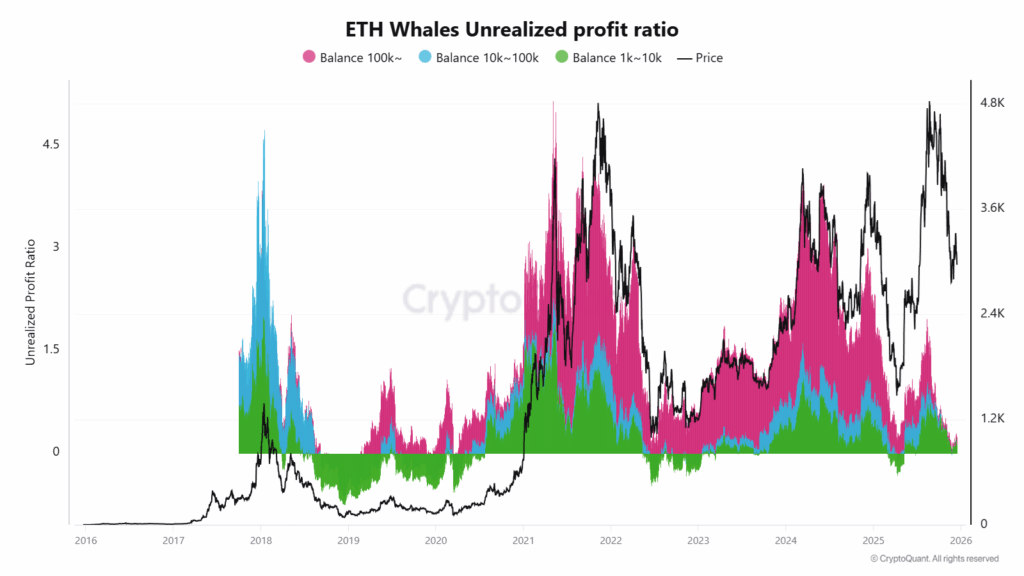
Ethereum Whale Unrealized Profit Ratio. Source: CryptoQuant

CryptoQuant analyst CW8900 stated that these holders did not take profits during this cycle and are increasing positions. This suggests the current price range offers an opportunity to acquire ETH at favorable levels. Continued accumulation at these prices could indicate a potential bottom formation zone.

However, bearish analysis raises questions about outcomes if the four-month downtrend continues. Whale investors would face actual losses in that scenario. Two factors suggest this possibility remains viable heading into year-end.

Active sending addresses for ETH reached the lowest level of 2025 in December. The metric displays a clear downward trend as network activity has cooled. Without retail buying pressure, ETH struggles to generate momentum needed for price breakouts even with institutional demand present.

CryptoOnchain analyst noted that lack of retail participation can limit short-term upside as retail flow typically drives momentum during early recovery phases. The realized price for ETH accumulation addresses serves as key support around $3,000.

These conditions place whale investors in a position requiring action. Selling to recover capital or limit losses could intensify downward pressure. Such movements could potentially trigger panic selling at institutional scale if support levels fail to hold through December close.


TagsETHEREUM

Trending Cryptos

Related Questions

QWhat does a negative Coinbase Premium Index indicate for Ethereum?

AA negative Coinbase Premium Index indicates lower Ethereum prices on Coinbase Pro's USD pair compared to Binance's USDT pair, reflecting selling pressure from U.S.-based institutional traders.

QWhat is the significance of the ETH Whale Unrealized Profit Ratio approaching zero?

AThe ETH Whale Unrealized Profit Ratio approaching zero indicates that large investors (holding 1,000 to 100,000+ ETH) now hold an average cost basis near current market prices with minimal unrealized profit, meaning they are close to their breakeven threshold.

QAccording to the article, what is a key support level for Ethereum's price?

AThe realized price for ETH accumulation addresses serves as a key support level around $3,000.

QWhat potential risk do whale investors face if the four-month downtrend in Ethereum continues?

AIf the four-month downtrend continues, whale investors would face actual losses on their positions, which could lead them to sell to recover capital or limit losses, potentially intensifying downward pressure and triggering panic selling.

QWhat factor is identified as limiting Ethereum's upside momentum despite institutional demand?

AA lack of retail participation is limiting Ethereum's short-term upside momentum, as retail flow typically drives momentum during early recovery phases, and active sending addresses have reached their lowest level of 2025.

Related Reads

The More Proficient AI Becomes at Answering, Why Do Humans Need Deep Thinking More? Fudan Releases the 2026 Blue Book on Intelligent Development in Humanities and Social Sciences

As AI capabilities rapidly expand, particularly in generating sophisticated text, analyzing data, and automating complex tasks, the need for human deep thinking becomes more critical, not less. The "2026 Blue Paper on Intelligent Development for Humanities and Social Sciences" from Fudan University argues that the relationship between AI and these fields is shifting from "one-way empowerment" to "bidirectional fusion." While AI transforms research methodologies, the humanities must guide its purpose, application, and governance. The core challenge is no longer processing vast information, but defining worthwhile problems, establishing genuine causal mechanisms, and constructing verifiable evidence chains. AI excels at producing coherent, fluent outputs but risks oversimplifying complex social realities into standardized formats it can easily process. For instance, in areas like climate-society systems, the difficulty lies not in handling more variables, but in understanding the fundamental mismatches between natural and social systems. Similarly, in automated research, AI can efficiently search for statistically significant results or generate papers quickly, potentially masking flawed assumptions or "packaging" statistical noise as discovery. The speed of paper production does not equate to the speed of genuine knowledge advancement. This underscores the non-transferable human responsibility for judgment. Deep thinking must be embedded into research workflows, governance systems, and organizational structures. Key principles include: * **Maintaining the Evidence Chain:** While AI can handle tasks like data processing, researchers must retain oversight over problem definition, conceptual translation into metrics, causal interpretation, and defining the scope of conclusions. Frameworks like STRIDES aim to document decisions and enable audit trails. * **Ensuring Meaningful Human Oversight:** In public governance, AI systems should operate in an "assistive" rather than an "agentic" mode. Human operators must retain genuine intervention, correction, and explanation rights to prevent "responsibility theater," where humans merely rubber-stamp algorithmic decisions. * **Translating Principles into Practice:** AI governance needs enforceable mechanisms across a system's lifecycle—pre-deployment risk assessment, runtime monitoring and human-in-the-loop controls, and post-hoc review and accountability—tailored to the level of risk involved. * **Defining Direction, Not Just Answers:** Humanities and social sciences provide the essential framework for navigating value conflicts (e.g., efficiency vs. fairness) and analyzing the social consequences of technology, questions AI alone cannot resolve. Building lasting capacity requires more than isolated projects. It demands integrated infrastructure—shared data standards, tools, interdisciplinary training, and collaborative mechanisms—as measured by initiatives like the "Chinese Universities AI4SSH Index." The ultimate imperative is clear: as AI becomes better at answering questions, humans must become more deliberate and responsible in deciding which questions are worth asking, critically evaluating the answers, and steering the technology's impact on society.

marsbit13m ago

The More Proficient AI Becomes at Answering, Why Do Humans Need Deep Thinking More? Fudan Releases the 2026 Blue Book on Intelligent Development in Humanities and Social Sciences

marsbit13m ago

Three Rounds in a Row, Shanghai Gives Birth to a $10 Billion Satellite Internet Unicorn

Shanghai-based semiconductor company Sixic has raised a new strategic investment round, securing backing from investors including Xinhuanet Venture Capital and Tongding Group, with continued support from existing investors. This marks the company's third disclosed financing this year, following a 1.5 billion RMB raise in February, officially cementing its status as a new Shanghai unicorn with a valuation exceeding 10 billion USD. The financing comes amid a dynamic period for China's commercial aerospace sector. Recent milestones include a successful controlled landing of a rocket first stage, signaling a path toward lower launch costs, and the establishment of a national Commercial Aerospace Innovation Consortium comprising 271 entities. Sixic stands out as the only 6G satellite internet baseband chip company within this consortium. The article highlights a market shift from a focus on rockets and satellites towards recognizing the value of the terminal and connectivity layer, essential for completing the commercial loop. Satellite internet, integral to 6G and commercial aerospace, is entering an industrial phase with clear policy support, including China's pioneering allocation of 6GHz spectrum for 6G R&D. Sixic specializes in 5G/6G satellite communication baseband chips, a highly complex segment. Unlike terrestrial communication, satellite chips must address challenges like high Doppler shift and signal loss. The company's technological validation is a key driver for investment. It has secured product certifications from leading global smartphone manufacturers, new energy vehicle makers, and communication module companies. A strategic partnership with ZTE was announced in March to collaborate on 6G NTN satellite internet. The company has achieved a full technical verification loop, from lab tests to in-orbit validation, including successfully demonstrating 5G NTN standard-based HD video calls via satellite in 2025. It maintains a 100% first-pass success rate for chip tape-outs and possesses full-stack in-house R&D capabilities. Sixic's strategy focuses on ASIC development for future commercial-scale, power-efficient consumer devices like smartphones. Its early and deep involvement in industry standards and constellation planning creates a significant competitive barrier. Looking ahead, Sixic's opportunity extends beyond chips into modules and terminal ecosystems. It has developed a full range of baseband SoC solutions and provides reference designs to help partners launch products quickly. The recent release of the CM7620 broadband satellite communication module at MWC Shanghai completes its "chip-module-terminal" portfolio. This latest funding round represents a strategic bet on the foundational communication capabilities that will underpin the next generation of 6G and satellite internet value chains.

marsbit56m ago

Three Rounds in a Row, Shanghai Gives Birth to a $10 Billion Satellite Internet Unicorn

marsbit56m ago

Trading

Spot

Hot Articles

Discussions

Welcome to the HTX Community. Here, you can stay informed about the latest platform developments and gain access to professional market insights. Users' opinions on the price of ETH (ETH) are presented below.

活动图片