Ethereum (ETH) Faces Crosscurrents as Scalability Upgrades Clash With Whale Selling Pressure

bitcoinistPublished on 2026-01-08Last updated on 2026-01-08

Abstract

Ethereum (ETH) is experiencing a clash between positive structural developments and market headwinds. While developers are advancing scalability upgrades, such as increasing the blob limit to enhance network capacity and reduce fees, large holders are selling significant amounts of ETH, creating near-term downward pressure. Over 300,000 ETH was sold by whales in a short period, despite growing institutional staking activity that continues to lock supply and reduce exchange reserves. These opposing forces are shaping ETH’s outlook as it trades above $3,200, with the market assessing whether demand can outweigh the selling pressure amid ongoing protocol improvements.

The Ethereum (ETH) ecosystem is facing a mix of structural progress and market uncertainty. On one side, developers are pushing forward with a series of scalability upgrades aimed at lowering fees and expanding capacity across the network.

Related Reading: South Korea Explores Crypto Account Freezing Measure To Prevent Market Manipulation

On the other hand, large holders are using recent price strength to reduce exposure, introducing short-term selling pressure. Together, these opposing forces are building Ethereum’s near-term outlook as ETH trades above the $3,200 level.

The contrast is clear, while the protocol is absorbing more capital through staking and infrastructure improvements, parts of the market are testing how much supply and demand can absorb during a renewed rally.
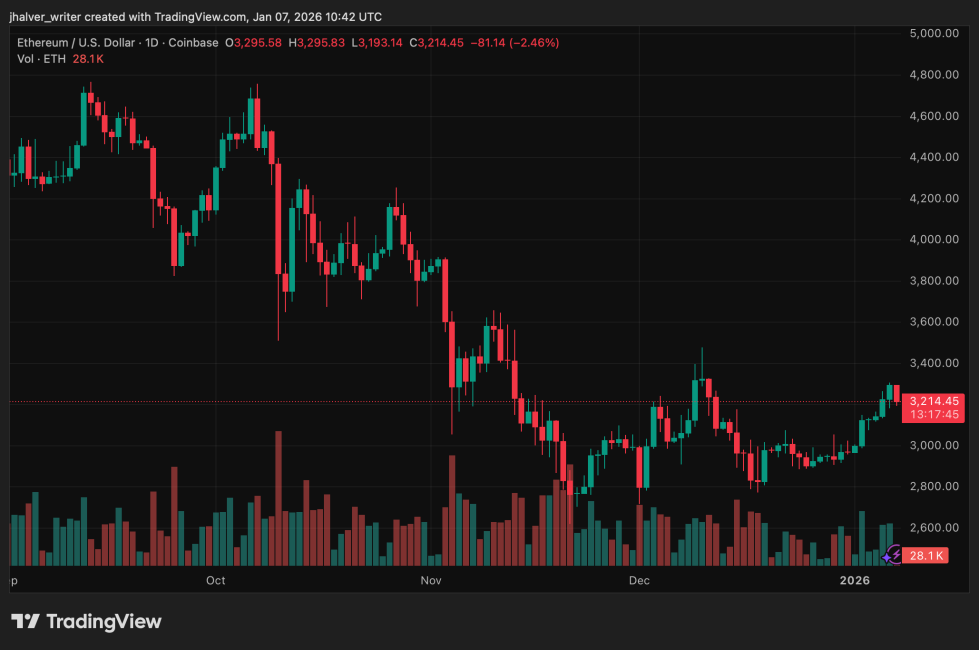
ETH's price moving sideways on the daily chart. Source: ETHUSD on Tradingview

Scalability Roadmap Moves Forward

Ethereum developers activated the second Blob Parameter-Only (BPO) hard fork this week, raising the blob limit from 15 to 21 and increasing the blob target from 10 to 14.

Blobs are temporary data containers used primarily by rollups to batch transactions more efficiently. With each blob holding 128 kilobytes, the network can now process roughly 2.6 megabytes of blob data per block.

The upgrade is part of a broader effort to scale Ethereum through layer-2 networks rather than pushing all activity onto the main chain. Since the first BPO fork in December, transaction fees on Ethereum have shown reduced volatility, reflecting lower congestion as rollups move data off-chain.

Developers are already discussing additional changes, including raising the gas limit from 60 million to 80 million, and later up to 200 million under the planned Glamsterdam hard fork in 2026. That upgrade is expected to introduce parallel transaction processing, further increasing throughput.

Ethereum’s (ETH) Staking Growth Tightens Liquid Supply

At the same time, staking activity is reshaping Ethereum’s supply dynamics. Institutional participation has increased, highlighted by BitMine’s latest deposits, which pushed its total staked ETH close to 780,000 tokens, worth over $2.5 billion.

Network-wide data indicates that more than 1.3 million ETH are waiting to enter staking, while the validator exit queue has dropped to zero. This imbalance suggests that fewer validators are choosing to exit, even amid market volatility.

As more ETH is locked into consensus contracts, circulating supply on exchanges continues to decline, potentially limiting downside pressure over the medium term.

Whale Selling Adds Near-Term Pressure

Despite these fundamentals, large holders have recently turned into net sellers. Whale wallets holding between 100,000 and 1 million ETH sold roughly 300,000 ETH over three days, valued at about $970 million.

This selling coincided with ETH’s breakout from a multi-week descending wedge, indicating that some whales are using the rally to take profits.

Related Reading: Scudo Announced: Tether’s Newest Crypto And Gold Unit – Here’s The Breakdown

While long-term holders remain largely inactive, helping to stabilize the broader structure, continued distribution by whales could slow upside momentum. Ethereum now sits at a crossroads, balancing protocol-level progress against market-driven supply pressure as traders assess whether demand can sustain the next leg higher.

Cover image from ChatGPT, ETHUSD chart from Tradingview

Trending Cryptos

Related Reads

The Verdict in Choi Tae-won's Divorce Case: Revealing the Inheritance Undercurrent Behind SK Hynix's Trillion-Won Empire

SK Group Chairman Chey Tae-won's high-profile divorce case, involving a record 1.38 trillion won settlement, has drawn attention to the succession plans for Korea's second-largest conglomerate, especially its crown jewel, SK hynix. Unlike traditional chaebol scripts centered on the eldest son, Chey's three children from his marriage to former President Roh Tae-woo's daughter, Roh Soh-yeong, are carving distinct, non-traditional paths. Eldest daughter Chey Yun-jung (b. 1989) is seen as the most evident successor. With a scientific and consulting background, she holds executive roles at SK bioscience and SK Inc.'s growth support department, focusing on future strategy and biopharma. Her marriage is to an AI infrastructure entrepreneur, not a traditional business alliance. Second daughter Chey Min-jung (b. 1991) took a unique route, voluntarily serving as a South Korean naval officer, including an anti-piracy deployment. She later worked on policy and strategy for SK hynix in Washington D.C. before co-founding an AI-driven healthcare startup. She married a former U.S. Marine Corps officer, connecting her to U.S. defense and policy circles—networks crucial for a global semiconductor giant. The only son, Chey In-geun (b. 1995), who studied physics like his father, worked briefly at SK E&S before joining McKinsey. Despite fitting the traditional "heir" profile as the eldest son, he remains silent and holds no public position or shares in SK, suggesting the old succession playbook is obsolete. As SK hynix's valuation soars, becoming a geopolitical asset in the AI era, the heirs' legitimacy is no longer automatic. They must prove themselves in fields like AI biotech, global policy, and strategic consulting. Their marriages also reflect new elite networks in tech and defense, not old political alliances. Their inheritance is the complex challenge of navigating a globalized, tech-driven world, not just a corporate throne.

marsbitYesterday 09:06

The Verdict in Choi Tae-won's Divorce Case: Revealing the Inheritance Undercurrent Behind SK Hynix's Trillion-Won Empire

marsbitYesterday 09:06

From OpenSea to OpenRouter: Is Alex Atallah Repeating His 'Exit at the Peak' Playbook?

From OpenSea to OpenRouter: Is Alex Atallah Repeating His "Exit at the Peak" Playbook? According to the Wall Street Journal, payments giant Stripe is in talks to acquire the AI model aggregation platform OpenRouter in a potential deal valuing the company near $100 billion. This would mark founder Alex Atallah's second creation of a company reaching a $100 billion valuation, following his co-founding of NFT marketplace OpenSea. OpenRouter, founded just over three years ago, has grown rapidly by acting as a unified gateway for developers to access over 400 AI models. It currently has about 10 million users and processes over 200 trillion tokens monthly. While the platform's annualized revenue is around $50 million, its valuation has skyrocketed from $1.3 billion in March 2026. The potential acquisition by Stripe, a company OpenRouter's founder once likened it to, represents a major expansion into AI infrastructure for the payments leader. This move echoes Atallah's previous timing with OpenSea, where he departed before the NFT market's significant downturn. For OpenRouter, selling now may be strategic. Despite its scale, its business model—charging a 5-5.5% fee on AI inference calls—faces pressure from competition, open-source models, and potential price wars among model providers, limiting its profitability narrative for an IPO. A key asset for potential acquirers like Stripe is OpenRouter's vast repository of real-world AI usage data, which offers unique insights into model performance and developer preferences that are difficult to replicate. Whether this potential deal signifies a new valuation benchmark for AI infrastructure or another market peak signal remains to be seen.

链捕手Yesterday 08:42

From OpenSea to OpenRouter: Is Alex Atallah Repeating His 'Exit at the Peak' Playbook?

链捕手Yesterday 08:42

Trading

Spot

Hot Articles

Discussions

Welcome to the HTX Community. Here, you can stay informed about the latest platform developments and gain access to professional market insights. Users' opinions on the price of ETH (ETH) are presented below.

活动图片
















