Ethereum Co-Founder Buterin Netted $70,000 On Polymarket Last Year, Here’s How

bitcoinistPublished on 2026-01-28Last updated on 2026-01-28

Abstract

Ethereum co-founder Vitalik Buterin revealed he earned $70,000 trading on Polymarket in the past year by betting against what he termed collective "madness." With an initial investment of $440,000, his strategy focused on mean reversion in irrational markets, such as betting against extreme predictions like Trump winning a Nobel Prize or the dollar collapsing. Buterin primarily trades in politics and tech, targeting areas prone to hype. He also highlighted significant oracle vulnerabilities, citing an example where a faulty update from a data source (ISW) caused a market to settle incorrectly, emphasizing that low security standards in Web2 oracles pose a major risk to prediction markets. Buterin discussed centralized and decentralized (e.g., UMA) solutions but noted concerns about vote manipulation in the latter.

Ethereum co-founder Vitalik Buterin says he made $70,000 trading prediction markets on Polymarket last year, not by chasing hot narratives, but by fading what he calls collective “madness.” The Ethereum co-founder framed the profit as a function of behavioral reflexes in thin, hype-prone markets, and used the conversation to surface a separate concern: oracle fragility in real-world event settlement.

Here’s How Ethereum’s Buterin Netted $70,000

In an interview posted by Foresight News reporter Joe Zhou on X, Zhou asked whether Buterin still used Polymarket after being active last year. “Yes, I made $70,000 on Polymarket last year,” Buterin replied. When pressed on sizing, he said his initial investment was $440,000, implying a mid-teens return that sits in sharp contrast to the more common retail experience of getting chopped up by headline-driven probability swings.

Buterin described his playbook as opportunistic mean reversion on sentiment rather than prediction as such. “My method is simple: I look for markets that are in ‘madness mode’ and then bet that ‘madness won’t happen,’” he said.

“For example, there’s a market betting on whether Trump will win the Nobel Peace Prize. Or some markets predict the dollar will go to zero next year during periods of extreme panic. When market sentiment enters this irrational ‘madness mode,’ I bet on the opposite, and this usually makes money.”

When Zhou asked where he tends to focus on Polymarket (crypto, politics, entertainment, economics), Buterin said his attention clusters around politics and technology, and reiterated that the edge, in his view, comes from arenas where participants are “caught up in a frenzy and irrationality.”

The more consequential part of the thread moved from trading style to settlement integrity. Zhou raised the question of informational asymmetries and “advance knowledge”, referencing online chatter around a Venezuela-related market and asked whether Buterin had seen similar dynamics. Buterin steered the answer toward oracle vulnerabilities, citing a wartime contract whose outcome hinged on a narrow operational definition.

He described a market on the Ukraine war that settled based on whether Russia “controlled a certain city,” where the smart contract defined “control” as control of the city’s most important train station. The oracle source, he said, was anchored to Institute for the Study of War (ISW) tweets and maps.

Then came the failure mode: “ISW employees, perhaps by mistake, or perhaps intentionally, hacked their own company’s system; their maps suddenly updated to show that the Russian army controlled the train station,” Buterin said. “This caused something that everyone thought had only a 5% probability (almost impossible) to instantly become 100% in the prediction market. Although ISW retracted the update the next day, the money may have already been paid out.”

For Buterin, the lesson is not merely that prediction markets can be wrong, but that the data supply chain they outsource to can be brittle in ways crypto participants systematically underestimate. “This reveals a huge problem: the security standards of current oracle data sources (such as Web2 news websites and Twitter) are too low,” he said. “They never imagined that a single message they posted would determine the ownership of $1 million on the blockchain.”

Asked how to solve the oracle problem, Buterin sketched two broad approaches. The first is a centralized trust model, effectively designating an authoritative publisher like Bloomberg. The second is token voting, a decentralized mechanism he associated with UMA. Buterin said confidence in UMA has been slipping due to a perceived game-theoretic weakness: if a whale coalition can dominate voting, minority “truth” voters can be punished economically, pressuring participants to mirror power rather than reality.

At press time, Ethereum traded at $3,010.
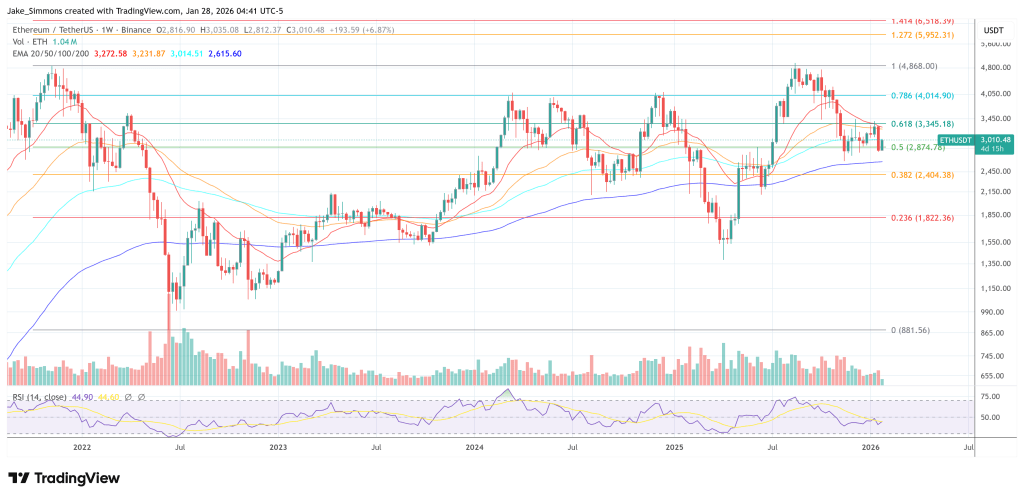
Ethereum remains stuck between the 0.618 and 0.5 Fib, 1-week chart | Source: ETHUSDT on TradingView.com

Related Questions

QHow did Vitalik Buterin make $70,000 on Polymarket last year?

AHe made $70,000 by betting against what he called collective 'madness' in prediction markets, employing an opportunistic mean reversion strategy on sentiment rather than making direct predictions.

QWhat was Vitalik Buterin's initial investment on Polymarket that resulted in a $70,000 profit?

AHis initial investment was $440,000.

QAccording to Buterin, what is the main problem with current oracle data sources for prediction markets?

AHe stated that the security standards of current oracle data sources (like Web2 news websites and Twitter) are too low, as they are not designed to handle the financial consequences of their information determining the settlement of large sums of money on the blockchain.

QWhat specific example did Buterin use to illustrate oracle fragility in real-world event settlement?

AHe cited a market on the Ukraine war that settled based on whether Russia controlled a specific city, with 'control' defined by a single train station. The oracle, which used ISW tweets and maps, failed when an ISW update (later retracted) incorrectly showed Russian control, causing a 5% probability event to instantly settle at 100%.

QWhat two broad approaches did Buterin suggest for solving the oracle problem?

AHe suggested a centralized trust model (designating an authoritative publisher like Bloomberg) and a decentralized token voting mechanism (like UMA's), though he noted concerns that the latter can be vulnerable to whale coalitions dominating the vote.

Related Reads

U.S. Stock Market Trend: Nasdaq Plunges 3.5% Intraday Before a Remarkable Recovery, All Eyes on CPI Tomorrow

"US Stock Market Trends: Nasdaq Plunges 3.5% Before Dramatic Recovery, Eyes on Tomorrow's CPI" On Tuesday, US markets experienced a wild swing. The Nasdaq initially surged nearly 0.7% before plummeting to a 3.5% intraday loss following a post by Donald Trump on Truth Social. He stated that Iran had shot down a US Apache helicopter in the Strait of Hormuz and that the US "must...respond." The index, however, staged a remarkable recovery in the final two hours, closing down only 0.97%, as subsequent remarks from Trump and Vice President Vance suggested a potential Iran deal within days. The S&P 500 fell 0.26%, while the Dow Jones gained 0.17%, supported by its non-tech components. This incident marked the first loss of a US military asset since tensions with Iran escalated in late February. Despite the event, crude oil prices fell sharply (WTI -3.93%) due to expectations of a near-term deal, OPEC+ plans to increase output, and fears that strong jobs data could lead to Fed rate hikes. Market attention is now laser-focused on the May CPI data release Wednesday morning. This report is seen as critical evidence for whether hot job growth is fueling inflation and will heavily influence expectations for the Federal Reserve's upcoming meeting. A hotter-than-expected reading could trigger further sell-offs, particularly in tech, while a cooler print could spark a significant rebound. The article notes a clear sector rotation, with money flowing out of tech (Nasdaq down over 5% in a week) into defensive sectors like healthcare and consumer staples. Other assets like gold and Bitcoin also remain under pressure. The overarching sentiment is one of "war fatigue," with markets desperately awaiting concrete results from the prolonged Iran negotiations rather than reacting to each new headline.

marsbit14m ago

U.S. Stock Market Trend: Nasdaq Plunges 3.5% Intraday Before a Remarkable Recovery, All Eyes on CPI Tomorrow

marsbit14m ago

Second Only to GPUs and Memory: MLCCs Are Becoming the Next Billion-Dollar Windfall for AI Computing Power

After GPU and memory, MLCC (Multi-Layer Ceramic Capacitors) is emerging as the next critical component in AI compute, potentially a multi-billion-dollar market. The article highlights a significant, industry-wide price increase for MLCCs, driven not by inventory cycles but by a fundamental, structural demand surge from AI and automotive sectors. AI servers require exponentially more MLCCs than traditional servers—from 2,000 to over 350,000 units per high-end AI rack—primarily to stabilize power for increasingly powerful, low-voltage GPUs. A key AI server's MLCC cost can reach thousands of dollars, making it the third-largest cost component after GPUs and memory. This demand is compounded by the automotive shift to EVs and advanced ADAS. Supply, however, struggles to keep up. Manufacturing high-end MLCCs involves extreme precision and faces six major barriers: proprietary technology, long customer certification cycles (12-18 months for AI), high capital intensity, patent thickets, specialized talent, and massive scale. Industry capacity grows at only ~10% annually, creating a persistent supply-demand gap projected to last until 2030. Three companies dominate this high-end market. **Murata** (40% global share) is the stable leader. **Samsung Electro-Mechanics** offers the highest growth elasticity with aggressive expansion. **Taiyo Yuden** is the purest MLCC play. While their current P/E ratios appear high, they are expected to compress rapidly as earnings surge, powered by significant pricing power and operational leverage. Key risks include a potential slowdown in AI capex, high valuations, competition from Chinese manufacturers in lower tiers, yen appreciation, and consumer electronics weakness. The article concludes that MLCCs are transforming from a commoditized component into a strategic, capacity-constrained asset essential for the AI-powered future.

marsbit44m ago

Second Only to GPUs and Memory: MLCCs Are Becoming the Next Billion-Dollar Windfall for AI Computing Power

marsbit44m ago

The First to Bring an AI OS to 1.4 Billion People Might Actually Be WeChat?

WeChat has introduced a significant AI update, allowing mini-program developers to integrate their services with WeChat AI. Developers can choose an "automatic mode," where WeChat AI autonomously analyzes and operates mini-programs without additional coding, or a "development mode" for creating customized skills. This move effectively transforms WeChat's vast ecosystem—including millions of mini-programs, WeChat Pay, and official accounts—into an execution layer for AI. The technical documentation reveals that WeChat's approach aligns with industry standards like MCP (Model Context Protocol) and incorporates practical lessons from AI-agent development. Key design principles include a clear "attention weight" system for API calls and a "fact + action" response structure to ensure reliable operations. Unlike Apple's Siri, which struggles with third-party app integration, WeChat's centralized control over mini-program code provides a "God's-eye view," enabling seamless AI orchestration across services. This development revives the concept of "WeChat OS," where the app could function as a natural-language-operated platform for daily tasks—from booking flights to ordering food—all within a chat interface. While challenges remain in areas like payment security and user trust, WeChat's existing service network and massive user base position it uniquely to advance AI agents from conversation to actionable assistance, potentially making complex tasks feel effortless for its 1.432 billion monthly active users.

marsbit1h ago

The First to Bring an AI OS to 1.4 Billion People Might Actually Be WeChat?

marsbit1h ago

Trading

Spot
Futures

Hot Articles

Discussions

Welcome to the HTX Community. Here, you can stay informed about the latest platform developments and gain access to professional market insights. Users' opinions on the price of ETH (ETH) are presented below.

活动图片