Ethereum Bears Keep Control As ETH Rejects Trendline Resistance

bitcoinistPublished on 2026-06-21Last updated on 2026-06-21

Abstract

Ethereum's (ETH) recent price rebound is still viewed as unconvincing by some analysts, with technical analysis indicating continued bearish control. ETH has failed to break above a key falling trendline and a horizontal resistance zone, forming a pattern of lower highs and lower lows. This rejection at a confluence of resistances strengthens the bearish case. The critical support zone to watch is between $1,350 and $1,500. A breakdown below this area would signal significant weakness. Currently, ETH is trapped between this support and the dominant falling resistance, keeping the market in a compressed technical state. Ethereum's struggle is also significant for the broader altcoin market, as it often sets the tone for risk appetite. The analysis concludes that bulls require a decisive break above the identified resistance before any talk of a sustained reversal is warranted.

Ethereum’s latest rebound has not yet convinced all analysts that the downtrend is over. A June 20 TradingView idea from TheSignalyst argued that ETH remains bearish after continuing to trade below a falling red trendline and printing a sequence of lower highs and lower lows.
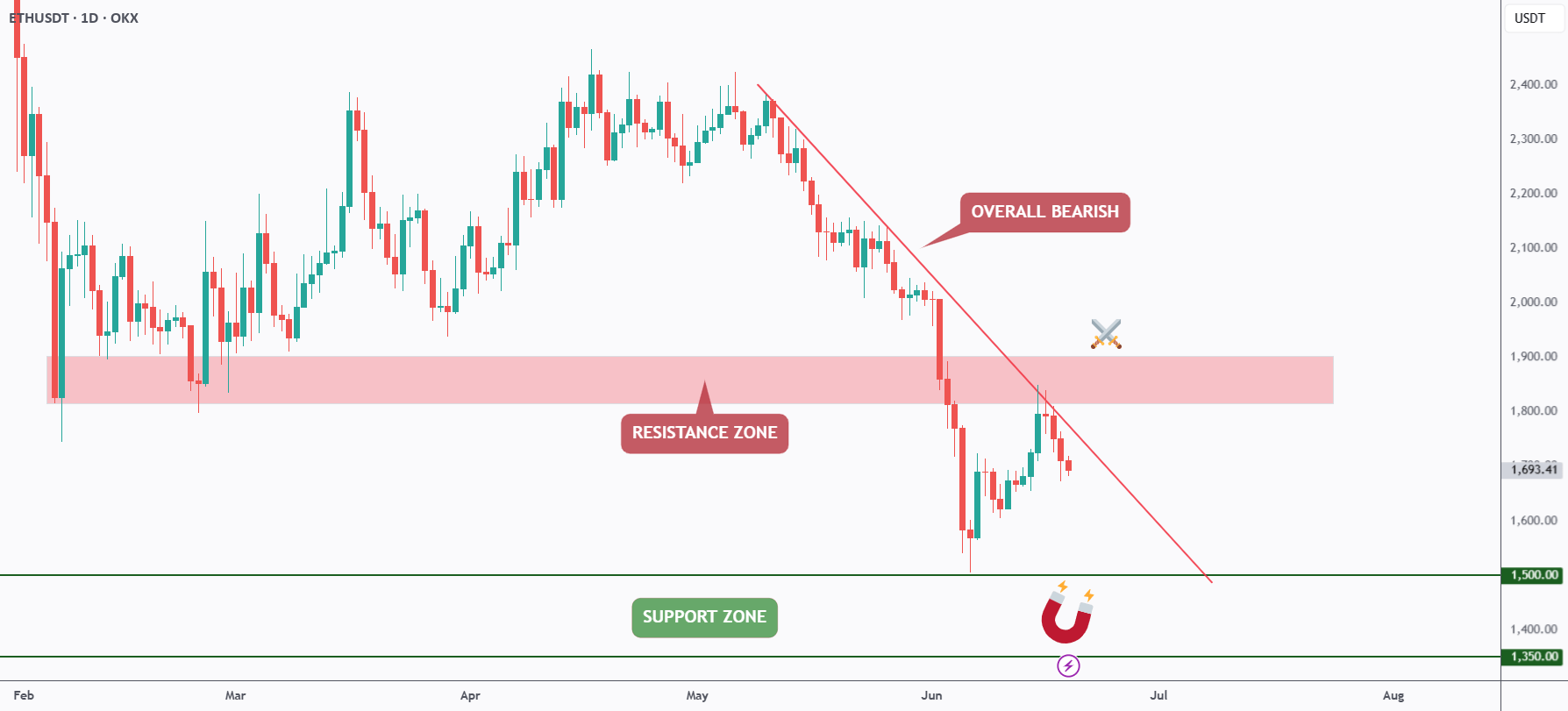
TradingView chart referenced in this analysis

The analyst’s chart shows ETH rejecting a confluence area made up of the falling trendline and a horizontal structure zone. That matters because confluence resistance can attract sellers more aggressively than a single isolated level. When price fails at both diagonal and structural resistance, traders often treat the move as confirmation that bears are still defending control.

Support Zone Still Defines The Downside Risk

The important support area, according to the idea, sits between $1,350 and $1,500. That gives traders a clear zone to watch if the rejection continues. A controlled pullback into that range could produce another reaction, but a decisive break below it would make the broader ETH structure look much weaker.

For now, ETH is caught between a support zone that has mattered before and a falling trendline that keeps capping rebounds. Until one of those areas gives way, the market remains technically compressed.

Why This Setup Matters Beyond ETH

Ethereum’s chart also matters for the wider altcoin market. When ETH struggles against the dollar, risk appetite across DeFi and smaller-cap crypto assets often weakens with it. That does not mean every altcoin follows ETH tick-for-tick, but Ethereum remains the benchmark for much of the smart-contract market.

TheSignalyst’s setup is therefore a warning that the recent rebound still has work to do. Bulls need a clean break above resistance before the market can talk seriously about a stronger reversal.

This report is based on information from TradingView TheSignalyst.

This article was written by the News Desk and edited by Samuel Rae.

Trending Cryptos

Related Questions

QAccording to the TradingView idea from TheSignalyst, why is Ethereum (ETH) considered to remain bearish?

AETH is considered bearish because it continues to trade below a falling red trendline and has printed a sequence of lower highs and lower lows, failing to break above a confluence area of resistance.

QWhat key support zone for ETH is identified in the analysis, and what would a break below it signify?

AThe key support zone identified is between $1,350 and $1,500. A decisive break below this support range would make the broader ETH price structure look much weaker, indicating increased downside risk.

QWhat is the significance of the confluence resistance area mentioned in the article?

AThe confluence resistance area, formed by the falling trendline and a horizontal structure zone, is significant because such combined resistance can attract sellers more aggressively than a single level. Price failing there confirms that bears are still defending control of the market.

QWhy does Ethereum's price action matter for the broader altcoin market according to the article?

AEthereum's price action matters for the broader altcoin market because when ETH struggles against the dollar, risk appetite across DeFi and smaller-cap crypto assets often weakens alongside it. Ethereum serves as a key benchmark for much of the smart-contract market.

QWhat do bulls need to achieve for the market to consider a stronger reversal, based on the analyst's conclusion?

ABased on the analyst's conclusion, bulls need to achieve a clean break above the identified resistance (the confluence of the falling trendline and horizontal structure zone) before the market can talk seriously about a stronger reversal.

Related Reads

Blood Loss of $55 Million Selling 3,588 BTC, Strategy Becomes a Literal Scumbag

On July 6th, Strategy (formerly MicroStrategy) disclosed in an SEC filing that it sold 3,588 Bitcoin (BTC) between June 29th and July 5th for approximately $216 million, at an average price of ~$60,200. This marked the company's largest net sale since initiating its Bitcoin strategy in 2020 and its first institutionalized reduction of its core holding. The sale resulted in a realized loss of about $54.8 million, as the selling price was below its average cost basis of ~$75,476 per BTC. The proceeds were used to pay preferred stock dividends and replenish USD reserves. This move follows a new "Digital Credit Capital Framework" approved on June 29th, authorizing the sale of up to $1.25 billion in Bitcoin. The sale consumes roughly 17% of this authorized amount in its first week. Strategy's foundational narrative, built by founder Michael Saylor, was a commitment to "never sell" Bitcoin. The recent institutionalized selling framework and these substantial sales represent a significant shift from that original promise. While the amount sold is only 0.4% of Strategy's total holdings of 843,775 BTC, the action challenges the premium at which its stock (MSTR) trades relative to its Bitcoin holdings. Investors had priced in the "never sell" narrative. The company now faces a contradiction: it sells Bitcoin at a loss to pay dividends on the preferred stock it issued to fund Bitcoin purchases. Saylor has framed selling as a tool for future strategic purchases, but each sale erodes the credibility of the original commitment, potentially threatening the premium valuation of MSTR shares.

Foresight News56m ago

Blood Loss of $55 Million Selling 3,588 BTC, Strategy Becomes a Literal Scumbag

Foresight News56m ago

Dialogue with Yihui Capital, SoundAI Technology, Ling Universe, and Zhongbo Jili: Opportunities and Challenges in the AI Smart Hardware Track

On June 28, 2026, an event titled "New Opportunities in AI Hardware: The Battle for Interactive Entry Points Begins" was held in Beijing. It featured a report from ITJuzi and discussions with experts from SoundAI, Ling Universe, One Reed Capital, and Zhongbo Juli on the opportunities and challenges in China's AI hardware sector. Key report findings highlight the sector's intense activity: 327 out of 431 startups founded post-2023 have secured funding, with 179 investments in H1 2026 alone. The landscape is dominated by embodied intelligent robots, while wearable tech like smart rings and AI glasses shows rapid growth. Geographically, Shenzhen leads, leveraging its superior hardware supply chain, followed by Beijing and Shanghai. The overarching trend is for companies to focus on micro-innovations within specific scenarios rather than reinventing foundational technology. Industry leaders shared several critical insights: 1. **Balancing Innovation & Market Readiness**: Entrepreneurs face the "hammer looking for a nail" dilemma. Success requires balancing technical capability with user acceptance, cost control, and incremental design improvements rather than chasing disruptive innovation. 2. **Competitive Landscape**: The future interactive entry point may not be a single super-device but a mix of universal terminals and specialized, scenario-specific hardware. While large companies have ecosystem advantages, startups can win by deeply targeting vertical markets and specific user groups. 3. **Core Challenges & Business Models**: Key hurdles include deep understanding of AI models and navigating non-transparent hardware supply chains. Viable business models may involve selling hardware at cost and generating revenue through software subscriptions, but this requires tight control over both hardware BOM and model inference costs. 4. **The Road to Commercialization**: The ultimate test is market validation—achieving sales growth and sustainable cash flow. Companies must find the right application scenario, use edge computing effectively, and close the loop from technology to commercial success. 5. **The Future of Interaction**: Proactive, context-aware interaction is the next frontier, though it's currently limited by issues like model hallucinations and environmental perception. The near-term focus should be on identifying target users and creating a coherent experience in specific domains, such as health wearables. In summary, to succeed in the competitive AI hardware arena, companies must strategically choose their niche, build a team with the right geographical advantages (e.g., leveraging Shenzhen's supply chain), and most importantly, execute a flawless commercialization strategy that translates technology into market-accepted products and sustainable business growth.

marsbit1h ago

Dialogue with Yihui Capital, SoundAI Technology, Ling Universe, and Zhongbo Jili: Opportunities and Challenges in the AI Smart Hardware Track

marsbit1h ago

Trading

Spot

Hot Articles

Discussions

Welcome to the HTX Community. Here, you can stay informed about the latest platform developments and gain access to professional market insights. Users' opinions on the price of ETH (ETH) are presented below.

活动图片