Ethereum Approaching Major Capitulation Zone — On-Chain Metrics Hint At Impending Shift

bitcoinistPublished on 2026-03-15Last updated on 2026-03-15

Abstract

Following a period of underperformance, Ethereum has found some stability around the $2,000 level. However, on-chain analyst Boris warns that multiple metrics suggest the market is under significant stress and may be approaching a major capitulation phase. Key indicators signaling potential trouble include the Net Unrealized Profit/Loss (NUPL) metric, which is negative, indicating investors are holding unrealized losses. Furthermore, Ethereum's price is currently trading below its realized price of $2,200, meaning the average investor is at a loss. The network has also recently ended a 1,340-day streak during which most ETH tokens were in profit—a signal that often coincides with the end of a market cycle and bear market bottoms. For a market bottom to form, Boris notes the NUPL would need to move deeper into the capitulation zone. If another sell-off occurs, it could force investors to surrender their positions, creating a potential opportunity for long-term holders. At the time of writing, Ethereum's price is approximately $2,092, down over 1% in the past day.

Following a disappointing performance in February, the Ethereum price has seen some semblance of relief over the past two weeks. With the steadying market condition, the “king of altcoins” has managed to hold its own around the psychological $2,000 level.

This, expectedly, has been enough to rouse hopes in silent investors on the Ether token’s future; however, a market analyst has revealed reasons to believe that Ethereum buyers might want to sit on their hands — at least in the meantime.

Multiple Indicators Align To Reflect High Market Stress

In a recent post on the social media platform X, on-chain analyst Boris highlighted data from three metrics, showing that the Ethereum market is starting to see a surge in pressure. According to the analyst, if the present conditions persist, a capitulation phase might be on the horizon for the second-largest cryptocurrency.

The market pundit started their analysis with the Net Unrealized Profit/Loss (NUPL) metric, which measures the overall profit or loss of investors by comparing the current market value of ETH to the price at which coins last moved on-chain. Boris shared in his post that the NUPL currently sits on a negative level, suggesting that Ethereum’s investors may be holding through unrealized losses.

Another major metric cited was the Realized Price metric, which represents the average price at which all coins in circulation were last moved on-chain. Boris pointed out in his tweet that the altcoin is currently trading beneath its realized price of $2,200.

When the market falls below this level, it indicates that the average Ethereum investor is holding through losses. Hence, this on-chain signal translates as a level of pressure being felt by Ethereum’s investors, as the market price continues to fluctuate below the realized price.
Source: @Fundingvest on X

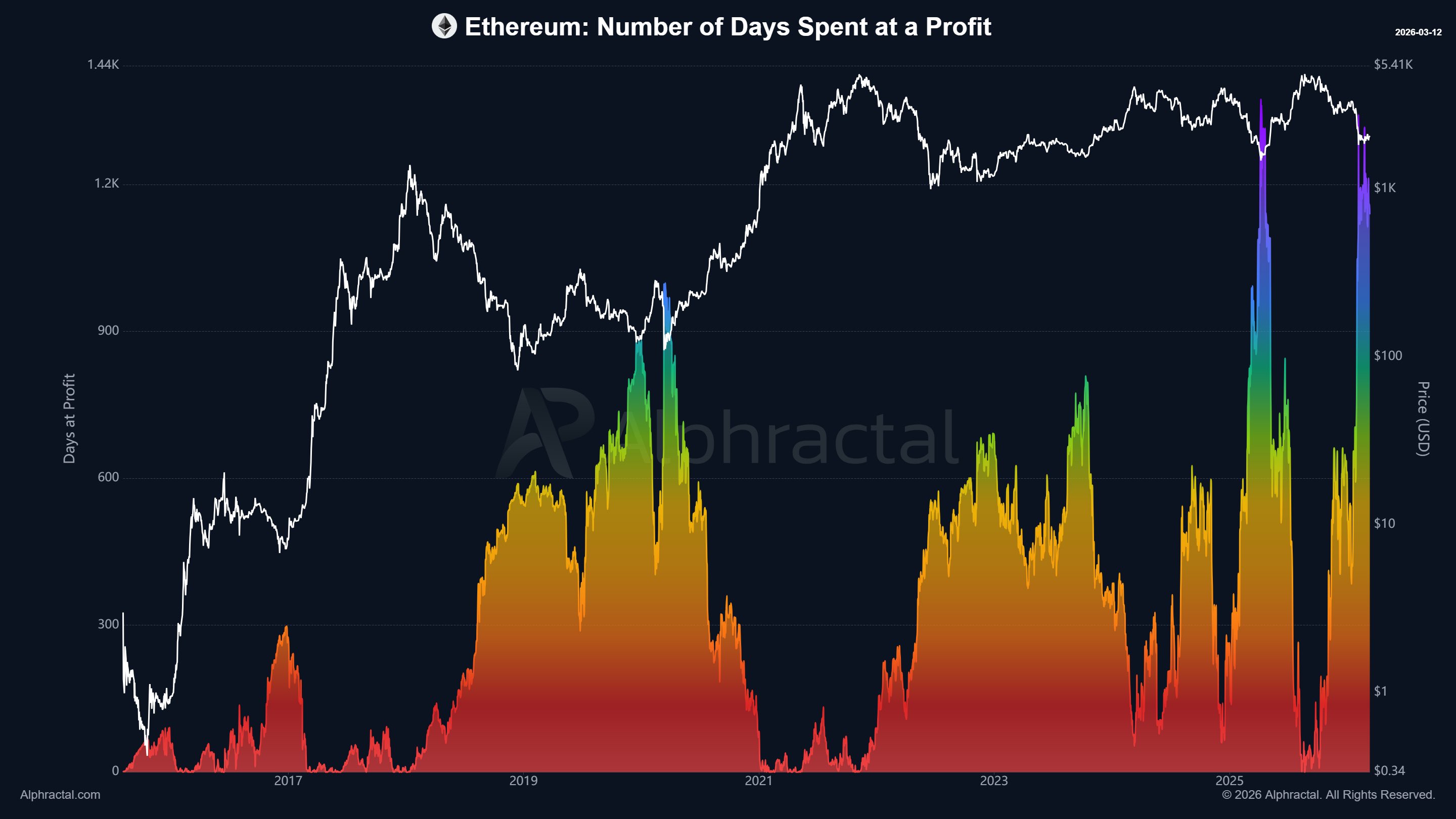
Furthermore, Boris mentioned the Number of Days Spent at a Profit metric in his analysis, saying that the Ethereum network recently ended an impressive 1,340-day streak, during which the majority of circulating Ether tokens remained profitable.

The analyst explained that this is often a signal that a market cycle has ended — a conjecture that is consistent with historical events and tends to appear close to the bottoms of bear markets.

Despite the present conditions, Boris warned that NUPL still has to move deeper towards the capitulation zone between –0.5 and –1 for a bottom to be formed. If the Ethereum price were to experience another sell-off round, the metric could enter the capitulation zone, where several investors might be forced to forfeit their positions — an event that would most likely be exploited by long-term traders (the diamond hands).

Ethereum Price At A Glance

As of this writing, the price of Ethereum stands at around about $2,092, reflecting an over 1% drop since the past day.

The price of ETH on the daily timeframe | Source: ETHUSDT chart on TradingView


Related Questions

QWhat are the three key on-chain metrics that analyst Boris highlighted to suggest Ethereum is approaching a capitulation zone?

AThe three key on-chain metrics are: 1) Net Unrealized Profit/Loss (NUPL), which is negative, indicating investors are holding unrealized losses. 2) The price trading below the Realized Price of $2,200, showing the average investor is at a loss. 3) The end of a 1,340-day streak where the majority of ETH tokens were profitable, a signal that a market cycle has ended.

QAccording to the analyst, what does it mean that Ethereum's NUPL is currently negative?

AA negative NUPL means that Ethereum investors, on average, are holding their coins at an unrealized loss, as the current market value is lower than the price at which those coins were last moved on-chain.

QWhat is the significance of the Ethereum price trading below its Realized Price?

AWhen the market price trades below the Realized Price, it indicates that the average investor in the market is holding their coins at a loss, which reflects significant market pressure and stress.

QWhat event did the 'Number of Days Spent at a Profit' metric recently signal, and what is its historical significance?

AThe metric recently ended a 1,340-day streak of profitability for the majority of circulating ETH. Historically, this is a signal that a market cycle has ended and often appears close to the bottoms of bear markets.

QWhat condition must the NUPL meet for a market bottom to be formed, according to the analyst's warning?

AThe analyst warned that the NUPL must move deeper into the capitulation zone, specifically between -0.5 and -1, for a market bottom to be formed. This would likely be triggered by another sell-off, forcing weaker investors to forfeit their positions.

Related Reads

Should You Buy SpaceX Stock at $1.7 Trillion? Here's What the Market Is Worried About

SpaceX is preparing for a massive IPO aiming to raise around $75 billion at a valuation of approximately $1.75 trillion. While its achievements in reusable rockets and the profitable Starlink satellite internet service are clear, the market is concerned about the aggressive valuation. Key issues include: the current $1.75 trillion valuation, which is about 94 times 2025 revenue, seems to price in not just existing businesses but also unproven future ventures like AI infrastructure and orbital data centers. Financially, while Starlink is profitable, the AI division, bolstered by the acquisition of xAI, is incurring massive losses and consuming the majority of capital expenditures. This acquisition also introduced complex related-party financing arrangements and debt onto SpaceX's balance sheet. Furthermore, corporate governance poses a challenge. SpaceX's dual-class share structure ensures founder Elon Musk retains absolute control, limiting ordinary shareholders' influence over high-risk, long-term strategic decisions. The future success of ambitious projects like the Starship rocket—critical for lowering costs and enabling new services—remains a significant variable for the valuation. In summary, the market's apprehension (FUD) centers not on doubting SpaceX's past technological triumphs but on questioning how much premium public investors should pay for a future that combines proven profits with highly speculative and capital-intensive new ventures, all under a governance structure that offers limited shareholder oversight.

marsbit41m ago

Should You Buy SpaceX Stock at $1.7 Trillion? Here's What the Market Is Worried About

marsbit41m ago

Breaking the DeFi Cascading Liquidation Curse: Vitalik Proposes a New Solution

Vitalik Buterin has proposed a new DeFi design to eliminate the automatic liquidation mechanism that causes market instability during sharp downturns. The current system, used by protocols like Aave, triggers forced sales when collateral value falls below a threshold, often exacerbating price drops and creating systemic selling pressure. Buterin's alternative model is based on splitting an asset like ETH into two synthetic option-like tokens, P and N, pegged to a price index. Their combined value always equals one ETH. Instead of sudden liquidation, a position's value gradually drifts from its target peg if the market moves. Users must proactively rebalance their holdings to maintain their desired exposure, transferring the management burden from the protocol to the user or automated tools. A key advantage is the reduced reliance on real-time oracles. Pricing decisions are deferred until contract expiry, allowing for more robust, fault-tolerant oracle designs. This removes a clear liquidation threshold that speculators can target for manipulation or MEV extraction. However, significant challenges remain. Frequent rebalancing could incur high slippage and transaction costs, necessitating new liquidity provider models. The design is better suited for hedging instruments than for stablecoins requiring a rigid 1:1 peg. While not an immediate replacement for existing systems, the proposal challenges the foundational assumption that instantaneous forced liquidation is an unavoidable necessity in DeFi, opening the door for fundamentally different risk management architectures.

marsbit45m ago

Breaking the DeFi Cascading Liquidation Curse: Vitalik Proposes a New Solution

marsbit45m ago

The End of Single-Factor Cryptography

The article "The End of Single-Factor Crypto" posits a fundamental shift in the cryptocurrency ecosystem. It argues the era where crypto asset valuations were predominantly driven by, and correlated with, Bitcoin's price is ending. The space is bifurcating into two distinct economies: endogenous and exogenous. The endogenous economy represents traditional crypto, where token and project values are directly tied to crypto market prices. The emerging exogenous economy comprises projects and businesses that may utilize blockchain technology or tokens but derive their fundamental value from external, non-crypto factors like consumer demand, subscription revenue, or real-world utility. Examples include AI inference platforms like Venice, fintech lenders using blockchain for efficiency, and stablecoin/payment infrastructure companies acquired by giants like Mastercard and Stripe. This shift means investment analysis must change. For exogenous assets, evaluating traditional business fundamentals—such as revenue streams, unit economics, and competitive moats—becomes more critical than tracking Bitcoin charts. While endogenous assets like Bitcoin remain relevant, the growth of the exogenous category is driven by measurable demand independent of crypto price cycles, paving the way for a new, more diversified market phase. Consequently, crypto is evolving from a single-factor, reflexive asset class into a multifaceted ecosystem with varied drivers and investment theses.

marsbit46m ago

The End of Single-Factor Cryptography

marsbit46m ago

Morning Post | Bitmine Plans to Raise $300 Million Through Preferred Stock Issuance; Polymarket Accuses Kalshi of Commercial Espionage

ChainCatcher's Daily Crypto Brief: Key developments from the past 24 hours include significant funding moves, regulatory actions, and market predictions. Bitmine announced a $300 million preferred stock fundraising. Polymarket accused rival prediction platform Kalshi of corporate espionage, citing numerous suspicious coincidences in product launches, a claim Kalshi strongly denied. The U.S. Department of Justice, in a joint "Disruption Week" anti-fraud operation with companies like Coinbase and Meta, froze over $3.8 million in cryptocurrency linked to scams. In infrastructure news, Macau completed its integration with the multi-central bank digital currency bridge, mBridge, aiming to build efficient cross-border payment channels. Cosmos Labs acquired the block explorer Mintscan. Market-wise, Geoffrey Kendrick, Standard Chartered's Head of Digital Assets Research, stated Bitcoin is nearing a bottom around $63,000, maintaining a year-end target of $100,000. He noted stability in U.S. spot Bitcoin ETF holdings. Ahead of SpaceX's anticipated IPO, internal insiders at Rocket Lab (RKLB) sold over $18.41 million in stock. In tokenization, Goldman Sachs partnered with Apex and Archax to launch a tokenized real estate fund. The meme token tracker GMGN reported the top trending tokens: on Ethereum, HEX, SHIB, LINK, PEPE, mUSD; on Solana, TROLL, swarms, WORLDCUP, neet, Buttcoin; and on Base, PEPE, toby, ODDS, ELSA, SKI.

链捕手1h ago

Morning Post | Bitmine Plans to Raise $300 Million Through Preferred Stock Issuance; Polymarket Accuses Kalshi of Commercial Espionage

链捕手1h ago

Trading

Spot
Futures

Hot Articles

Discussions

Welcome to the HTX Community. Here, you can stay informed about the latest platform developments and gain access to professional market insights. Users' opinions on the price of ETH (ETH) are presented below.

活动图片















