Ethereum And Solana Are Topping Developer Activity Again, But Why Are Their Prices Struggling?

bitcoinistPublished on 2026-03-14Last updated on 2026-03-14

Abstract

Despite leading in crypto developer activity, Ethereum and Solana are experiencing significant price struggles. Data from Artemis shows Ethereum’s ecosystem, particularly its EVM, leads with 31,620 weekly commits, followed by Solana’s SVM with 7,056. However, both networks have seen sharp declines: Ethereum’s weekly commits dropped 54% and developer activity fell 34% over three months, while Solana saw declines of 43% and 40%, respectively. The broader crypto ecosystem has also suffered, with weekly commits plummeting from 870,900 in March last year to 217,500 in February. Analysts attribute the price weakness to an ongoing bear market. CryptoQuant’s Julio Moreno suggests Ethereum could fall to $1,500 by late 2024 if the downturn continues, citing an “adoption paradox” where network activity rises while prices fall. Market experts predict further declines, with Bitcoin potentially bottoming between September and October.

Ethereum and Solana are currently leading developer activity in the crypto space, while developer activity in the broader ecosystem declines. This comes as prices continue to struggle with the ongoing war between the U.S. and Iran, which is sparking rising oil prices.

Ethereum And Solana Lead Developer Activity Amid Broad Decline

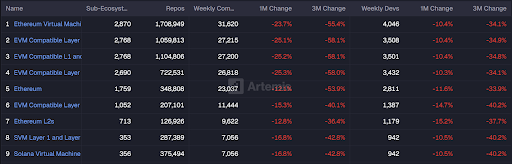
Artemis data show that the Ethereum and Solana ecosystems are leading in developer activity amid declines in weekly commits and weekly active developers in crypto. In the Ethereum ecosystem, the Ethereum Virtual Machine (EVM) is seeing the most activity, with 31,620 weekly commits.

It is worth noting that several sectors in the Ethereum ecosystem currently rank among the top seven in developer activity. Meanwhile, the Solana ecosystem comes next, with the Solana Virtual Machine (SVM) Layer 1 and Layer 2 seeing the most activity, at 7,056 weekly commits. However, there has been a significant decline in the crypto ecosystem as a whole.

Further data from Artemis shows that weekly commits have dropped from a yearly high of around 870,900 in March last year to as low as 217,500 in February. Notably, weekly commits crashed around the time of the crypto market’s infamous ‘October 10’ crash, which led to the largest liquidation event in crypto history.
Source: Chart from Artemis

Similarly, the weekly active developers have also declined from a yearly high of 10,600 in May last year to as low as 4,000. This metric has been declining since the October 10 crypto market crash, suggesting that current price action is affecting developer sentiment. Ethereum and Solana have also seen declines in their weekly commits and developer activity despite leading in these metrics.

The Ethereum network has seen a 54% decline in weekly commits over the last three months and a 34% decline in developer activity over this same period. Meanwhile, the Solana network has seen 43% decline in weekly commits over the last three months and a 40% decline in developer activity over the same period.

Why Prices Continue To Struggle

Ethereum and Solana prices continue to struggle, as experts note that the crypto market is in a bear market. CryptoQuant’s Head of Research, Julio Moreno, recently reiterated this, stating that the bear market is still on despite the relief rally that Bitcoin saw this week, which pushed ETH and SOL higher.

Market analyst Doctor Profit recently stated that Bitcoin is likely to bottom between September and October, suggesting that Ethereum and Solana could still see larger declines. Meanwhile, Moreno told The Block that ETH could decline to $1,500 by the third quarter of this year or the early part of the fourth quarter if the bear market persists. The analyst also noted that Ethereum is facing an “adoption paradox,” with network activity rising while the ETH price falls.

ETH trading at $2,077 on the 1D chart | Source: ETHUSDT on Tradingview.com

Trending Cryptos

Related Questions

QAccording to the article, which two ecosystems are leading in developer activity despite a broad decline in the crypto space?

AEthereum and Solana are leading in developer activity.

QWhat major external event is mentioned as a reason for the struggling crypto prices?

AThe ongoing war between the U.S. and Iran, which is sparking rising oil prices.

QWhat was the largest liquidation event in crypto history, as referenced in the article?

AThe 'October 10' crash.

QWhat specific 'paradox' is Ethereum facing, according to CryptoQuant's Head of Research?

AAn 'adoption paradox,' where network activity is rising while the ETH price falls.

QWhat price level did analyst Julio Moreno suggest ETH could decline to if the bear market persists?

A$1,500 by the third quarter of this year or the early part of the fourth quarter.

Related Reads

STRC Major De-pegging's First Financial Report, How Will Strategy Repair Its Capital Flywheel?

Bitcoin treasury company Strategy released its Q2 2026 earnings report on July 31. Despite a 6.9% year-over-year revenue increase to $122 million, the company recorded a net loss of $8.22 billion, largely due to $8.32 billion in unrealized losses from Bitcoin price fluctuations. As of quarter-end, Strategy holds 843,775 BTC with an average cost of $75,000 per coin, and Bitcoin per share increased. The report highlights a critical shift in Strategy's capital model following the de-pegging of its key financing tool, STRC (Strategic Coin), which fell below its $100 target. Management's top priority is restoring STRC to its target value, aiming for a recovery by September 8. They rule out discounted STRC issuances and plan to maintain its dividend yield at 12%, instead focusing on bolstering its $3.75 billion cash reserve. Strategy has moved from a one-way "buy-and-hold" Bitcoin strategy to active capital management. This new approach, part of its "Digital Credit Capital Framework," involves flexibly managing its balance sheet across four elements: BTC, USD cash, common stock (MSTR), and digital credit securities like STRC. This allows for BTC monetization (having sold $218.4 million in BTC so far), strategic repurchases of discounted securities, and debt optimization, as seen with a $1.5 billion convertible bond buyback. The company's future hinges on two key tests: successfully re-pegging STRC to restore market confidence in its digital credit system, and a long-term recovery in Bitcoin's price to ultimately support its growth thesis.

marsbit26m ago

STRC Major De-pegging's First Financial Report, How Will Strategy Repair Its Capital Flywheel?

marsbit26m ago

STRC's First Financial Report Post-Depegging, How is Strategy Restoring the Capital Flywheel?

On July 31, 2026, Bitcoin treasury company Strategy released its Q2 financial report. Despite a 6.9% year-over-year increase in revenue to $122 million, the company recorded a substantial net loss of $8.22 billion, primarily due to $8.32 billion in unrealized losses from Bitcoin holdings. While Strategy's core Bitcoin strategy remains intact—its holdings grew 11% to 843,775 BTC—the company is undergoing a fundamental shift in its capital model. Following the de-pegging of its key financing tool, the STRCoin (STRC), from its $100 target in May, Strategy has pivoted from a one-directional "raise funds, buy Bitcoin" cycle to a more dynamic, multi-asset capital management approach. A key part of this new framework is the "Monetization Program," through which Strategy has sold approximately $218.4 million worth of BTC to bolster liquidity. The company's top priority is repairing STRC's peg, committing not to issue discounted shares until it returns to its target range. It has initiated a $1 billion buyback program for discounted digital credit securities, having repurchased $28.9 million face value of STRC so far. Management aims to restore the peg around September 8, 2026. Strategy now actively manages a matrix of assets: Bitcoin (for accumulation or strategic sales), USD cash reserves (now at $3.75 billion), common stock (MSTR), and digital credit securities like STRC. This allows for tactical moves like repurchasing discounted debt or equity to capture value. The future success of Strategy's "capital flywheel" hinges on two factors: the short-term ability to successfully re-peg STRC to restore market confidence in its digital credit system, and the long-term price trajectory of Bitcoin, upon which its entire investment thesis ultimately depends.

Odaily星球日报31m ago

STRC's First Financial Report Post-Depegging, How is Strategy Restoring the Capital Flywheel?

Odaily星球日报31m ago

With Two Consecutive Quarters of Losses, Coinbase Must Rely on Paths Beyond Trading

Coinbase posted its second consecutive quarterly net loss of $359 million on $1.22 billion in revenue for Q2, highlighting its vulnerability to crypto market cycles where weaker prices and lower volatility reduce user trading. However, the report also reveals a strategic shift in its business model. Despite a 25% quarter-over-quarter decline in global spot trading volume, Coinbase increased its market share to a company-record 10.3%. This suggests its position as a compliant U.S. on-ramp is strengthening even in a cooler market. A key development is the diversification of revenue streams. Transaction revenue fell to $599 million, nearly equaling subscription and services revenue of $555 million. Stablecoin services, generating $292 million, are becoming a crucial revenue "floor." This income, derived from interest on the $20 billion average USDC balance held on its platform, is less tied to daily trading activity. Furthermore, while spot trading volume dropped significantly, derivatives volume held steady at $1.03 trillion. Coinbase is pushing to integrate spot, stablecoin, and derivatives liquidity to create a more interconnected and sticky ecosystem for users. The GAAP net loss includes non-cash expenses like stock-based compensation and crypto asset valuation changes. Its adjusted EBITDA remained positive at $208 million for the 14th straight quarter, indicating core operations can cover ongoing costs. The company is also reducing expenses to manage the downturn. The central question moving forward is whether Coinbase's growing market share, stablecoin revenues, and expanding product integration can sufficiently offset the inherent cyclicality of its core trading business during future market contractions.

marsbit46m ago

With Two Consecutive Quarters of Losses, Coinbase Must Rely on Paths Beyond Trading

marsbit46m ago

Trading

Spot

Hot Articles

Discussions

Welcome to the HTX Community. Here, you can stay informed about the latest platform developments and gain access to professional market insights. Users' opinions on the price of ETH (ETH) are presented below.

活动图片