Ethereum Activity Soars: Active Addresses Set New Record

bitcoinistPublished on 2026-03-21Last updated on 2026-03-21

Abstract

Ethereum has set a new all-time high in its 30-day moving average of active addresses, indicating a significant surge in user activity on the network. This increase occurred in February 2026, a period during which Bitcoin experienced a downturn—breaking the conventional pattern where address activity typically cools during bear markets. Despite this record engagement, the U.S. Ethereum spot ETFs have recently seen two consecutive days of net outflows, totaling over $191 million. Meanwhile, Ethereum’s price remains steady at approximately $2,100.

Data shows the Ethereum network has recently set a new all-time high (ATH) in the Active Addresses indicator, suggesting elevated user activity.

30-Day MA Of Ethereum Active Addresses Has Reached A New ATH

As highlighted by CryptoQuant community analyst Maartunn in an X post, the Ethereum Active Addresses has set a new record in its 30-day moving average (MA) value. This on-chain indicator keeps track of the unique total number of addresses that are participating in some kind of transaction activity on the blockchain every day.

When the value of this metric rises, it means the number of users interacting on the network is going up. Such a trend suggests the cryptocurrency is attracting attention. On the other hand, the indicator going down suggests addresses are turning inactive, potentially because investors have lost interest in the blockchain.

Now, here is the chart shared by Maartunn that shows the trend in the 30-day MA of the Ethereum Active Addresses over the past decade:
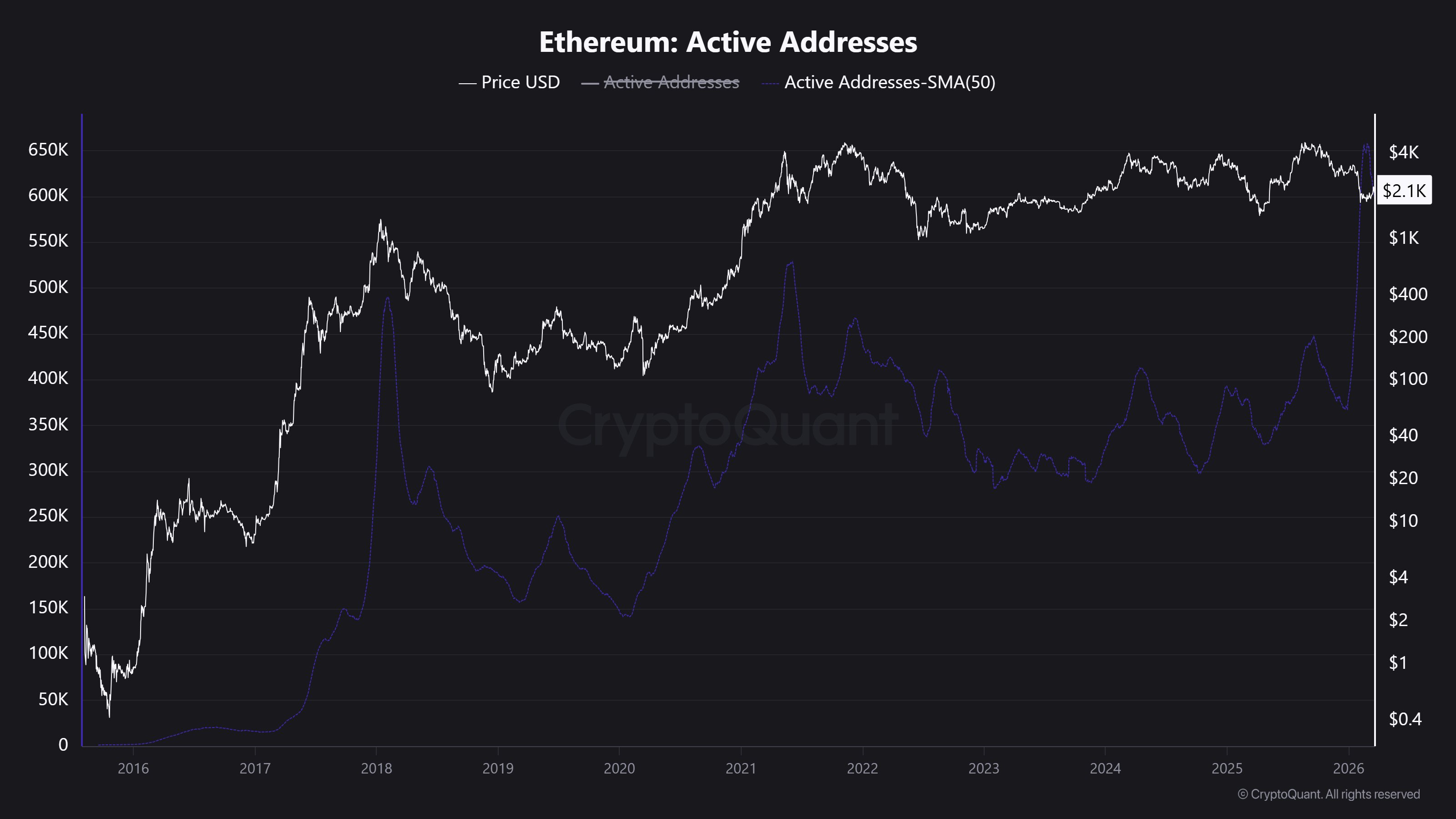
Looks like the value of the metric has shot up recently | Source: @JA_Maartun on X

As displayed in the above graph, the 30-day MA of the Ethereum Active Addresses saw a rise alongside the bull rally in the second half of 2025, implying user activity ramped up. Price surges tend to be exciting to investors, so it’s not unusual to see transaction interest go up alongside them.

From the chart, it’s visible that once the bearish market shift occurred in the last quarter of 2025, the Active Addresses also started going down, a sign that investors began to shift their attention away from the network.

In 2026 so far, however, something extraordinary has happened. While Bitcoin saw another leg down during February, what actually accompanied it was a sharp spike in the indicator that took its value to a new ATH.

In the past, cyclical peaks in the Active Addresses has tended to coincide with major bull runs, with bear markets usually witnessing a cooldown in the metric. As such, the latest trend in the Ethereum network has broken the conventional pattern.

In some other news, the Ethereum spot exchange-traded funds (ETFs) started on a green streak earlier, but the last two days has seen the netflow trend flip back to negative, as data from SoSoValue shows.
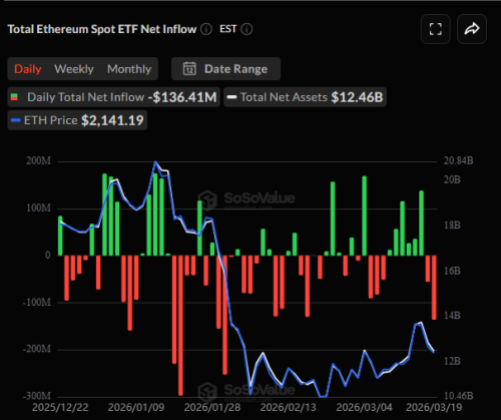
How the US ETH spot ETF netflow has changed over the last few months | Source: SoSoValue

As is visible in the above graph, the US Ethereum spot ETFs have seen $136.4 million flow out during the past day. The day before, they saw outflows of over $55 million. While these red netflow spikes haven’t retraced all the inflows that occurred during the early six-day streak, they still hint at a change of winds in the market.

ETH Price

At the time of writing, Ethereum is floating around $2,100, unchanged from one week ago.

Looks like the price of the coin has retraced from its highs | Source: ETHUSDT on TradingView


Trending Cryptos

Related Questions

QWhat new all-time high has the Ethereum network recently set according to the article?

AThe Ethereum network has set a new all-time high (ATH) in the 30-day moving average of Active Addresses.

QWhat does a rise in the Active Addresses indicator typically signify for the Ethereum network?

AA rise in the Active Addresses indicator signifies that the number of users interacting on the network is increasing, suggesting the cryptocurrency is attracting more attention.

QHow did the article describe the recent trend in Ethereum Active Addresses compared to conventional patterns?

AThe recent sharp spike in Active Addresses to a new ATH during a period when Bitcoin's price declined broke the conventional pattern where peaks in this metric usually coincide with bull runs and cool down during bear markets.

QWhat was the net flow status of US Ethereum spot ETFs in the last two days mentioned in the article?

AIn the last two days, the US Ethereum spot ETFs saw net outflows, with over $55 million the day before and $136.4 million on the past day, flipping the trend to negative.

QWhat was the price of Ethereum at the time the article was written?

AAt the time of writing, Ethereum was floating around $2,100.

Related Reads

The Changing Landscape: What Are Crypto VCs Experiencing?

Title: The Shifting Landscape of Crypto Venture Capital The era of dedicated crypto venture capital funds is undergoing a significant transformation. Once essential for navigating the sector's complexity and high risk, these specialized funds are now facing an identity crisis as the market matures. This shift mirrors historical patterns in other specialized investment classes like cleantech and SPACs, where initial information advantages dissipate as technologies become mainstream and integrated into existing industry frameworks. The article argues that crypto is reaching a critical inflection point, transitioning from a "building phase" to an "integration phase." Major players like Stripe, BlackRock, and Visa now engage with crypto not for its novel mechanics but as a foundational financial infrastructure. Their needs—regulatory compliance, banking partnerships, distribution channels—align with traditional fintech, a domain easily understood by large, generalist funds like Sequoia and Founders Fund. This evolution creates a "barbell effect" within the VC landscape. On one end are massive, diversified platforms that can incorporate crypto as one vertical among many. On the other are small, nimble funds focused on niche, experimental projects. The middle ground—medium-sized dedicated crypto funds—is being squeezed out. Their typical fund size makes it impossible to generate sufficient returns solely from early-stage crypto bets, yet they cannot compete with giants for later-stage deals. Consequently, leading crypto-native firms like Paradigm and Framework Ventures are expanding into AI, robotics, and other sectors, driven partly by LP pressure for better returns amid a broader VC DPI crisis. Others, like Dragonfly and a16z, have narrowed their crypto focus predominantly to financial infrastructure like stablecoins, reframing the sector's core narrative. For crypto entrepreneurs, this consolidation presents challenges. While generalist funds offer larger checks and broader resources, crypto projects now compete fiercely with AI for attention and capital within these firms. Furthermore, the long-term, non-commercial foundational work that built the ecosystem—funded by dedicated crypto VCs—is less likely to attract generalist capital focused on direct returns. The conclusion is that "crypto investor" as a standalone category is becoming obsolete, akin to "internet investor." Crypto is becoming a baseline infrastructure layer. The future will see a barbell structure: large-scale growth financing handled by generalist funds, while pioneering, speculative projects are funded by small, specialized vehicles. The dedicated crypto funds of the 2017-2021 boom, which incubated core infrastructure, are giving way to this new, bifurcated reality.

Foresight News16m ago

The Changing Landscape: What Are Crypto VCs Experiencing?

Foresight News16m ago

As Consensus Accelerates, What Are Young Investors Betting On?

Title: As Consensus Forms Faster, What Are Young Investors Betting On? In the rapid evolution of tech investment, a new generation of young investors is navigating a landscape where AI, robotics, commercial aerospace, and quantum computing are advancing simultaneously. Traditional investment logic based on financial models is giving way to a need for deep technical understanding and the ability to act before industry consensus forms. An analysis of trends from the "WAIC FUTURE TECH" list of young investment leaders reveals key shifts in focus. The first major trend is the movement of AI from the digital screen into the physical world. Investment is shifting from large language models and chatbots towards embodied AI, robotics, AI hardware, and edge computing. While demonstrations generate excitement, the real challenge lies in achieving scalable, reliable, and cost-effective delivery in complex real-world environments like factories and logistics. Success depends not just on algorithms but on the integration of sensors, actuators, and control systems. Second, the competitive focus for large models is moving beyond raw capability toward building an "intelligence flywheel." The goal is to create self-reinforcing systems where user interaction generates data, improving the model, which in turn enhances the user experience and attracts more engagement. Companies that successfully embed AI into workflows to create these closed-loop systems can build lasting value that isn't easily erased by the next model upgrade. Third, facing a potential bottleneck in high-quality human-generated data, investors are looking at new underlying technologies. Reinforcement learning and self-play, as demonstrated by AlphaGo Zero, offer paths for AI to generate its own experience. Scientific foundation models, which aim to build general AI capabilities for fields like life sciences and materials discovery, represent a non-consensus direction that could unlock new frontiers of knowledge and data. Finally, in deep-tech areas like quantum computing, commercial aerospace, and space-based infrastructure, patient capital is essential. These fields have long, uncertain development and validation cycles involving complex engineering, supply chains, and regulations. Investment here requires a long-term view, focusing on foundational team capabilities and the eventual emergence of market demand, even if commercial returns are distant. Collectively, these trends illustrate how young investors are adapting to a new era. They are learning to make earlier, technically-informed judgments, balance hype with real-world viability, and provide the patient capital needed to build the deep-tech foundations of the future.

marsbit44m ago

As Consensus Accelerates, What Are Young Investors Betting On?

marsbit44m ago

Can Japan Buy Growth with AI? Will the Bond Market Believe It?

Japan's cabinet has introduced the 2026 Basic Policy on Economic and Fiscal Management and Reform, shifting its primary fiscal target. The new framework moves away from the traditional annual primary balance goal and instead prioritizes a stable reduction of the debt-to-GDP ratio. This change is tied to a strategy of increased "responsible proactive fiscal" spending, aiming to boost long-term growth through investments in strategic sectors like AI, semiconductors, energy, and robotics. The government estimates total public and private investment in 62 key technologies could exceed 370 trillion yen by 2040. The market reaction has been mixed and cautious. While equity markets may respond to policy signals, bond markets are focused on fiscal credibility. Concerns center on whether the weakening of the clear primary balance anchor could lead to looser fiscal discipline. If investors doubt that these strategic investments will generate sufficient productivity gains, tax revenue, and nominal growth to outpace rising interest costs, they may demand higher yields on Japanese Government Bonds (JGBs). Recent volatility in the yen and JGB yields, with the 10-year yield briefly reaching 2.9%, reflects this skepticism. The success of this new framework hinges on two factors: whether Japan can achieve a nominal growth rate consistently higher than its long-term interest rates, and whether future budgets demonstrate disciplined control over bond issuance. The government's narrative is that strategic investment is essential to break Japan's cycle of low growth, aging, and labor shortages. However, the bond market will continuously assess the credibility of this plan, pricing the risk that it may represent fiscal expansion rather than a viable growth strategy.

marsbit1h ago

Can Japan Buy Growth with AI? Will the Bond Market Believe It?

marsbit1h ago

Trading

Spot

Hot Articles

Discussions

Welcome to the HTX Community. Here, you can stay informed about the latest platform developments and gain access to professional market insights. Users' opinions on the price of ETH (ETH) are presented below.

活动图片














