Ethereum activity hits 788K addresses – Can ETH finally break out?

ambcryptoPublished on 2026-04-03Last updated on 2026-04-03

Abstract

Ethereum's network activity has surged, with over 788,000 daily active addresses and more than 255,000 new addresses created, indicating strong underlying demand and user growth. Despite this, ETH's price remains range-bound between $1,807 support and $2,371 resistance, failing to break out despite repeated tests. On-chain data shows persistent outflows from exchanges, suggesting accumulation, but this has not yet translated into significant buying pressure. Derivatives markets reveal declining open interest and a negative funding rate, reflecting bearish sentiment and reduced leverage. While network fundamentals strengthen, the price lacks the momentum for a sustained breakout due to ongoing consolidation and dominant short positioning.

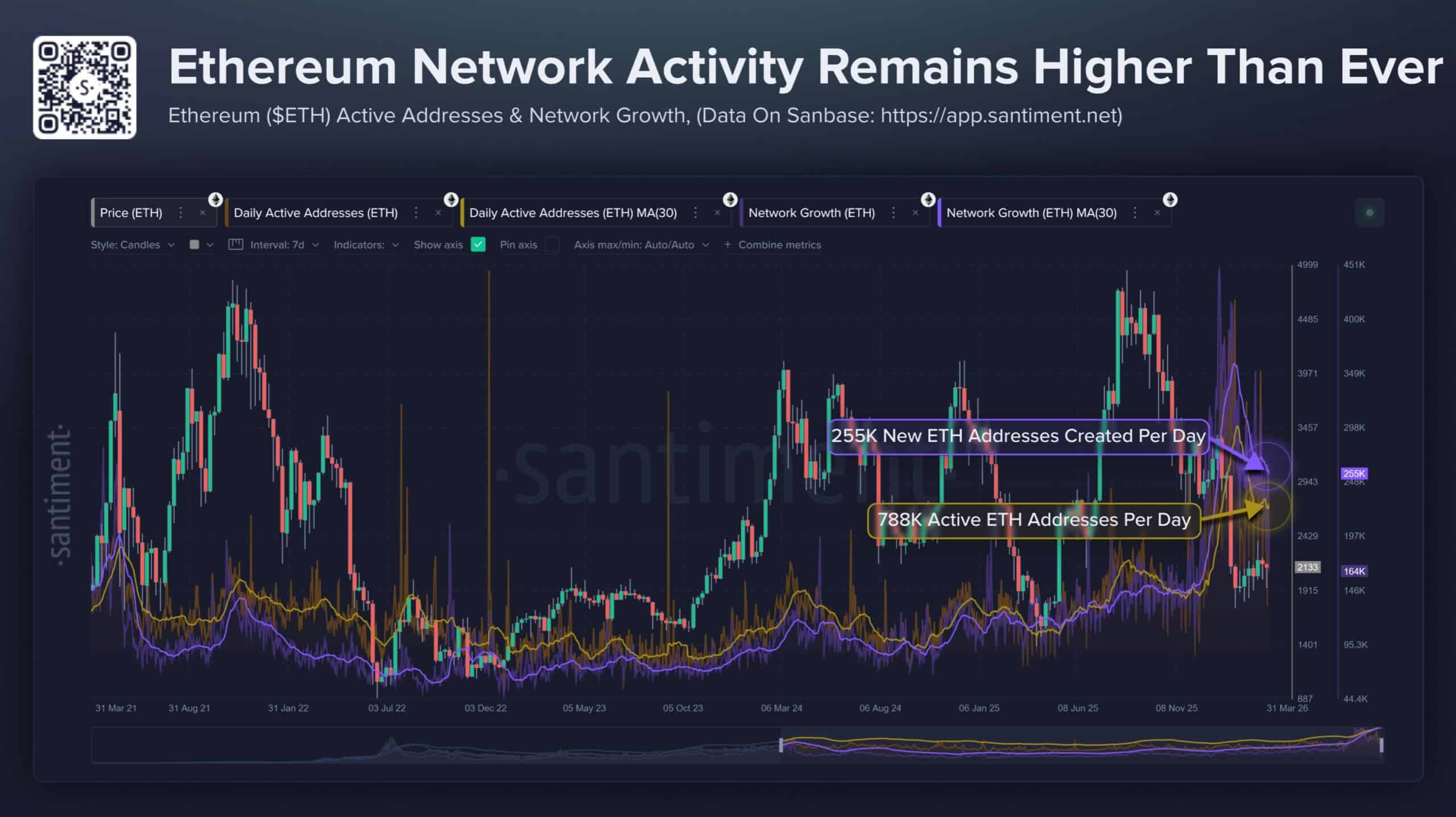
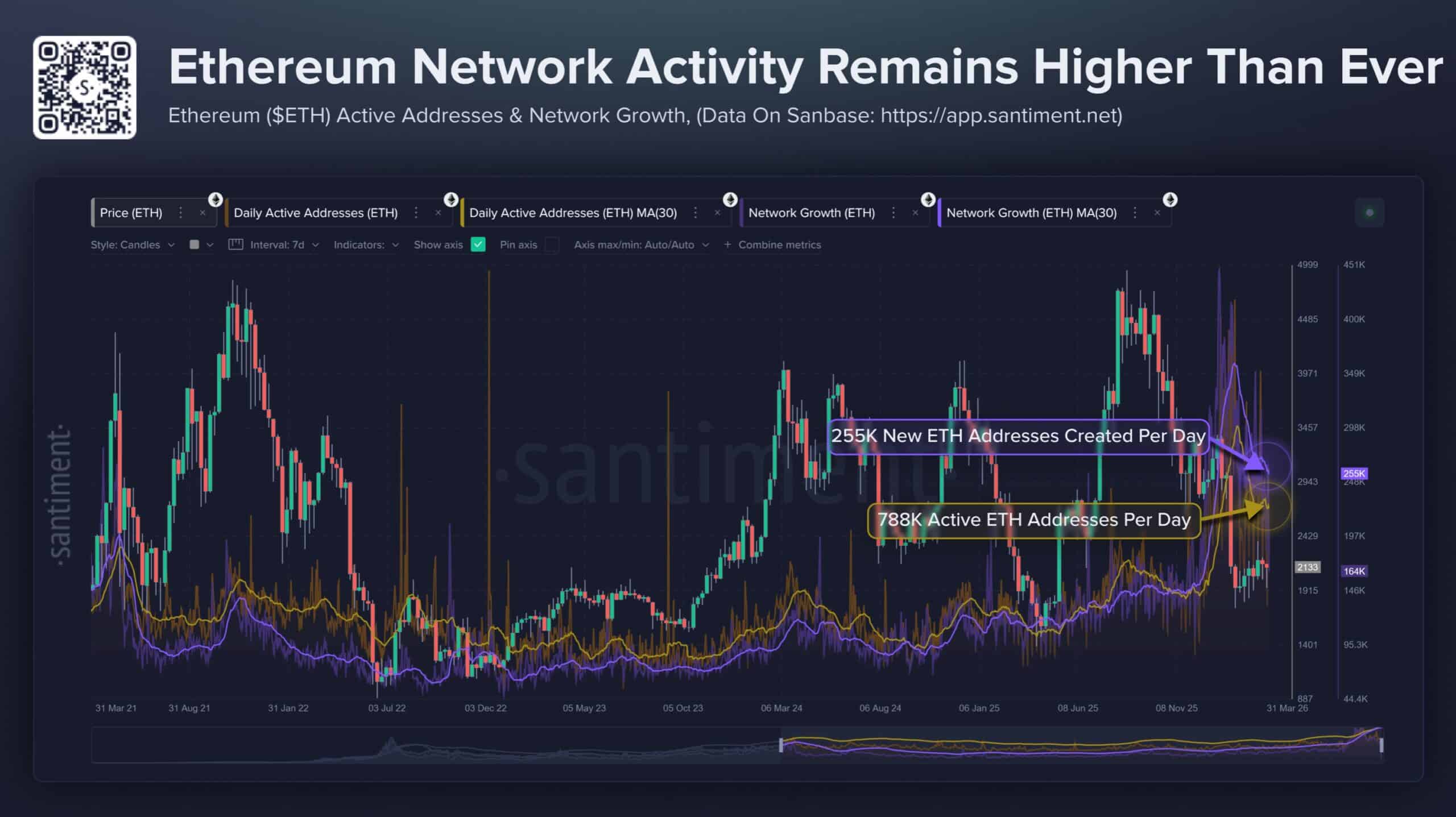
Ethereum’s network activity has surged toward historic highs, with over 788K Daily Active Addresses interacting across the network.
Source: Santiment

In addition, more than 255K new addresses are being created each day, reflecting sustained user onboarding.

As more addresses interact with the network daily, underlying demand appears to strengthen beneath the surface.

Yet, price behavior suggests that this demand has not fully translated into visible buying pressure.

This gap raises a critical question about how much of this activity reflects organic growth versus structural positioning, leaving the market in a state where participation increases, but price direction remains unresolved.

Ethereum price range holds as resistance caps upside

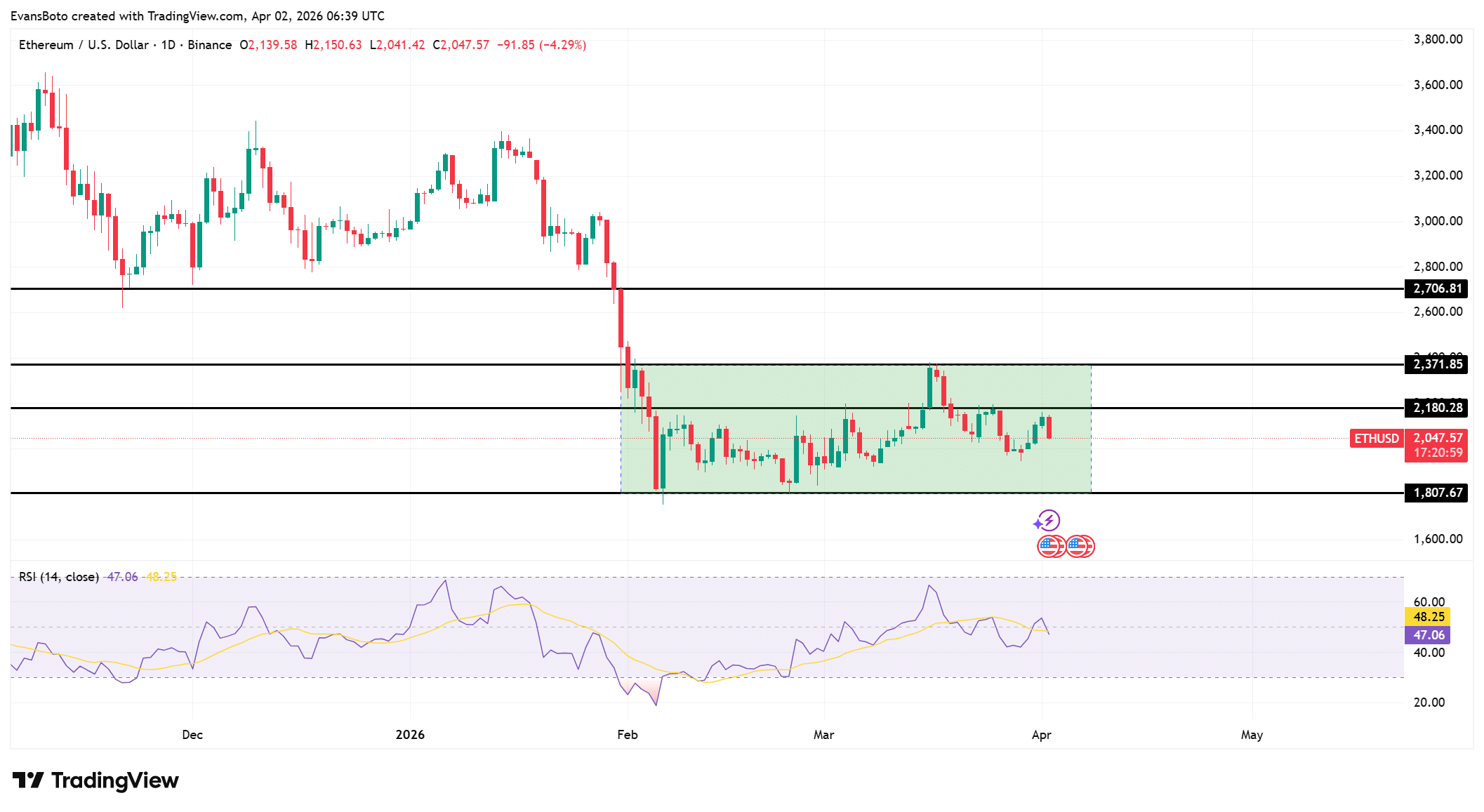
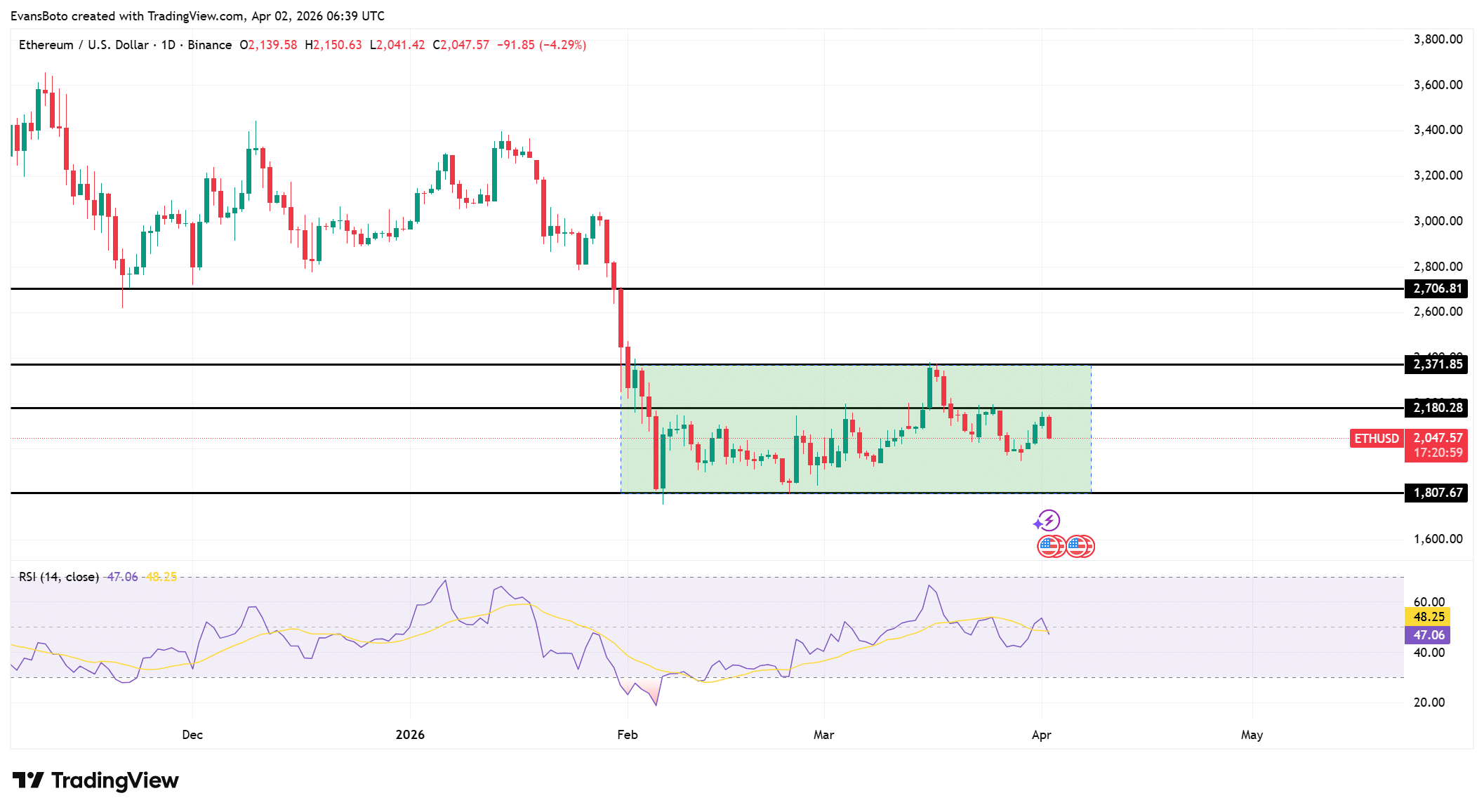
Despite strong on-chain growth, Ethereum [ETH] traded within a defined range between $1,807 support and $2,371 resistance.

Price repeatedly tested the $2,371 resistance but failed to sustain a breakout. This kept the structure compressed and limited upward expansion.

RSI stabilized near 47.06, reflecting neutral momentum without clear directional bias.

Although RSI recovered from oversold levels, it failed to break above 60. That indicated bullish strength remained limited.

Meanwhile, resistance near $2,180 continued to reject upward moves.

Each rejection maintained a pattern of lower highs within the range. This pattern limited bullish continuation.

However, repeated defenses of $1,807 showed buyers remained active at lower levels. That balance reflected ongoing indecision between accumulation and distribution.
Source: TradingView

Outflows persist despite consolidation phase

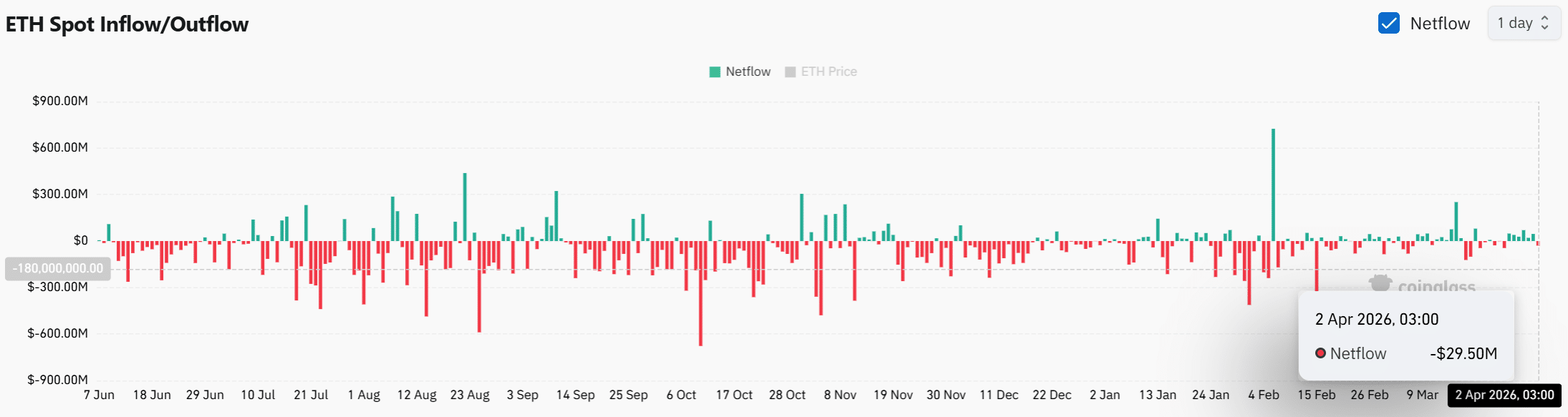
While price continues compressing, Spot Netflows remained negative, with recent data showing a $29.50M outflow.

This trend indicates that ETH continues leaving exchanges, which reduces immediately available supply for selling.

Such persistent outflows typically reflect accumulation behavior, as investors move assets into private wallets.

However, despite this supply tightening, price has not responded with upward expansion.

This suggests that although selling pressure may be decreasing, demand has not yet intensified enough to absorb resistance levels.

The continued outflow trend strengthens the underlying structure, yet price remains locked within the range as the market absorbs this shift gradually.
Source: CoinGlass

Ethereum leverage declines as shorts gain control

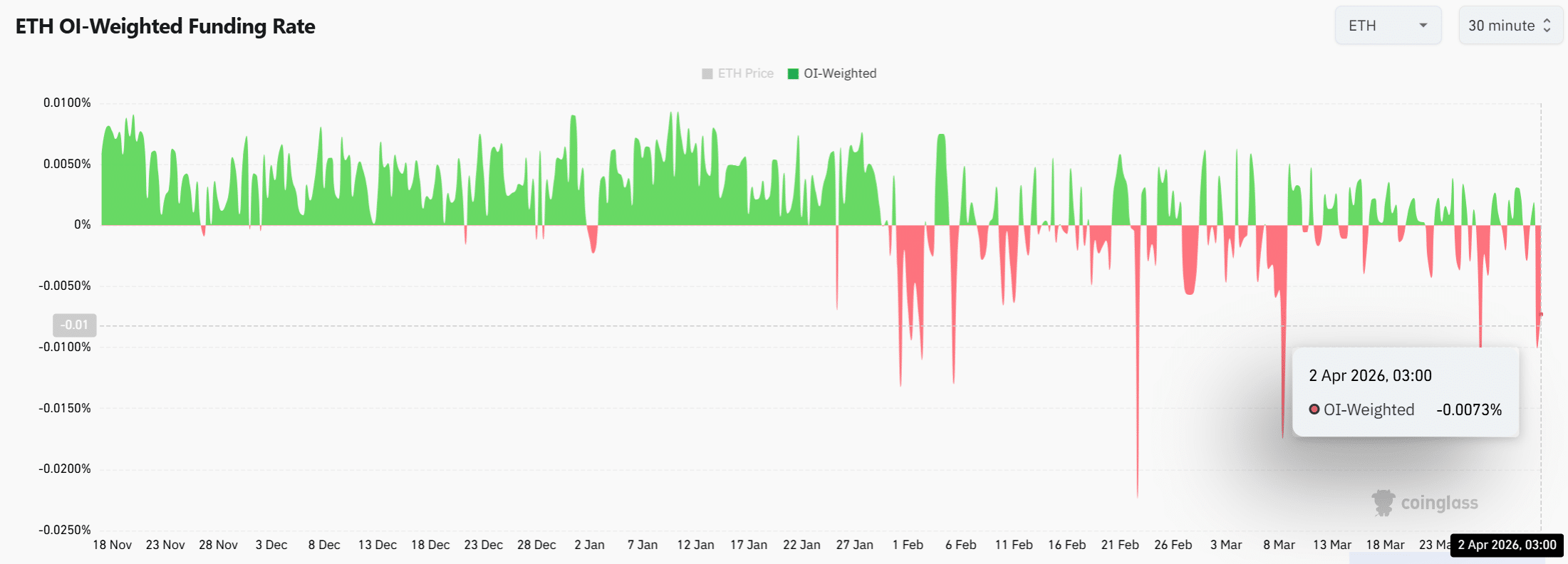
Beyond spot activity, derivatives data revealed a shift in positioning, as Open Interest [OI] dropped by 8.59% to $28.18B.

This decline showed that traders have reduced exposure, signaling lower participation in leveraged positions.

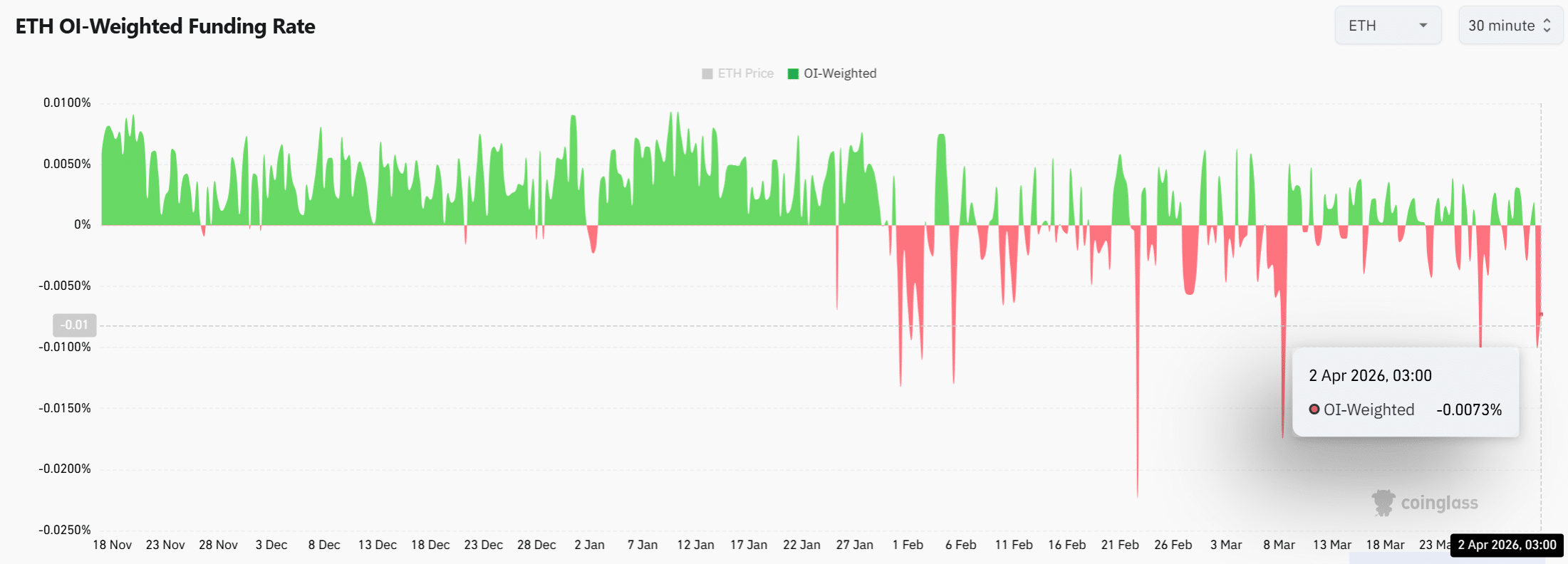
In addition, the OI-Weighted Funding Rate turned negative to -0.0073%, indicating that short positions now dominate.

This shift reflects growing bearish sentiment in the derivatives market, where traders increasingly position for downside or continued consolidation.

However, reduced leverage can also lower volatility, which reinforces the current range-bound behavior.

Therefore, as traders step back and shorts gain control, the price remains constrained, lacking the aggressive positioning needed to drive a breakout.
Source: CoinGlass

Can activity drive a breakout?

Ethereum’s network growth continues to strengthen its foundation, yet the price remains constrained within a defined range.

Reduced leverage and dominant short positioning limit upward expansion, despite ongoing accumulation signals.

This structure suggests that while underlying demand continues building, the market still requires stronger conviction to translate adoption into a sustained breakout.


Final Summary

  • Ethereum [ETH] network activity surged, with over 788K Daily Active Addresses and 255K new addresses created daily.
  • Rising participation signaled growing underlying demand, though price failed to reflect this strength.


Trending Cryptos

Related Questions

QWhat is the current number of Daily Active Addresses on the Ethereum network mentioned in the article?

AOver 788,000 Daily Active Addresses.

QWhat are the key support and resistance levels for Ethereum's price as discussed in the article?

AThe key support level is $1,807 and the resistance level is $2,371.

QWhat does the negative Spot Netflows data indicate about Ethereum's market activity?

AIt indicates that ETH is leaving exchanges, which reduces immediately available supply and typically reflects accumulation behavior as investors move assets to private wallets.

QHow did the Open Interest (OI) and OI-Weighted Funding Rate change, and what does this signal?

AOpen Interest dropped by 8.59% to $28.18B, and the OI-Weighted Funding Rate turned negative to -0.0073%, signaling reduced trader exposure and that short positions now dominate, reflecting growing bearish sentiment.

QDespite strong on-chain growth, why has Ethereum price failed to break out according to the article?

AThe price has failed to break out due to reduced leverage, dominant short positioning in derivatives, and a lack of strong enough demand to absorb resistance levels, keeping the market range-bound.

Related Reads

NVIDIA CPU Advances, China's RISC-V Responds: Semiconductor Deep Dive - Part Four

NVIDIA is set to launch its new Vera AI data center CPU in China as early as August, with high pricing. While this move offers a new option, it highlights China's continued dependence on foreign-controlled Arm architecture. In response, the Chinese semiconductor industry is increasingly turning to RISC-V as a strategic alternative for achieving high-performance computing autonomy. The article explores the concept of the "impossible triangle" in CPU development—balancing prosperity, control, and autonomy—and posits that RISC-V's open-source, modular nature offers a unique path to achieving all three. While RISC-V is already dominant in embedded systems, the focus is now shifting to data centers and AI workloads. China has become a global hotspot for RISC-V development, driven by AI-driven compute demand, supply chain concerns from export controls, cost benefits of open-source, and strong policy support. Multiple Chinese companies have reportedly crossed the key performance threshold of 15 SPECint per GHz, a benchmark for entering the high-performance CPU club. Progress extends beyond single-core benchmarks. Companies are developing complete computing subsystems, including commercial-grade coherent network-on-chip (NoC) technology and server processors with up to 40 cores that strictly adhere to the RVA23 standard to ensure software compatibility. Real-world applications are emerging in areas like video transcoding and edge AI. However, significant challenges remain. The RISC-V ecosystem faces fragmentation, immature toolchains and verification processes, and gaps in single-core performance and energy efficiency compared to mature x86 and Arm architectures. The formidable software moat, epitomized by NVIDIA's CUDA, is a long-term hurdle. In conclusion, while RISC-V cannot immediately replace offerings like NVIDIA's Vera, it represents a viable long-term path for China to develop a self-sufficient, high-performance CPU ecosystem. The journey is acknowledged to be long and arduous, requiring sustained effort to overcome technical and ecosystem challenges.

marsbit5h ago

NVIDIA CPU Advances, China's RISC-V Responds: Semiconductor Deep Dive - Part Four

marsbit5h ago

My Coding Betting Dashboard is Profiting, but Polymarket is Truly Not a Good Place for 'Arbitrage'

The author built a custom monitoring dashboard for Polymarket, a prediction market platform, and tested it with $1,600, achieving over 30% returns. However, the core argument is that Polymarket is not a good venue for traditional arbitrage. The dashboard has two main sections: a "Portfolio Dashboard" for tracking active positions with key metrics like total capital, P&L, and a risk-control module using a tier system (T1, T2, T3), and an "Opportunity Watchlist" for monitoring markets. The article details a critical structural trap in binary markets: a bet with a high perceived probability of success still carries a 100% loss risk if wrong. The author's T1/T2/T3 system is designed to manage this by limiting position sizes based on conviction and time horizon, emphasizing that high confidence should not equal high concentration. A key insight is the danger of "pseudo-diversification"—betting on different markets driven by the same underlying variable. The author concludes that Polymarket offers few true low-risk, arbitrage opportunities. It is instead a high-risk environment where wins can create a false sense of mastery, leading to large losses. The platform is better viewed as a training ground for honing judgment through disciplined, framework-driven betting rather than a reliable income source. The tools help transform intuition into structured, rule-based decisions to mitigate the risk of catastrophic errors.

marsbit8h ago

My Coding Betting Dashboard is Profiting, but Polymarket is Truly Not a Good Place for 'Arbitrage'

marsbit8h ago

WeChat AI Card Hands-On Guide: Has the AI Shopping Era Arrived?

**"WeChat AI Card" Practical Test Guide: Has the Era of AI Shopping Arrived?** WeChat has officially launched the "AI Exclusive Card," a feature integrated into its Workbuddy AI assistant. This card is designed to handle payments for AI-initiated purchases. Our hands-on test reveals it's not yet a tool for fully autonomous AI shopping, but rather a controlled payment layer for AI agents. The AI Card functions as an isolated sub-wallet within WeChat Pay. Users must bind the card and transfer funds into it from their main wallet. Crucially, every transaction requires explicit user confirmation via smartphone scan; AI cannot spend autonomously. Currently accessible through the Workbuddy agent, the card targets specific digital consumption scenarios: purchasing paid content (reports, data), calling paid APIs/tools, and subscribing to services. Its design prioritizes security and control by separating funds and mandating approval for each payment. We tested a real-world scenario: ordering bubble tea via Workbuddy using a "Meituan Life Assistant" skill. The process encountered multiple hurdles: high "skill" usage costs (exceeding daily free credits), and most importantly, while a payment was successfully initiated, the AI purchased an incorrect product (a mismatched group-buy coupon instead of the desired drink). This highlights the current limitation: the **AI Card only solves the payment step**. The broader challenge lies in the **AI agent's execution chain**—accurately understanding intent, navigating third-party platforms, selecting the right product, and ensuring proper fulfillment. The payment succeeded, but the purchase failed to meet the user's need. In conclusion, the WeChat AI Exclusive Card is a cautious, early-step experiment in AI commerce. It provides a secure, user-controlled payment method for agent interactions but is not yet capable of reliable, end-to-end complex purchases. For now, it's best used for low-value, low-risk digital services with careful user verification at each step. The vision of AI handling complete shopping tasks remains a work in progress.

marsbit11h ago

WeChat AI Card Hands-On Guide: Has the AI Shopping Era Arrived?

marsbit11h ago

Trading

Spot
Futures

Hot Articles

Discussions

Welcome to the HTX Community. Here, you can stay informed about the latest platform developments and gain access to professional market insights. Users' opinions on the price of ETH (ETH) are presented below.

活动图片