Ethereum Active Addresses Near All-Time High Despite Price Plunge

bitcoinistPublished on 2026-02-04Last updated on 2026-02-04

Abstract

Despite Ethereum's price plunging 21% in a week to around $2,290, on-chain data reveals a significant and counterintuitive trend. The 100-day moving average of Ethereum Active Addresses has surged sharply in 2026, reversing its previous decline from late 2025. This metric, which tracks the number of unique wallets transacting daily on the network, has reached 469,303. This figure is notably higher than last year's cycle high and is nearly at its all-time high from the 2021 bull market. This surge in network activity, which began with the market's recovery, has continued even as the price rally faded, suggesting a potential decoupling between user transaction activity and price action.

On-chain data shows the Active Addresses indicator has shot up for Ethereum even as the cryptocurrency’s price has witnessed a drawdown.

Ethereum Network Activity Has Surged Recently

In a new post on X, CryptoQuant community analyst Maartunn has talked about the latest trend in the 100-day moving average (MA) of the Ethereum Active Addresses. This metric measures the total number of wallets that are coming online on the blockchain every day. An address is said to be “online” when it participates in some kind of transaction activity (whether as a sender or receiver), so the Active Addresses basically tracks the daily amount of wallets making at least one transfer.

When the value of the indicator rises, it means a higher number of users are becoming involved in network activity. Such a trend suggests trading interest in the cryptocurrency is going up. On the other hand, the metric witnessing a decline implies attention may be moving away from the blockchain as a fewer amount of addresses are making transactions.

Now, here is the chart shared by Maartunn that shows the trend in the 100-day MA of the Ethereum Active Addresses over the last decade:
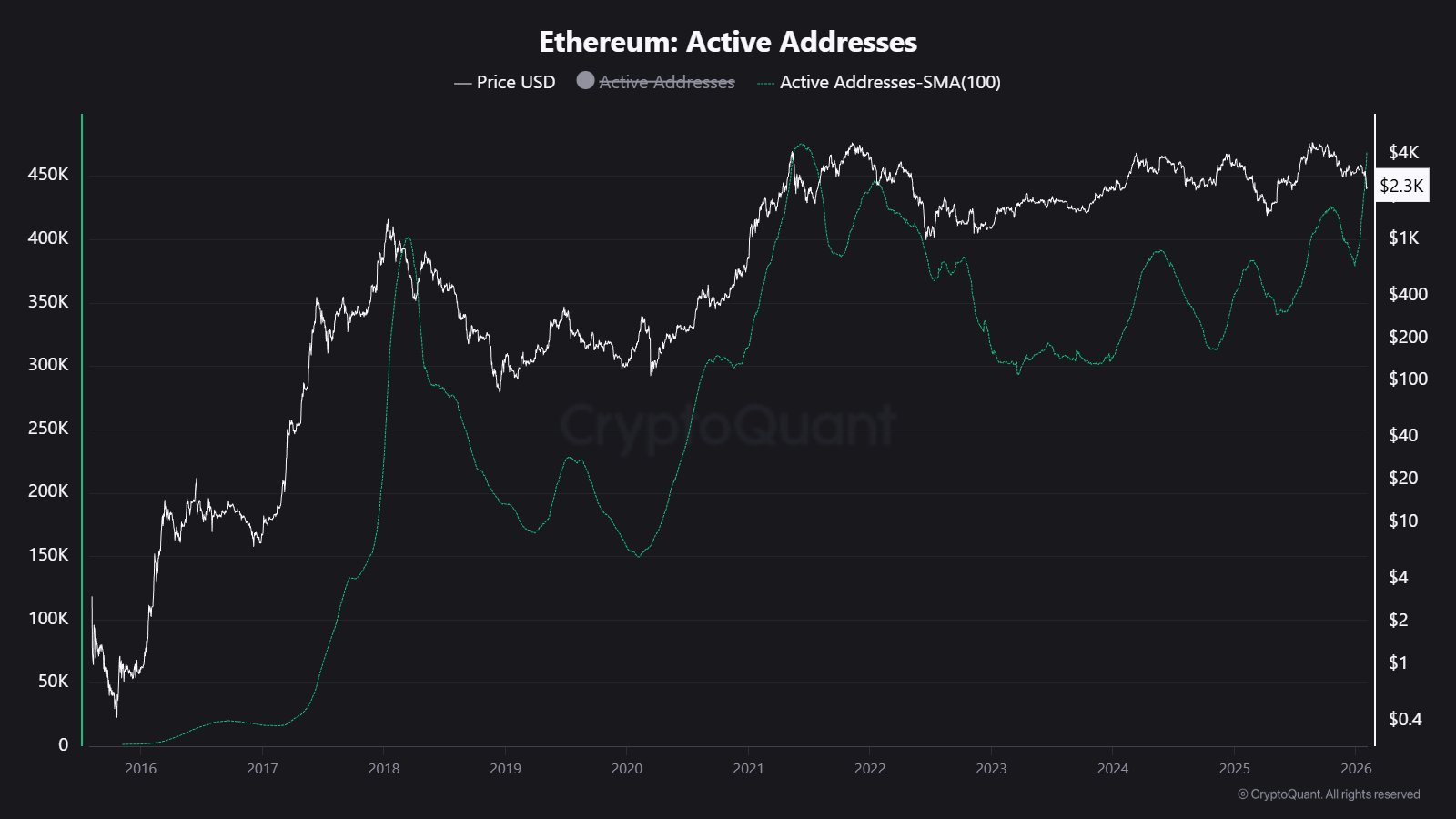
The value of the metric appears to have been going up in recent days | Source: @JA_Maartun on X

As displayed in the above graph, the 100-day MA Ethereum Active Addresses registered a decline in the last quarter of 2025 as the cryptocurrency’s price went through a bearish shift. Investor excitement tends to die as bullish momentum disappears, so it could be why network activity saw a decrease.

It’s also visible in the chart, however, that since hitting a bottom, the trend has observed a sharp reversal in 2026. The rise in activity initially emerged as the market recovered, but it has continued even as the rally has fizzled out and ETH has crashed alongside the wider sector.

Naturally, since it’s a 100-day MA, some delay is associated with its value, so a drop in activity could very well be reflected later, but it’s nonetheless interesting that a sharp reversal in Active Addresses has even occurred so far. Currently, the indicator’s 100-day MA value is sitting at 469,303, which is notably higher than the cycle high from last year and almost the same level as the all-time high (ATH) set back during the 2021 bull market.

In the last two cycles, the indicator’s cyclical peak followed a major price top, but that doesn’t appear to be the case for the current cycle so far. It now remains to be seen whether the recent trend is a sign that transaction activity is decoupling from price action or if it’s a temporary deviation.

ETH Price

At the time of writing, Ethereum is floating around $2,290, down 21% in the last seven days.

Looks like the price of the coin has plunged over the last few days | Source: ETHUSDT on TradingView


Related Questions

QWhat does the Active Addresses indicator measure for Ethereum?

AThe Active Addresses indicator measures the total number of wallets that come online on the Ethereum blockchain each day by participating in some kind of transaction activity, either as a sender or receiver.

QWhat trend has the 100-day moving average of Ethereum Active Addresses shown recently?

AThe 100-day moving average of Ethereum Active Addresses has shown a sharp increase in 2026 after hitting a bottom, rising to 469,303, which is nearly the same level as the all-time high set during the 2021 bull market.

QHow does the current activity trend differ from previous cycles according to the article?

AIn previous cycles, the cyclical peak of the Active Addresses indicator followed a major price top, but in the current cycle, the activity has surged even as the price has plunged, suggesting a potential decoupling of transaction activity from price action.

QWhat was the percentage decline in Ethereum's price over the last seven days mentioned in the article?

AEthereum's price declined by 21% over the last seven days, floating around $2,290 at the time of writing.

QWhy is the recent surge in Active Addresses considered interesting despite the price drop?

AThe surge is interesting because it has continued even as the rally fizzled out and ETH crashed, which is unusual as network activity typically declines when bullish momentum disappears and investor excitement dies.

Related Reads

The Niche Consensus Among Elites: Has College Become an Expensive Waste?

**Summary:** A growing "anti-college" movement is gaining traction among elite circles in Silicon Valley, challenging the traditional value of a four-year university degree. Proponents argue that college has become an expensive, slow, and increasingly irrelevant waste of time, especially in the fast-paced tech world where opportunities pass by quickly. The movement is led by figures like billionaire Peter Thiel, who criticizes universities for high costs, ideological indoctrination, and stifling true innovation. His "Thiel Fellowship" pays young people to drop out and pursue ventures. Companies like Palantir Technologies (co-founded by Thiel) fuel this trend with programs like the "Meritocracy Fellowship," which offers high school graduates paid internships as an alternative to immediate college enrollment, promising a practical "Palantir Degree." Key drivers include: 1. **Economics:** Skyrocketing student debt versus the allure of immediate, high-paying tech jobs or startup funding. 2. **Technology:** AI and online tools lowering barriers to self-education and product development, making formal instruction seem inefficient. 3. **Culture:** A backlash against perceived "woke" ideology and DEI policies in universities, coupled with a belief that these institutions suppress meritocracy and masculine drive. The movement is notably male-dominated. Critics, like economist David Deming, warn against overgeneralizing from dropout success stories (survivorship bias). He emphasizes that genuine autodidacts are rare, corporate training is narrowly focused, and the "college wage premium" remains high for most people. University liberal arts education, he argues, builds adaptable problem-solving skills and broad perspectives. The debate highlights a deeper crisis in education. The core model of the modern university appears increasingly mismatched with the speed of the information age. The movement signals a shift in the locus of learning from institutional "education" to personal, active "learning" powered by the internet and AI. Ultimately, this may not mean the end of university, but rather a painful evolution. The future likely holds more hybrid, personalized, and lifelong learning pathways. The central question becomes: in a world changing faster than any curriculum, how do we best learn?

marsbit19m ago

The Niche Consensus Among Elites: Has College Become an Expensive Waste?

marsbit19m ago

From Subsidies to Token-Based Pricing to Price Cuts: Is OpenAI Sparking a Price War? Is the Inflection Point for Token Economics Nearing?

The commercialization of generative AI is facing a critical inflection point as a potential price war looms. According to The Wall Street Journal, OpenAI is considering a significant cut to its token fees to compete with rival Anthropic, signaling a shift from a growth-at-all-costs model focused on token consumption. This move comes as both companies, reportedly losing billions on compute, prepare for IPOs, and as enterprise customers face "bill shock" from switching to usage-based token billing. Reports indicate poor ROI, with one analysis finding only 18 cents of every dollar spent on AI tokens generates user-facing value. The industry's initial phases—from flat-rate subscriptions to aggressive subsidies—have given way to a reckoning with real costs. Analysts debate the future: some predict a bifurcation between premium, high-cost models for complex tasks and cheaper alternatives for routine work, while others believe overall spending will still rise as agentic AI increases tokens per task. Notably, Chinese model DeepSeek's low-cost API is gaining traction with U.S. enterprises, adding competitive pressure. The core challenge is redefining value beyond token volume ("tokenmaxxing") toward measurable productivity ("valuemaxxing"), as the entire AI value chain, from cloud providers to chipmakers, feels the ripple effects of unsustainable pricing.

marsbit23m ago

From Subsidies to Token-Based Pricing to Price Cuts: Is OpenAI Sparking a Price War? Is the Inflection Point for Token Economics Nearing?

marsbit23m ago

Trading

Spot
Futures

Hot Articles

Discussions

Welcome to the HTX Community. Here, you can stay informed about the latest platform developments and gain access to professional market insights. Users' opinions on the price of ETH (ETH) are presented below.

活动图片