Ether price trend forecasts triple-digit rally as ETH ETF inflows resume

cointelegraphPublished on 2025-12-11Last updated on 2025-12-11

Abstract

Ether (ETH) price is consolidating near $3,200 after facing resistance between $3,350 and $3,650, a zone aligned with the 200-day EMA. Despite this pullback, spot ETH ETF inflows have shown early signs of recovery, rising 28% from $16.8 billion to $21.5 billion since November 21. Net taker volume, while still negative at –$138 million, has improved significantly from October’s –$500 million, indicating reduced selling pressure and a potential shift in market structure. If this trend continues, it could signal a bullish breakout, reminiscent of early 2025 before ETH’s 3x rally. However, ETH is currently testing key support between $3,100–$3,180. A hold above this level could lead to a rebound toward $3,450 and possibly $3,900, while a breakdown might trigger a retest of $3,000. Derivatives data shows neutral but fragile sentiment, with mildly positive funding rates and near-neutral bid/ask ratios. The next major price move depends on whether improving ETF inflows and taker activity translate into sustained buying pressure.

Ether’s (ETH) price action cooled this week after a sharp rejection from the $3,650 to $3,350 supply zone, with the altcoin now hovering near $3,200. The rejection aligned with the 200-day exponential moving average (EMA), reinforcing overhead resistance just as spot exchange-traded funds (ETFs) flows began showing early signs of recovery.

Key takeaways:

  • Spot Ether ETF flows have risen from $16.8 billion to $21.5 billion since Nov. 21, a 28% increase.

  • Net taker volumes rose, signaling that aggressive sellers are weakening while taker buyers slowly return.
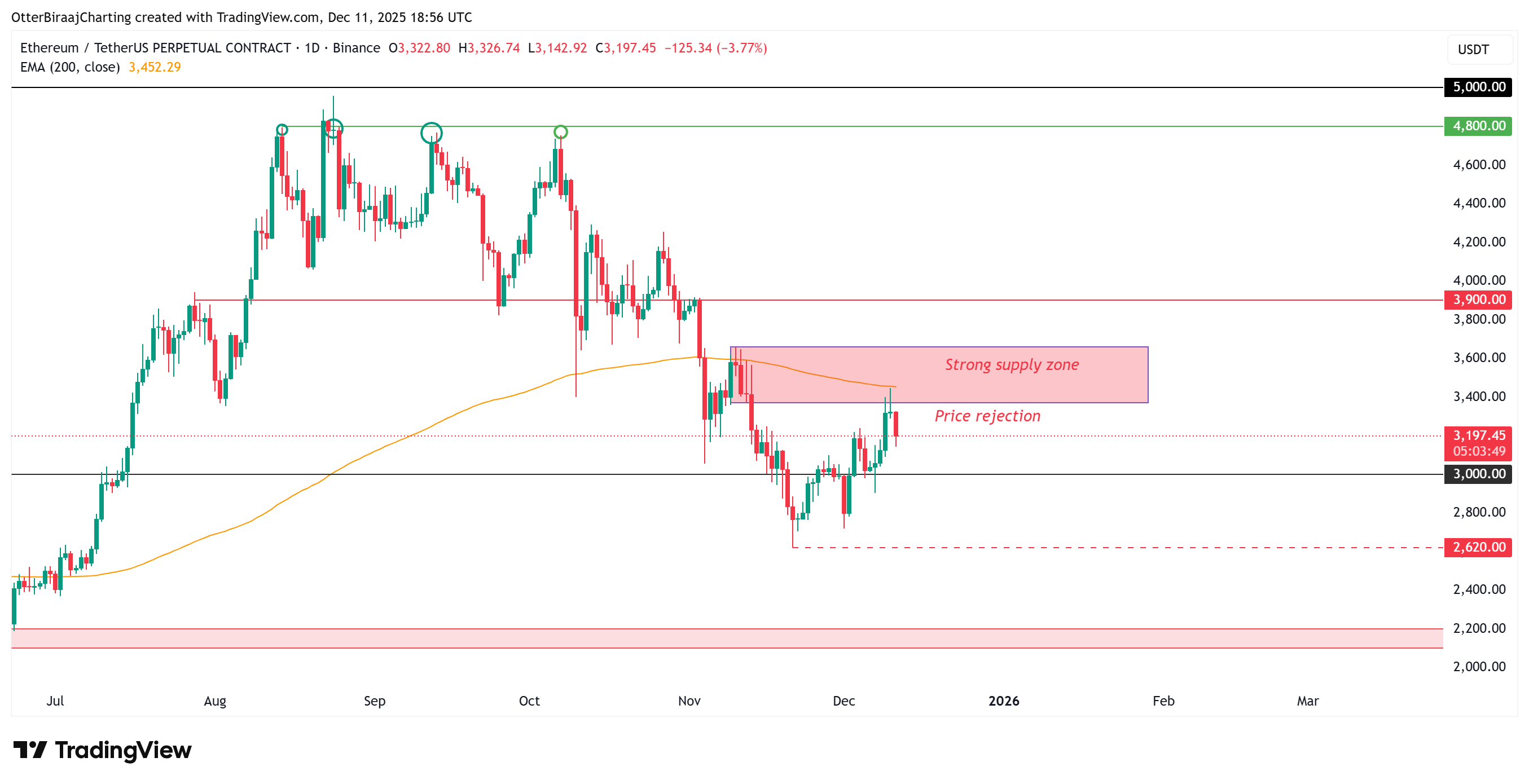
Ethereum one-day chart. Source: Cointelegraph/TradingView

ETF inflows resume, but ETH charts reflect traders’ fear

According to Glassnode, spot ETH ETFs are finally showing “the first signs of life” after several weeks of outflows. A 28% recovery since Nov. 21 in total net ETF assets hints at improving demand into year-end.

However, the rebound is still modest compared to the $32 billion peak in early October, suggesting that institutional conviction has not fully returned.
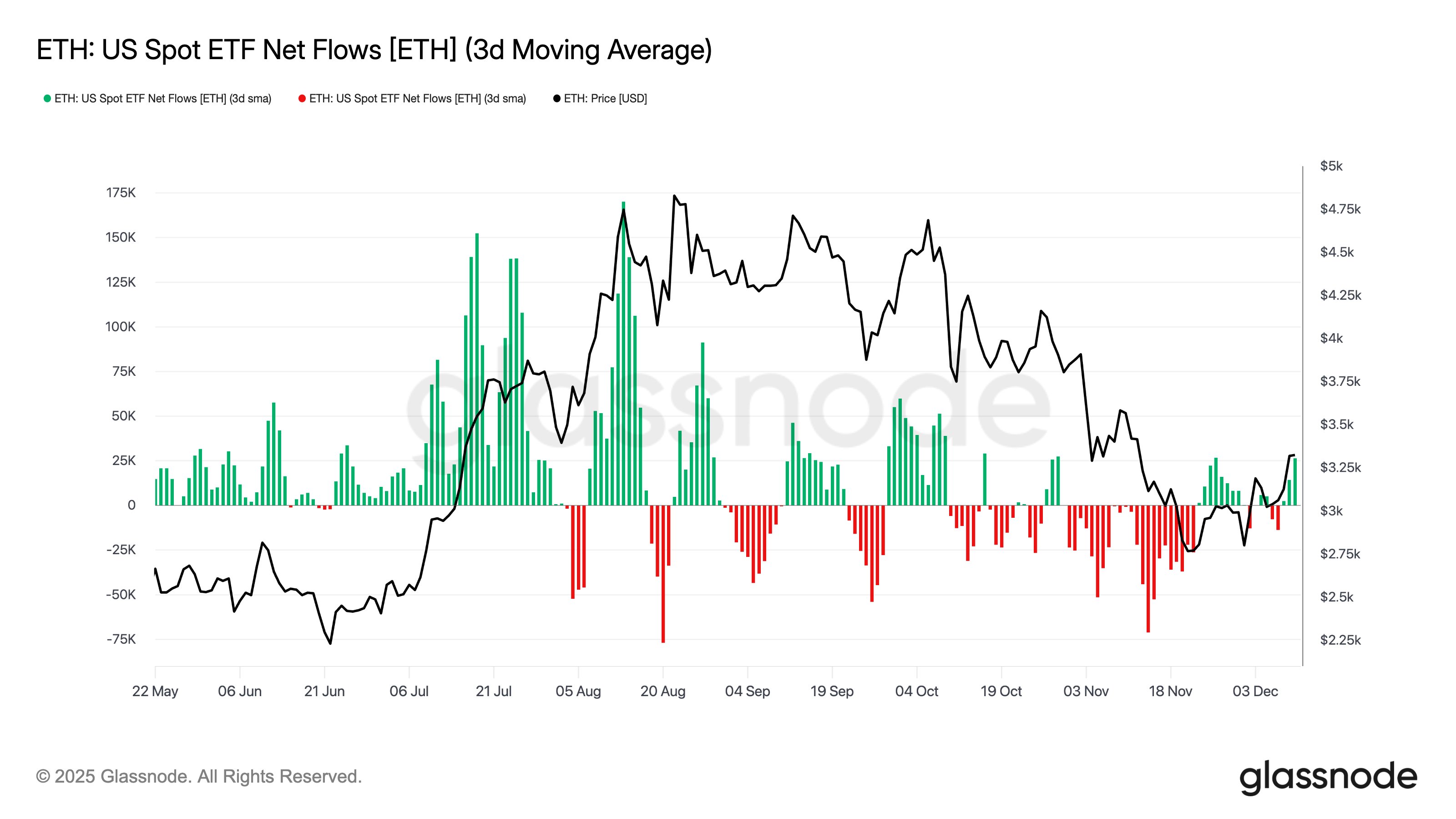
Spot ETH ETF net flows. Source: Glassnode

Data from CryptoQuant strengthened this narrative. The net taker volume remained negative at –$138 million, yet the improvement from October’s –$500 million extreme marks a structural shift. Aggressive sellers dominated the market during the September–October drawdown, but that dynamic is slowly fading.

The 30-day moving average of net taker volume also shows an ascending pattern in its lows, a structure last seen in early 2025, just before ETH launched a 3X rally and printed a new all-time high.

If the current trajectory holds, a positive flip in taker volume activity could be a high-probability trigger for another bullish breakout phase for ETH in the coming weeks.
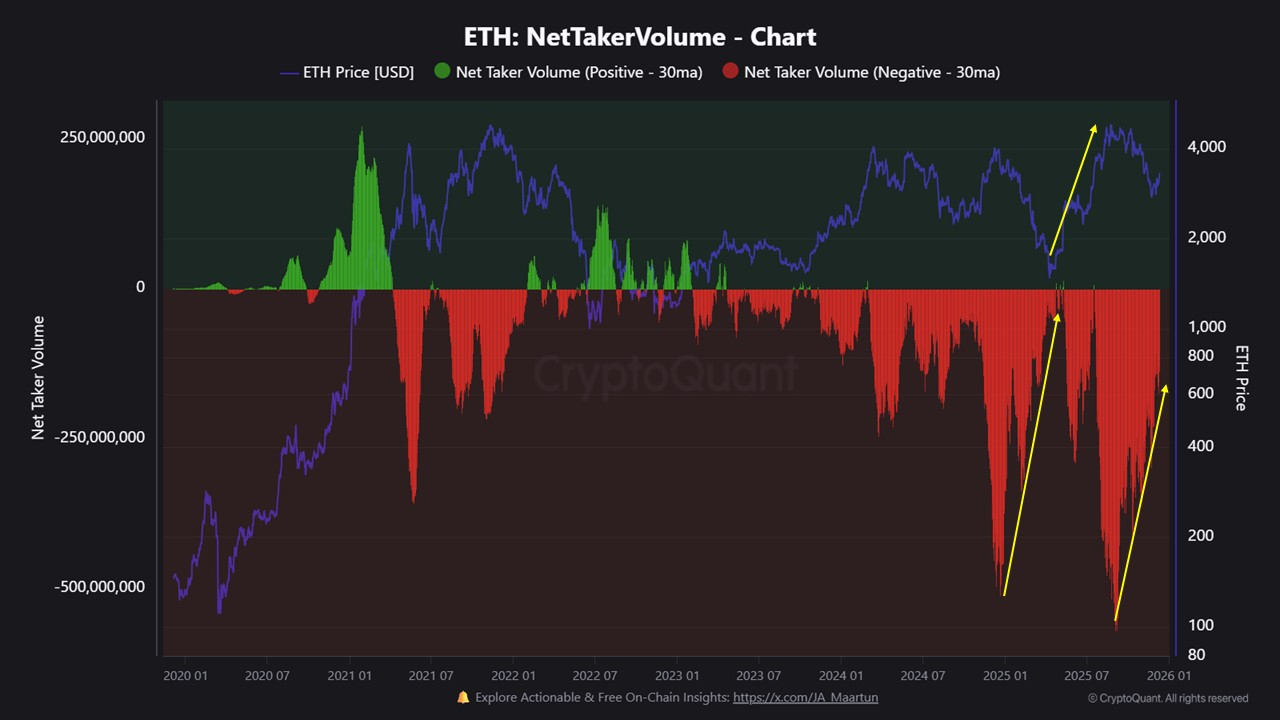
Ether Net taker volume data. Source: CryptoQuant

Related: Ether vs. Bitcoin: ETH price poised for 80% rally in 2026

ETH price compresses at support as derivatives cool off

Ether is currently testing the $3,100–$3,180 order block on the four-hour chart, a region that could serve as a demand zone. ETH price continued to respect its ascending channel, but momentum is clearly cooling. The market is now at a structural crossroads.
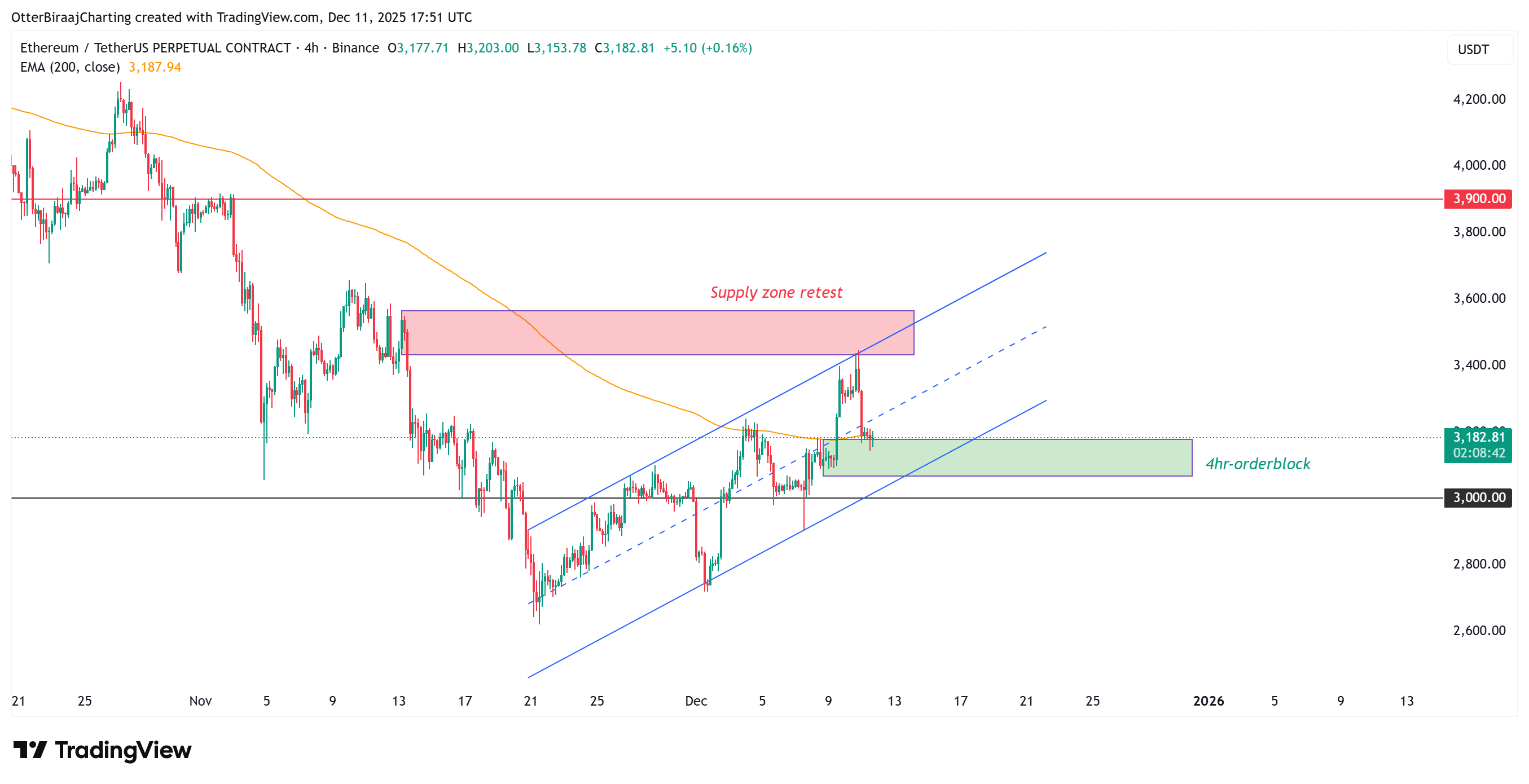
Ether four-hour chart. Source: Cointelegraph/TradingView

In a bullish scenario, holding the demand block and channel support would allow ETH to rebound toward the daily 200-EMA. A clean break above $3,450 would invalidate the rejection and reopen the path toward $3,900 resistance.

However, from a bearish standpoint, a breakdown below the ascending channel support exposes a bearish confirmation and a possible retest of $3,000, a key support level.

Data from Hyblock indicated that Ether derivatives support the neutral but fragile thesis. Aggregated open interest (OI) has unwound slightly after the rejection. The funding rate is mildly positive but not stretched, and the bid/ask ratio remains close to neutral, showing spot takers are not yet leaning aggressively bullish.
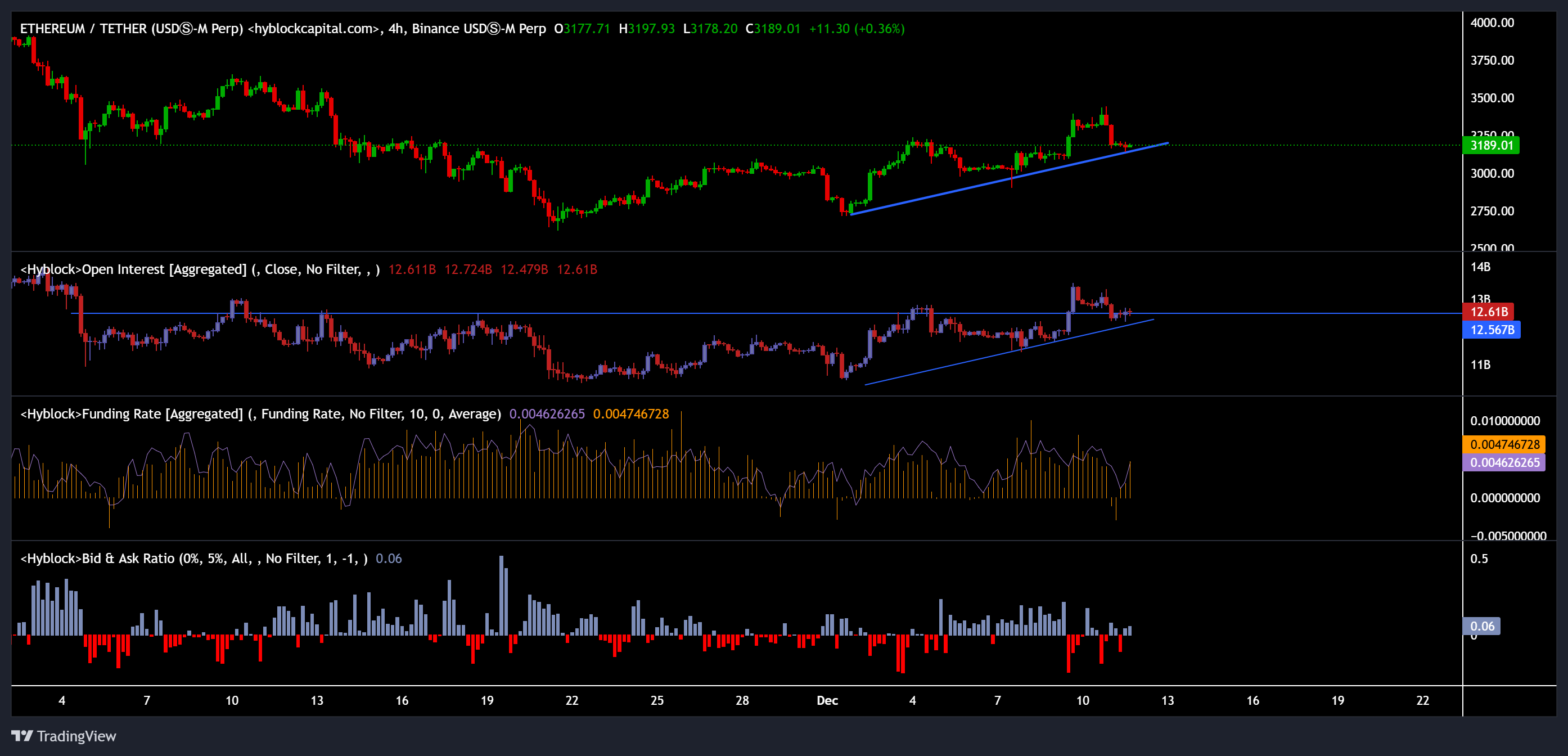
Ether futures data analysis. Source: Hyblock Capital

ETH’s next major move now depends on whether bulls can defend the demand zone long enough for improving taker flows and ETF demand to translate into sustained upside pressure.

Related: Bitcoin rallies fail at $94K despite Fed policy shift: Here’s why

This article does not contain investment advice or recommendations. Every investment and trading move involves risk, and readers should conduct their own research when making a decision. While we strive to provide accurate and timely information, Cointelegraph does not guarantee the accuracy, completeness, or reliability of any information in this article. This article may contain forward-looking statements that are subject to risks and uncertainties. Cointelegraph will not be liable for any loss or damage arising from your reliance on this information.


Trending Cryptos

Related Reads

The Robinhood Stock Tokens You Bought Are Just Debts from Jersey Island

The Robinhood stock tokens you buy are essentially debt securities issued by a shell company in Jersey, not real equity. These tokens merely track stock prices like NVIDIA or Apple but grant no shareholder rights like voting or dividends. If the underlying company fails, you have no claim on its assets. Instead, you hold a debt instrument from Robinhood Assets (Jersey) Limited, which promises returns based on stock performance. If this Jersey entity goes bankrupt, you become an unsecured creditor. This complex structure stems from Robinhood's past crisis during the 2021 GameStop short squeeze, where T+2 settlement caused liquidity issues. The blockchain-based tokens enable instant settlement, theoretically preventing such trading halts. The product is classified by the SEC as a "linked security" or structured note, carrying counterparty risk not borne by actual shareholders. It is available globally but excluded from the US, UK, and other major markets, while Robinhood offers a fully compliant, asset-backed token model in Europe under MiFID II. The system relies on oracles for pricing, which poses risks like manipulation and faulty liquidations seen in DeFi exploits. Robinhood profits from spreads and aims to become a full-chain settlement layer. Meanwhile, competitors like Ondo have launched SEC-registered, fully compliant equity tokens in the US with actual voting rights and dividends. Robinhood’s Jersey debt model appears as a transitional, regulatory-arbitrage product, aiming to capture market share ahead of future regulatory clarity.

Foresight News12m ago

The Robinhood Stock Tokens You Bought Are Just Debts from Jersey Island

Foresight News12m ago

Can Open USD Support Stripe's Ambitions?

Can Open USD support Stripe's ambition? The article argues that OUSD represents a pivotal strategic move for Stripe, shifting its narrative from being a superior payments API company to becoming a "money movement network." Unlike simply facilitating payments, this new model aims to organize and define the settlement layer, default assets, and economic distribution rules for future commerce. The analysis highlights OUSD's role in giving Stripe a potential default settlement asset, enabling deeper economics through reserve earnings, and providing a programmable money layer for emerging use cases like AI agentic commerce. Crucially, OUSD is presented not as a direct "USDC killer" but as an attempt to redefine the business model of stablecoins, proposing a collaborative governance structure where contributing partners share in the network's economic benefits and governance. For Stripe, this is about evolving from a powerful "abstraction layer" over traditional financial rails into an active participant and potential architect of the next-generation global settlement network. While OUSD alone cannot immediately realize this ambition, it signals Stripe's intent to move closer to the money layer itself, positioning itself at the center of future money flows in an increasingly automated, platform-driven, and AI-powered economy. The ultimate question is whether Stripe can transition from being a best-in-class payment processor to becoming the foundational infrastructure for internet-native money movement.

marsbit31m ago

Can Open USD Support Stripe's Ambitions?

marsbit31m ago

Trading

Spot

Hot Articles

Discussions

Welcome to the HTX Community. Here, you can stay informed about the latest platform developments and gain access to professional market insights. Users' opinions on the price of ETH (ETH) are presented below.

活动图片