ETH/BTC Ratio Falls Back To Early-2023 Levels As Traders Debate Ethereum Value
bitcoinistPublished on 2026-06-21Last updated on 2026-06-21
Abstract
The ETH/BTC ratio has fallen back to 0.027, a level last seen in early 2023, and is significantly below its 2021 peak near 0.088. This prompts a key market debate: Is Ethereum (ETH) now a historically cheap contrarian buy against Bitcoin (BTC), or is it in a structural decline? Analyst Woetoe highlighted this question.
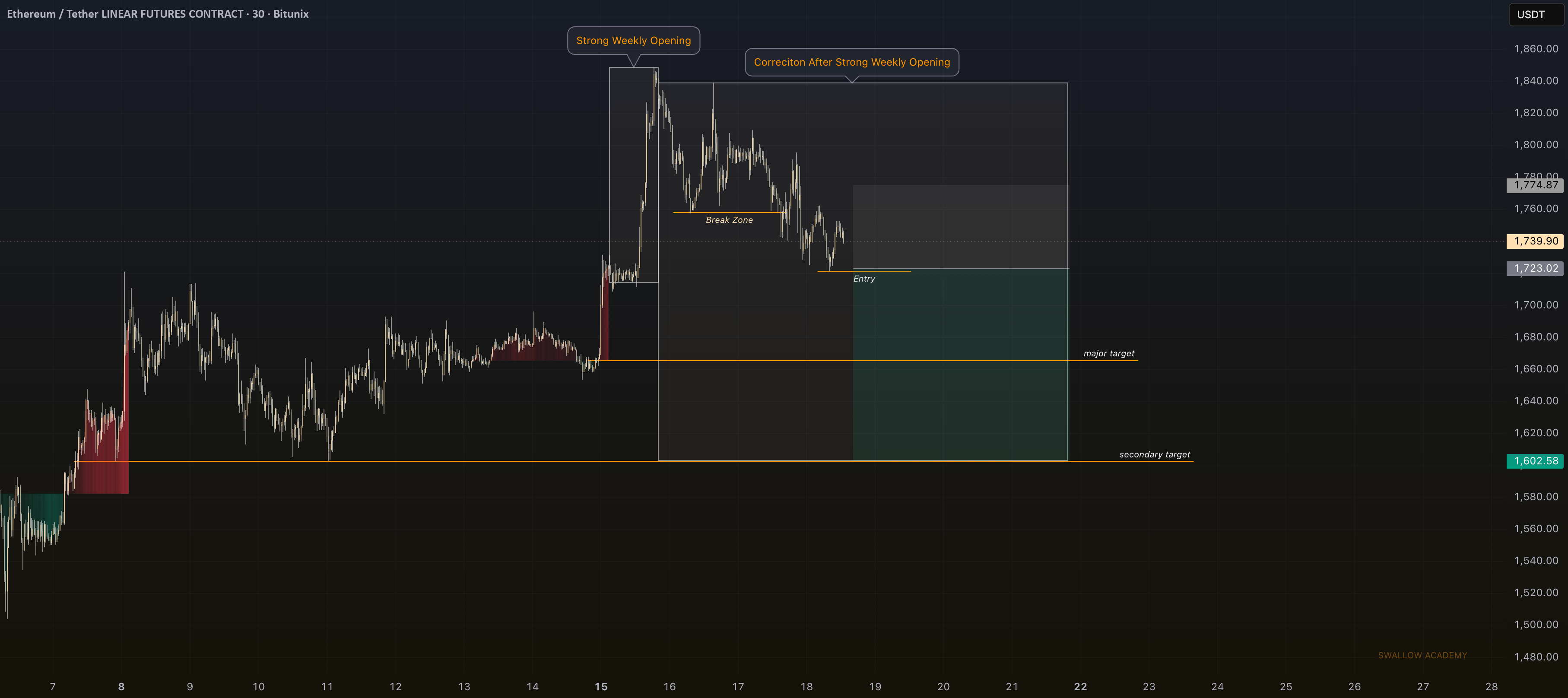
Simultaneously, ETH's USD chart (ETHUSDT) indicates bearish correction risk. Analysis from SwallowAcademy points to a broken market structure following an aggressive weekly open, with price rolling over below the $1,774 high and a potential pullback toward the $1,660-$1,723 zone.
This creates a complex setup. While ETH appears undervalued relative to BTC, its standalone technicals remain weak. The report concludes that for ETH bulls, the immediate priority is not valuation arguments but reclaiming technical strength and beginning to outperform BTC again.
Trusted Editorial content, reviewed by leading industry experts and seasoned editors. Ad Disclosure
TL;DR
Woetoe says the ETH/BTC ratio is near 0.027, back around early-2023 levels.
The analyst contrasted that with the 2021 peak near 0.088.
A separate ETHUSDT TradingView setup shows bearish correction risk after a strong weekly open.
The ETH/BTC ratio at 0.027. Back to early 2023 levels.
In 2021 at the peak it was 0.088. Three times what it is today.$ETH is historically cheap against bitcoin on a relative basis.
Contrarian bet or structural decline? pic.twitter.com/sF9DgKyKwq
TradingView chart referenced in this analysis
— Woetoe (@cryptowoetoe) June 20, 2026
Ethereum’s relative performance against Bitcoin is back under pressure. In a June 20 X post, Woetoe said the ETH/BTC ratio is at 0.027, bringing it back to early-2023 levels. The analyst contrasted that with the 2021 peak around 0.088 and asked whether ETH is now a contrarian bet or facing structural decline.
That question captures the core debate around Ethereum right now. A low ETH/BTC ratio can look attractive to investors who believe Ethereum will eventually regain leadership. It can also be a warning that capital continues to prefer Bitcoin over the broader smart-contract ecosystem.
ETHUSDT Chart Shows Correction Risk
The dollar chart is not offering a simple bullish answer either. SwallowAcademy’s June 20 TradingView idea described ETHUSDT as entering a bearish correction after a strong weekly open. The analyst said the initial push was unusually aggressive, which increased the need for a deeper pullback to rebalance the move.
The setup highlighted a broken market structure and price rolling over below the $1,774 high. The stated game plan focused on selling a retest into a $1,723 entry zone, with $1,660 referenced in the idea title as part of the corrective framework.
A Relative-Value Setup With Real Risk
The combination creates an interesting but risky setup. ETH may look historically cheap against Bitcoin, but the ETHUSDT chart still shows corrective pressure. That means a relative-value trader may see opportunity while a momentum trader sees weakness.
The distinction matters. Cheap can stay cheap if market structure keeps deteriorating. For ETH bulls, the first job is not to argue valuation; it is to reclaim technical strength and start outperforming BTC again.
This report is based on information from Woetoe on X and TradingView SwallowAcademy.
This article was written by the News Desk and edited by Samuel Rae.
Editorial Process for bitcoinist is centered on delivering thoroughly researched, accurate, and unbiased content. We uphold strict sourcing standards, and each page undergoes diligent review by our team of top technology experts and seasoned editors. This process ensures the integrity, relevance, and value of our content for our readers.
ShareTweetShareShare
Sign Up for Our Newsletter!
For updates and exclusive offers enter your email.
Sign Up
I consent to my submitted data being collected and stored.
Leave this field empty if you're human:
Bitcoinist Editorial Team
Follow
Full Profile
Related Posts
Kraken Brings Solana DEX Trading Directly to Its Main App
2 hours ago
Ethereum Bears Keep Control As ETH Rejects Trendline Resistance
8 hours ago
XRP Reversal Setup Forms Around Harmonic Pattern And Key Support Zone
11 hours ago
Hyperliquid ETF Claim Draws Attention As HYPE Narrative Builds On X
12 hours ago
Bitcoin Must Hold $60K Or Risk Major Breakdown, TradingView Analyst Warns
14 hours ago
Venus Protocol Integrates Tokenized Stocks As Lending Collateral On BNB Chain
QWhat is the current ETH/BTC ratio and how does it compare to its 2021 peak?
AThe current ETH/BTC ratio is approximately 0.027, a level last seen in early 2023. This is significantly lower than its 2021 peak, which was around 0.088.
QAccording to SwallowAcademy's analysis on TradingView, what is the outlook for ETHUSDT?
AAccording to SwallowAcademy, the ETHUSDT chart is entering a bearish correction after a strong weekly open. The analysis highlights a broken market structure, with price rolling over below the $1,774 high, and suggests a corrective pullback could target levels around $1,660.
QWhat is the core debate about Ethereum's current market position as mentioned in the article?
AThe core debate is whether Ethereum's low ETH/BTC ratio represents a contrarian buying opportunity because it is historically cheap against Bitcoin, or if it signals a structural decline where capital continues to favor Bitcoin over Ethereum and the broader smart-contract ecosystem.
QAccording to the article, what is the primary task for Ethereum bulls who see value in the current ratio?
AFor Ethereum bulls, the primary task is not just to argue about valuation, but to reclaim technical strength and for ETH to start outperforming Bitcoin (BTC) again, as a low ratio can persist if market structure continues to deteriorate.
QBased on the combined analysis, why is the current ETH setup considered 'interesting but risky'?
AThe setup is interesting but risky because ETH appears historically cheap relative to Bitcoin, suggesting a relative-value opportunity. However, the ETHUSDT chart simultaneously shows bearish corrective pressure, meaning a momentum trader sees weakness. The risk is that 'cheap can stay cheap' if technical weakness persists.
DIGITAL GOLD ($BITCOIN): A Comprehensive Analysis Introduction to DIGITAL GOLD ($BITCOIN) DIGITAL GOLD ($BITCOIN) is a blockchain-based project operating on the Solana network, which aims to combine the characteristics of traditional precious metals with the innovation of decentralized technologies. While it shares a name with Bitcoin, often referred to as “digital gold” due to its perception as a store of value, DIGITAL GOLD is a separate token designed to create a unique ecosystem within the Web3 landscape. Its goal is to position itself as a viable alternative digital asset, although specifics regarding its applications and functionalities are still developing. What is DIGITAL GOLD ($BITCOIN)? DIGITAL GOLD ($BITCOIN) is a cryptocurrency token explicitly designed for use on the Solana blockchain. In contrast to Bitcoin, which provides a widely recognized value storage role, this token appears to focus on broader applications and characteristics. Notable aspects include: Blockchain Infrastructure: The token is built on the Solana blockchain, known for its capacity to handle high-speed and low-cost transactions. Supply Dynamics: DIGITAL GOLD has a maximum supply capped at 100 quadrillion tokens (100P $BITCOIN), although details regarding its circulating supply are currently undisclosed. Utility: While precise functionalities are not explicitly outlined, there are indications that the token could be utilized for various applications, potentially involving decentralized applications (dApps) or asset tokenization strategies. Who is the Creator of DIGITAL GOLD ($BITCOIN)? At present, the identity of the creators and development team behind DIGITAL GOLD ($BITCOIN) remains unknown. This situation is typical among many innovative projects within the blockchain space, particularly those aligning with decentralized finance and meme coin phenomena. While such anonymity may foster a community-driven culture, it intensifies concerns about governance and accountability. Who are the Investors of DIGITAL GOLD ($BITCOIN)? The available information indicates that DIGITAL GOLD ($BITCOIN) does not have any known institutional backers or prominent venture capital investments. The project seems to operate on a peer-to-peer model focused on community support and adoption rather than traditional funding routes. Its activity and liquidity are primarily situated on decentralized exchanges (DEXs), such as PumpSwap, rather than established centralized trading platforms, further highlighting its grassroots approach. How DIGITAL GOLD ($BITCOIN) Works The operational mechanics of DIGITAL GOLD ($BITCOIN) can be elaborated on based on its blockchain design and network attributes: Consensus Mechanism: By leveraging Solana’s unique proof-of-history (PoH) combined with a proof-of-stake (PoS) model, the project ensures efficient transaction validation contributing to the network's high performance. Tokenomics: While specific deflationary mechanisms have not been extensively detailed, the vast maximum token supply implies that it may cater to microtransactions or niche use cases that are still to be defined. Interoperability: There exists the potential for integration with Solana’s broader ecosystem, including various decentralized finance (DeFi) platforms. However, the details regarding specific integrations remain unspecified. Timeline of Key Events Here is a timeline that highlights significant milestones concerning DIGITAL GOLD ($BITCOIN): 2023: The initial deployment of the token occurs on the Solana blockchain, marked by its contract address. 2024: DIGITAL GOLD gains visibility as it becomes available for trading on decentralized exchanges like PumpSwap, allowing users to trade it against SOL. 2025: The project witnesses sporadic trading activity and potential interest in community-led engagements, although no noteworthy partnerships or technical advancements have been documented as of yet. Critical Analysis Strengths Scalability: The underlying Solana infrastructure supports high transaction volumes, which could enhance the utility of $BITCOIN in various transaction scenarios. Accessibility: The potential low trading price per token could attract retail investors, facilitating wider participation due to fractional ownership opportunities. Risks Lack of Transparency: The absence of publicly known backers, developers, or an audit process may yield skepticism regarding the project's sustainability and trustworthiness. Market Volatility: The trading activity is heavily reliant on speculative behavior, which can result in significant price volatility and uncertainty for investors. Conclusion DIGITAL GOLD ($BITCOIN) emerges as an intriguing yet ambiguous project within the rapidly evolving Solana ecosystem. While it attempts to leverage the “digital gold” narrative, its departure from Bitcoin's established role as a store of value underscores the need for a clearer differentiation of its intended utility and governance structure. Future acceptance and adoption will likely depend on addressing the current opacity and defining its operational and economic strategies more explicitly. Note: This report encompasses synthesised information available as of October 2023, and developments may have transpired beyond the research period.
654 Total ViewsPublished 2025.05.13Updated 2025.05.13
Fractal Bitcoin is a Layer-1 scalability solution built on the Bitcoin core code, enabling infinite scalability through a recursive approach.
48.1k Total ViewsPublished 2025.06.30Updated 2025.06.30
Discussions
Welcome to the HTX Community. Here, you can stay informed about the latest platform developments and gain access to professional market insights. Users' opinions on the price of BTC (BTC) are presented below.