Eric Trump Has A Bitcoin Strategy That Could Make Michael Saylor Sweat

bitcoinistPublished on 2026-05-13Last updated on 2026-05-13

Abstract

Eric Trump, co-founder of American Bitcoin, unveiled an aggressive Bitcoin strategy at the 2026 Bitcoin conference, positioning the company as a direct competitor to Michael Saylor's MicroStrategy. The core distinction lies in ABTC's architectural model: while MicroStrategy buys Bitcoin on the open market, ABTC mines it first through its partnership with Hut 8 Corp. This "mining-to-treasury" pipeline allows ABTC to acquire Bitcoin at a claimed discounted rate, currently producing 8-10 BTC daily, and retain all mined coins rather than selling them for operating costs. This strategy has yielded results, with ABTC reporting a 116% Bitcoin yield increase from its September 2025 IPO to late January 2026, holding 6,899 BTC valued at roughly $474 million. While MicroStrategy's holdings (818,334 BTC) remain vastly larger, Trump argues that ABTC's integrated model provides a structural cost advantage. The company recently expanded its mining capacity by 12% to further its disciplined accumulation, aiming to close the gap as the corporate Bitcoin treasury sector evolves.

Eric Trump, co-founder and Chief Strategy Officer of American Bitcoin, has laid out an aggressive Bitcoin accumulation framework that positions the Trump-backed company as a direct challenger to Strategy — Michael Saylor’s industry-defining Bitcoin treasury firm — through a combination of in-house mining, disciplined treasury retention, and what ABTC describes as a “mining to treasury” pipeline unavailable to pure accumulation plays.

Speaking at the Bitcoin 2026 conference in Las Vegas, Trump declared that Bitcoin is currently in its greatest period ever, pointing to what he described as a transformational shift in the past six months relative to the prior three years — driven by record ETF launches, corporate treasury adoption, and major banks now offering Bitcoin-backed financial products.

The declaration arrived not as an outside observer but as the operating executive of one of the most closely watched Bitcoin treasury companies in the nascent sector.

The Structural Advantage ABTC Claims Over Strategy

The core distinction Eric Trump and Asher Genoot, Executive Chair of American Bitcoin’s board, have drawn between ABTC and Strategy is architectural. Strategy accumulates Bitcoin exclusively through capital markets — equity offerings, convertible notes, and debt instruments — and then purchases Bitcoin on the open market. American Bitcoin mines it first.

Through its majority owner and infrastructure partner Hut 8 Corp. (Nasdaq: HUT), which contributed the vast majority of its Bitcoin mining ASICs in exchange for an 80% stake in the venture, ABTC acquires Bitcoin at what it describes as a discounted rate relative to spot market purchases, per Benzinga’s reporting on the company’s positioning. The framework combines active mining output — currently delivering an estimated eight to ten BTC daily through Hut 8’s facilities — with a dollar cost averaging strategy and a strict policy of retaining rather than liquidating mined coins to cover operating costs.

The company describes the result as the “absolute accumulation machine” — a structure where every operational dollar spent on mining generates Bitcoin that flows directly into the treasury rather than being sold to fund the next cycle of production, per American Bitcoin’s own promotional materials.

The Numbers Behind The Claim

The strategy has produced measurable results. American Bitcoin reported a Bitcoin yield of approximately 116% from its September 2025 Nasdaq debut through late January 2026 — a metric measuring growth in Bitcoin holdings from mined or purchased coins, calculated separately from capital raising activity. The company’s holdings stood at 6,899 BTC, valued at approximately $474 million, making it the 16th-largest corporate Bitcoin holder globally, per Bitcointreasuries.net data cited by Benzinga.

In March 2026, ABTC expanded its mining fleet with the purchase of 11,298 additional ASIC miners, increasing capacity by approximately 12% and adding roughly 3.05 EH/s to its hashrate. The miners were deployed at its Drumheller facility in Alberta, Canada.

Strategy, by comparison, held 818,334 BTC valued at approximately $61.81 billion as of the end of Q1 2026, per CNBC — a gap that makes ABTC’s rivalry claim aspirational rather than imminent. But the strategic logic Eric Trump is articulating — that mining-integrated accumulation generates Bitcoin at a structural cost advantage over open-market purchases — represents a genuinely differentiated model within the corporate treasury landscape.

This development marks a pivotal moment for Bitcoin treasury competition in the nascent sector. Whether American Bitcoin’s mining-to-treasury pipeline can close the gap with Strategy’s scale advantage will depend on Bitcoin’s price trajectory, mining economics, and ABTC’s ability to expand its hashrate faster than difficulty adjusts — a race that is only just beginning.
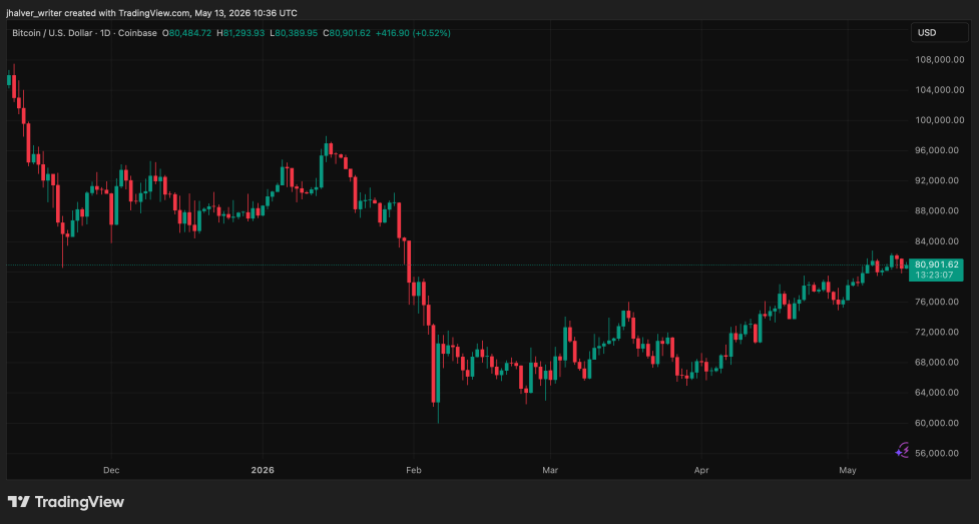
BTC's price trends to the upside on the daily chart. Source: BTCUSD on Tradingview

As of this writing, Bitcoin trades at around $81,500, with American Bitcoin’s treasury now holding nearly 7,000 BTC as the company continues its stated mission of disciplined accumulation at every price level.

Cover image from Grok, BTCUSD Chart from Tradingview

Trending Cryptos

Related Questions

QWhat is the core structural advantage that American Bitcoin (ABTC) claims to have over MicroStrategy, according to Eric Trump?

AThe core structural advantage is that ABTC acquires Bitcoin through in-house mining at a discounted rate relative to spot market purchases, creating a 'mining to treasury' pipeline. In contrast, MicroStrategy accumulates Bitcoin exclusively through capital markets and open-market purchases.

QHow much Bitcoin did American Bitcoin (ABTC) report holding as of late January 2026, and what was its approximate value?

AAs of late January 2026, American Bitcoin reported holding 6,899 BTC, valued at approximately $474 million.

QWhat key development did Eric Trump point to as driving Bitcoin's 'greatest period ever' in his speech?

AHe pointed to a transformational shift driven by record ETF launches, corporate treasury adoption, and major banks now offering Bitcoin-backed financial products over the past six months.

QWhat was the approximate daily Bitcoin mining output of American Bitcoin through its partner Hut 8's facilities?

AThrough Hut 8's facilities, American Bitcoin was delivering an estimated eight to ten BTC daily from its mining operations.

QHow does American Bitcoin's 'absolute accumulation machine' framework differ from typical mining operations regarding operating costs?

AIn ABTC's framework, Bitcoin mined is retained in the treasury rather than being sold to cover operating costs, meaning every operational dollar spent on mining generates Bitcoin that flows directly into the treasury.

Related Reads

Altman Admits: Overestimated AI Snatching Jobs! Huang Renxun: The Unemployment Narrative Is Completely Backwards

Sam Altman has revised his earlier predictions about AI rapidly replacing jobs, admitting he overestimated the speed at which AI would eliminate entry-level white-collar roles. Speaking on the "Invest Like the Best" podcast, he stated that people do not truly want an AI CEO, as accountability and human connection remain critical. He found that individuals prefer interacting with people who can be held responsible for decisions. Similarly, NVIDIA's Jensen Huang argued that the narrative of AI destroying jobs is misguided. He distinguishes between tasks and jobs, noting that while AI can automate specific tasks, entire jobs—encompassing communication, judgment, coordination, and accountability—are not eliminated. He cited examples like radiologists and software engineers, where demand for these roles has increased as AI handles repetitive tasks, allowing for business expansion and the creation of more positions. Data from a University of Maryland and LinkUp study supports this, showing that U.S. job postings for new graduates have actually risen, countering the fear of vanishing entry-level roles. However, a significant shift is occurring: the traditional entry-level tasks that help newcomers gain experience are being automated, making initial career access more challenging. The key insight is that as AI takes over standardized tasks, the enduring value of human work shifts toward areas of responsibility, trust-building, and final decision-making—aspects that AI cannot replicate. The real "moat" for professionals lies in these irreplaceable human elements.

marsbit3m ago

Altman Admits: Overestimated AI Snatching Jobs! Huang Renxun: The Unemployment Narrative Is Completely Backwards

marsbit3m ago

Weekly Editor's Picks (0725-0731)

Weekly Editor's Picks (0725-0731) provides a curated selection of deep analysis, filtering out market noise. Key themes from this week include: **Macro & Policy:** The Federal Reserve's upcoming meeting is marked by high uncertainty, balancing cooling inflation data against persistent price pressures. Meanwhile, the U.S. crypto regulatory Clarity Act faces critical political hurdles, with its 2026 passage probability seen as low. **Investing & Crypto:** Analysis suggests long-term crypto success depends on conviction through volatile cycles, focusing on assets like Bitcoin and core smart contract platforms. A trend noted is the increasing similarity between global equity markets (especially tech) and crypto, driven by narrative and leverage. Several major crypto protocols show strong revenue growth, but this isn't always translating to token price appreciation due to sell pressure and structural factors. **AI & Semiconductors:** Nvidia's rising credit default swap rates signal market concern over AI infrastructure financing risks. The storage sector experienced volatility as markets began pricing in potential 2027 oversupply. Despite a record profitable quarter, SK Hynix's results were deemed "below expectations," reflecting heightened investor demands for future growth visibility. **Markets & DeFi:** TradeXYZ demonstrated remarkable accuracy in pre-market pricing for a major A股 listing. The token ONDO saw gains, linked to its growing role in the on-chain tokenized stock ecosystem. **Ethereum:** Post-Pectra upgrade, a major structural shift is underway as Lido begins migrating millions of ETH to new validator architectures designed for capital efficiency. **Also Highlighted:** Butian's bullish stock market move; OpenAI's Altman promising major advances; Samsung and SK Hynix securing large AI chip deals; Apple reaching a $5T market cap; and ongoing discussions around exchange security following Poolin's bankruptcy case.

marsbit38m ago

Weekly Editor's Picks (0725-0731)

marsbit38m ago

Low Investment Isn't Apple's Immunity Pass

While Meta and Google face investor scrutiny over ballooning AI capital expenditures, Apple's minimal AI investment has paradoxically become a strength. Its market cap recently reclaimed the global top spot, surpassing $5 trillion. The irony is deep: Apple's own AI efforts have lagged, with "Apple Intelligence" delayed and core talent lost, forcing reliance on partners like Google Gemini and Alibaba's Qianwen. Its Q3 FY2026 (Q2 CY) earnings initially seemed stellar. Revenue hit $109.4B (up 16% YoY), with iPhone and Mac sales, growing 22% and 29% respectively, driving most of the growth. However, the stock fell over 8% post-earnings. The primary concern was a weaker Q4 revenue growth forecast of 9-11%, below expectations, due to looming supply chain constraints. Apple is feeling the indirect cost of the AI boom. Soaring memory and chip prices, fueled by massive data center investments from Microsoft, Amazon, and others, are forcing Apple to raise Mac and iPad prices significantly. The upcoming iPhone launch is also expected to see substantial price hikes. Despite avoiding heavy AI infrastructure spending—its capital expenditures are actually down 28%—Apple cannot escape the industry-wide supply and cost pressures. While Apple's operating cash flow remains robust, its substantial R&D spending (up 32% YoY) has yet to yield major AI breakthroughs. As Tim Cook prepares to step down as CEO, Apple faces a challenging transition: balancing its premium hardware success against the strategic and cost pressures of the AI era it has so far cautiously navigated.

marsbit1h ago

Low Investment Isn't Apple's Immunity Pass

marsbit1h ago

PA Graphics Explanation | One Chart to Understand the Major Web3 Events in August 2026

**PANews Crypto Calendar: Key Web3 Events in August 2026** PANews introduces its revamped crypto calendar, featuring comprehensive coverage, flexible filtering, and easy export options. The market in August will be shaped by multiple key events across macroeconomics, regulation, tokenomics, and project developments: * **Macro & Policy:** Key US economic data releases (July Non-Farm Payrolls, CPI), the Federal Reserve meeting minutes, and the Jackson Hole Economic Symposium will be in focus. On the regulatory front, the US Senate plans to release a new draft of the *CLARITY Act*, while the EU's expanded crypto ban against Belarus comes into effect. * **Token Unlocks:** Significant token unlocks are scheduled for assets including ENA, AVAX, CONX, ZRO, and KAITO, which may influence market volatility. * **Project Updates & Shutdowns:** Several services, including Exchange Art, Ctrl Wallet, Zapper, NFTfi, and Summer.fi, are set to cease operations or undergo major adjustments. Users are advised to manage their assets accordingly. * **Corporate Activity:** Q2 earnings reports from companies like SpaceX, Circle, and Nvidia are due. Unitree Robotics will initiate its IPO subscription on the STAR Market, and Moonshot AI plans to begin a Pre-IPO financing round. * **Industry Events:** Major conferences such as Bitcoin Asia 2026 and the 2026 Digital Expo will take place. The overarching market narrative for August will revolve around macroeconomic expectations, regulatory developments, token unlock schedules, and ongoing industry consolidation.

marsbit1h ago

PA Graphics Explanation | One Chart to Understand the Major Web3 Events in August 2026

marsbit1h ago

Trading

Spot

Hot Articles

How to Buy SWEAT

Welcome to HTX.com! We've made purchasing Sweat Economy (SWEAT) simple and convenient. Follow our step-by-step guide to embark on your crypto journey.Step 1: Create Your HTX AccountUse your email or phone number to sign up for a free account on HTX. Experience a hassle-free registration journey and unlock all features.Get My AccountStep 2: Go to Buy Crypto and Choose Your Payment MethodCredit/Debit Card: Use your Visa or Mastercard to buy Sweat Economy (SWEAT) instantly.Balance: Use funds from your HTX account balance to trade seamlessly.Third Parties: We've added popular payment methods such as Google Pay and Apple Pay to enhance convenience.P2P: Trade directly with other users on HTX.Over-the-Counter (OTC): We offer tailor-made services and competitive exchange rates for traders.Step 3: Store Your Sweat Economy (SWEAT)After purchasing your Sweat Economy (SWEAT), store it in your HTX account. Alternatively, you can send it elsewhere via blockchain transfer or use it to trade other cryptocurrencies.Step 4: Trade Sweat Economy (SWEAT)Easily trade Sweat Economy (SWEAT) on HTX's spot market. Simply access your account, select your trading pair, execute your trades, and monitor in real-time. We offer a user-friendly experience for both beginners and seasoned traders.

2.5k Total ViewsPublished 2024.03.29Updated 2026.06.02

How to Buy SWEAT

Discussions

Welcome to the HTX Community. Here, you can stay informed about the latest platform developments and gain access to professional market insights. Users' opinions on the price of SWEAT (SWEAT) are presented below.

活动图片