Drift Protocol incident uncovered: Did ‘negligence’ lead to the $285M loss?

ambcryptoPublished on 2026-04-06Last updated on 2026-04-06

Abstract

Drift Protocol's $285 million hack underscores a critical industry lesson: security cannot be sacrificed for scalability. This incident, potentially linked to the same group behind the 2024 Radiant Capital hack, reveals a meticulously planned attack where perpetrators posed as a legitimate firm to gain trust. In response, Drift froze protocol functions and collaborated with law enforcement, though market confidence remained shaken. The timing is significant, as Solana recently tested quantum-resistant upgrades that slowed the network by 90%, highlighting the inherent trade-offs between security and performance. Public scrutiny has intensified, with some labeling the breach "civil negligence," signaling a shift in the 2026 cycle toward prioritizing security, accountability, and quantum-threat preparedness over mere scalability.

This cycle clearly favors security over scalability, which marks a big shift from previous years.

Back in 2025, protocols like Ethereum [ETH] and Solana [SOL] focused on scaling the network, boosting transaction throughput, reducing congestion, and staying competitive in the fast-growing DeFi space. Their goal was simple: make the blockchain more scalable, even if that meant taking on extra risk under the hood.

However, the recent Drift protocol incident drives home a clear lesson: you cannot trade security for speed. In this context, could the attack actually act as a blessing in disguise, pushing the community and protocol teams to rethink operational security and put integrity above scalability?
Source: X

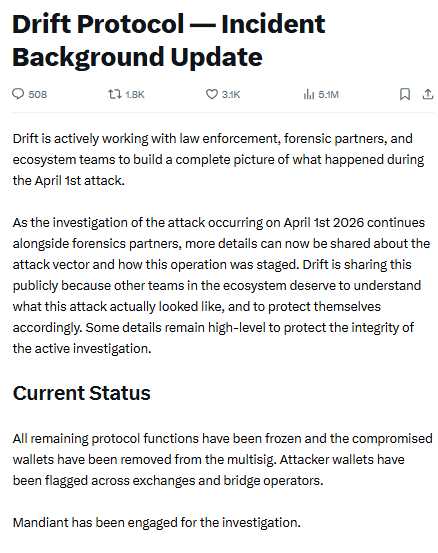
According to the official statement, the team is working closely with law enforcement and forensic experts to investigate the Drift incident. Because of this, they froze all protocol functions, removed compromised wallets, and flagged attacker wallets across exchanges.

Interestingly, early evidence ties the attack to the same group behind the October 2024 Radiant Capital hack, though final attribution is still pending. The big takeaway? This was a months-long, carefully planned operation. The attackers posed as a legitimate trading firm, building trust through in-person meetings, and even deposited over $1 million to appear credible.

On paper, Drift’s response shows accountability in action, but the market reaction didn’t really reflect confidence. So, the question is, does this Drift incident expose security weaknesses and force the industry to rethink operational practices to prevent similar attacks in the future?

Drift incident sparks public pressure and industry wake-up call

Even with the massive $285 million hack, the Drift incident highlights some important lessons.

According to AMBCrypto, the “timing” makes this attack especially relevant. Solana recently tested a quantum-resistant model to prepare for future quantum threats, but the experiment slowed the network by 90%, showing that security upgrades can come at a cost.

In this light, the Drift incident clearly shows that security can’t be an afterthought, even as protocols chase speed, scalability, and new features. Put simply, even with Solana’s 90% slowdown, the focus must stay on robust, practical security, something the Drift incident helped bring into sharp focus.
Source: X

Beyond the technical lessons, the public scrutiny that followed, though, adds another layer of pressure.

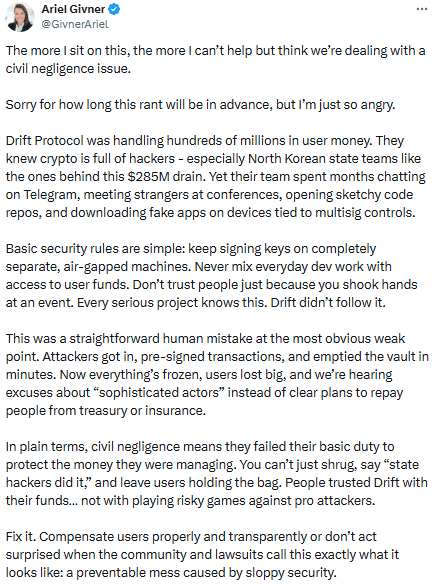
As the post above highlights, some reactions even called the hack “civil negligence,” implying that the protocol itself carried responsibility for the breach, alongside the attackers. This perspective isn’t too far-fetched, given the industry’s approach to security over the past few cycles.

Looking at it this way, the Drift protocol incident could be the wake-up call the market needed to move away from last year’s “scalability-first” mindset. The 2026 cycle is therefore shaping up to be security-driven, fueled by accountability, public pressure, and growing concerns around quantum threats.


Final Summary

  • The Drift incident highlights that security must come before speed, forcing protocols to rethink operational practices.
  • Public scrutiny and industry pressure are pushing the 2026 cycle to be security-driven, with quantum-threat preparedness taking center stage.


Trending Cryptos

Related Questions

QWhat was the main focus of blockchain protocols like Ethereum and Solana in 2025, according to the article?

AIn 2025, protocols like Ethereum and Solana focused on scaling the network, boosting transaction throughput, reducing congestion, and staying competitive in the fast-growing DeFi space, even if it meant taking on extra risk.

QWhat is the primary lesson the Drift protocol incident is said to drive home?

AThe primary lesson is that you cannot trade security for speed, and it should push the community to rethink operational security and put integrity above scalability.

QHow did the attackers gain the trust of the Drift protocol before the exploit?

AThe attackers posed as a legitimate trading firm, building trust through in-person meetings, and deposited over $1 million to appear credible.

QWhat broader industry shift is the Drift incident sparking for the 2026 cycle?

AThe incident is sparking a shift towards a security-driven cycle, fueled by accountability, public pressure, and growing concerns around quantum threats, moving away from the previous 'scalability-first' mindset.

QWhat was the estimated financial loss from the Drift Protocol incident?

AThe estimated financial loss from the Drift Protocol incident was $285 million.

Related Reads

Will the Fed Definitely Raise Interest Rates in September? How Will Crypto and U.S. Stocks Withstand the Pressure?

The market's expectation for a September Fed rate hike surged dramatically in early August, jumping from under 50% to over 80% within a week. This shift followed a contentious July FOMC meeting, where a 9-3 vote to hold rates revealed growing dissent from hawkish members advocating for an immediate hike to combat persistent inflation. The primary catalyst for this repricing is rising oil prices, driven by renewed geopolitical tensions around the Strait of Hormuz, which threaten global supply. Energy costs directly influence inflation metrics, making the upcoming July CPI report (due August 12th) a critical data point. If it shows inflation reaccelerating, the probability of a September hike will solidify. For Bitcoin and crypto assets, this is typically bearish news. Bitcoin continues to behave as a high-beta, liquidity-sensitive risk asset. A rate hike raises the opportunity cost of holding non-yielding assets and could drive capital toward money markets, pressuring crypto prices in the short term. However, historical patterns suggest that if a hike is perceived as the end of a tightening cycle rather than the start, any negative price impact may be brief. U.S. stocks, particularly crypto-linked equities like Coinbase and growth-oriented tech stocks, are also vulnerable. Higher rates increase discount rates in valuation models, putting pressure on high-multiple companies. This coincides with a pivotal tech earnings season where investor focus has shifted from massive AI capital expenditure to tangible revenue and cash flow generation. Companies with negative cash flow and weak growth narratives could face heightened volatility if borrowing costs rise in September. In summary, a September Fed hike has evolved into a mainstream market scenario. Key factors to watch are oil prices, the July CPI report, and Fed communications, which will determine the final decision and its impact on volatile crypto and equity markets.

marsbit4m ago

Will the Fed Definitely Raise Interest Rates in September? How Will Crypto and U.S. Stocks Withstand the Pressure?

marsbit4m ago

A 'Overlooked' Market Event: Joint US-Japan-South Korea Intervention, Rare US Treasury Involvement, and Bessent's Quiet 'Market Rescue'?

Summary: The United States, Japan, and South Korea executed their largest coordinated foreign exchange intervention in nearly 30 years. The action targeted depreciation pressure on the Japanese yen and South Korean won. This move is seen as a significant effort by the US to stabilize the financial markets of its key allies and prevent the spillover of risks. Key details: * Japan reportedly intervened on July 30 using approximately 8.45 trillion yen (about $52.8 billion). South Korean authorities also intervened that day, selling dollars to support the won. * Notably, the US Treasury Department intervened directly in yen markets for the first time in roughly 30 years. The New York Fed, reportedly acting on behalf of the Treasury, sold euros to buy yen via Goldman Sachs and Morgan Stanley on July 31. Analysts view the use of the euro-yen pair as a way to alleviate yen pressure without adding selling pressure to the US dollar. * Prior to the action, the New York Fed conducted "rate checks" on both USD/JPY and EUR/JPY, a newer signaling tool that falls between verbal and physical intervention. The intervention is interpreted as going beyond traditional currency stabilization. Analysts, such as Michael Hartnett of Bank of America, suggest it resembles a "Price Keeping Operation" for the AI era. The core US objectives are perceived to be: 1. Preventing rapid yen depreciation from triggering a sharp rise in Japanese government bond yields. 2. Containing financial stress from spreading across Asian markets like South Korea and Japan. 3. Reducing the risk of disorderly capital flows impacting the US bond market. This coordinated action underscores the importance of Japan and South Korea as critical partners in the US semiconductor and AI supply chain. Stabilizing their financial markets is seen as vital to mitigating risks to the broader tech industry and the US market itself. The intervention coincides with market pressures, including the KOSDAQ index hitting a low since October 2022. While seen as a move to control volatility, some analysts caution it may not fundamentally reverse existing market trends.

marsbit8m ago

A 'Overlooked' Market Event: Joint US-Japan-South Korea Intervention, Rare US Treasury Involvement, and Bessent's Quiet 'Market Rescue'?

marsbit8m ago

Will the Federal Reserve Definitely Raise Interest Rates in September? How Will Cryptocurrencies and US Stocks Bear the Pressure?

In early August 2024, market expectations for a September Federal Reserve rate hike surged dramatically, from below 50% to over 80%, driven by renewed inflation concerns. This shift followed a contentious July FOMC meeting where a 9-3 vote to hold rates revealed a growing hawkish faction advocating for an immediate hike, citing prolonged above-target inflation. The key catalyst is escalating conflict near the Strait of Hormuz, which has pushed oil prices up approximately 20% in July, threatening to reignite inflation. The next critical data point is the July CPI report on August 12th; a hot reading could solidify hike expectations. For crypto assets, particularly Bitcoin, this represents near-term pressure. Bitcoin continues to exhibit high-beta, risk-on characteristics, making it sensitive to tightening liquidity and higher opportunity costs. However, historical precedent suggests that if a hike is perceived as the cycle's end rather than its start, the negative impact may be brief, with markets quickly pivoting to anticipate future rate cuts. U.S. stocks, especially crypto-linked equities like Coinbase and high-valuation tech stocks, face amplified volatility. Higher rates increase discount rates in valuation models, pressuring growth stocks. This coincides with a pivotal tech earnings season where investor focus has shifted from massive AI capital expenditures to demonstrable revenue and cash flow generation. Companies with negative cash flows and weak growth narratives could see severe pressure if a September hike materializes, as financing costs would rise. Key indicators to watch include oil prices, upcoming inflation data, and Fed commentary at events like the Jackson Hole symposium.

Odaily星球日报8m ago

Will the Federal Reserve Definitely Raise Interest Rates in September? How Will Cryptocurrencies and US Stocks Bear the Pressure?

Odaily星球日报8m ago

Trading

Spot

Hot Articles

How to Buy DRIFT

Welcome to HTX.com! We've made purchasing Drift Protocol (DRIFT) simple and convenient. Follow our step-by-step guide to embark on your crypto journey.Step 1: Create Your HTX AccountUse your email or phone number to sign up for a free account on HTX. Experience a hassle-free registration journey and unlock all features.Get My AccountStep 2: Go to Buy Crypto and Choose Your Payment MethodCredit/Debit Card: Use your Visa or Mastercard to buy Drift Protocol (DRIFT) instantly.Balance: Use funds from your HTX account balance to trade seamlessly.Third Parties: We've added popular payment methods such as Google Pay and Apple Pay to enhance convenience.P2P: Trade directly with other users on HTX.Over-the-Counter (OTC): We offer tailor-made services and competitive exchange rates for traders.Step 3: Store Your Drift Protocol (DRIFT)After purchasing your Drift Protocol (DRIFT), store it in your HTX account. Alternatively, you can send it elsewhere via blockchain transfer or use it to trade other cryptocurrencies.Step 4: Trade Drift Protocol (DRIFT)Easily trade Drift Protocol (DRIFT) on HTX's spot market. Simply access your account, select your trading pair, execute your trades, and monitor in real-time. We offer a user-friendly experience for both beginners and seasoned traders.

5.6k Total ViewsPublished 2024.05.17Updated 2026.06.02

How to Buy DRIFT

Discussions

Welcome to the HTX Community. Here, you can stay informed about the latest platform developments and gain access to professional market insights. Users' opinions on the price of DRIFT (DRIFT) are presented below.

活动图片












