Author: KarenZ, Foresight News
The Ethereum Foundation (EF) has finally begun to define its own boundaries.
In this reorganization, the most significant aspect is not merely the reduction of 54 people (approximately 20% of the Foundation), but that it has brought a long-standing, unresolved question into the open: What should the EF still manage, and what must it let go? The answer is already written into the new organizational structure: the protocol, security, privacy, and access layers are given greater prominence.
In an Organizational Chart, What Matters Most is the Weighting
The Ethereum Foundation's new structure is broadly divided into eight sections: the Protocol layer, the Access layer, the User layer, the Community layer, the Institutional layer, the Operations layer, along with Management and Management Support.
According to the official organizational chart annotations, the Protocol layer is the largest, with 57 people; the Access layer has 34, the Operations layer 26, the Community layer 25; the Institutional layer has 12, the User layer 5; Management has 5, and Management Support 6.
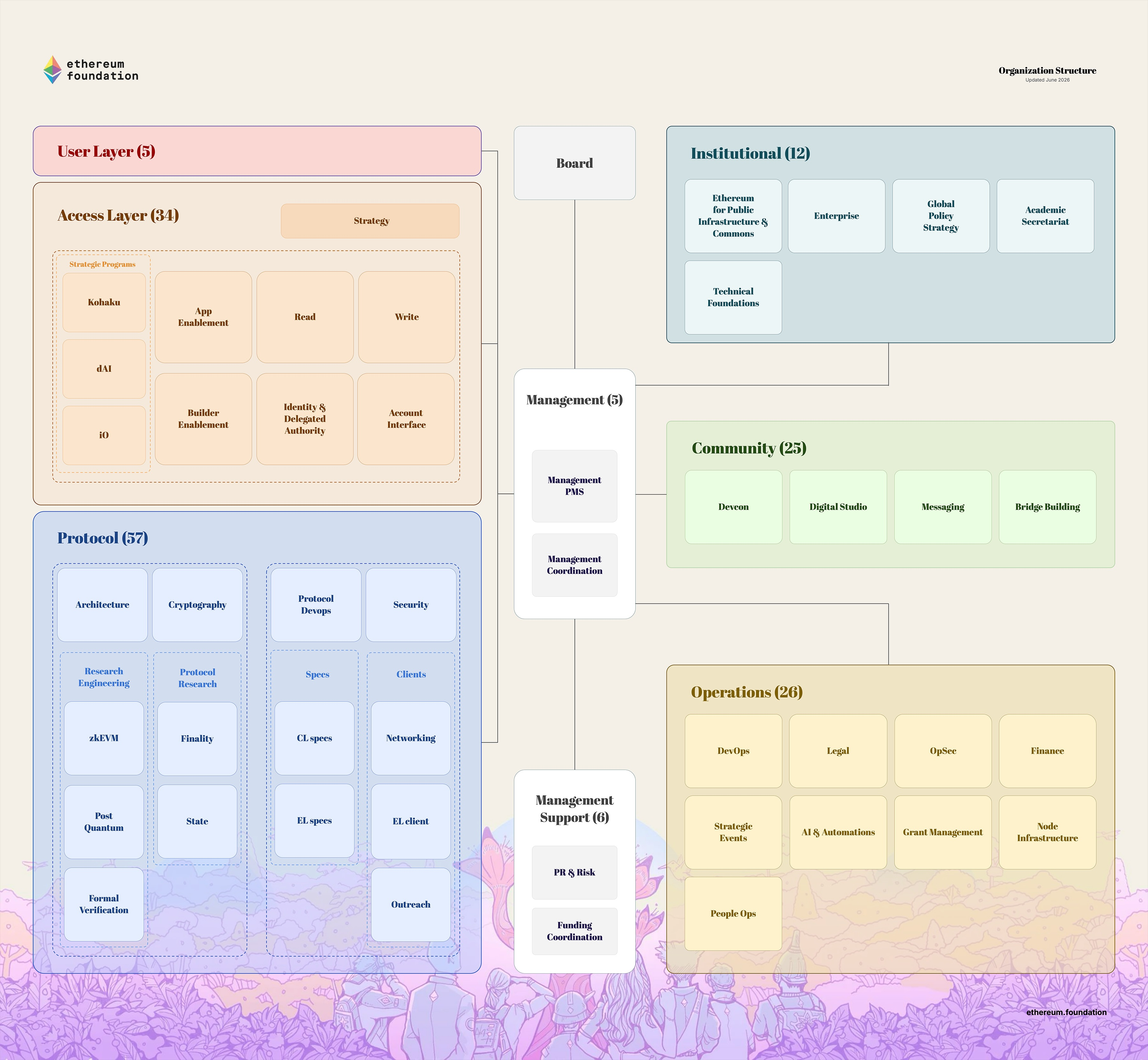
This ranking itself is telling: after the EF's contraction, resources have not been evenly diluted but are instead being concentrated towards the Protocol and Access layers once more. In other words, the Foundation is focusing more energy back on the most foundational and hardest-to-outsource parts of Ethereum: protocol evolution, security, privacy, clients, specifications, and the entry points through which users and institutions actually interact with the chain.
First, let's look at the Protocol layer. The official definition is to continue maintaining Ethereum's most defensible attributes: censorship resistance, capture resistance, open-source nature, privacy, and security. The EF blog states it bluntly: the protocol team's work is not to make Ethereum easier to market, nor to transform it into a financially controlled rail by intermediaries, but to ensure it remains dependable when counterparties fail, platforms censor, governments overreach, or intermediaries extract rent.
In the detailed breakdown chart of the Protocol layer provided by EF researcher Justin Drake, what stands out most is not each individual name, but several technical lines that have been explicitly elevated in priority.
Most prominent is the Architecture Group: led by Justin Drake, with Vitalik Buterin also listed. Justin Drake has frequently pushed discussions on strawmap, post-quantum security, zkEVM, issuance policy, etc., over the past year, while Vitalik represents one of the highest weights in Ethereum's long-term roadmap. Their simultaneous presence in the Architecture Group indicates that the EF is not simply compressing teams, but is reassigning higher priority to the long-term evolution of the protocol.
Several more specific long-term technical topics are also individually highlighted: Thomas Coratger is responsible for post-quantum security (a team newly established in January 2026), Ignacio Hagopian for zkEVM, and Alex Hicks for formal verification. These names may not all be publicly active, but the directions they represent are critical: post-quantum security relates to whether Ethereum can complete its cryptographic migration ahead of schedule, zkEVM relates to the long-term form of the execution layer and proof systems, and formal verification is a new tool the EF hopes to use to reduce protocol complexity and client maintenance costs.
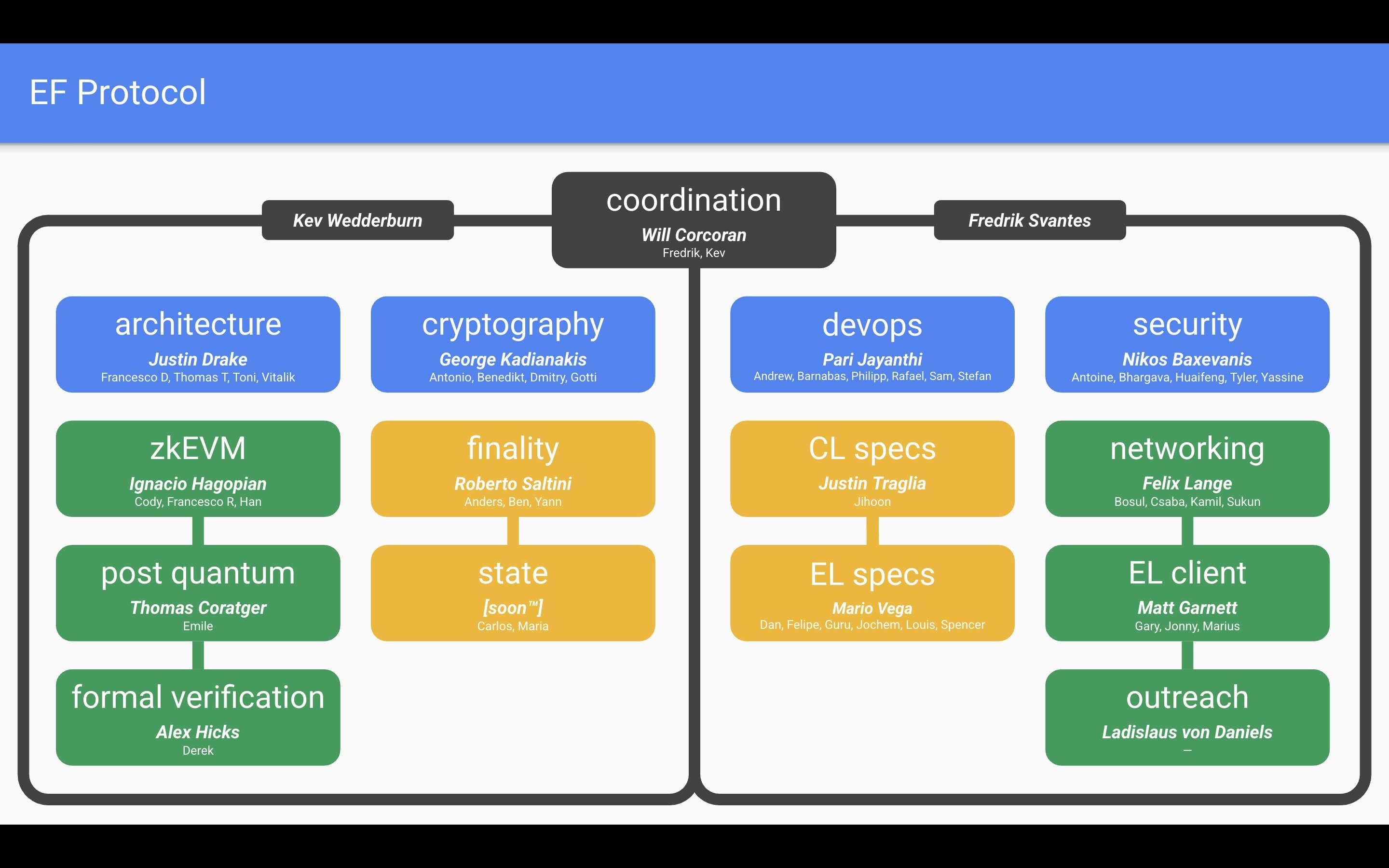
Additionally, cryptography is overseen by George Kadianakis. He has long been involved in research related to privacy networks and anonymous communication, including security research for the Tor anonymous communication network; the Security direction is led by Nikos Baxevanis; and Protocol DevOps is led by Pari Jayanthi.
The signal from these two charts is strong: The EF is not turning the Protocol layer into a generic "Research Department"; instead, it's breaking down post-quantum security, zkEVM, formal verification, finality, clients, specifications, and security engineering into accountable sub-units. Ethereum's next challenge is not a single scalability problem, but a set of interconnected hard problems: a faster L1, stronger privacy, lower complexity, fewer trusted dependencies, and a cryptographic migration before quantum computing risks materialize.
Justin Drake's update made the Protocol layer's direction even more specific. He stated the EF Protocol cluster shrank from about 100 to about 60 people, that EF subsidies for consensus and execution layer clients will end in 2027, and that annual expenditure, including grants, is dropping to around $30 million. He also mentioned that timelines for strategic upgrades like post-quantum security and zkEVM are shortening, and that AI-assisted formal verification and automated research are changing protocol R&D methods.
Vitalik also noted that Ethereum's ongoing Strawmap is a "Phase 3"-style overhaul involving consensus, proofs, privacy, account models, state, and more. He further judged that the multi-client model might shift from a past emphasis on "redundant security" towards more "specialization," with some security responsibilities shouldered by AI-assisted formal verification.
This touches a sensitive point in Ethereum's culture. In the past, multiple clients were seen as a hallmark of Ethereum's security philosophy: as long as no single client exceeds a critical threshold, the chain won't halt due to one bug. But if protocol complexity continues to rise, the cost of all clients fully replicating the same capabilities will become increasingly high. The EF's new direction seems to be betting on another security philosophy: reduce unnecessary complexity, and combine provable correctness, formal verification, AI-assisted research, and specialized clients.
This path carries risks. Formal verification is not magic, and AI cannot replace engineering responsibility. Yet it points to the deep waters of Ethereum's next round of competition: future chains won't just compete on TPS, but also on who can establish new safe production methods before complexity spirals out of control. If Ethereum wants privacy, scaling, MEV resistance, post-quantum security, and better user access simultaneously, the bottleneck is no longer just human scale, but R&D methodology, engineering coordination, and roadmap trade-offs.
20% Layoff, ~40% Budget Cut: The EF is Learning to Live Long-term
Vitalik's explanation of this reorganization gets closer to the financial and strategic underpinnings. He stated that the EF's budget this year is decreasing by approximately 40%, with the goal of shifting from consuming an average of about 15% of remaining funds annually pre-2026, to becoming a long-term endowment-style organization with a roughly 5% annual spend rate post-2030.
This passage is important because it explains the EF's real dilemma: a foundation operating on an ETH treasury cannot spend forever as if in a bull market. The more Ethereum aspires to be "world-class infrastructure," the less the EF can operate like a perpetually expanding tech company. Tech companies justify expenses with growth; foundations constrain expenses with mission. When these two logics are mixed, you get the state repeatedly criticized by outsiders in recent years: the Foundation is expected to fund public goods, support applications, branding, conferences, institutional adoption, ecosystem relations—everything finds a justification, and everything can dilute the main line.
Comments from Tomasz K. Stańczak, former co-Executive Director of the Ethereum Foundation, provide another perspective. He acknowledged the direction of cutting large events, client funding, institutional teams, and non-core large projects, but also expressed concern that the new organizational chart still appears complex.
He also mentioned that the EF needs more professional, transparent treasury management, and should not miss significant ETH opportunities in staking and capital allocation due to insufficient financial capabilities.
The Ethereum Ecosystem Needs to Grow More Nodes
Another subtle change during the reorganization is the EF pushing some work outside to the broader ecosystem.
The emergence of EthLabs fits perfectly within this context. The organization describes itself as a non-profit R&D lab for Ethereum and ETH, aiming to make Ethereum the settlement layer for the global economy, and emphasizes its role in translating real needs between users, applications, wallets, L2s, infrastructure, institutions, ETH holders, core developers, and researchers into protocol work, standards, infrastructure, and products.
EthLabs resembles a prototype for the EF's "multi-node future." It takes on some work that the EF is no longer suited to handle directly but remains crucial for Ethereum: closer to adoption, more ETH-focused, and closer to product and market feedback. If the EF is the constitutional layer, organizations like EthLabs are more like policy labs and engineering translators. Their value lies not in speaking for the EF, but in ensuring Ethereum doesn't have to place all public goods, research, adoption, and narrative on the same foundation.
Recommended reading: "Ethlabs Established, Treasury Companies Pay for Ethereum After EF"
In a thread on June 22nd, the EF mentioned that realizing Ethereum's potential requires a set of organizations collaborating around a shared vision, and that over the past year, multiple organizations have emerged, enhancing the ecosystem's resilience and capacity. It named EthLabs, Ethereum Apps Guild (EAG, promoting adoption of native Ethereum apps), Ethereum Economic Zone (EEZ, a framework for synchronizing composable Rollups), and Argot (maintaining Solidity and open-source compiler tools relied upon by the Ethereum ecosystem), and concluded by emphasizing: "The privilege of stewarding Ethereum should not be hoarded, but shared thoughtfully with others committed to building self-sovereign infrastructure."
Viewed against the backdrop of the EF's reorganization, these organizations collectively illustrate one thing: Ethereum is no longer suited to place all public goods, adoption, research, standards, and narrative on a single central foundation. The EF needs to concentrate resources on the hardest-to-replace work: protocol, security, privacy, and access layers; while application adoption, developer tools, ecosystem coordination, institutional communication, ETH narrative, and productization advancement need more external nodes to fill the gaps.
The real test lies here. A multi-node structure can increase resilience, but may also create new coordination costs. Whether third-party organizations can form complementary roles rather than pushing their own separate agendas; whether they can reduce the ecosystem's dependency on the EF rather than creating new centers of discourse; and whether they can transform funding, talent, and research outcomes into actual products and protocol progress—these factors will determine if the EF's step back is a healthy devolution of power or a more complex coordination experiment.
The EF's New Role: Contracting Boundaries, Betting on Hard Problems
The true signal released by this reorganization runs deeper: the Ethereum Foundation is abandoning the safety of being "big and complete," turning towards a narrower, harder, more long-term role.
The EF's reorganization points not to contraction itself, but to redefining the boundaries of the Foundation's responsibilities. Doing less doesn't mean ambition has shrunk; it's more like a discipline: concentrating limited funds and talent on the hardest-to-replace areas. Making things harder also doesn't equate to technical romanticism; it requires the EF to deliver executable roadmaps for post-quantum security, formal verification, zkEVM, privacy, and access layers, while simultaneously enabling new nodes outside the Foundation to genuinely grow.
Vitalik mentioned that Ethereum must be worthy of occupying a place in the era of quantum computing, Mars rockets, powerful biotechnology, and artificial intelligence, and be capable of confronting the challenges brought by this era.
This path won't please everyone. Developers will worry about reduced funding, institutions about narrower interfaces, the market will think it doesn't tell a good enough story, and the community will continue questioning the EF's transparency. As Tomasz expressed concern: if the org chart gets smaller but decisions remain opaque, the reorganization is just a more expensive typesetting exercise.