
Dogecoin Technical Analysis: Has DOGE Stopped Falling? This Key Support Level Holds the Answer

金色财经Published on 2025-12-09Last updated on 2025-12-09

Abstract

Based on technical analysis by Cantonese Cat, Dogecoin (DOGE) is currently testing a critical long-term support zone around $0.12–$0.14, defined by the lower edge of the monthly Ichimoku Cloud. Trading near $0.1405, DOGE is down approximately 3.8% for the month and remains below key Ichimoku components—the Conversion Line ($0.20092) and Base Line ($0.27491)—as well as below major moving averages on the weekly chart. The monthly close above this cloud support is crucial to maintaining the long-term bullish structure and avoiding a breakdown. On the weekly chart, DOGE is consolidating within a key support area of $0.135–$0.145, which aligns with historical consolidation levels. However, it has broken below an ascending trendline, with resistance now formed by this trendline and multiple moving averages, including the 200-week MA near $0.15563. The market is closely watching whether DOGE can hold this support to confirm a potential base formation.

According to charts shared by cryptocurrency analyst Cantonese Cat, Dogecoin (DOGE) is currently positioned above the long-term support band defined by its monthly Ichimoku Cloud. The analyst noted that DOGE is "testing the lower edge of its monthly Ichimoku Cloud."

Dogecoin Tests Key Monthly Cloud Support

The DOGE monthly chart shows the Dogecoin price at approximately $0.14050, down about 3.8% for the month. The monthly candlestick opened at $0.14599, reached a high of $0.15340, and probed a low of $0.13177, showing a pattern of volatility with a generally weaker bias.

Monthly Ichimoku Kinko Hyo Structure Analysis

The chart uses standard parameter settings (9-26-52-26). The current Conversion Line (Tenkan-sen) is near $0.20092, and the Base Line (Kijun-sen) is near $0.27491. The forward span of the Cloud (Kumo) is near $0.23792 and $0.26674, respectively, extending into 2026 and forming a red cloud band.

The current Dogecoin price of around $0.14 is significantly below both the Conversion and Base Lines and is currently within the region of the Cloud's lower edge. The bottom of this cloud, after descending into the $0.12–$0.13 range, is gradually flattening, becoming a key level watched by analysts.
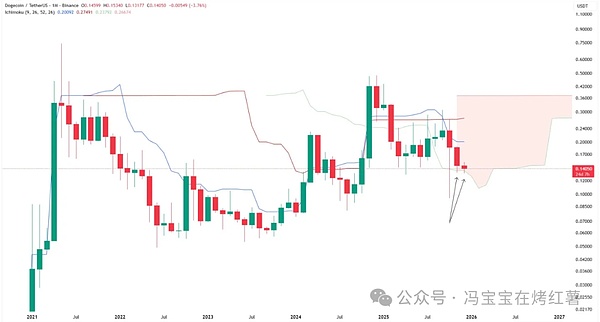
The October monthly candlestick had a long lower shadow, briefly dipping into the mid-$0.06 range but ultimately closing above the Cloud's lower edge. The currently forming monthly candlestick is testing this support again, with the price, at the time of the screenshot, slightly above this area, reported around $0.14.

In Ichimoku analysis, the Cloud's lower edge is often seen as the final support for maintaining structural integrity on higher timeframes. For the current chart, the implication is relatively clear: as long as the monthly close remains above the $0.12–$0.14 support zone, the price action of the past several years can still be interpreted as a long-term basing area, rather than a complete trend breakdown.

Weekly Chart Shows Price in Key Support Zone

On the DOGE/USDT weekly chart, the price is currently within a red support zone near $0.135–$0.145. This zone coincides with a previous consolidation range and was also a former horizontal resistance level before the prior upward breakout.

The closing prices of the most recent several weekly candlesticks have clustered here, with upper and lower shadows frequently piercing this area, reflecting repeated testing and contention. The current candlestick is trading near $0.14392, placing the price in the upper half of this support zone, but it remains below the 20-week, 50-week, 100-week, and 200-week moving averages, with the 200-week MA around $0.15563.
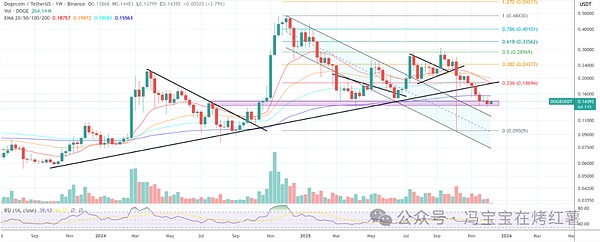
Meanwhile, Dogecoin has broken below the ascending trendline support connecting previous highs, followed by a significant pullback. Currently, this breached trendline, along with the multiple moving averages above, forms a resistance area, compressing the price between this resistance and the red horizontal support zone, resulting in a consolidation pattern.


Trending Cryptos

Related Questions

QWhat is the key support level for Dogecoin (DOGE) according to the monthly Ichimoku Cloud analysis?

AThe key support level is the lower edge of the monthly Ichimoku Cloud, which is in the $0.12–$0.14 range.

QWhat does it mean for DOGE's long-term trend if the monthly closing price remains above the $0.12–$0.14 support zone?

AIt would indicate that the long-term price structure remains intact as a bottoming area, rather than a complete trend breakdown.

QOn the weekly chart, what is the significance of the $0.135–$0.145 price region for DOGE?

AIt is a critical support zone that coincides with a historical consolidation range and was previously a horizontal resistance level before a breakout.

QWhere is DOGE's price currently trading relative to its major moving averages on the weekly chart?

AIt is trading below the 20-week, 50-week, 100-week, and 200-week moving averages, with the 200-week MA near $0.15563.

QWhat has happened to the ascending trendline that connected previous highs on the weekly chart?

ADOGE has broken below this ascending trendline support, which has led to a significant pullback in price.

Related Reads

Upbit is Anxious: A Hasty Counterattack Aimed at Regaining Stablecoin Market Share

Title: Upbit's Rushed Counterattack to Reclaim Stablecoin Market Share Facing a dramatic shift in South Korea's stablecoin market, leading exchange Upbit launched a promotional campaign from July 26 to August 9, waiving the 0.05% trading fee for stablecoins paired with the Korean Won (KRW) and rapidly listing new stablecoins like RLUSD and USDG. This move is a direct response to its plummeting market share in this sector. Historically a duopoly with Bithumb, the market has been reshaped since October 2025 when Coinone permanently removed fees for USDC trading. By June 2026, Coinone led with 34.8% of stablecoin volume, followed by Bithumb (31.1%) and Upbit (30.1%). This contrasts sharply with the overall crypto market, where Upbit commands 60%. The data shows stablecoin demand is highly sensitive to fees, as users primarily buy them to transfer capital overseas for derivatives trading or forex arbitrage. South Korean exchanges have seen a net outflow of stablecoins for 18 consecutive months, totaling approximately 14.9 trillion KRW, underscoring their role as a cross-border capital conduit. Upbit's limited-time promotion initially boosted its daily stablecoin volume by 162%, but the surge was almost entirely in USDT (98.1% of volume). The newly listed stablecoins saw negligible, fleeting interest. Furthermore, the promotional effect quickly waned in the second week, with volume dropping 33% on weekdays. A concurrent weakening of the KRW also contributed to the trading spike, independent of the fee waiver. The analysis suggests that once the promotion ends, Upbit is unlikely to retain its temporary gains unless it matches Coinone's permanent zero-fee policy, forcing a choice between market share and fee revenue. Upbit's strategic push may be less about immediate profit and more about preparing for future regulatory shifts. With South Korea's *Digital Asset Basic Act* on the horizon, which will regulate KRW-backed stablecoins, and following Dunamu's (Upbit's parent) integration into Naver Financial to build a payment ecosystem, securing a dominant position in the dollar stablecoin distribution channel holds long-term strategic value. However, potential regulatory conflicts could prevent Upbit from listing a future Naver-issued KRW stablecoin, making the current fight for dollar stablecoin flow even more critical.

marsbit5h ago

Upbit is Anxious: A Hasty Counterattack Aimed at Regaining Stablecoin Market Share

marsbit5h ago

Michael Saylor Compares Bitcoin and Gold!

Michael Saylor, founder of MicroStrategy, argues that Bitcoin fundamentally changes how wealth is stored and transferred by transforming digital scarcity into economic value. He describes Bitcoin as the first digital monetary network, combining computers, digital networks, and cryptography. It digitizes monetary assets, allowing their supply to be controlled by public protocols rather than institutions, thus converting economic value into information transmissible over global networks. Comparing Bitcoin to gold, Saylor states that while increasing Bitcoin's supply is harder, its integration with software and transfer is easier. He highlights Bitcoin's proof-of-work mechanism, which ties it to the physical world by consuming real energy to secure the ledger, making past transactions immutable. This creates a shared security system involving miners, energy companies, and investors. Saylor suggests "digital monetary energy" is a more accurate term than "digital gold." He emphasizes that the Bitcoin network is an adaptive ecosystem of miners, nodes, developers, and users. Its core design is intentionally simple, focused on maintaining a secure ledger for scarce digital assets, with complex functionalities built in higher-layer applications. This architecture allows Bitcoin to serve as a foundation for transmitting value and fostering innovation in payments and financial services. Saylor notes Bitcoin's deeper impact lies in creating digital sovereignty, where private keys give individuals permissionless control over their economic power, with ownership verified mathematically, not by institutions. He concludes that while gold's physical scarcity makes it money, Bitcoin's digital scarcity does the same, characterizing Bitcoin as the monetary energy of the digital age.

cryptonews.ru6h ago

Michael Saylor Compares Bitcoin and Gold!

cryptonews.ru6h ago

Trading

Spot

Hot Articles

What is DOGE M

Doge Matrix ($doge m): The New Breed of Community-Driven Cryptocurrency Introduction In the ever-evolving landscape of cryptocurrency, new projects constantly emerge, each aiming to capture the interest of investors and enthusiasts alike. One of the latest entrants to this domain is Doge Matrix, represented by the ticker symbol $doge m. This project has attracted attention thanks to its roots in the popular meme culture surrounding Dogecoin, establishing its place within the web3 space. This article aims to provide a comprehensive analysis of Doge Matrix, covering its overview, creator, investors, functionality, timeline, and notable aspects. What is Doge Matrix ($doge m)? Doge Matrix is a community-driven cryptocurrency project that seemingly builds upon the widespread appeal of Dogecoin, a digital currency known for its Shiba Inu mascot and its meme origins. While the overarching objectives of Doge Matrix are not extensively defined, it is characterized by a commitment to harnessing community involvement and support. Unlike traditional cryptocurrencies that often emphasize utility or intrinsic value through underlying technologies, Doge Matrix positions itself within a space that embraces the cultural phenomenon of cryptocurrencies, particularly appealing to those who resonate with the ethos of meme-based assets. Drawing on the strengths of the Dogecoin community, Doge Matrix operates as part of a broader ecosystem, inviting participation and engagement from users who share an interest in cryptocurrency and the digital landscape. Who is the Creator of Doge Matrix ($doge m)? The identity of the creator of Doge Matrix remains unknown. This lack of transparency is not an uncommon occurrence in the cryptocurrency space, where some projects are launched without revealing the identities of their founders. The absence of information regarding the founding team can raise questions among potential investors about the project’s accountability and direction. Who are the Investors of Doge Matrix ($doge m)? As it stands, there is no publicly available information detailing the investors or investment foundations that back Doge Matrix. The project appears to rely primarily on community support rather than institutional investment. This model aligns with the community-driven nature of the initiative, fostering an environment where the direction of the project is shaped by its participants rather than being dictated by a select few financial backers. How Does Doge Matrix ($doge m) Work? The specifics regarding the operational mechanisms of Doge Matrix are somewhat vague, reflecting a broader trend of projects in the meme coin space where innovative functionalities are not always clearly articulated. Nonetheless, Doge Matrix seems designed to tap into the existing cryptocurrency ecosystem by encouraging user participation while tapping into the familiar cultural references associated with Dogecoin. Its potentially unique characteristics derive from community interactions rather than technological advancements, emphasizing shared experiences and collaboration among token holders. While the exact innovations have not been explicitly outlined, the project appears to create a space where community members can engage, share ideas, and propel the project's potential forward. Timeline of Doge Matrix ($doge m) Reflecting on the project’s timeline reveals notable events that have defined its journey thus far: November 25, 2024: Doge Matrix reached its all-time high value, marking a significant milestone in its early history. January 1, 2025: Conversely, Doge Matrix hit its all-time low value, illustrating the volatility often associated with cryptocurrencies, especially in the early stages of a project's lifecycle. Ongoing: The project continues to be actively traded and supported by its community, although specific future milestones or objectives have yet to be disclosed. Key Points About Doge Matrix ($doge m) Community Focus At the heart of Doge Matrix is a commitment to community engagement. The project thrives on the premise of collaboration and shared objectives among its members, emphasizing the importance of collective effort. Unlike centralized projects that often have a defined leadership structure, Doge Matrix at present showcases a more fluid approach to governance, where every community member's voice matters. Volatility The cryptocurrency market is notorious for its volatility, and Doge Matrix is no exception. Its price history reflects significant fluctuations between high and low values, which is typical of many new cryptocurrencies but underscores the risks associated with investment in emerging tokens. Lack of Detailed Information One of the most striking features about Doge Matrix is the scarcity of detailed information regarding its technological underpinnings and operational mechanisms. This ambiguity necessitates that potential investors conduct thorough due diligence before engaging with the project. Conclusion In summary, Doge Matrix ($doge m) illustrates a new wave of cryptocurrency projects that lean heavily on community engagement and cultural relevance. While lacking in certain specifics—such as clear leadership, defined objectives, and detailed functionality—the project has managed to generate interest within the crypto community, leveraging the established appeal of meme culture. As with any investment in the cryptocurrency space, understanding the inherent risks and conducting comprehensive research is essential for potential participants. Doge Matrix stands as a reminder of the dynamic, sometimes unpredictable nature of the crypto industry, marked by constant evolution and enthusiasm for community-driven initiatives.

4.4k Total ViewsPublished 2025.02.03Updated 2025.02.03

What is DOGE M

Discussions

Welcome to the HTX Community. Here, you can stay informed about the latest platform developments and gain access to professional market insights. Users' opinions on the price of DOGE (DOGE) are presented below.

活动图片