
Dogecoin Sell-Off Intensifies! Over $5 Million in DOGE Long Positions Wiped Out, Bears Dominate as Price Threatens New Lows?

金色财经Published on 2025-12-18Last updated on 2025-12-18

Abstract

Dogecoin (DOGE) continues its decline, with selling pressure intensifying as large holders reduce their holdings. On-chain data shows addresses holding 100 million to 1 billion DOGE have significantly lowered their supply since early December. Derivatives markets reflect growing bearish sentiment, with short positions rising to 53.91% and over $5 million in long liquidations in 24 hours. Technically, DOGE has broken below key support levels and is approaching the S1 pivot at $0.1231. A breakdown could lead to a test of the $0.1000 psychological level. Key indicators like MACD and RSI signal continued downward momentum. A rebound would face resistance near the 50-day EMA around $0.1556.

Dogecoin (DOGE) extended its decline, continuing its downward trend on Thursday. Following a 4% drop in the previous trading session, selling pressure in the market intensified further. On-chain data indicates that large investors continued to reduce their holdings, leading to a significant decrease in DOGE's circulating supply after profit-taking operations.

Meanwhile, short positions in the derivatives market have increased noticeably, reflecting a rise in bearish sentiment as retail interest wanes. Technical analysis shows that DOGE has broken below its April low, strengthening the downtrend, with the next key target level looking toward the $0.1000 mark.

On-Chain Demand and Retail Sentiment Weaken Simultaneously

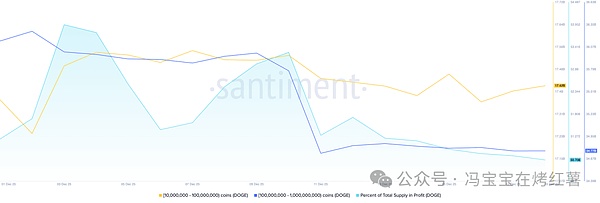
According to Santiment, addresses holding 100 million to 1 billion DOGE currently hold 34.77 billion coins, down significantly from 36.14 billion on December 1. Although this group shifted to a wait-and-see approach after a concentrated sell-off of over 1 billion DOGE on December 10, their overall share of holdings has dropped from a peak of 53.95% on December 3 to 50.70%, indicating continued capital outflow.
Derivatives Market Dominated by Bears

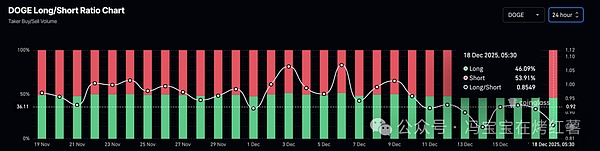
Amid the cautious overall sentiment in the cryptocurrency market due to the release of U.S. CPI data on Thursday and the Bank of Japan's interest rate decision on Friday, DOGE's performance faced simultaneous pressure. According to CoinGlass data, the proportion of DOGE derivative short positions has risen from 52.59% on Wednesday to 53.91%, with bearish forces taking the lead.

In the past 24 hours, DOGE long positions worth over $5 million were liquidated, further confirming intensified selling pressure in the market.
Technical Analysis: Will the $0.10 Level Be Tested?

So far, DOGE has accumulated a decline of over 6%, with its price gradually approaching the S1 pivot support at $0.1231. The meme coin's daily closing price hit a new low since October 17, 2024, and it has fallen for the third consecutive week.

If the $0.1231 support level is broken, DOGE could further decline toward the psychological barrier of $0.1000. Technical indicators also lean bearish: the MACD indicator crossed below the signal line on Monday and has continued to decline, highlighting downside risks; the RSI indicator is currently at 33 and shows a downward trend, gradually approaching oversold territory, reflecting significant bearish pressure in the market.
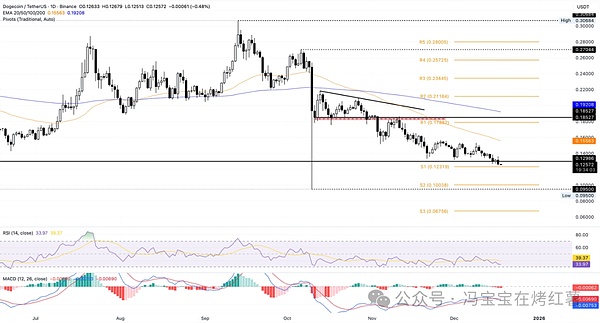
Conversely, if DOGE finds support near $0.1231 and stages a rebound, the 50-day Exponential Moving Average (EMA) around $0.1556 will form a key near-term resistance level.


Trending Cryptos

Related Questions

QWhat is the current trend in Dogecoin (DOGE) prices according to the article?

ADogecoin is experiencing a continued decline, with selling pressure intensifying and prices falling for the third consecutive week.

QHow much were DOGE long positions liquidated in the last 24 hours?

AOver $5 million in DOGE long positions were liquidated in the past 24 hours.

QWhat key support level is DOGE approaching, and what is the next target if it breaks?

ADOGE is approaching the S1 pivot support level at $0.1231. If this support breaks, the next key target is the psychological level of $0.1000.

QWhat does the short position percentage in the DOGE derivatives market indicate?

AThe short position percentage has increased from 52.59% to 53.91%, indicating that bearish sentiment is dominant and short sellers are in control.

QWhich technical indicators are mentioned as showing bearish signals for DOGE?

AThe MACD indicator crossed below its signal line and continues to trend lower, and the RSI is at 33 and falling, approaching oversold territory, both indicating significant bearish pressure.

Related Reads

Agent Race Ends, Super Workbench Takes Over

The era of fragmented AI agents is ending. Over the past month, China's tech giants—Tencent, Alibaba, and ByteDance—have simultaneously shifted strategy: instead of launching new, standalone AI agents, they are consolidating their various agent projects into unified "super workbenches." Tencent integrated its QClaw teams into WorkBuddy, a strategic product hailed as a potential third flagship after QQ and WeChat. Alibaba is merging its QoderWork, Wukong, and MuleRun agents into a new "Qianwen Office" platform under DingTalk's leadership. ByteDance rebranded its TRAE SOLO coding agent to TRAE Work, signaling a broader focus on workflow collaboration. This convergence marks a pivotal industry consensus. The initial exploration phase, where companies rapidly built numerous overlapping agents for different scenarios, proved costly and inefficient. With open-source tools eroding technical barriers, competition has shifted from agent creation to resource consolidation and cost control. Historically, platform wars are won not by creating more products, but by simplifying them—as seen with browsers unifying web access and super-apps consolidating services. Now, the "super workbench" aims to become the unified AI entry point for work. This reflects a deeper market realization: the primary audience for AI is no longer just programmers (a market in the tens of millions) but all knowledge workers (a market of billions). The real opportunity lies in augmenting everyday tasks—managing emails, documents, data, and meetings—across the entire workday. The core battleground is becoming control over the primary AI entry point that employees use daily. Tencent's WorkBuddy leverages WeChat and Tencent Docs; Alibaba's Qianwen Office taps into DingTalk's organizational data; ByteDance's TRAE Work integrates with Feishu's workflows. Whoever owns this "super workbench" gains strategic control over orchestrating enterprise data and APIs. This shift is redefining enterprise software. Traditional SaaS applications, valued for their user interfaces, will recede into the background. Their core functionalities will be exposed as standardized "Skills" or APIs for the super workbench's agents to invoke. Software value will shift from selling user seats to charging based on API calls and outcomes delivered. The evolution of agents is moving through clear stages: first as novel standalone products, then as consolidated primary work entry points, and finally as pervasive, invisible capabilities embedded into the digital fabric. The recent moves by major tech firms signal the transition from the first stage into the second, accelerating toward the third. In the end, the most successful agent technology may become invisible—like electricity or the HTTP protocol—a fundamental, unnamed infrastructure powering work itself.

marsbit17m ago

Agent Race Ends, Super Workbench Takes Over

marsbit17m ago

Michael Saylor: 110 Reasons to Oppose BIP-110

Michael Saylor presents 110 arguments against Bitcoin Improvement Proposal (BIP) 110, a soft fork aimed at restricting certain non-monetary data storage uses (like inscriptions) on the Bitcoin blockchain. He acknowledges the proponents' valid concerns—such as node costs, fee pressure, and preserving Bitcoin's monetary focus—but fundamentally disagrees with the proposed solution. Saylor argues that BIP 110 represents a dangerous precedent of using consensus rules to enforce value judgments on transaction validity, moving away from Bitcoin's core principles of neutrality and permissionless innovation. His key objections are organized into eleven categories: 1) It violates neutrality and hard consensus by banning currently valid transactions. 2) It fails to meet the high burden of proof required for a consensus change, lacking concrete data on the alleged crisis. 3) Its seven bundled technical restrictions are overly broad, targeting generic script functionalities and blocking future upgrade paths. 4) It sacrifices compatibility and future optionality by closing off designed upgrade hooks. 5) Its temporary rules add significant complexity (grandfathering, expiry states) without sufficient justification. 6) The economic and security impacts, particularly on miner revenue and fee markets, are uncertain and unmodeled. 7) Superior, market-based tools (fee markets, relay/mining policies) already exist to manage blockchain load. 8) It stifles innovation by creating a chilling effect for developers. 9) Its modified activation mechanism (55% threshold, forced signaling) is aggressive and risks network splits. 10) The precedent it sets—using consensus to suppress disliked but legal uses—is more dangerous than the problem it aims to solve. 11) A better path exists: improving measurements, refining resource-based policies, and allowing market forces to work. Saylor concludes that Bitcoin's strength lies in its neutral rules, open markets, and hard consensus. Changing these foundational elements to target specific use cases is an unnecessary and risky "iatrogenic" intervention. He advocates for guarding Bitcoin's neutrality rather than acting as its redeemer.

marsbit32m ago

Michael Saylor: 110 Reasons to Oppose BIP-110

marsbit32m ago

Trading

Spot

Hot Articles

What is DOGE M

Doge Matrix ($doge m): The New Breed of Community-Driven Cryptocurrency Introduction In the ever-evolving landscape of cryptocurrency, new projects constantly emerge, each aiming to capture the interest of investors and enthusiasts alike. One of the latest entrants to this domain is Doge Matrix, represented by the ticker symbol $doge m. This project has attracted attention thanks to its roots in the popular meme culture surrounding Dogecoin, establishing its place within the web3 space. This article aims to provide a comprehensive analysis of Doge Matrix, covering its overview, creator, investors, functionality, timeline, and notable aspects. What is Doge Matrix ($doge m)? Doge Matrix is a community-driven cryptocurrency project that seemingly builds upon the widespread appeal of Dogecoin, a digital currency known for its Shiba Inu mascot and its meme origins. While the overarching objectives of Doge Matrix are not extensively defined, it is characterized by a commitment to harnessing community involvement and support. Unlike traditional cryptocurrencies that often emphasize utility or intrinsic value through underlying technologies, Doge Matrix positions itself within a space that embraces the cultural phenomenon of cryptocurrencies, particularly appealing to those who resonate with the ethos of meme-based assets. Drawing on the strengths of the Dogecoin community, Doge Matrix operates as part of a broader ecosystem, inviting participation and engagement from users who share an interest in cryptocurrency and the digital landscape. Who is the Creator of Doge Matrix ($doge m)? The identity of the creator of Doge Matrix remains unknown. This lack of transparency is not an uncommon occurrence in the cryptocurrency space, where some projects are launched without revealing the identities of their founders. The absence of information regarding the founding team can raise questions among potential investors about the project’s accountability and direction. Who are the Investors of Doge Matrix ($doge m)? As it stands, there is no publicly available information detailing the investors or investment foundations that back Doge Matrix. The project appears to rely primarily on community support rather than institutional investment. This model aligns with the community-driven nature of the initiative, fostering an environment where the direction of the project is shaped by its participants rather than being dictated by a select few financial backers. How Does Doge Matrix ($doge m) Work? The specifics regarding the operational mechanisms of Doge Matrix are somewhat vague, reflecting a broader trend of projects in the meme coin space where innovative functionalities are not always clearly articulated. Nonetheless, Doge Matrix seems designed to tap into the existing cryptocurrency ecosystem by encouraging user participation while tapping into the familiar cultural references associated with Dogecoin. Its potentially unique characteristics derive from community interactions rather than technological advancements, emphasizing shared experiences and collaboration among token holders. While the exact innovations have not been explicitly outlined, the project appears to create a space where community members can engage, share ideas, and propel the project's potential forward. Timeline of Doge Matrix ($doge m) Reflecting on the project’s timeline reveals notable events that have defined its journey thus far: November 25, 2024: Doge Matrix reached its all-time high value, marking a significant milestone in its early history. January 1, 2025: Conversely, Doge Matrix hit its all-time low value, illustrating the volatility often associated with cryptocurrencies, especially in the early stages of a project's lifecycle. Ongoing: The project continues to be actively traded and supported by its community, although specific future milestones or objectives have yet to be disclosed. Key Points About Doge Matrix ($doge m) Community Focus At the heart of Doge Matrix is a commitment to community engagement. The project thrives on the premise of collaboration and shared objectives among its members, emphasizing the importance of collective effort. Unlike centralized projects that often have a defined leadership structure, Doge Matrix at present showcases a more fluid approach to governance, where every community member's voice matters. Volatility The cryptocurrency market is notorious for its volatility, and Doge Matrix is no exception. Its price history reflects significant fluctuations between high and low values, which is typical of many new cryptocurrencies but underscores the risks associated with investment in emerging tokens. Lack of Detailed Information One of the most striking features about Doge Matrix is the scarcity of detailed information regarding its technological underpinnings and operational mechanisms. This ambiguity necessitates that potential investors conduct thorough due diligence before engaging with the project. Conclusion In summary, Doge Matrix ($doge m) illustrates a new wave of cryptocurrency projects that lean heavily on community engagement and cultural relevance. While lacking in certain specifics—such as clear leadership, defined objectives, and detailed functionality—the project has managed to generate interest within the crypto community, leveraging the established appeal of meme culture. As with any investment in the cryptocurrency space, understanding the inherent risks and conducting comprehensive research is essential for potential participants. Doge Matrix stands as a reminder of the dynamic, sometimes unpredictable nature of the crypto industry, marked by constant evolution and enthusiasm for community-driven initiatives.

4.1k Total ViewsPublished 2025.02.03Updated 2025.02.03

What is DOGE M

Discussions

Welcome to the HTX Community. Here, you can stay informed about the latest platform developments and gain access to professional market insights. Users' opinions on the price of DOGE (DOGE) are presented below.

活动图片