Dogecoin Is Breakout Ready: Analyst Shows Major Target For The Meme Coin King

bitcoinistPublished on 2026-01-12Last updated on 2026-01-12

Abstract

Technical analysis by Jonathan Carter indicates that Dogecoin is poised for a potential breakout from a prolonged descending channel that has constrained its price action since September 2025. Recent trading behavior shows weakening selling pressure, with DOGE pushing toward the upper trendline and reclaiming the 50-day moving average—a bullish signal. A confirmed breakout could trigger a rally toward initial targets in the mid-$0.15 range, followed by resistance levels at $0.18–$0.20, $0.24, and ultimately $0.28–$0.30. These short- to mid-term targets are achievable if bullish sentiment strengthens across crypto markets.

Technical analysis of Dogecoin’s price action on the daily candlestick timeframe chart shows that the meme coin has spent the past several months grinding lower inside a clearly defined descending channel. However, technical analysis proposes that the structure may be nearing its end.

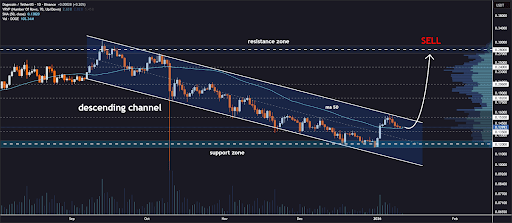
A daily chart shared on X by crypto analyst Jonathan Carter points to a setup that shows Dogecoin is about to break out of the descending channel. Although the meme coin has yet to confirm a full breakout, the chart now shows multiple conditions aligning that traders are closely watching.

Descending Channel Nearing Its Breaking Point

Dogecoin has spent an extended period moving within a declining structure that has repeatedly limited upside attempts since September 2025. This prolonged compression has kept price action controlled and largely predictable, but it has also stored directional pressure beneath the surface. Each attempt to move higher was previously rejected at the upper boundary, keeping the price compressed into a descending channel.

That structure, however, now appears to be weakening. According to technical analysis from Jonathan Carter, that pressure is now beginning to tilt upward, with recent trading behavior showing less follow-through from sellers than in recent weeks.
Source: Chart from Jonathan Carter on X

Recent candles show Dogecoin pushing higher from the lower boundary of the channel and pressing toward its upper trendline. Although it was rejected at the upper boundary early January, it hasn’t veered far away from the top of the channel. This is important because descending channels often act as continuation patterns only until buying pressure overwhelms sellers at resistance.

50-Day Moving Average And The Path Back To $0.30

One of the more notable details on the chart is Dogecoin’s interaction with the 50-day moving average. After spending weeks trading below this level, price has now reclaimed it and is attempting to hold above it.

Holding above the 50-day average strengthens the case that the current move is not just another short-lived bounce. As long as the Dogecoin price continues to hold above this moving average, then the bullish outlook is valid.

If Dogecoin manages to break cleanly above the channel resistance, the analysis outlines a sequence of upside levels that could come into play quickly. Initial follow-through would place the price back into the mid-$0.15 range, followed by a push toward the high-$0.18s and the $0.20 region, areas that previously acted as congestion zones.

After that, the chart points to $0.24 as the next target and then finally $0.28 to $0.30 as the last recovery target zone before any rejection comes into the picture.

These are short- to mid-term price targets, not long-term projections. These targets are very feasible and can even be reached within the next few weeks if a bullish wave of sentiment were to sweep across the entire crypto market.

DOGE trading at $0.13 on the 1D chart | Source: DOGEUSDT on Tradingview.com

Trending Cryptos

Related Questions

QWhat technical pattern has Dogecoin been trading within for the past several months according to the analysis?

ADogecoin has been trading within a clearly defined descending channel.

QWhich analyst is cited in the article for the technical analysis showing Dogecoin is breakout ready?

AThe analysis is from crypto analyst Jonathan Carter.

QWhat key moving average has Dogecoin recently reclaimed, which is seen as a bullish signal?

ADogecoin has recently reclaimed the 50-day moving average.

QWhat is the final short-to-mid-term price target zone mentioned in the analysis if Dogecoin breaks out?

AThe final short-to-mid-term price target zone is $0.28 to $0.30.

QWhat is the primary condition for the bullish outlook to remain valid, as stated in the article?

AThe bullish outlook remains valid as long as the Dogecoin price continues to hold above the 50-day moving average.

Related Reads

Global Market Share Survey: Japanese Firms Lead in Semiconductor Materials

Global Market Share Survey: Japanese Firms Lead in Semiconductor Materials According to the 2025 "Major Goods and Services Market Share Survey" by Nikkei, Japanese companies maintain strong positions in semiconductor-related materials. In silicon wafers, Shin-Etsu Chemical ranks first with a 26.3% share, followed by SUMCO at 17.8%. Together, they hold 44.1% of the market, widening their lead over competitors from Taiwan, Germany, and South Korea. In photoresists, Tokyo Ohka Kogyo, JSR, and Shin-Etsu Chemical occupy the top three spots, with a combined share of 60.5%. Despite their strength in materials, Japanese firms have a weaker presence in core semiconductor segments like DRAM and NAND flash memory, where South Korean and U.S. companies dominate. For instance, SK Hynix and Samsung lead in DRAM, while China’s CXMT doubled its share to 6% in 2025. The semiconductor market is projected to grow rapidly, with WSTS forecasting a 90% increase to $1.5112 trillion by 2026. Major players like Samsung, SK Hynix, and Micron are making massive investments to expand capacity. To maintain their edge in materials, Japanese companies must similarly commit to large-scale, risk-taking investments. In contrast, Japan’s automotive sector shows stagnation. Toyota remains the global leader but with only a slight share increase to 12.3%, while Japanese brands are absent from the top five in the EV market. In shipbuilding, Imabari Shipbuilding rose to third place globally with a 7.2% share, benefiting from large container ship deliveries. However, Chinese and South Korean firms dominate the sector, holding the top two positions. Japan aims to revitalize its shipbuilding industry through government and corporate efforts, targeting a near doubling of output by 2035. Addressing labor shortages and adopting advanced technologies like physical AI will be critical for competitiveness.

marsbit18m ago

Global Market Share Survey: Japanese Firms Lead in Semiconductor Materials

marsbit18m ago

STRC Major De-pegging's First Financial Report, How Will Strategy Repair Its Capital Flywheel?

Bitcoin treasury company Strategy released its Q2 2026 earnings report on July 31. Despite a 6.9% year-over-year revenue increase to $122 million, the company recorded a net loss of $8.22 billion, largely due to $8.32 billion in unrealized losses from Bitcoin price fluctuations. As of quarter-end, Strategy holds 843,775 BTC with an average cost of $75,000 per coin, and Bitcoin per share increased. The report highlights a critical shift in Strategy's capital model following the de-pegging of its key financing tool, STRC (Strategic Coin), which fell below its $100 target. Management's top priority is restoring STRC to its target value, aiming for a recovery by September 8. They rule out discounted STRC issuances and plan to maintain its dividend yield at 12%, instead focusing on bolstering its $3.75 billion cash reserve. Strategy has moved from a one-way "buy-and-hold" Bitcoin strategy to active capital management. This new approach, part of its "Digital Credit Capital Framework," involves flexibly managing its balance sheet across four elements: BTC, USD cash, common stock (MSTR), and digital credit securities like STRC. This allows for BTC monetization (having sold $218.4 million in BTC so far), strategic repurchases of discounted securities, and debt optimization, as seen with a $1.5 billion convertible bond buyback. The company's future hinges on two key tests: successfully re-pegging STRC to restore market confidence in its digital credit system, and a long-term recovery in Bitcoin's price to ultimately support its growth thesis.

marsbit1h ago

STRC Major De-pegging's First Financial Report, How Will Strategy Repair Its Capital Flywheel?

marsbit1h ago

STRC's First Financial Report Post-Depegging, How is Strategy Restoring the Capital Flywheel?

On July 31, 2026, Bitcoin treasury company Strategy released its Q2 financial report. Despite a 6.9% year-over-year increase in revenue to $122 million, the company recorded a substantial net loss of $8.22 billion, primarily due to $8.32 billion in unrealized losses from Bitcoin holdings. While Strategy's core Bitcoin strategy remains intact—its holdings grew 11% to 843,775 BTC—the company is undergoing a fundamental shift in its capital model. Following the de-pegging of its key financing tool, the STRCoin (STRC), from its $100 target in May, Strategy has pivoted from a one-directional "raise funds, buy Bitcoin" cycle to a more dynamic, multi-asset capital management approach. A key part of this new framework is the "Monetization Program," through which Strategy has sold approximately $218.4 million worth of BTC to bolster liquidity. The company's top priority is repairing STRC's peg, committing not to issue discounted shares until it returns to its target range. It has initiated a $1 billion buyback program for discounted digital credit securities, having repurchased $28.9 million face value of STRC so far. Management aims to restore the peg around September 8, 2026. Strategy now actively manages a matrix of assets: Bitcoin (for accumulation or strategic sales), USD cash reserves (now at $3.75 billion), common stock (MSTR), and digital credit securities like STRC. This allows for tactical moves like repurchasing discounted debt or equity to capture value. The future success of Strategy's "capital flywheel" hinges on two factors: the short-term ability to successfully re-peg STRC to restore market confidence in its digital credit system, and the long-term price trajectory of Bitcoin, upon which its entire investment thesis ultimately depends.

Odaily星球日报1h ago

STRC's First Financial Report Post-Depegging, How is Strategy Restoring the Capital Flywheel?

Odaily星球日报1h ago

Trading

Spot

Hot Articles

Discussions

Welcome to the HTX Community. Here, you can stay informed about the latest platform developments and gain access to professional market insights. Users' opinions on the price of MEME (MEME) are presented below.

活动图片