Demand Test: Bitcoin Whales Earn Record $1.2 Billion, Ethereum Holders Return to Profitability

cryptonews.ruPublished on 2026-08-25Last updated on 2026-08-25

Abstract

In just three days after Bitcoin's price recovery, new Bitcoin whales have realized over $1.2 billion in profit, marking the largest profit-taking event for this cohort on record according to CryptoQuant. The peak occurred on August 20 with roughly $614 million, setting a daily record. Analysts note this selling pressure began after Bitcoin rose above the realized price of short-term whales, which was around $68,900. With Bitcoin trading near $77,700 on August 23, these whales were sitting on an average profit of about 12.8%. The market recovery allowed investors who were previously at breakeven or at a loss to lock in gains. CryptoQuant described the situation as a key test for Bitcoin demand; sustained prices above whale cost-basis with normalized profit-taking could signal strong new demand, while continued selling pressure could turn the rally into a mere break-even exit. Simultaneously, large Ethereum holders have also returned to an unrealized profit zone following its rally, as noted by CryptoQuant analyst Darkfost. Current profit levels, however, remain relatively low and are not seen as creating significant selling pressure. The Unrealized Profit/Loss Ratio for different whale cohorts stands at 0.075 (for 1k-10k ETH holders), 0.16 (10k-100k ETH), and 0.38 (over 100k ETH). This marks a significant improvement from June, when these whales were in substantial unrealized loss, with Ethereum having risen over 65% since then. The increased profitability is viewed as a pos...

New Bitcoin whales realized over $1.2 billion in profit in just three days following the recovery in the price of the first cryptocurrency. This has become the largest profit-taking event for this cohort in the entire history of observations, stated CryptoQuant.

The peak occurred on August 20 — about $614 million, which also became an absolute daily record, the statement said.
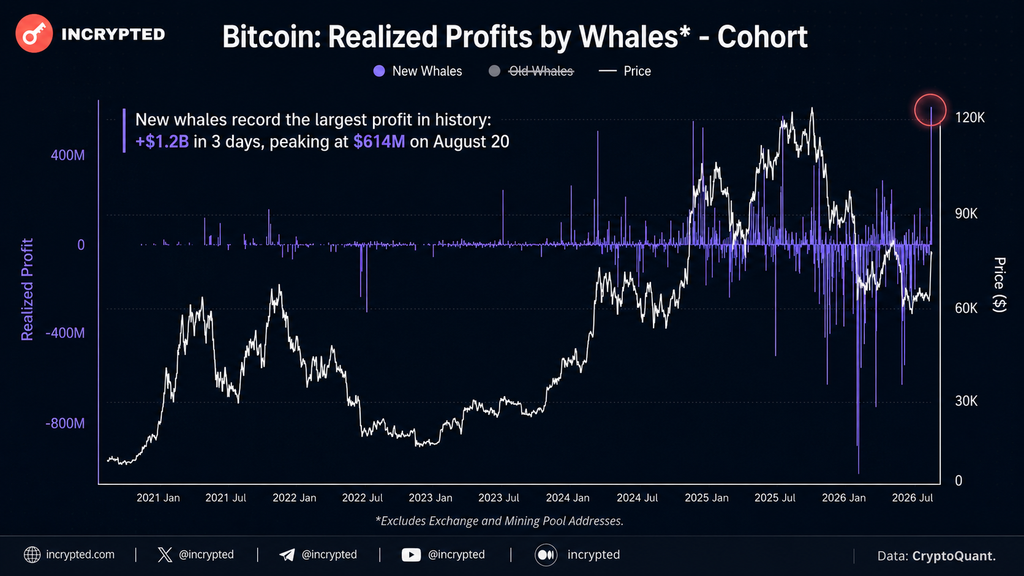
Bitcoin whales' realized profit. Infographic: Incrypted.

Analysts noted that profit-taking began after Bitcoin returned above the realized price of short-term whales. This indicator was about $68,900, while on August 23, Bitcoin was trading near $77,700 — approximately 12.8% above the average cost basis of this cohort.

For several months, large investors who recently purchased Bitcoin were at or below their purchase price. The market recovery changed the situation, opening up the opportunity for them to realize profits, the experts added.

CryptoQuant called the current situation an important test for Bitcoin's demand. If the asset can hold above the cost basis of the whales, and profit-taking volumes normalize, this may indicate the ability of new demand to absorb the supply.

At the same time, continued high seller activity and the first cryptocurrency falling back below this level could turn the rally into a "break-even exit," where investors who were previously at a loss will increase selling pressure on the price, CryptoQuant emphasized.

What's Happening with Ethereum?

Against the backdrop of the Ethereum rally, large holders of the asset have also returned to the zone of unrealized profit, noted CryptoQuant analyst using the pseudonym Darkfost. He stressed that the current profitability level remains relatively low and, in his opinion, is not capable of creating significant pressure on the asset's price.

According to the analyst, the unrealized profit/loss ratio for different cohorts is:

  • 1,000-10,000 $ETH — 0.075;
  • 10,000-100,000 $ETH — 0.16;
  • more than 100,000 $ETH — 0.38.

Note, the ratio reflects the average percentage of "paper" profit for Ethereum holders relative to their purchase price: the higher the value, the greater the plus for investors.

According to Darkfost, the increase in profitability for large investors may be a more positive signal for Ethereum, as it improves their sentiment. The analyst reminded that in June, whales were in significant unrealized loss, while since then the asset has grown by more than 65%.

Recall that earlier, Coinbase CEO Brian Armstrong predicted Bitcoin could reach $400,000 by 2030.


Trending Cryptos

Related Questions

QAccording to the article, what was the record profit Bitcoin whales realized in just three days?

ANew Bitcoin whales realized more than $1.2 billion in profit over three days following the cryptocurrency's price recovery.

QWhat does CryptoQuant call the current situation regarding Bitcoin?

ACryptoQuant called the current situation an important test for Bitcoin's demand.

QWhat condition could turn the current Bitcoin rally into a 'break-even exit' scenario?

AAccording to CryptoQuant, if high seller activity persists and Bitcoin returns below the cost basis of the whales, the rally could turn into a 'break-even exit' scenario.

QHow did the profitability status of large Ethereum holders change according to the analyst Darkfost?

ALarge Ethereum holders returned to a state of unrealized profit, although the level of profitability remains relatively low.

QWhat is the significance of the unrealized profit/loss ratio for different cohorts of Ethereum holders?

AThe ratio reflects the average percentage of 'paper' profit for Ethereum holders relative to their purchase price. A higher value indicates investors are holding a greater profit.

Related Reads

Ilya Delivers, Huang Jen-Hsun Bets 50 Billion on SSI, First Model Suspected to Launch This Week

Ilya Sutskever's Safe Superintelligence (SSI) lab, backed by a rumored $5 billion investment from NVIDIA granting exclusive access to next-gen systems, may release its first groundbreaking model as early as this week. Industry insiders are hinting at a major breakthrough from a non-major player, with some claiming AI will be "utterly transformed." The model is speculated to fundamentally differ from current large language models like ChatGPT. Instead of relying on massive, static pre-training and ever-larger context windows, SSI's approach reportedly centers on **Test-Time Training (TTT)**. This would allow the model to **update its own internal weights in real-time** as it processes information, effectively "learning on the fly" and internalizing new knowledge like a human, rather than just referencing it from a large prompt. This aligns with Ilya Sutskever's long-stated vision of moving beyond the "pre-training" and "scaling" era. He envisions superintelligence not as a monolithic, pre-loaded database, but as an adaptive, "infinitely curious 15-year-old genius" capable of continual learning through interaction. SSI's strategy has been focused solely on this goal of "safe superintelligence" through efficient continual learning and alignment, explaining its prior silence. If successful, this model could disrupt the entire AI industry, challenging the current reliance on vast compute resources for training and the business models built around context windows. It suggests that core technological leaps, not just financial scale, remain decisive in the AI race.

marsbit23m ago

Ilya Delivers, Huang Jen-Hsun Bets 50 Billion on SSI, First Model Suspected to Launch This Week

marsbit23m ago

Kinetiq Team Announces Elysium L2 Network for Hyperliquid

On August 24, the liquid staking protocol Kinetiq announced Elysium, a new L2 network for the Hyperliquid ecosystem. It aims to increase HyperEVM's throughput and simplify the launch of spot markets, tokens, and DeFi applications. Elysium will use $HYPE for gas fees and plans direct integration with HyperCore's trading engine, giving apps access to its liquidity and orderbook data. Technical details and partners will be revealed later, with a launch date set for "soon." A primary reason for Elysium's development is to overcome HyperEVM's limitations, such as low throughput and rising fees during high load. Kinetiq claims the L2 will start with significantly higher block production and transaction speeds, later aiming to approach HyperCore's performance. This targets applications needing frequent state updates like high-frequency spot trading and AMMs, and will provide them deeper access to HyperCore orderbook data. The network also proposes to streamline the process of launching new assets within Hyperliquid, allowing a token to progress from AMM liquidity to HyperCore's spot orderbook and eventually to perp markets via HIP-3 in a unified flow. Regarding revenue, Kinetiq's model allocates 50% of sequencer fees to buy back and burn $KNTQ, 25% to developers using Elysium's block space, and 25% to the Kinetiq treasury. Elysium marks Kinetiq's expansion beyond its core liquid staking product, kHYPE.

cryptonews.ru36m ago

Kinetiq Team Announces Elysium L2 Network for Hyperliquid

cryptonews.ru36m ago

Trading

Spot

Hot Articles

Discussions

Welcome to the HTX Community. Here, you can stay informed about the latest platform developments and gain access to professional market insights. Users' opinions on the price of ETH (ETH) are presented below.

活动图片