Delphi Digital: Solana to Usher in the Most Radical Technical Upgrade Cycle in Its History

链捕手Published on 2026-01-21Last updated on 2026-01-21

Abstract

Delphi Digital's report, "2026 is the Year of Solana," outlines an aggressive technical upgrade cycle aimed at transforming Solana into a decentralized, Nasdaq-like environment for high-performance on-chain trading. Key upgrades include: - **Alpenglow**: A consensus overhaul introducing Votor and Rotor, reducing finality to 100-150ms and improving resilience with a "20+20" fault tolerance model. - **Firedancer**: A new independent validator client in C++ to enhance performance and client diversity. - **DoubleZero**: A private fiber-optic network overlay to minimize latency between validators, enabling faster consensus. - **BAM & Harmonic**: Market-based systems for fair, private transaction ordering and block building. - **Raiku**: A deterministic execution layer for applications requiring guaranteed, low-latency performance, like HFT. These upgrades aim to make Solana's native on-chain order books competitive with centralized exchanges in latency, liquidity, and fairness, positioning it as the leading L1 for capital markets.

Original Title: 2026 is the Year of Solana

Original Author: Delphi Digital

Original Compilation: Nicky, Foresight News

Solana's 2026 roadmap may be the most radical upgrade cycle in the network's history, featuring a comprehensive overhaul from the consensus mechanism to infrastructure, aiming to become the decentralized Nasdaq.

Solana's roadmap aims to transform it into an exchange-grade environment, enabling native on-chain central limit order books (CLOBs) to compete with centralized exchanges (CEXs) in terms of latency, liquidity depth, and fairness. Here are all the upgrades to achieve this goal.

Alpenglow: A Comprehensive Overhaul of the Consensus Mechanism

Alpenglow is the most significant protocol-level change in Solana's history. It introduces a completely new consensus architecture built around two core components: Votor and Rotor.
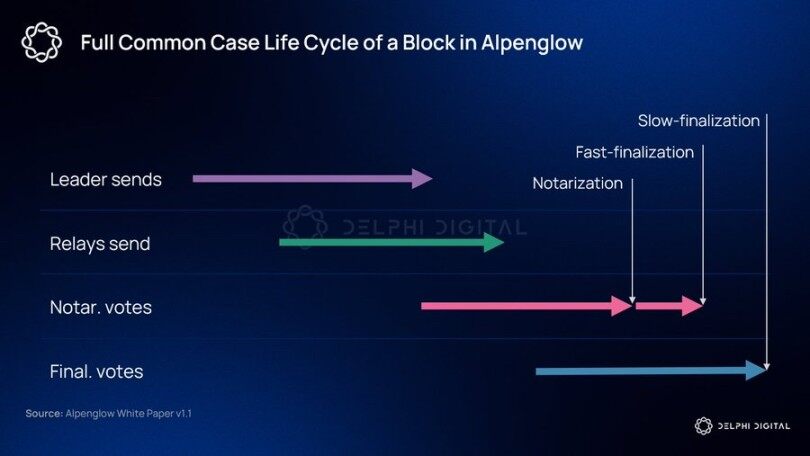
Votor completely overhauls how the network reaches consensus. Instead of chaining multiple voting rounds together, it allows validators to aggregate votes off-chain and submit finalization within one or two rounds. The result is a theoretical finalization time reduced from the original 12.8 seconds to 100-150 milliseconds.

Votor runs two finalization paths in parallel. If a block receives overwhelming support (over 80% stake) in the first round, it is finalized immediately. If support is between 60%-80%, a second round of voting is initiated. If support in the second round also exceeds 60%, the block is finalized. This design ensures finalization even if parts of the network are unresponsive.

Rotor revolutionizes the block propagation mechanism by routing messages directly through validators with high stake and stable bandwidth.

Alpenglow also introduces a "20+20" resilience model: security is guaranteed as long as the total stake of malicious actors does not exceed 20%; liveness is maintained even if an additional 20% go offline. This means Alpenglow can still achieve finalization even if up to 40% of the network's nodes are malicious or offline.

Under Alpenglow, the Proof of History mechanism is effectively deprecated, replaced by deterministic epoch scheduling and local timers. This upgrade is expected to launch in early to mid-2026.

Firedancer: Runtime Performance Improvements

Since its inception, Solana has relied on a single validator client (now called Agave). This monoculture has long been a core weakness of the network. Any bug or failure at the client level could potentially cause a full-network outage.

Firedancer is a second, independent validator client developed by Jump, written in C++. Its design goal is to turn Solana validators into deterministic, high-throughput engines capable of handling millions of TPS with minimal latency variance.

Frankendancer is its transitional version, combining Firedancer's network and block production modules with Agave's runtime and consensus components. As Firedancer gradually reaches mainnet readiness, validator diversity is expected to increase significantly.

In this competitive context, both teams have iterated extensively.

DoubleZero: High-Performance Fiber Optic Infrastructure

DoubleZero is a private network overlay that connects validators via dedicated fiber optic lines, the same infrastructure used by traditional exchanges (like Nasdaq and CME) for microsecond transmissions.
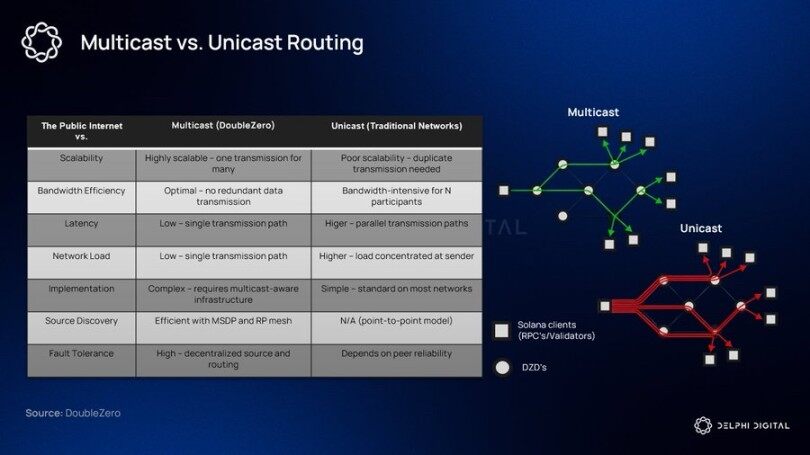
As the validator set expands, information propagation becomes more difficult. More nodes mean more destinations, which introduces temporal inconsistency into the network. DoubleZero eliminates this variance by routing messages along optimal paths, rather than bouncing around the public internet.

Alpenglow's finalization model relies on validators receiving and responding to messages within strict time windows. If propagation is inconsistent, votes arrive late, quorums form slower, and finalization takes longer. By narrowing the latency gap between validators, DoubleZero allows Votor to finalize faster and Rotor's propagation to be more uniform.

DoubleZero also supports multicast, replicating data within the network and delivering it to all validators simultaneously.

Block Building: BAM and Harmonic

Two complementary trends are reshaping Solana's block building layer:

BAM (Block Assembly Marketplace) is Jito's reimagining of Solana's transaction pipeline. Instead of the slot leader unilaterally deciding transaction ordering, it inserts a market and privacy layer between ordering and execution. Transactions are imported into a Trusted Execution Environment (TEE), meaning neither validators nor builders can see the raw transaction content until ordering is finalized. This prevents opportunistic pre-execution behaviors like front-running.

Harmonic targets another part of the pipeline — who builds the block. It introduces an open block builder aggregation layer, enabling validators to accept block proposals from multiple competing builders in real-time. Think of Harmonic as a meta-market, and BAM as the micro-market.

Raiku: Deterministic Execution Guarantees

Raiku fills the remaining gap. Solana has arguably solved most throughput bottlenecks, but it does not natively provide deterministic latency or programmable execution guarantees for specific applications. The granular control required for high-frequency trading (HFT)-style matching and on-chain central limit order books (CLOBs) far exceeds what an L1 can reasonably provide.
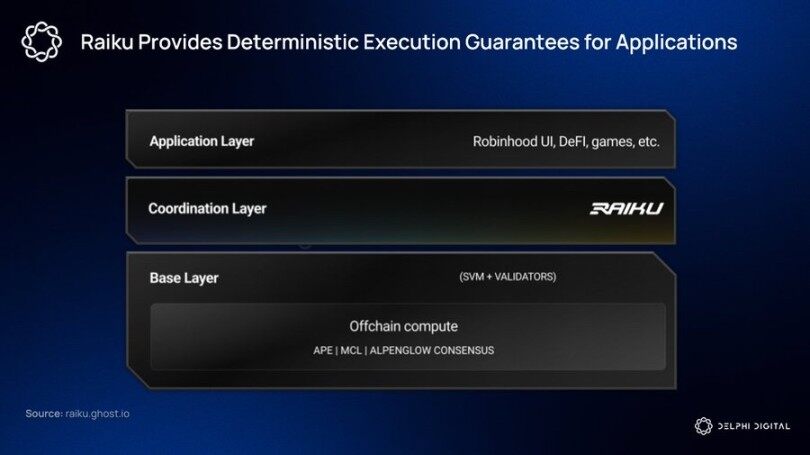
Raiku provides a scheduling/auction layer that runs parallel to the Solana validator set, offering applications a programmable, deterministic pre-execution environment without modifying the L1 consensus mechanism. It enables guaranteed execution for pre-committed workflows via Ahead-of-Time (AOT) transactions and caters to real-time needs via Just-in-Time (JIT) transactions.

Bringing Capital Markets On-Chain

Among high-performance public chains, Solana remains the dominant player, but this dominance is meaningless without users and efficient on-chain markets. While the vast majority of meme coins are still traded on Solana, on-chain perpetual futures markets are rapidly consolidating on a few platforms.

To compete with centralized players, performance must be on par. We believe the Solana ecosystem has recognized this issue and is optimistic about closing the gap. The upcoming upgrades are highly anticipated, and new Solana-native perpetual exchanges like BULK are set to launch early in the year.

Retail demand for trading spot assets on Solana remains huge. While Hyperliquid暂时 dominates the perpetuals market for now, Solana has established itself as the preferred L1 for trading任意 spot pairs. Centralized exchanges are still far ahead, but Solana is currently the preferred solution for on-chain trading.

Products like xStocks are bringing on-chain stocks directly to Solana. Liquidity, price discovery, and speculative attention are concentrating onto this single chain that offers faster settlement, better user experience, and denser capital.

This is the rationale for Solana bringing capital markets on-chain.

Recommended Reading:

RootData 2025 Web3 Industry Annual Report

Binance Power Shift: The Dilemma of a 300 Million User Empire

Following Farcaster's Pivot, Lens Protocol Changes Hands, Leaving the Web3 Social Dream in Tatters

2026 Cryptocurrency Exchange Listing Decision Survey Report: Over 88% of Respondents Use RootData for Cross-Verification, Lack of Project Transparency Affects Listing Efficiency


Trending Cryptos

Related Questions

QWhat is the main goal of Solana's 2026 roadmap according to Delphi Digital?

AThe main goal is to transform Solana into an exchange-grade environment where native on-chain centralized limit order books (CLOBs) can compete with centralized exchanges (CEXs) in terms of latency, liquidity depth, and fairness.

QWhat is Alpenglow and what are its two core components?

AAlpenglow is the most significant protocol-level change in Solana's history, introducing a new consensus architecture. Its two core components are Votor, which overhauls how the network reaches consensus, and Rotor, which revolutionizes block propagation.

QHow does the Firedancer client improve the Solana network?

AFiredancer is a second, independent validator client written in C++ that aims to turn Solana's validators into deterministic, high-throughput engines capable of handling millions of TPS with minimal latency variance, thereby increasing client diversity and network resilience.

QWhat problem does the DoubleZero infrastructure solve for the Solana network?

ADoubleZero solves the problem of inconsistent message propagation time across a growing validator set by using a private network overlay with dedicated fiber optics, which routes messages on optimal paths to reduce latency gaps and enable faster finality.

QWhat role do BAM and Harmonic play in reshaping Solana's block production layer?

ABAM (Block Assembly Marketplace) reimagines the transaction pipeline by inserting a market and privacy layer between ordering and execution to prevent opportunistic pre-execution. Harmonic introduces an open block builder aggregation layer, allowing validators to accept block proposals from multiple competing builders in real-time.

Related Reads

In Conversation with Ray Dalio: We Are Currently in an AI Bubble, with 1% of My Portfolio in Bitcoin

Ray Dalio, founder of Bridgewater Associates, warns in an interview that the current AI boom shows classic bubble characteristics, which could lead to significant economic downturns as seen in past cycles like 1929 or 2000. He explains that speculative enthusiasm, fueled by debt and overvaluation, often precedes a crash when rising rates or taxation force asset sales, causing widespread losses and recession. Dalio also outlines his "Big Cycle" theory, describing an approximate 80-year pattern where widening wealth gaps, massive government deficits, and shifting geopolitical power (like China's rise) create internal conflict and global instability. He emphasizes that we are in a late-cycle, transitional phase where traditional powers like the US and UK face decline. For personal wealth protection, Dalio advises diversification beyond cash into assets like stocks, bonds, real estate, and particularly gold, which he prefers over Bitcoin. While he holds about 1% of his portfolio in Bitcoin as a non-printable hard asset, he views gold as more secure from technological or governmental threats. Regarding AI's impact, Dalio believes it will disproportionately benefit capital owners, worsening inequality by replacing both physical and cognitive labor. He suggests that human intuition and emotional intelligence, combined with AI, will be key for future workers. On taxation, Dalio argues that wealth taxes are impractical and risk triggering asset sell-offs, reducing productive investment. He points to the UK as a cautionary example of debt, low productivity, and political strife. Geopolitically, Dalio foresees a more regionalized world, with the US showing weakness in prolonged conflicts like with Iran, akin to past imperial declines. The ideal outcome, he suggests, is coexisting powerful blocs (e.g., Americas, China-Asia Pacific) without major war.

marsbit2h ago

In Conversation with Ray Dalio: We Are Currently in an AI Bubble, with 1% of My Portfolio in Bitcoin

marsbit2h ago

Daily 7.2 Trillion KRW: Foreign Capital's Record Net Buying on Friday! Wall Street Says Headwinds for Korean Stock Fund Flows Have Subsided

South Korean stock market sees a dramatic shift in fund flows. On July 31, foreign investors made a record net purchase of approximately KRW 7.2 trillion in KOSPI stocks, marking a fundamental reversal from the persistent large-scale net outflows seen in previous months. This contributed to a significant narrowing of foreign net selling in July to KRW 9.8 trillion, down sharply from KRW 48.4 trillion in June and KRW 44.5 trillion in May. Simultaneously, domestic institutional pressure eased. South Korean pension funds and asset managers turned to a net buying position in July, purchasing KRW 1.0 trillion worth of KOSPI shares, contrasting with net sales in May and June. Market volatility is expected to be dampened by new financial regulations. Effective July 31, the Financial Services Commission tightened access for retail investors to single-stock leveraged ETFs by raising the minimum cash deposit requirement. Trading volumes for these products subsequently dropped to about 50% of their monthly average. Citigroup Research maintains its year-end KOSPI target of 10,000 points. The firm cites several supportive factors: the substantial easing of headwinds from capital outflows, a robust fundamental outlook for the semiconductor sector, historically low market valuations, strong economic fundamentals, and the potential for policy support from financial authorities if needed.

marsbit2h ago

Daily 7.2 Trillion KRW: Foreign Capital's Record Net Buying on Friday! Wall Street Says Headwinds for Korean Stock Fund Flows Have Subsided

marsbit2h ago

Thanks to Dice Rolls, Bitcoin Keys Are Stored Offline, But Not Everyone Will Do It

The article discusses using dice rolls to generate secure Bitcoin wallet seeds, providing entropy independent of potentially flawed hardware random number generators. It explains that each fair dice roll offers about 2.585 bits of entropy, with around 50 rolls needed for a standard 12-word seed phrase and 99+ recommended for higher security. This method gained attention after a vulnerability was revealed in some Coldcard hardware wallets, where a faulty firmware RNG (dating back to 2021) compromised generated keys. The analysis notes that while a dice-generated main seed was safe from this specific flaw, other Coldcard functions (like creating paper wallets, backup keys, or passwords) could still be vulnerable if they used the defective RNG. The piece argues that while dice-based entropy is technically robust, the manual process is error-prone, tedious, and unrealistic for most new users, who might make mistakes in recording or inputting rolls. It concludes that while manual entropy generation should remain an option for advanced users, the long-term goal is to develop reliable, user-friendly hardware and software that securely generates randomness without requiring specialized knowledge. Coldcard users are advised to check their firmware version and replace any secondary secrets (like paper wallet keys) created with vulnerable devices, while also considering multi-signature setups with devices from different manufacturers for added security.

cryptonews.ru7h ago

Thanks to Dice Rolls, Bitcoin Keys Are Stored Offline, But Not Everyone Will Do It

cryptonews.ru7h ago

Trading

Spot

Hot Articles

Discussions

Welcome to the HTX Community. Here, you can stay informed about the latest platform developments and gain access to professional market insights. Users' opinions on the price of SOL (SOL) are presented below.

活动图片














