Decoding Unitree's IPO Prospectus: The True Picture of the Robot Market

marsbitPublished on 2026-05-25Last updated on 2026-05-25

Abstract

Unitree Robotics's IPO prospectus reveals a profitable and rapidly growing company, dominating the global humanoid robot market by shipment volume (5,500 units in 2025). A key shift is that humanoids now constitute over half of its revenue, up from just 1.9% in 2023. However, the current market reality is stark: 74% of humanoid sales are for academic research, 17% for commercial "display" purposes, and only 9% for genuine industrial applications. In contrast, its quadruped robots see more mature industrial use (e.g., inspection). Financially, Unitree is strong with 335% revenue growth to ~$252M in 2025, ~60% gross margins (bolstered by deep vertical integration of key components like motors), and GAAP profitability since 2024. The company plans to invest nearly half of its $620M IPO proceeds into AI and "embodied" large model development, signaling a strategic push beyond hardware into the critical software layer for future differentiation. Unitree's story highlights that while advanced, cost-effective hardware exists, widespread commercial and industrial adoption awaits more capable AI models.

Author:Tanay Jaipuria

Compiled by: Deep Tide TechFlow

Deep Tide Guide: Unitree robotics is about to conduct an IPO on the Shanghai Stock Exchange's Sci-Tech Innovation Board, raising $620 million. The prospectus reveals for the first time the complete financial data of a profitable robot company. The company shipped 5,500 humanoid robots in 2025, ranking first globally, but 74% were sold to universities for research, with genuine industrial applications accounting for only 9%—this is the current reality of the robotics industry: hardware is ready, but commercialization is waiting for AI models to catch up.

Unitree Robotics recently submitted an IPO application to the Shanghai Stock Exchange's Sci-Tech Innovation Board, planning to raise $620 million. This prospectus is quite interesting because it gives us a clear view of the current state of the robot market.

Unitree is already profitable, growing rapidly, and leads in global humanoid robot shipments.

This article will discuss:

  • What Unitree produces
  • The shift in revenue structure towards humanoid robots
  • Who is buying robots (and why)
  • The vertical integration strategy
  • Financial status
  • Ambitions at the model layer

1. What Unitree Produces

Unitree was founded in 2016 and is based in Hangzhou. Its founder, Wang Xingxing, is a self-taught robotics expert who built the first quadruped robot in his own apartment. The company currently has 480 employees, with about 175 engaged in R&D.
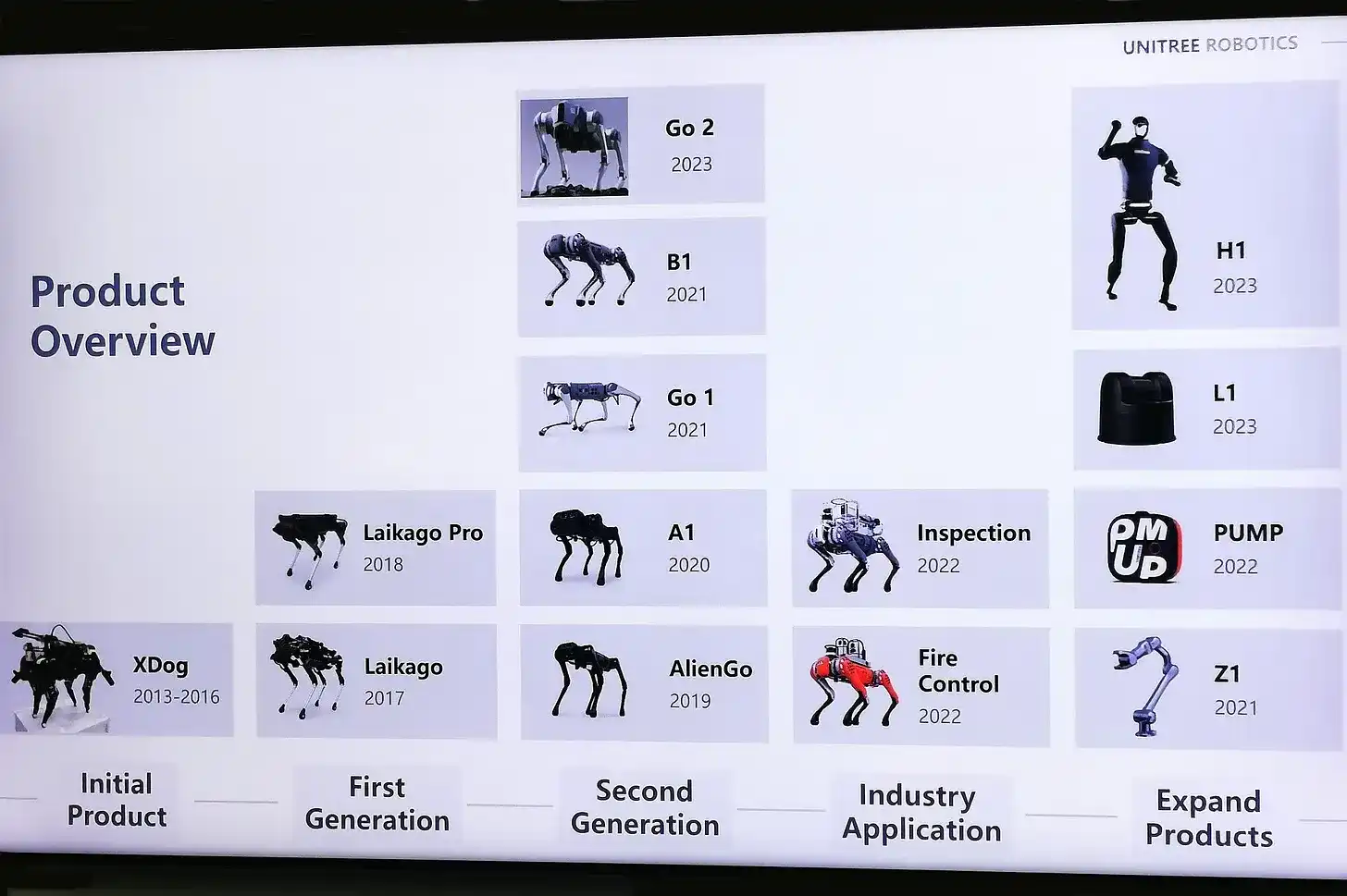
The company sells two product lines:

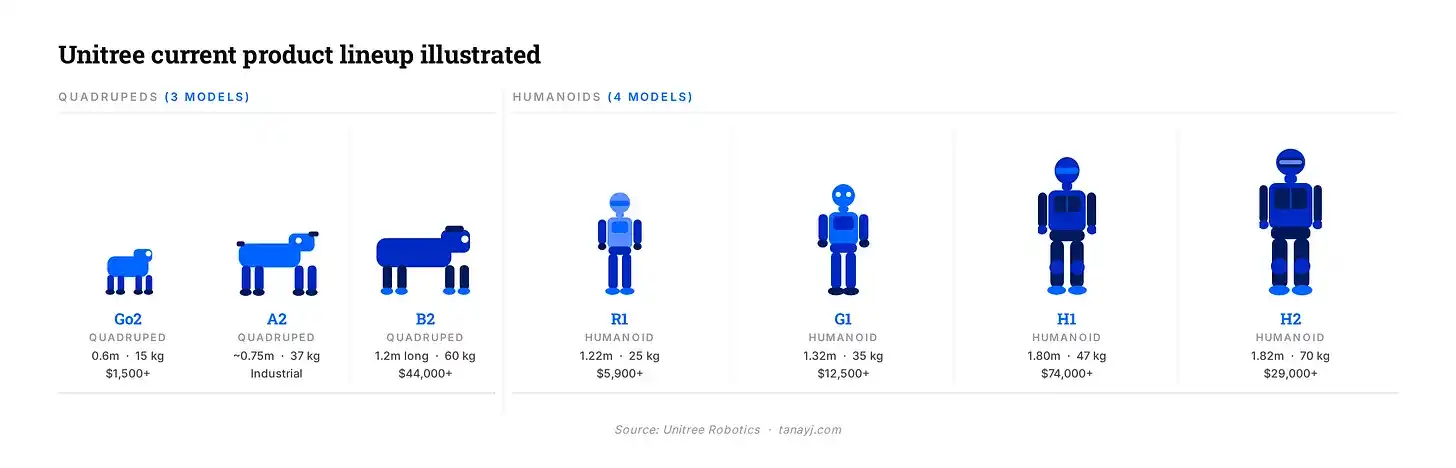
Quadruped Robots: Go2 (consumer and research grade), B2 (industrial grade), and A2

Humanoid Robots: H1, H2, G1, and R1. The G1 is the one you might have seen in viral videos, standing 1.32 meters tall and weighing 35 kg.
The company began international sales in 2018. Over 35% of revenue comes from outside China, including a significant number of academic customers in the US.

2. The Shift in Revenue Structure Towards Humanoid Robots

Two years ago, Unitree was essentially a robot dog company, primarily selling quadruped robots. Humanoid robots accounted for only 1.9% of revenue in 2023.

By the first three quarters of 2025, humanoid robots already accounted for over half of core revenue.
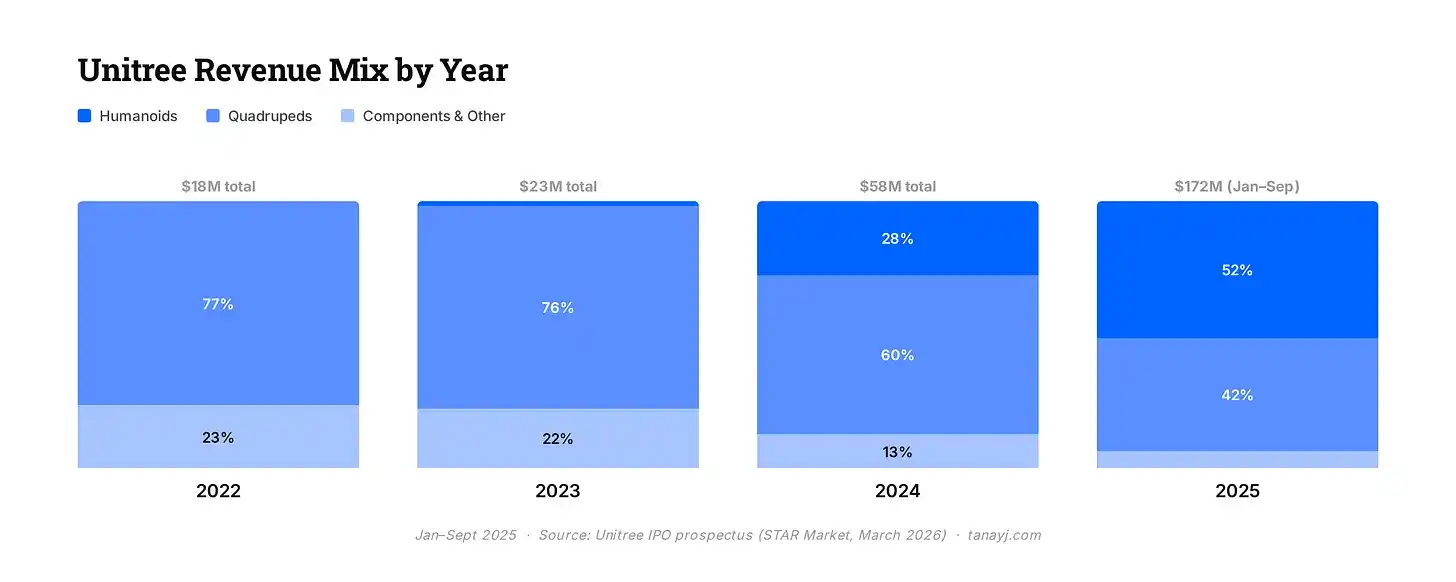
This shift was driven by improved product-market fit and aggressive marketing. The company's humanoid robots have appeared on CCTV's Spring Festival Gala for two consecutive years, one of the most-watched programs globally. Jensen Huang brought Unitree robots on stage at the 2024 GTC conference.

This brand exposure translated into commercial and research demand, something most Chinese hardware companies have never truly achieved.

The shipment data for humanoid robots is particularly impressive. Unitree shipped about 5,500 humanoid robots in 2025, making it the world's largest manufacturer of humanoid robots by shipment volume. China's Zhiyuan Robotics comes closest to this number. In contrast, well-known US companies like Figure AI and Agility Robotics have only shipped in the hundreds.
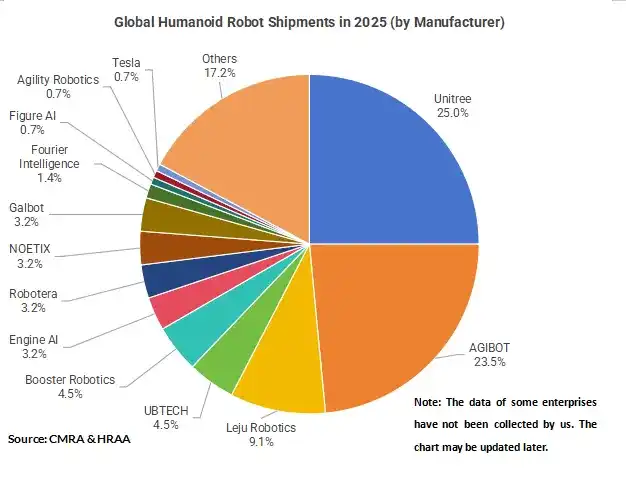
The 5-year target in the prospectus is an annual production capacity of 75,000 humanoid robots and 115,000 quadruped robots. This is about 14 times the humanoid robot shipments in 2025. The goal is aggressive but also highlights how early stage we still are.

3. Who is Really Buying Robots

The prospectus categorizes buyers into three types: Research & Education, Commercial & Consumer, and Industrial Applications.

The reality is that most current demand for humanoid robots comes from research and education purposes.
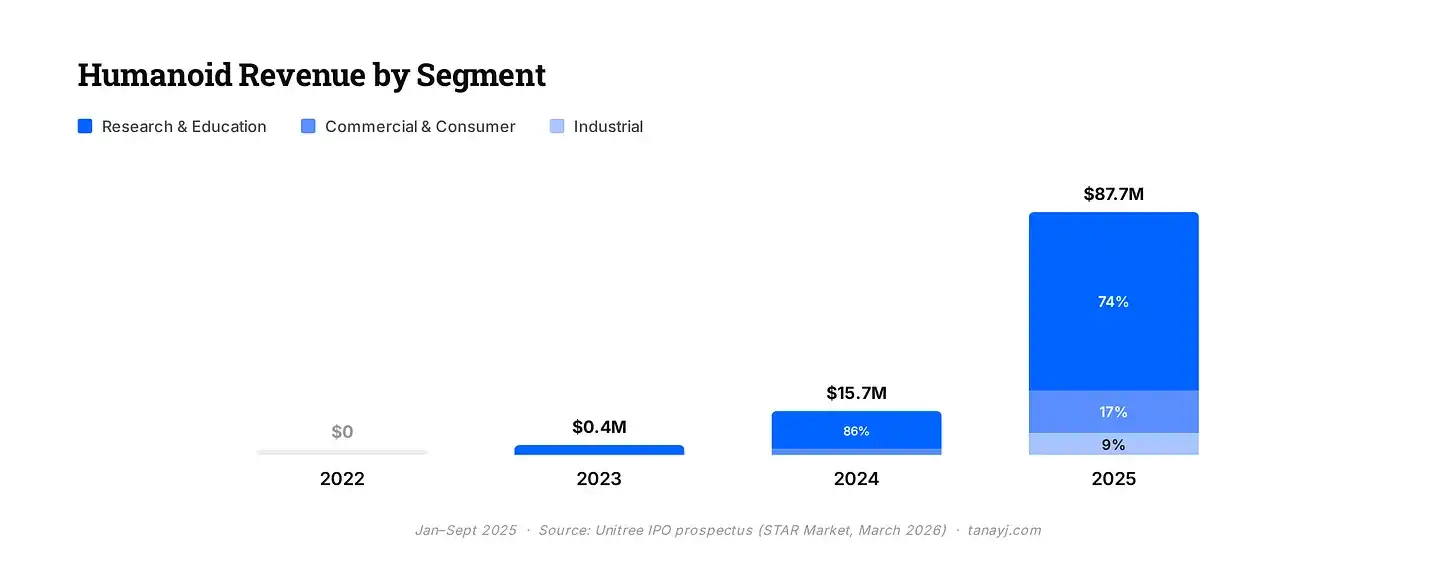
1/ Research & Education accounts for 74% of humanoid robot revenue/shipments. Academic buyers have been Unitree's core support since at least 2022 and remain the company's largest revenue source.

2/ Commercial & Consumer accounts for 17% of humanoid robot shipments. Non-academic consumers who buy these robots mainly use them for "showcasing": acting as eye-catching promoters in retail stores, tourist spots, performances, and exhibitions. Consumer revenue grew nearly fourfold year-on-year in the first nine months of 2025, which sounds impressive, but the base was actually very small. In reality, the practical use of a $25,000 humanoid robot today is to stand at the entrance of a store in Shenzhen attracting tourists.

3/ Industrial Applications account for only 9% of humanoid robot shipments. Unitree acknowledges that industrial deployment is more limited because the technology is not yet mature enough, which illustrates the current technological state. Within this 9% of shipments, about 50-70% are used in scenarios like corporate reception and guiding tours. So overall, only 3-4% of humanoid robot shipments are genuinely used for work like corporate reception and inspection.

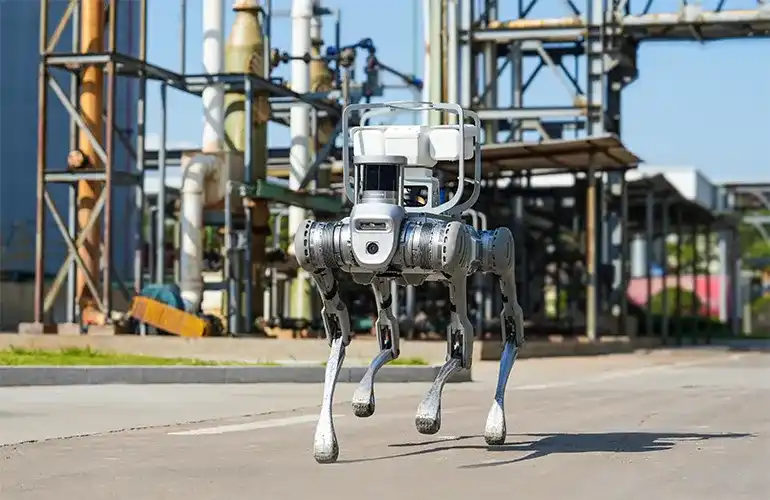
For quadruped robots, the situation is better: only about one-third of revenue comes from research, over 40% from commercial use, and the rest from industrial use. Productive use cases there are relatively more mature. Clients include State Grid, Southern Grid, PetroChina, Sinopec, Baowu Group, and JD.com (Unitree's largest customer). These companies use quadruped robots for real inspection scenarios in chemical plants, substations, coal mines, pipelines, etc.
4. Vertical Integration Strategy

A unique aspect of Unitree is that it independently designs and manufactures most of its key components: high-torque motors, precision reducers, encoders, joint modules, intelligent controllers, high-precision sensors, dexterous hands, lidars, and cameras. According to McKinsey data, the drive system (motors, reducers, and the joint systems that actually make the robot move) typically accounts for 40-60% of the total BOM cost of a humanoid robot.

Most companies in this field source these components externally, but Unitree manufactures them itself. Outsourced components account for only about 14-18% of the total cost. What it outsources are only generic parts like batteries, flash memory, and differentiated parts like the core computing board.

The unit manufacturing cost for quadruped robots has decreased from about $3,300 in 2022 to about $1,800 in mid-2025, a 46% reduction. Humanoid robot costs have also decreased, from about $10,800 to $9,200 over the same period.

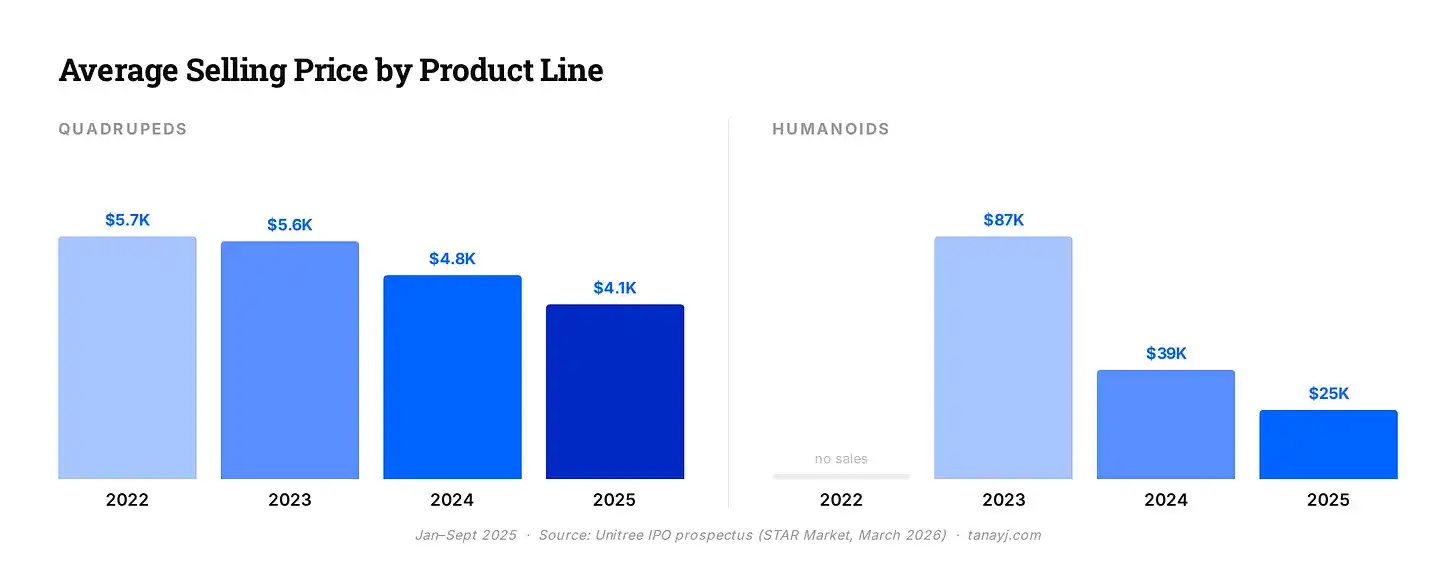
Interestingly, as shown in the chart below, the average selling prices for both quadruped and humanoid robots have also dropped significantly year by year. However, gross margins have actually expanded over the period, rising from the low 40s in 2022-2023 to nearly 60% in 2025, largely due to their vertical integration strategy.
5. Financial Status

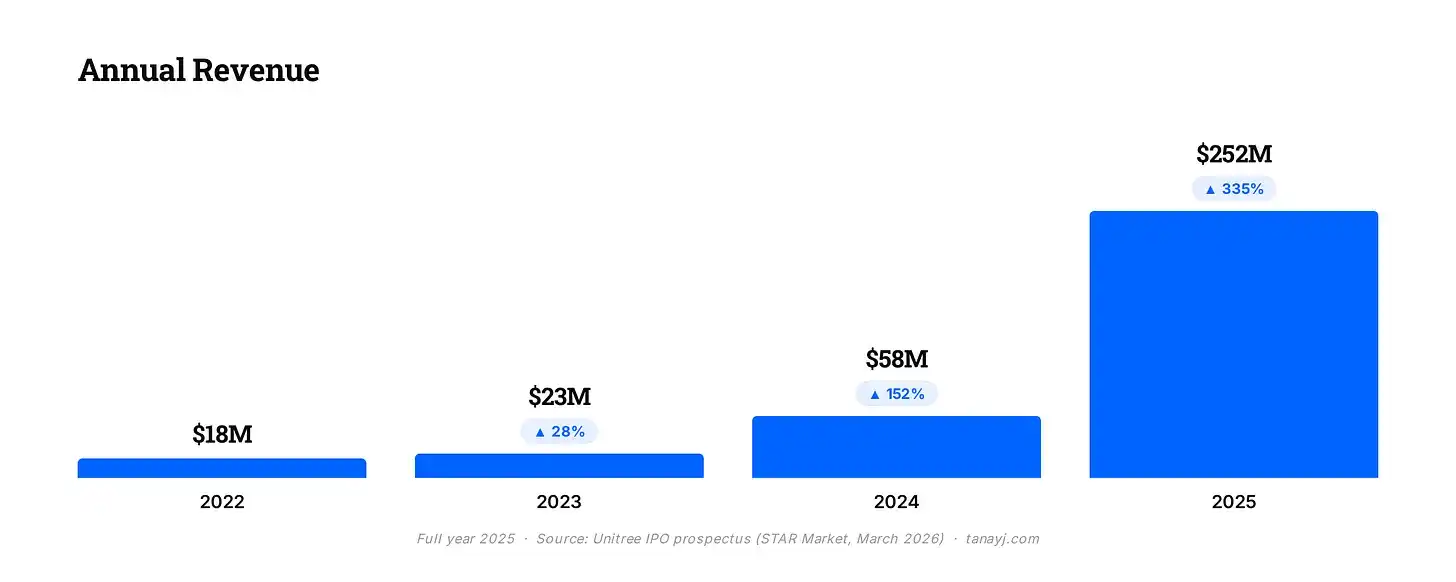
Revenue grew from $58 million in 2024 to an estimated ~$252 million in 2025, a 335% increase, primarily driven by strong performance in humanoid robots. For most of the company's history, international sales accounted for over 55% of revenue. In 2025, the domestic Chinese market surpassed exports for the first time, although the absolute value of export revenue still more than doubled year-on-year.
Gross margins are close to 60% and have been expanding over the years.
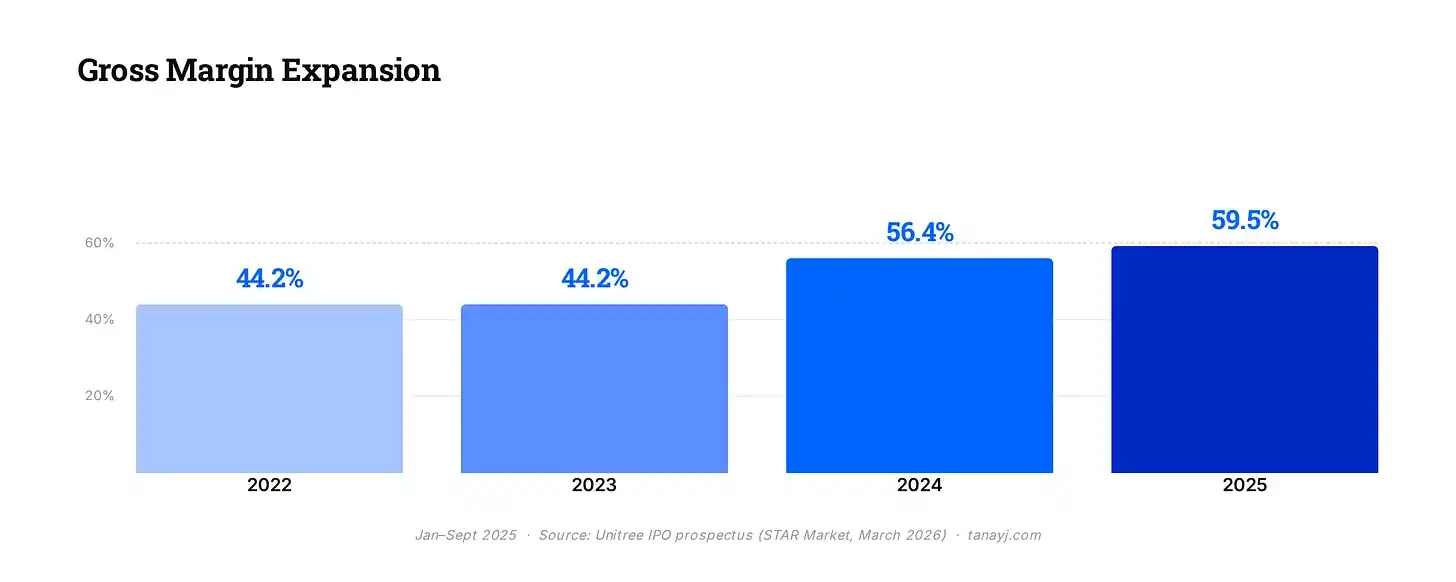
For comparison: Most hardware companies have gross margins of 30-40%. Software companies typically achieve 70-80%. For a company selling physical robots, Unitree's gross margins are relatively high, benefiting from their vertical integration strategy and currently relatively differentiated products.

The company became profitable on a GAAP basis in 2024, with a profit margin of about 18%, and close to 35% on an adjusted basis.
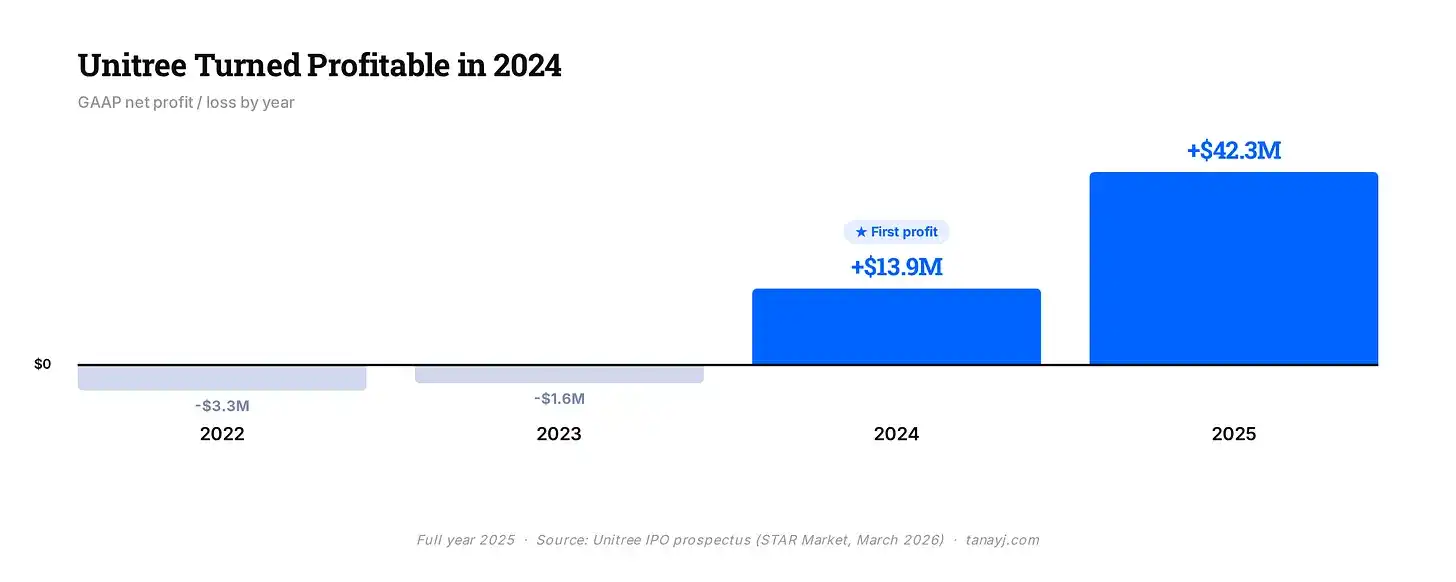
Unitree's IPO target valuation is approximately $6-7 billion.

6. Ambitions at the Model Layer

Unitree plans to allocate nearly half of the IPO proceeds to software. Out of the $620 million raised, about $300 million will be used for AI model training over the next three years, with approximately $100 million invested annually in what the company calls the "Embodied Large Model."

The prospectus describes two parallel model architectures. The first is VLA (Vision-Language-Action): a model that directly maps visual and language inputs to motor commands, allowing the robot to generalize to unfamiliar tasks without manually coded instructions. The second is WMA (World Model + Action), which is their preferred direction. The WMA model builds an internal simulation of physical reality. The robot predicts what will happen before acting, rather than learning purely through trial and error.

They have already released initial versions of both. They open-sourced UnifoLM-WMA-0 in September 2025; UnifoLM-VLA-0 was released in January 2026.

They also detailed the approximate allocation of spending on the model side, as shown below:
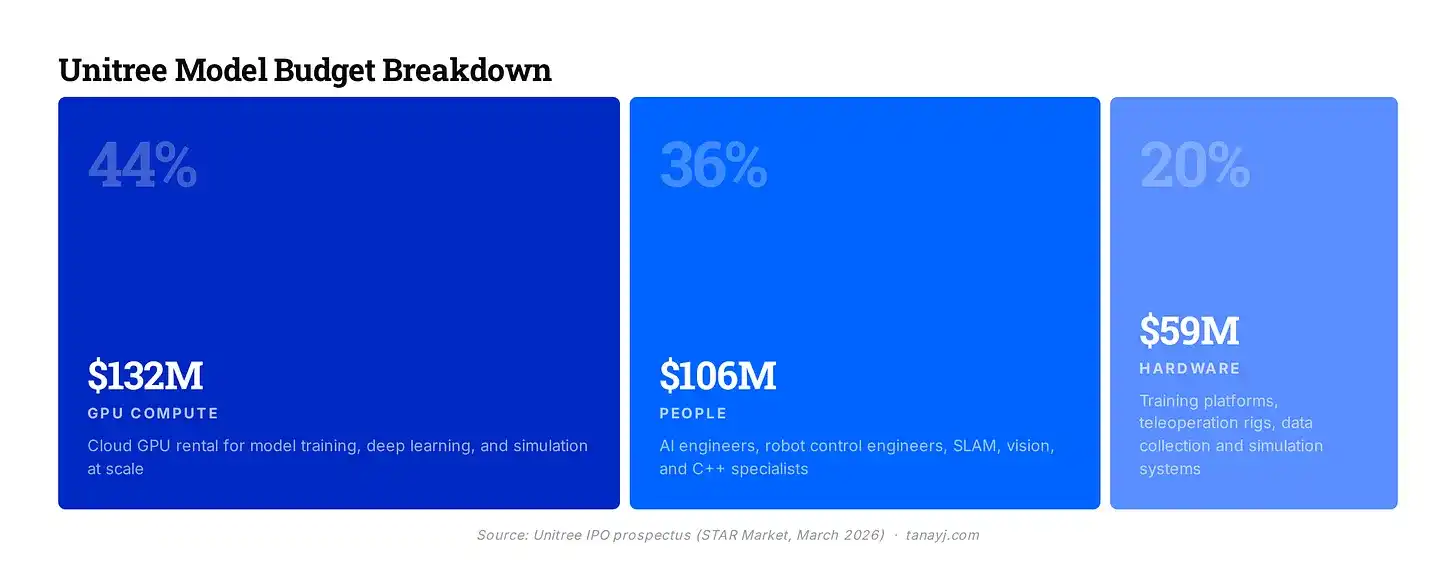
Unitree's current hardware leadership is real, but the company understands that lasting advantage in robotics may require control over the model layer: the systems that decide what the robot does and how it moves. Software ambition is also a hedge against commoditization. Unitree has built a moat in hardware manufacturing.

But if actuators and joint modules eventually become standard components like batteries in electric vehicles, then defensibility shifts to the model layer.

7. Summary

Unitree has a profitable hardware business, a genuine manufacturing moat, and ships more humanoid robots than anyone else, at prices others cannot match. But as the actual usage patterns of humanoid robots show, the story of widespread commercial application is still in its early stages. "Showcase" use cases dominate consumer demand, and industrial deployment is narrow.

Unitree gives us a glimpse of the current state of the robotics market; there is still much work to be done in models, hardware, and use cases. If you're building in robotics and embodied AI, feel free to reach out at tanay at wing.vc.

Related Questions

QWhat were the key financial highlights and performance metrics revealed in Unitree Robotics' IPO prospectus?

AUnitree's prospectus shows rapid growth, with revenue expected to reach approximately $252 million in 2025, a 335% increase from 2024's $58 million. The company achieved GAAP profitability in 2024 with margins around 18% (nearly 35% on an adjusted basis). Gross margins are near 60%, which is high for a hardware company, largely due to its vertical integration strategy. The IPO aims to raise $620 million at a target valuation of $6-7 billion.

QWho are the primary customers for Unitree's humanoid robots, and what does this indicate about the current state of the market?

AAs of 2025, 74% of Unitree's humanoid robot shipments were for scientific research and education, 17% for commercial/consumer 'showcase' uses (like retail displays), and only 9% for industrial applications. Furthermore, within that 9%, 50-70% are used for enterprise reception and guided tours. This indicates that widespread commercial and industrial deployment is still in its early stages. The primary productive use for robots today remains in research and niche, non-autonomous applications, highlighting that hardware capabilities may be ahead of the AI models and software needed for complex tasks.

QWhat is Unitree's vertical integration strategy, and what benefits has it provided?

AUnitree's vertical integration strategy involves independently designing and manufacturing most of its robots' key components, including high-torque motors, precision reducers, encoders, joint modules, controllers, sensors, dexterous hands, LiDAR, and cameras. Only generic components like batteries and flash memory are outsourced. This strategy has reduced manufacturing costs (e.g., quadruped robot costs dropped 46% from ~$3300 in 2022 to ~$1800 in mid-2025) while allowing the company to expand its gross margins to nearly 60% despite falling average selling prices. It provides cost control, supply chain security, and a hardware moat.

QWhat are Unitree's ambitions in the AI model layer, and how does it plan to use funds from the IPO?

AUnitree plans to invest heavily in AI software development, allocating roughly $300 million (about half of the $620 million IPO proceeds) over the next three years for AI model training. The focus is on developing 'Embodied Large Models,' specifically two architectures: VLA (Vision-Language-Action) models for direct mapping from sensory input to action, and WMA (World Model + Action) models, which it favors. WMA models create an internal simulation of physical reality to predict outcomes before acting. The company has already released open-source versions of both. This investment is a strategic move to build a defensible advantage in the software layer as hardware components potentially become commoditized.

QHow has Unitree's product mix and market focus shifted in recent years?

AUnitree has undergone a significant shift from being primarily a quadruped robot company to a leader in humanoid robots. In 2023, humanoids accounted for only 1.9% of its revenue. By the first three quarters of 2025, humanoid robots constituted over half of its core revenue. This shift was driven by improved product-market fit and aggressive marketing (e.g., appearances on China's Spring Festival Gala and NVIDIA's GTC stage). The company shipped approximately 5,500 humanoid robots in 2025, making it the world's largest manufacturer by volume. Its ambitious 5-year goal is to produce 75,000 humanoids annually.

Related Reads

DeFi Has Reached Its Most Dangerous Moment: The Real Vulnerabilities Are Not in the Code

DeFi in Peril: The Real Vulnerability Isn't in the Code April 2026 marked a paradigm shift in DeFi security, with over $625 million lost across 30 incidents—the worst month in crypto history by event count. Crucially, none of the major exploits (Drift Protocol: $285M, KelpDAO: $292M, Wasabi Protocol: $4.5M) resulted from smart contract vulnerabilities. Instead, failures occurred in the operational "plumbing": social engineering to compromise multi-signature councils, a single-point-of-failure 1-of-1 bridge validator, and stolen admin private keys. These events expose a fundamental misalignment: the industry's security model has long focused on code audits, while the actual attack surface has shifted to privileged access points and off-chain infrastructure. The article introduces the term "OpenFi" to describe this reality: permissionless, on-chain, yet operationally dependent on trusted third parties (admins, validators, oracles) at key junctures. The KelpDAO exploit vividly demonstrated asymmetric "contagion risk." A configuration error in a smaller protocol triggered a panic, causing approximately $13.2 billion in outflows from larger, unaffected protocols like Aave within 48 hours, as users fled uncertain collateral. The core dilemma is the double-edged sword of centralization. Operational levers like emergency councils (e.g., Arbitrum freezing stolen funds post-KelpDAO) enable crisis response but also create catastrophic attack surfaces if compromised (e.g., Drift). The path forward demands radical honesty: protocols must clearly disclose their trust assumptions, operational levers, and failure modes. The industry must treat operational security (key management, configurations, incident response) with the same rigor as code security. Survival depends on building systems whose risks can be understood, priced, and insured, moving beyond the outdated "code is law" mantra to a mature model of disclosed and managed trust.

链捕手5h ago

DeFi Has Reached Its Most Dangerous Moment: The Real Vulnerabilities Are Not in the Code

链捕手5h ago

Vitalik's Article Emphasizes Ethereum Must Be 'Amazing', But Foundation Is Not the Center

Vitalik Buterin has published a lengthy response to recent community criticism directed at the Ethereum Foundation (EF). Acknowledging a sense of "unease," he addresses concerns about the EF's strategic direction, its perceived disconnect from ETH's price performance, and calls for its reduced central role. Vitalik rejects the notion that the EF should be the central governing body of Ethereum, framing it instead as one "node with a clear mandate" among many within the ecosystem. He highlights the EF's limited ETH holdings (≈0.16% of supply) compared to other blockchain foundations and states it will no longer sell significant amounts of ETH. Its future focus will be on long-term, critical projects that align with Ethereum's core values of censorship-resistance and decentralization, which might not otherwise happen. A core argument is that Ethereum must be "amazing," but not by merely chasing higher transaction speeds at the cost of decentralization. He proposes focusing on the "CROPS" dimensions: creating a Cryptographically provable, Reliable, Open, Private, and Secure network. This includes pursuing goals like a formally verifiable, bug-free Ethereum client and minimizing protocol-level reliance on intermediaries. The article concludes by noting that while Vitalik clarifies the EF's refocused role, he does not directly address community suggestions for creating a new organization explicitly aligned with ETH's economic interests. This "alignment gap" is presented as a key challenge for Ethereum's future.

链捕手6h ago

Vitalik's Article Emphasizes Ethereum Must Be 'Amazing', But Foundation Is Not the Center

链捕手6h ago

Galxe: How a Quest Platform Evolved into Web3's Growth Infrastructure

Galxe, once perceived as a simple Web3 quest platform, has evolved into a core growth infrastructure within the Web3 ecosystem. It addresses a fundamental Web3 growth dilemma: the lack of a mature, systematic user acquisition and retention system akin to Web2's advertising and analytics platforms. While users complete quests (social tasks, on-chain interactions) for rewards, Galxe's true innovation lies in transforming these fragmented, one-off actions into lasting, verifiable identity credentials. This process of *behavioral assetization* creates a persistent record of a user's activities across projects and chains. For users, their wallet accumulates a valuable history that can unlock future access and rewards, fostering a "profile-building" mentality. For projects, Galxe provides a pre-screened user pool with rich behavioral data, enabling targeted outreach to users based on their specific on-chain history and community engagement. Galxe employs a gamefied growth path, guiding users from low-friction social tasks into deeper, valuable on-chain interactions through a structured progression of quests. This solves the incentive-behavior mismatch common in Web3, filtering users by their willingness to engage. Beyond quests, products like Passport (identity verification) and Starboard (community analytics) position Galxe as a comprehensive growth operating system. The platform's defensible advantage is its self-reinforcing data and network flywheel: more projects attract more users, enriching behavioral data; richer data enables better user targeting, attracting more projects. Ultimately, Galxe is shifting Web3's growth logic from short-term "reward-driven" traffic towards a long-term "identity-driven" relationship model, where a user's accumulated on-chain履历 becomes a core asset.

marsbit6h ago

Galxe: How a Quest Platform Evolved into Web3's Growth Infrastructure

marsbit6h ago

Trading

Spot
Futures

Hot Articles

What is SONIC

Sonic: Pioneering the Future of Gaming in Web3 Introduction to Sonic In the ever-evolving landscape of Web3, the gaming industry stands out as one of the most dynamic and promising sectors. At the forefront of this revolution is Sonic, a project designed to amplify the gaming ecosystem on the Solana blockchain. Leveraging cutting-edge technology, Sonic aims to deliver an unparalleled gaming experience by efficiently processing millions of requests per second, ensuring that players enjoy seamless gameplay while maintaining low transaction costs. This article delves into the intricate details of Sonic, exploring its creators, funding sources, operational mechanics, and the timeline of significant events that have shaped its journey. What is Sonic? Sonic is an innovative layer-2 network that operates atop the Solana blockchain, specifically tailored to enhance the existing Solana gaming ecosystem. It accomplishes this through a customised, VM-agnostic game engine paired with a HyperGrid interpreter, facilitating sovereign game economies that roll up back to the Solana platform. The primary goals of Sonic include: Enhanced Gaming Experiences: Sonic is committed to offering lightning-fast on-chain gameplay, allowing players and developers to engage with games at previously unattainable speeds. Atomic Interoperability: This feature enables transactions to be executed within Sonic without the need to redeploy Solana programmes and accounts. This makes the process more efficient and directly benefits from Solana Layer1 services and liquidity. Seamless Deployment: Sonic allows developers to write for Ethereum Virtual Machine (EVM) based systems and execute them on Solana’s SVM infrastructure. This interoperability is crucial for attracting a broader range of dApps and decentralised applications to the platform. Support for Developers: By offering native composable gaming primitives and extensible data types - dining within the Entity-Component-System (ECS) framework - game creators can craft intricate business logic with ease. Overall, Sonic's unique approach not only caters to players but also provides an accessible and low-cost environment for developers to innovate and thrive. Creator of Sonic The information regarding the creator of Sonic is somewhat ambiguous. However, it is known that Sonic's SVM is owned by the company Mirror World. The absence of detailed information about the individuals behind Sonic reflects a common trend in several Web3 projects, where collective efforts and partnerships often overshadow individual contributions. Investors of Sonic Sonic has garnered considerable attention and support from various investors within the crypto and gaming sectors. Notably, the project raised an impressive $12 million during its Series A funding round. The round was led by BITKRAFT Ventures, with other notable investors including Galaxy, Okx Ventures, Interactive, Big Brain Holdings, and Mirana. This financial backing signifies the confidence that investment foundations have in Sonic’s potential to revolutionise the Web3 gaming landscape, further validating its innovative approaches and technologies. How Does Sonic Work? Sonic utilises the HyperGrid framework, a sophisticated parallel processing mechanism that enhances its scalability and customisability. Here are the core features that set Sonic apart: Lightning Speed at Low Costs: Sonic offers one of the fastest on-chain gaming experiences compared to other Layer-1 solutions, powered by the scalability of Solana’s virtual machine (SVM). Atomic Interoperability: Sonic enables transaction execution without redeployment of Solana programmes and accounts, effectively streamlining the interaction between users and the blockchain. EVM Compatibility: Developers can effortlessly migrate decentralised applications from EVM chains to the Solana environment using Sonic’s HyperGrid interpreter, increasing the accessibility and integration of various dApps. Ecosystem Support for Developers: By exposing native composable gaming primitives, Sonic facilitates a sandbox-like environment where developers can experiment and implement business logic, greatly enhancing the overall development experience. Monetisation Infrastructure: Sonic natively supports growth and monetisation efforts, providing frameworks for traffic generation, payments, and settlements, thereby ensuring that gaming projects are not only viable but also sustainable financially. Timeline of Sonic The evolution of Sonic has been marked by several key milestones. Below is a brief timeline highlighting critical events in the project's history: 2022: The Sonic cryptocurrency was officially launched, marking the beginning of its journey in the Web3 gaming arena. 2024: June: Sonic SVM successfully raised $12 million in a Series A funding round. This investment allowed Sonic to further develop its platform and expand its offerings. August: The launch of the Sonic Odyssey testnet provided users with the first opportunity to engage with the platform, offering interactive activities such as collecting rings—a nod to gaming nostalgia. October: SonicX, an innovative crypto game integrated with Solana, made its debut on TikTok, capturing the attention of over 120,000 users within a short span. This integration illustrated Sonic’s commitment to reaching a broader, global audience and showcased the potential of blockchain gaming. Key Points Sonic SVM is a revolutionary layer-2 network on Solana explicitly designed to enhance the GameFi landscape, demonstrating great potential for future development. HyperGrid Framework empowers Sonic by introducing horizontal scaling capabilities, ensuring that the network can handle the demands of Web3 gaming. Integration with Social Platforms: The successful launch of SonicX on TikTok displays Sonic’s strategy to leverage social media platforms to engage users, exponentially increasing the exposure and reach of its projects. Investment Confidence: The substantial funding from BITKRAFT Ventures, among others, emphasizes the robust backing Sonic has, paving the way for its ambitious future. In conclusion, Sonic encapsulates the essence of Web3 gaming innovation, striking a balance between cutting-edge technology, developer-centric tools, and community engagement. As the project continues to evolve, it is poised to redefine the gaming landscape, making it a notable entity for gamers and developers alike. As Sonic moves forward, it will undoubtedly attract greater interest and participation, solidifying its place within the broader narrative of blockchain gaming.

1.5k Total ViewsPublished 2024.04.04Updated 2024.12.03

What is SONIC

What is $S$

Understanding SPERO: A Comprehensive Overview Introduction to SPERO As the landscape of innovation continues to evolve, the emergence of web3 technologies and cryptocurrency projects plays a pivotal role in shaping the digital future. One project that has garnered attention in this dynamic field is SPERO, denoted as SPERO,$$s$. This article aims to gather and present detailed information about SPERO, to help enthusiasts and investors understand its foundations, objectives, and innovations within the web3 and crypto domains. What is SPERO,$$s$? SPERO,$$s$ is a unique project within the crypto space that seeks to leverage the principles of decentralisation and blockchain technology to create an ecosystem that promotes engagement, utility, and financial inclusion. The project is tailored to facilitate peer-to-peer interactions in new ways, providing users with innovative financial solutions and services. At its core, SPERO,$$s$ aims to empower individuals by providing tools and platforms that enhance user experience in the cryptocurrency space. This includes enabling more flexible transaction methods, fostering community-driven initiatives, and creating pathways for financial opportunities through decentralised applications (dApps). The underlying vision of SPERO,$$s$ revolves around inclusiveness, aiming to bridge gaps within traditional finance while harnessing the benefits of blockchain technology. Who is the Creator of SPERO,$$s$? The identity of the creator of SPERO,$$s$ remains somewhat obscure, as there are limited publicly available resources providing detailed background information on its founder(s). This lack of transparency can stem from the project's commitment to decentralisation—an ethos that many web3 projects share, prioritising collective contributions over individual recognition. By centring discussions around the community and its collective goals, SPERO,$$s$ embodies the essence of empowerment without singling out specific individuals. As such, understanding the ethos and mission of SPERO remains more important than identifying a singular creator. Who are the Investors of SPERO,$$s$? SPERO,$$s$ is supported by a diverse array of investors ranging from venture capitalists to angel investors dedicated to fostering innovation in the crypto sector. The focus of these investors generally aligns with SPERO's mission—prioritising projects that promise societal technological advancement, financial inclusivity, and decentralised governance. These investor foundations are typically interested in projects that not only offer innovative products but also contribute positively to the blockchain community and its ecosystems. The backing from these investors reinforces SPERO,$$s$ as a noteworthy contender in the rapidly evolving domain of crypto projects. How Does SPERO,$$s$ Work? SPERO,$$s$ employs a multi-faceted framework that distinguishes it from conventional cryptocurrency projects. Here are some of the key features that underline its uniqueness and innovation: Decentralised Governance: SPERO,$$s$ integrates decentralised governance models, empowering users to participate actively in decision-making processes regarding the project’s future. This approach fosters a sense of ownership and accountability among community members. Token Utility: SPERO,$$s$ utilises its own cryptocurrency token, designed to serve various functions within the ecosystem. These tokens enable transactions, rewards, and the facilitation of services offered on the platform, enhancing overall engagement and utility. Layered Architecture: The technical architecture of SPERO,$$s$ supports modularity and scalability, allowing for seamless integration of additional features and applications as the project evolves. This adaptability is paramount for sustaining relevance in the ever-changing crypto landscape. Community Engagement: The project emphasises community-driven initiatives, employing mechanisms that incentivise collaboration and feedback. By nurturing a strong community, SPERO,$$s$ can better address user needs and adapt to market trends. Focus on Inclusion: By offering low transaction fees and user-friendly interfaces, SPERO,$$s$ aims to attract a diverse user base, including individuals who may not previously have engaged in the crypto space. This commitment to inclusion aligns with its overarching mission of empowerment through accessibility. Timeline of SPERO,$$s$ Understanding a project's history provides crucial insights into its development trajectory and milestones. Below is a suggested timeline mapping significant events in the evolution of SPERO,$$s$: Conceptualisation and Ideation Phase: The initial ideas forming the basis of SPERO,$$s$ were conceived, aligning closely with the principles of decentralisation and community focus within the blockchain industry. Launch of Project Whitepaper: Following the conceptual phase, a comprehensive whitepaper detailing the vision, goals, and technological infrastructure of SPERO,$$s$ was released to garner community interest and feedback. Community Building and Early Engagements: Active outreach efforts were made to build a community of early adopters and potential investors, facilitating discussions around the project’s goals and garnering support. Token Generation Event: SPERO,$$s$ conducted a token generation event (TGE) to distribute its native tokens to early supporters and establish initial liquidity within the ecosystem. Launch of Initial dApp: The first decentralised application (dApp) associated with SPERO,$$s$ went live, allowing users to engage with the platform's core functionalities. Ongoing Development and Partnerships: Continuous updates and enhancements to the project's offerings, including strategic partnerships with other players in the blockchain space, have shaped SPERO,$$s$ into a competitive and evolving player in the crypto market. Conclusion SPERO,$$s$ stands as a testament to the potential of web3 and cryptocurrency to revolutionise financial systems and empower individuals. With a commitment to decentralised governance, community engagement, and innovatively designed functionalities, it paves the way toward a more inclusive financial landscape. As with any investment in the rapidly evolving crypto space, potential investors and users are encouraged to research thoroughly and engage thoughtfully with the ongoing developments within SPERO,$$s$. The project showcases the innovative spirit of the crypto industry, inviting further exploration into its myriad possibilities. While the journey of SPERO,$$s$ is still unfolding, its foundational principles may indeed influence the future of how we interact with technology, finance, and each other in interconnected digital ecosystems.

54 Total ViewsPublished 2024.12.17Updated 2024.12.17

What is $S$

What is AGENT S

Agent S: The Future of Autonomous Interaction in Web3 Introduction In the ever-evolving landscape of Web3 and cryptocurrency, innovations are constantly redefining how individuals interact with digital platforms. One such pioneering project, Agent S, promises to revolutionise human-computer interaction through its open agentic framework. By paving the way for autonomous interactions, Agent S aims to simplify complex tasks, offering transformative applications in artificial intelligence (AI). This detailed exploration will delve into the project's intricacies, its unique features, and the implications for the cryptocurrency domain. What is Agent S? Agent S stands as a groundbreaking open agentic framework, specifically designed to tackle three fundamental challenges in the automation of computer tasks: Acquiring Domain-Specific Knowledge: The framework intelligently learns from various external knowledge sources and internal experiences. This dual approach empowers it to build a rich repository of domain-specific knowledge, enhancing its performance in task execution. Planning Over Long Task Horizons: Agent S employs experience-augmented hierarchical planning, a strategic approach that facilitates efficient breakdown and execution of intricate tasks. This feature significantly enhances its ability to manage multiple subtasks efficiently and effectively. Handling Dynamic, Non-Uniform Interfaces: The project introduces the Agent-Computer Interface (ACI), an innovative solution that enhances the interaction between agents and users. Utilizing Multimodal Large Language Models (MLLMs), Agent S can navigate and manipulate diverse graphical user interfaces seamlessly. Through these pioneering features, Agent S provides a robust framework that addresses the complexities involved in automating human interaction with machines, setting the stage for myriad applications in AI and beyond. Who is the Creator of Agent S? While the concept of Agent S is fundamentally innovative, specific information about its creator remains elusive. The creator is currently unknown, which highlights either the nascent stage of the project or the strategic choice to keep founding members under wraps. Regardless of anonymity, the focus remains on the framework's capabilities and potential. Who are the Investors of Agent S? As Agent S is relatively new in the cryptographic ecosystem, detailed information regarding its investors and financial backers is not explicitly documented. The lack of publicly available insights into the investment foundations or organisations supporting the project raises questions about its funding structure and development roadmap. Understanding the backing is crucial for gauging the project's sustainability and potential market impact. How Does Agent S Work? At the core of Agent S lies cutting-edge technology that enables it to function effectively in diverse settings. Its operational model is built around several key features: Human-like Computer Interaction: The framework offers advanced AI planning, striving to make interactions with computers more intuitive. By mimicking human behaviour in tasks execution, it promises to elevate user experiences. Narrative Memory: Employed to leverage high-level experiences, Agent S utilises narrative memory to keep track of task histories, thereby enhancing its decision-making processes. Episodic Memory: This feature provides users with step-by-step guidance, allowing the framework to offer contextual support as tasks unfold. Support for OpenACI: With the ability to run locally, Agent S allows users to maintain control over their interactions and workflows, aligning with the decentralised ethos of Web3. Easy Integration with External APIs: Its versatility and compatibility with various AI platforms ensure that Agent S can fit seamlessly into existing technological ecosystems, making it an appealing choice for developers and organisations. These functionalities collectively contribute to Agent S's unique position within the crypto space, as it automates complex, multi-step tasks with minimal human intervention. As the project evolves, its potential applications in Web3 could redefine how digital interactions unfold. Timeline of Agent S The development and milestones of Agent S can be encapsulated in a timeline that highlights its significant events: September 27, 2024: The concept of Agent S was launched in a comprehensive research paper titled “An Open Agentic Framework that Uses Computers Like a Human,” showcasing the groundwork for the project. October 10, 2024: The research paper was made publicly available on arXiv, offering an in-depth exploration of the framework and its performance evaluation based on the OSWorld benchmark. October 12, 2024: A video presentation was released, providing a visual insight into the capabilities and features of Agent S, further engaging potential users and investors. These markers in the timeline not only illustrate the progress of Agent S but also indicate its commitment to transparency and community engagement. Key Points About Agent S As the Agent S framework continues to evolve, several key attributes stand out, underscoring its innovative nature and potential: Innovative Framework: Designed to provide an intuitive use of computers akin to human interaction, Agent S brings a novel approach to task automation. Autonomous Interaction: The ability to interact autonomously with computers through GUI signifies a leap towards more intelligent and efficient computing solutions. Complex Task Automation: With its robust methodology, it can automate complex, multi-step tasks, making processes faster and less error-prone. Continuous Improvement: The learning mechanisms enable Agent S to improve from past experiences, continually enhancing its performance and efficacy. Versatility: Its adaptability across different operating environments like OSWorld and WindowsAgentArena ensures that it can serve a broad range of applications. As Agent S positions itself in the Web3 and crypto landscape, its potential to enhance interaction capabilities and automate processes signifies a significant advancement in AI technologies. Through its innovative framework, Agent S exemplifies the future of digital interactions, promising a more seamless and efficient experience for users across various industries. Conclusion Agent S represents a bold leap forward in the marriage of AI and Web3, with the capacity to redefine how we interact with technology. While still in its early stages, the possibilities for its application are vast and compelling. Through its comprehensive framework addressing critical challenges, Agent S aims to bring autonomous interactions to the forefront of the digital experience. As we move deeper into the realms of cryptocurrency and decentralisation, projects like Agent S will undoubtedly play a crucial role in shaping the future of technology and human-computer collaboration.

694 Total ViewsPublished 2025.01.14Updated 2025.01.14

What is AGENT S

Discussions

Welcome to the HTX Community. Here, you can stay informed about the latest platform developments and gain access to professional market insights. Users' opinions on the price of S (S) are presented below.

活动图片