Deciphering Aave V4: A Transformation from Product to "Bank"

marsbitPublished on 2026-03-31Last updated on 2026-03-31

Abstract

On March 30, Aave V4 officially launched on the mainnet, introducing a major architectural redesign centered around a unified liquidity model called "Hub and Spoke." The core change replaces isolated lending markets with a centralized liquidity pool (Hub) per chain or L2, which manages global liquidity, credit limits, and system constraints. Different Hubs (Core, Prime, Plus) cater to varying risk profiles and user needs. Spokes function as independent markets with custom parameters, allowing borrowers to access assets from the shared pool under specific rules. V4 improves capital efficiency by introducing risk-based interest rates—where borrowers using volatile collateral pay higher rates—and a refined liquidation mechanism that only restores positions to a target health factor. Additionally, idle liquidity in Hubs can be automatically deployed to governance-approved yield strategies, boosting returns for suppliers and DAO revenue. While the update doesn’t radically change the lending experience for users with high-quality collateral, it transforms Aave from a product into a bank-like financial infrastructure. This sets the stage for future expansions into services like structured products, credit facilities, and investment banking operations.

On the evening of March 30th, Beijing time, the long-planned Aave V4 officially launched on the mainnet, bringing the first piece of good news since the Aave DAO governance debates began in 2024.
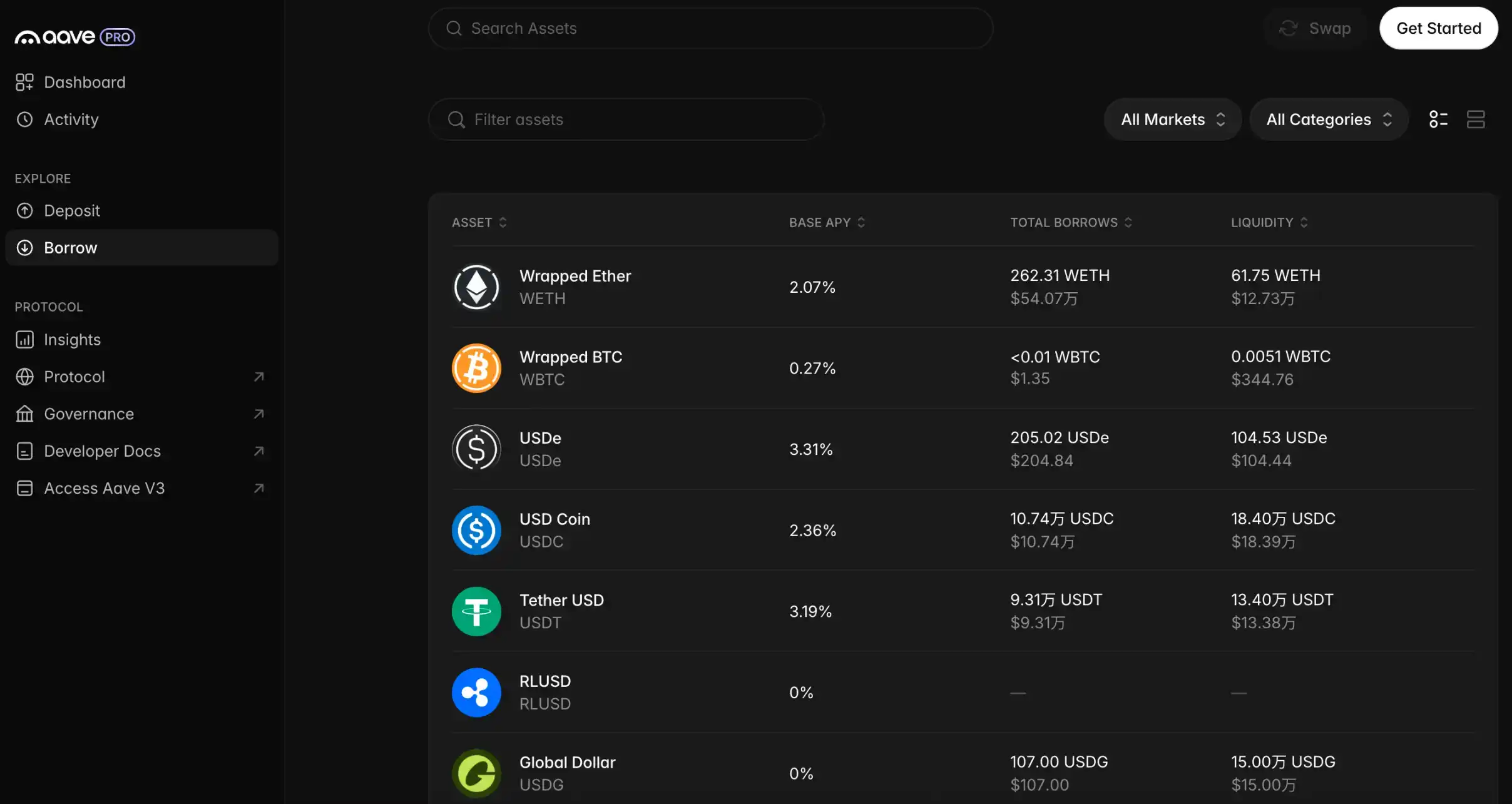
V4 can be described as a complete overhaul of Aave, with the most core change being the integration of previously independent lending markets into a unified liquidity pool architecture: the Hub and Spoke model.

In V4, each chain or L2 has a unified liquidity center (the Hub), where all assets deposited by users for lending are pooled into a single liquidity pool. The Hub is responsible for global coordination, credit limit control, system-level constraints (such as "Total Borrows ≤ Total Supply"), and emergency pauses. The Hub does not interface directly with users; it manages liquidity in the background.

It is worth noting that there is not just one Hub per chain, but different Hubs are designed based on different needs, which is essentially a form of risk isolation. For example, V4 has currently launched the Core Hub, Prime Hub, and Plus Hub. The Core Hub contains mainstream assets and is open to all users, the Prime Hub is designed for suppliers seeking more "controllable" collateral, and the Plus Hub is designed for strategic stablecoins, with its parameters needing to consider the project's scale.
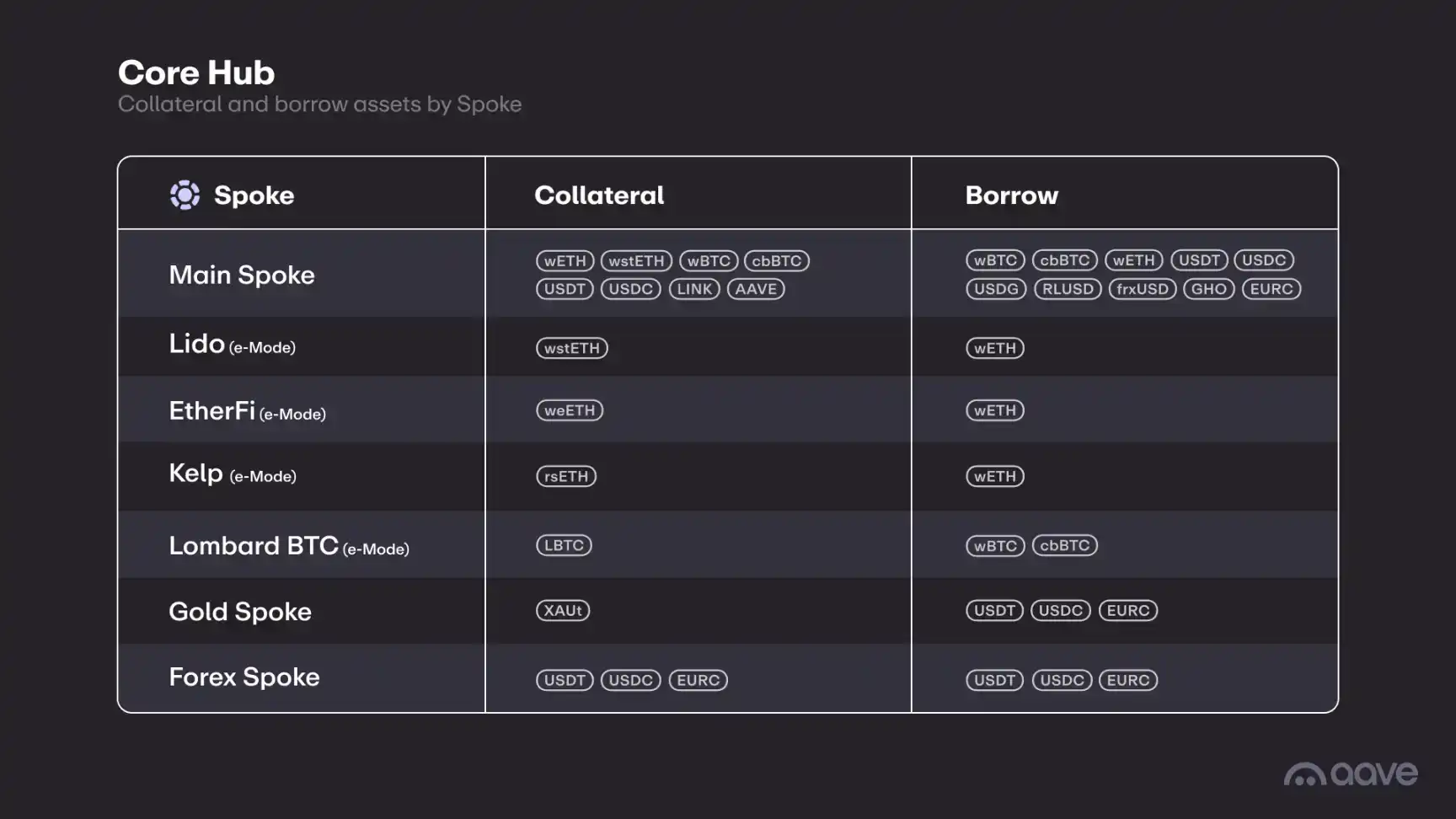
As for the Spoke, you can think of it as an independent market, each with its own lending functions, risk parameters, and collateral rules. Within a single Hub, user assets reside in the same liquidity pool, and borrowers choose different Spokes based on their needs. For example, as shown in the diagram above, a user can deposit WETH as a borrowable asset. Borrowers can borrow WETH from the first four Spokes, but only the EtherFi Spoke allows weETH to be used as collateral.

Although the official claim is that this integrates fragmented liquidity, in practice, the difference is not significant for users borrowing against high-quality collateral. For instance, if you want to抵押 ETH to borrow assets, the operation in V3 and V4 is not fundamentally different, as long as you ensure the health factor does not drop too low.

So, regarding the integration of liquidity, V4 indeed offers more精细 management than independent markets, but it's not a qualitative leap. The real differences come from the customizable parameters of the Spokes and the new liquidation engine.

In V4, a borrower's interest rate depends on the base rate and a risk premium. The base rate, like in V3, uses a utilization curve—rising slowly below optimal utilization and steeply above it. The risk premium depends on the nature of the collateral asset. If the collateral is more stable assets like USDT, ETH, or WBTC, the risk premium will be very low or even 0. However, high-risk altcoins will have a high risk premium, avoiding the situation where "good assets subsidize bad assets."

To give a simple example, in V3, the interest rate depended solely on supply and demand. When borrowing USDT, even though the loan-to-value (LTV) and liquidation threshold might differ, the interest rate for collateralizing ETH and LINK would be the same under the same supply and demand conditions, even though LINK's volatility is higher than ETH's. If the rates are the same, borrowers using LINK as collateral drive up the utilization rate, potentially causing borrowing costs for users collateralizing ETH to rise instead of fall.

V4 optimizes this flaw. Users borrowing against high-risk collateral need to pay a higher cost, while fund providers can earn higher yields. Simultaneously, the higher interest rate curbs borrowing demand, giving users borrowing against优质资产 a more明显的 cost advantage.

Regarding the liquidation mechanism, liquidators will only restore the health factor to the target value preset by the Spoke, and the lower the health factor, the higher the liquidation bonus. This design not only gives borrowers more room for maneuver but also reduces the platform's overall bad debt risk. Additionally, the new liquidation engine includes a "anti-dust mechanism," meaning if the remaining debt or collateral falls below a threshold (e.g., $1000), the liquidator must fully liquidate the position, preventing the accumulation of small残留 amounts that reduce capital efficiency.

Finally, idle liquidity in the Hub can be automatically deployed into low-risk yield strategies approved by governance (such as short-term government bonds, stablecoin LPs, money market instruments, etc.). This increases the income for fund suppliers while also boosting DAO revenue, which is perhaps one of the few advantages of "unified liquidity."

Overall, the advantages of Aave V4's unified liquidity for lending are not显著. The so-called composability—allowing borrowers to manage positions across different Spokes uniformly—is also not much more convenient than V3. But as the title suggests, V4 transforms Aave from a product into a financial infrastructure resembling a "bank."

Setting aside various complex operations, the core business of a bank is to accept deposits, retain a portion as reserves for daily user payments, transfers, etc., and earn the spread between deposits and loans through lending. As for idle funds, the bank can also allocate them to different investments within its risk tolerance.

The Bank of Saint George, established in 1407 in Genoa, Italy, is often considered the world's first bank. It not only provided deposit and loan services but also handled government debt management, currency exchange, and fund transfers, meeting the commercial needs of Genoa as a major European trade center at the time.

From the launch of ETHLend in 2017 to the mainnet release of Aave V4 in 2026, in less than 10 years, Aave has built what the earliest banks looked like. Of course, there are significant differences between Aave and a bank; this is just an analogy. Compared to P2P, the bank model, tempered by centuries of black swan events, is naturally a better choice, just as V4 is an improvement over V3.

If you look closely, you'll find that a vast amount of "innovation" in the DeFi sector has almost become历史尘埃, such as the hot DeFi 2.0 trend in the second half of 2021. Instead, projects like Aave, with simple business logic that has been成熟 in traditional finance for centuries, have survived and thrived. After years of exploration, many DeFi projects have likely discovered this truth: the ceiling for DeFi is high, but not a single step of the path taken by traditional finance can be skipped.

Aave V4's centralized liquidity opens up numerous future possibilities. For example, assets idle for a certain period (e.g., one year) could be allocated to relatively higher-risk investments, such as providing ETH/USDT liquidity on Uniswap. It could operate entirely in the mode of a commercial bank, gradually adding other commercial banking services, such as credit cards (referencing Ethfi's model of spending stablecoins borrowed against collateral), and so on.

Going a step further, Aave could expand into "investment banking." For instance, launching an ICO platform allowing users earning interest on deposited assets to borrow USDT or USDC to participate in investments, eliminating the need to withdraw and sell assets for stablecoins. This way, it could charge fees from projects on one side and collect interest on the other.

Although the Hub & Spoke mechanism doesn't bring massive innovation to lending itself, it paves the way for the next crucial steps.


Related Questions

QWhat is the core architectural change introduced in Aave V4?

AThe core architectural change in Aave V4 is the shift to a unified liquidity pool structure called 'Hub and Spoke'. This consolidates previously isolated lending markets into a single liquidity pool per chain or L2, with a central Hub managing global liquidity, credit limits, and system constraints, while Spokes function as independent markets with their own borrowing features and risk parameters.

QHow does Aave V4's new interest rate model differ from V3?

AIn Aave V4, a borrower's interest rate is determined by a base rate and a risk premium. The base rate, similar to V3, uses a utilization curve. The key difference is the addition of a risk premium based on the collateral asset's quality. Stable assets like ETH or USDT have a low or zero risk premium, while riskier altcoins carry a higher premium, preventing 'good assets from subsidizing bad assets'.

QWhat is the purpose of the new liquidation engine in Aave V4?

AThe new liquidation engine is designed to only restore a borrower's health factor to a Spoke's preset target value, with the liquidation bonus increasing as the health factor decreases. This gives borrowers more operational flexibility and reduces the platform's bad debt risk. It also includes a 'dust prevention mechanism' that forces a full liquidation of positions if the remaining debt or collateral falls below a certain threshold.

QHow does the V4 upgrade transform Aave's business model according to the article?

AThe article posits that the V4 upgrade transforms Aave from a mere product into a 'bank-like' financial infrastructure. By centralizing liquidity, it can operate similarly to a traditional bank: taking deposits, setting aside reserves, lending to earn interest, and automatically deploying idle funds into governance-approved, low-risk yield strategies, paving the way for future banking services.

QWhat future banking-like services does the article suggest Aave could explore after V4?

AThe article suggests Aave could explore services like using long-term idle assets for higher-risk investments (e.g., providing liquidity on Uniswap), offering credit card-like products (using抵押借贷 for spending), and even expanding into investment banking activities such as launching an ICO platform where users can borrow stablecoins to participate without selling their deposited assets.

Related Reads

AI Agent Completely Transforms Web3 Gaming: From the Rugpull Bakery Bot Controversy to the New 2026 Agent Paradigm

This article explores how the AI Agent paradigm is fundamentally transforming Web3 gaming, moving from a disruptive force to a core, legitimized element. It begins with the controversy in the competitive baking game Rugpull Bakery, where automated scripts caused fairness issues. Instead of banning them, the developers integrated AI Agents into the official gameplay by providing technical documentation (skill.md, agent.json), marking a shift towards "Agentic Gaming." The piece outlines three primary implementation models for AI Agents in Web3 games by 2026: 1. **Autonomous Competitors & Economic Entities:** AI Agents act as independent players with unique strategies. Examples include TEN Protocol's poker agents, AI Arena's trainable NFT fighters, and Satoshi Strike Force's "Digital Athletes" trained on player data. The Somnia blockchain is highlighted as a dedicated "Agentic L1" infrastructure supporting this model at scale. 2. **Modular Infrastructure & Programmable Environments:** This model, exemplified by EVE Frontier, allows AI Agents to program game world logic itself. Using "Smart Assemblies" (e.g., Smart Turrets, Smart Gates), Agents can modify shared economic and physical rules on-chain, creating dynamic, player/AI-built worlds. The ERC-8183 standard further enables these automated entities to hire other AI services for complex tasks. 3. **Hybrid Companions & Dynamic Adaptation:** Here, AI serves as a collaborative partner. In Parallel Colony, highly autonomous AI Avatars work alongside human players who provide high-level guidance. Illuvium plans to use AI to make NPCs dynamic and responsive, creating personalized, emergent narratives for each player. The conclusion posits that Web3 gaming has reached a "post-human" inflection point. Blockchains' transparency and programmability, combined with new standards and infrastructure like Somnia, make integrating and governing AI Agents not just viable but essential. The future lies in a symbiotic digital order where players transition from manual laborers to commanders and partners of algorithmic intelligence.

marsbit3m ago

AI Agent Completely Transforms Web3 Gaming: From the Rugpull Bakery Bot Controversy to the New 2026 Agent Paradigm

marsbit3m ago

Saylor's Purchase of 1550 Bitcoin Is a Bad Trade

**Title: Saylor's Purchase of 1,550 Bitcoins Was a Bad Trade** The article critically analyzes Strategy's recent move of selling 32 bitcoins followed by a much larger purchase of 1,550 bitcoins. While appearing bullish, the author argues this trade is detrimental to MSTR shareholders. The core argument revolves around the concept of "breakeven modified Net Asset Value (mNAV)," a key metric for Strategy. To increase Bitcoin per share (BPS) for MSTR holders, Strategy must issue new shares at a premium high enough that the funds raised can buy more bitcoin than the bitcoin backing each existing share. Currently, this breakeven mNAV is estimated at 1.30. The recent trade failed on two counts: 1. The shares for the $181 million raise were issued at an mNAV *below* the 1.30 breakeven point. Selling "cheap" shares to buy bitcoin actually *reduces* BPS. 2. Only $101.3 million of the raised funds were used to buy bitcoin; the rest went to boost the company's dollar reserves. The breakeven mNAV calculation assumes *100%* of proceeds are used for bitcoin purchases. Diverting funds, even if mNAV were high, dilutes BPS. The result is an estimated 0.19% decrease in Bitcoin per share for MSTR holders. In exchange, Strategy merely extended its operational runway for its dollar reserves from ~6.3 months to 7 months. The author interprets this as Strategy prioritizing the survival and development of its STRC business over its stated core goal of increasing MSTR's BPS. This constitutes a gamble: if sacrificing MSTR value leads to improved market sentiment and a recovery in STRC's price (and thus mNAV), the whole system could work. If not, Strategy may be forced into a cycle of further diluting MSTR to stay afloat, potentially leading to deferred STRC dividends or corporate decline. The article concludes with a hope for price recovery for Bitcoin, MSTR, and STRC.

Foresight News14m ago

Saylor's Purchase of 1550 Bitcoin Is a Bad Trade

Foresight News14m ago

The AI Bear Market Lasting Two Days Is Over; Why Did Funds Buy Back Storage Stocks First?

After a severe two-day selloff in early June that erased over $1 trillion from U.S. chip stock market value, capital is flowing back first to the memory sector. The correction was not driven by a collapse in AI demand but rather a market reassessment of high expectations. Stocks like Broadcom faced selling pressure despite strong AI revenue guidance, signaling a shift in focus from who has an "AI story" to who can most rapidly translate AI demand into verifiable profits and earnings per share (EPS). Memory companies, such as Micron and SK Hynix, are leading the recovery because their EPS growth is more immediately verifiable. The AI server boom directly increases demand for high-bandwidth memory (HBM) and high-capacity server DRAM, tightening supply and driving up contract prices for conventional DRAM and NAND Flash. This price increase, coupled with a shift to higher-margin products, flows directly into near-term revenue and profitability, as evidenced in recent earnings reports. In contrast, other AI semiconductor segments like GPUs, ASICs, and optical modules, while central to the long-term AI infrastructure story, face longer and less certain paths to EPS validation. Their growth depends more on future product cycles, customer adoption timelines, and capital expenditure plans. The rebound in memory stocks highlights a market preference for assets with shorter, more transparent EPS conversion cycles following the recent de-risking phase. However, this does not negate the potential of other AI hardware segments should they provide clearer near-term order visibility. The episode has raised the validation bar for all AI-related investments.

marsbit14m ago

The AI Bear Market Lasting Two Days Is Over; Why Did Funds Buy Back Storage Stocks First?

marsbit14m ago

Trading

Spot
Futures

Hot Articles

What is $BANK

Bank AI: A Revolutionary Step in the Future of Banking Introduction In an era marked by rapid advancements in technology, Bank AI stands at the intersection of artificial intelligence (AI) and banking services. This innovative project seeks to redefine the financial landscape, enhancing operational efficiency, security measures, and customer experiences through the power of AI. As we embark on this exploration of Bank AI, we will delve into what the project entails, its operational dynamics, its historical context, and significant milestones. What is Bank AI? At its core, Bank AI represents a transformative initiative aimed at integrating artificial intelligence into various banking operations. This project harnesses the capabilities of AI to automate processes, improve risk management protocols, and enhance customer interaction through personalised services. The primary objectives of Bank AI include: Automation of Banking Functions: By leveraging AI technologies, Bank AI aims to automate routine tasks, reducing the burden on human resources and enhancing efficiency. Enhanced Risk Management: The project utilises AI algorithms to predict and identify risks, thereby fortifying security measures against fraud and other threats. Personalisation of Banking Services: Bank AI focuses on offering tailored financial products and services by analysing customer data and behaviours. Improving Customer Experience: The implementation of AI-driven solutions, such as chatbots and virtual assistants, aims to provide users with more human-like interactions, revolutionising the way customers engage with banks. With these goals, Bank AI positions itself as a crucial player in rendering banking more efficient, secure, and user-centric. Who is the Creator of Bank AI? Details regarding the creator of Bank AI remain unknown. As such, no specific individual or organisation has been identified in the available information. The anonymity surrounding the project's inception raises questions but does not detract from its ambitious vision and objectives. Who are the Investors of Bank AI? Similar to the project's creator, specific information regarding the investors or supporting organisations of Bank AI has not been disclosed. Without this information, it is challenging to outline the financial backing and institutional support that might be propelling the project forward. Nevertheless, the importance of having a robust investment foundation is pivotal for sustaining development in such an innovative field. How Does Bank AI Work? Bank AI operates on several innovative fronts, focusing on unique factors that differentiate it from traditional banking frameworks. Below are key operational features: Automation: By applying machine learning algorithms, Bank AI automates various manual processes within banks. This results in reduced operational costs and allows human workers to redirect their efforts towards more strategic activities. Advanced Risk Management: The integration of AI into risk management practices equips banks with tools to accurately predict potential threats such as fraud, ensuring that customer information and assets remain secure. Tailored Financial Recommendations: Through continuous learning from customer interactions, the AI systems develop a nuanced understanding of user needs, enabling them to offer tailored advice on financial decisions. Enhanced Customer Interactions: Utilizing chatbots and virtual assistants powered by AI, Bank AI enables a more engaging customer experience, allowing users to have their queries resolved quickly, thus reducing wait times and improving satisfaction levels. Together, these operational features position Bank AI as a pioneer in the banking sector, establishing new benchmarks for service delivery and operational excellence. Timeline of Bank AI Understanding the trajectory of Bank AI requires a look at its historical context. Below is a timeline highlighting important milestones and developments: Early 2010s: The conceptualisation of AI integration into banking services began to gain attention as banking institutions recognised the potential benefits. 2018: A marked increase in the implementation of AI technologies occurred when banks started using AI tools like chatbots for basic customer service and risk management systems for improved security handling. 2023: The sophistication of AI continued to advance, with generative AI being introduced for more complex tasks such as document processing and real-time investment analysis. This year marked a significant leap in the capabilities afforded to banks by AI technology. 2024-Current Status: As of this year, Bank AI is on an upward trajectory, with ongoing research and developments poised to further enhance capabilities in banking operations. Continued exploration of AI applications hints at exciting developments yet to come. Key Points About Bank AI Integration of AI in Banking: Bank AI focuses on adopting artificial intelligence to streamline banking processes and improve user experiences. Automation and Risk Management Focus: The project strongly emphasises these areas, aiming to shift the burden of routine tasks while enhancing security frameworks through predictive analytics. Personalised Banking Solutions: By harnessing customer data, Bank AI enables tailored banking services that cater to individual user needs. Commitment to Development: Bank AI remains committed to ongoing research and development efforts, ensuring its adaptability and ongoing relevance as technology continues to evolve. Conclusion In summary, Bank AI exemplifies a crucial step forward in the banking industry, leveraging artificial intelligence to reshape operational paradigms, enhance security, and promote customer satisfaction. Despite gaps in information surrounding the creator and investors, the clear objectives and functional mechanisms of Bank AI provide a strong foundation for its ongoing evolution. As AI technology continues to advance and merge with the banking sector, Bank AI is well-positioned to significantly impact the future of financial services, enhancing the way we understand and interact with banking.

152 Total ViewsPublished 2024.04.06Updated 2024.12.03

What is $BANK

Discussions

Welcome to the HTX Community. Here, you can stay informed about the latest platform developments and gain access to professional market insights. Users' opinions on the price of BANK (BANK) are presented below.

活动图片













