Czech Central Bank’s Bitcoin Bet Delivers Early Findings, Governor Says

bitcoinistPublished on 2026-04-29Last updated on 2026-04-29

Aleš Michl, governor of the Czech National Bank, said the institution’s early research suggests a small Bitcoin allocation could improve portfolio returns without materially increasing overall risk. Speaking at the Bitcoin 2026 conference in Las Vegas, Michl framed the finding not as a policy shift or ideological endorsement, but as part of a broader effort to rethink reserve management while maintaining strict monetary discipline.

Michl opened his remarks by acknowledging the unusual nature of the subject. “Today I want to talk about a strange combination, a central bank and Bitcoin,” he said. “Most people do not put these two things together. I do.”

Bitcoin Trial Puts Czech Central Bank In Uncharted Territory

The governor placed the Bitcoin discussion inside the Czech National Bank’s recent macroeconomic record. When he became governor in mid-2022, he said, Czech inflation was close to 20%. At the time, he pledged to bring inflation back to 2% within two years, a target he said the bank achieved through tighter policy rather than “magic.”

“Even before COVID, money was too cheap for too long,” Michl said. “For too long, the system promoted borrowing. For too long the currency, our currency, the Czech koruna, was weakened.”

That experience, he argued, defines his version of conservative central banking: tighter policy for longer, support for saving, and a stronger domestic currency. His rule, stated bluntly, was: “Stay hawkish forever.”

But Michl’s speech moved beyond interest-rate policy into the management of the Czech National Bank’s foreign exchange reserves. The bank oversees about $180 billion in reserves, equivalent to roughly 44% of Czech GDP, which Michl described as among the largest reserve positions in the world relative to the size of the economy. That scale, he said, forces the bank to think carefully about the long-term construction of its portfolio.

Over the past four years, the Czech National Bank increased the share of equities in its portfolio from 15% to 26%. It also raised gold exposure from almost zero to 6%. Michl said the aim was to build a portfolio with higher expected returns than before, lower risk than an all-stock allocation, and even lower risk than an all-bond portfolio.

The next question, he said, was whether the bank could go further. That led to Bitcoin. Michl recalled buying coffee with Bitcoin in Prague about a decade ago, joking that the purchase would now be worth roughly $350. “It was the most expensive coffee of my life,” he said.

Still, he did not minimize Bitcoin’s risk profile. Michl described the asset as highly volatile and said its price could rise substantially or fall to zero. But he argued that the same conceptual risk exists across other assets: stocks can collapse, and bonds can fail. For a reserve manager, the issue is not whether one asset is risky in isolation, but how it behaves inside a diversified portfolio.

That was the central finding of the bank’s new working paper, according to Michl. “This is our model portfolio with 1% in Bitcoin,” he said. “And here comes the interesting part. With 1% in Bitcoin, expected return goes up and overall risk stays about the same in our Czech currency.”

Michl attributed that result to Bitcoin’s low long-term correlation with many traditional assets. Because Bitcoin does not move in the same way as conventional portfolio components, he said, a small allocation may improve the overall risk-return profile. “Return can go up and risk stay about the same,” he said. “That is diversification.”
The Czech National Bank has now created a separate Bitcoin test portfolio. Michl was careful to define its scope: “A test portfolio. Not a revolution. Not a political statement. A test.”

The experiment will run for two years, after which the central bank plans to publish the results and decide what comes next.

At press time, Bitcoin traded at $77,269.
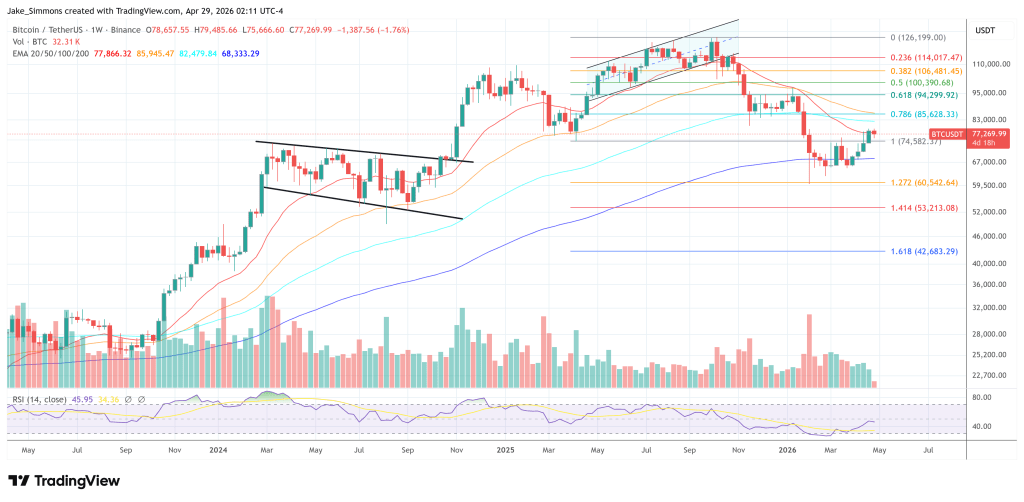
Bitcoin must overcome the 20-week EMA, 1-week chart | Source: BTCUSDT on TradingView.com

Trending Cryptos

Related Reads

Grayscale Forecasts Increase in Scarcity for Ethereum and Solana

Grayscale Research predicts that Ethereum (ETH) and Solana (SOL) could become scarcer assets due to proposed tokenomics changes in their respective blockchains. According to analyst Zach Pandl, both networks are considering protocol adjustments that would reduce the annual issuance rate of their native tokens. The report compares projected annual supply inflation over the next five years, estimating it could fall to around 0.4% for Ethereum and 1.1% for Solana by 2031, lower than gold's estimated 1.8% annual supply growth. Pandl notes that while the changes are still under community discussion, Solana's proposals have broader support and a higher chance of implementation. Reduced inflation would directly impact network stakers, as their rewards are funded by new token issuance. While stakers would receive fewer new tokens, the potential scarcity could support the market price of ETH and SOL. Non-staking holders could benefit directly from the decreased supply. For Ethereum, the debate on scarcity includes proposals like EIP-8363, which would burn a portion of staking rewards. Pandl concludes that the proposed changes would increase the scarcity of both assets and could create upward pressure on their prices. The analysis also notes Solana's ongoing infrastructure development, including the Alpenglow upgrade to speed up transaction finalization and significant growth in its tokenized asset ecosystem.

cryptonews.ru3h ago

Grayscale Forecasts Increase in Scarcity for Ethereum and Solana

cryptonews.ru3h ago

Trading

Spot

Hot Articles

What is $BANK

Bank AI: A Revolutionary Step in the Future of Banking Introduction In an era marked by rapid advancements in technology, Bank AI stands at the intersection of artificial intelligence (AI) and banking services. This innovative project seeks to redefine the financial landscape, enhancing operational efficiency, security measures, and customer experiences through the power of AI. As we embark on this exploration of Bank AI, we will delve into what the project entails, its operational dynamics, its historical context, and significant milestones. What is Bank AI? At its core, Bank AI represents a transformative initiative aimed at integrating artificial intelligence into various banking operations. This project harnesses the capabilities of AI to automate processes, improve risk management protocols, and enhance customer interaction through personalised services. The primary objectives of Bank AI include: Automation of Banking Functions: By leveraging AI technologies, Bank AI aims to automate routine tasks, reducing the burden on human resources and enhancing efficiency. Enhanced Risk Management: The project utilises AI algorithms to predict and identify risks, thereby fortifying security measures against fraud and other threats. Personalisation of Banking Services: Bank AI focuses on offering tailored financial products and services by analysing customer data and behaviours. Improving Customer Experience: The implementation of AI-driven solutions, such as chatbots and virtual assistants, aims to provide users with more human-like interactions, revolutionising the way customers engage with banks. With these goals, Bank AI positions itself as a crucial player in rendering banking more efficient, secure, and user-centric. Who is the Creator of Bank AI? Details regarding the creator of Bank AI remain unknown. As such, no specific individual or organisation has been identified in the available information. The anonymity surrounding the project's inception raises questions but does not detract from its ambitious vision and objectives. Who are the Investors of Bank AI? Similar to the project's creator, specific information regarding the investors or supporting organisations of Bank AI has not been disclosed. Without this information, it is challenging to outline the financial backing and institutional support that might be propelling the project forward. Nevertheless, the importance of having a robust investment foundation is pivotal for sustaining development in such an innovative field. How Does Bank AI Work? Bank AI operates on several innovative fronts, focusing on unique factors that differentiate it from traditional banking frameworks. Below are key operational features: Automation: By applying machine learning algorithms, Bank AI automates various manual processes within banks. This results in reduced operational costs and allows human workers to redirect their efforts towards more strategic activities. Advanced Risk Management: The integration of AI into risk management practices equips banks with tools to accurately predict potential threats such as fraud, ensuring that customer information and assets remain secure. Tailored Financial Recommendations: Through continuous learning from customer interactions, the AI systems develop a nuanced understanding of user needs, enabling them to offer tailored advice on financial decisions. Enhanced Customer Interactions: Utilizing chatbots and virtual assistants powered by AI, Bank AI enables a more engaging customer experience, allowing users to have their queries resolved quickly, thus reducing wait times and improving satisfaction levels. Together, these operational features position Bank AI as a pioneer in the banking sector, establishing new benchmarks for service delivery and operational excellence. Timeline of Bank AI Understanding the trajectory of Bank AI requires a look at its historical context. Below is a timeline highlighting important milestones and developments: Early 2010s: The conceptualisation of AI integration into banking services began to gain attention as banking institutions recognised the potential benefits. 2018: A marked increase in the implementation of AI technologies occurred when banks started using AI tools like chatbots for basic customer service and risk management systems for improved security handling. 2023: The sophistication of AI continued to advance, with generative AI being introduced for more complex tasks such as document processing and real-time investment analysis. This year marked a significant leap in the capabilities afforded to banks by AI technology. 2024-Current Status: As of this year, Bank AI is on an upward trajectory, with ongoing research and developments poised to further enhance capabilities in banking operations. Continued exploration of AI applications hints at exciting developments yet to come. Key Points About Bank AI Integration of AI in Banking: Bank AI focuses on adopting artificial intelligence to streamline banking processes and improve user experiences. Automation and Risk Management Focus: The project strongly emphasises these areas, aiming to shift the burden of routine tasks while enhancing security frameworks through predictive analytics. Personalised Banking Solutions: By harnessing customer data, Bank AI enables tailored banking services that cater to individual user needs. Commitment to Development: Bank AI remains committed to ongoing research and development efforts, ensuring its adaptability and ongoing relevance as technology continues to evolve. Conclusion In summary, Bank AI exemplifies a crucial step forward in the banking industry, leveraging artificial intelligence to reshape operational paradigms, enhance security, and promote customer satisfaction. Despite gaps in information surrounding the creator and investors, the clear objectives and functional mechanisms of Bank AI provide a strong foundation for its ongoing evolution. As AI technology continues to advance and merge with the banking sector, Bank AI is well-positioned to significantly impact the future of financial services, enhancing the way we understand and interact with banking.

381 Total ViewsPublished 2024.04.06Updated 2024.12.03

What is $BANK

Discussions

Welcome to the HTX Community. Here, you can stay informed about the latest platform developments and gain access to professional market insights. Users' opinions on the price of BANK (BANK) are presented below.

活动图片