Cyber Godfather Tibo Reveals: Google Had ChatGPT a Year Earlier but Dared Not Release It

marsbitPublished on 2026-08-03Last updated on 2026-08-03

Abstract

In a recent revelation, Thibault "Tibo" Sottiaux, the Codex lead at OpenAI, confirmed that Google developed a ChatGPT-like chatbot called "LMChat" a full year before OpenAI's launch. According to Tibo, who was part of the Google team at the time, the company was too cautious to release it, fearing it might disrupt its core search and advertising business. DeepMind, where the project was housed, was also restricted from launching products that could compete with Google's existing services. This account aligns with past statements from former Google Brain head Jeff Dean, who mentioned an internal chatbot that was deemed inferior to Google Search at the time. The article highlights this as a classic case of "innovator's dilemma," comparing Google's hesitation to Xerox's failure to commercialize groundbreaking technologies like the graphical user interface in the 1970s. The piece further notes a recent wave of high-profile departures from Google's AI teams to rivals like OpenAI and Anthropic, including key figures such as Transformer co-author Noam Shazeer and AlphaFold lead John Jumper. It concludes that Google's excessive caution and internal constraints, driven by the need to protect its lucrative search business, ultimately cost it a pioneering position in the generative AI revolution, allowing OpenAI to seize the initiative with ChatGPT's public release in November 2022.

What, Google really made ChatGPT a year earlier than OpenAI?

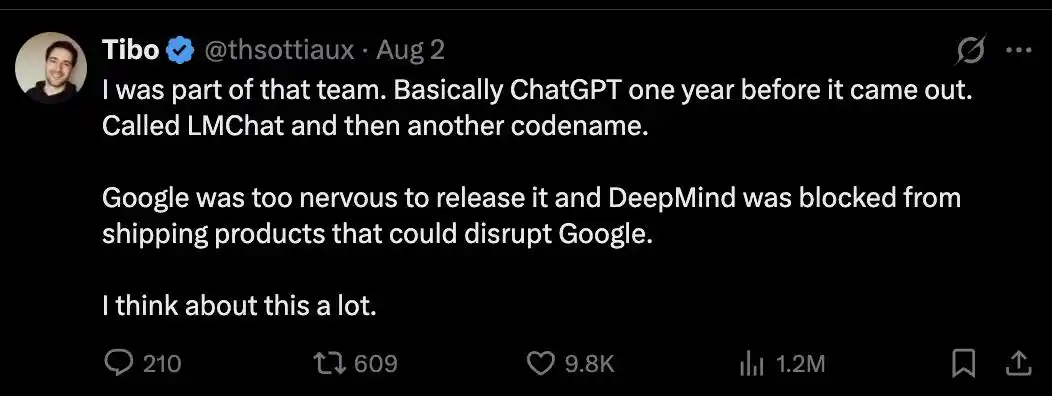
This isn't Google making excuses after the fact. This time, it's confirmed by an OpenAI insider, Codex lead Tibo:

That was basically ChatGPT a year early. It was initially called LMChat, and later had another codename.

Google was too nervous to release it, and DeepMind was prohibited from launching products that could impact Google's business.
But why does Tibo know such an old story so well?

The answer: He was on that Google team at the time.

I was a member of that team back then.

Yes, the Tibo who is now building "Infinite Tokens" for OpenAI was a firsthand participant in that Google project.

Netizens were shocked that Tibo had such a history:

No way, I thought you were just a reset button for Codex (just kidding).

Jeff Dean: I'm Not Convinced!!

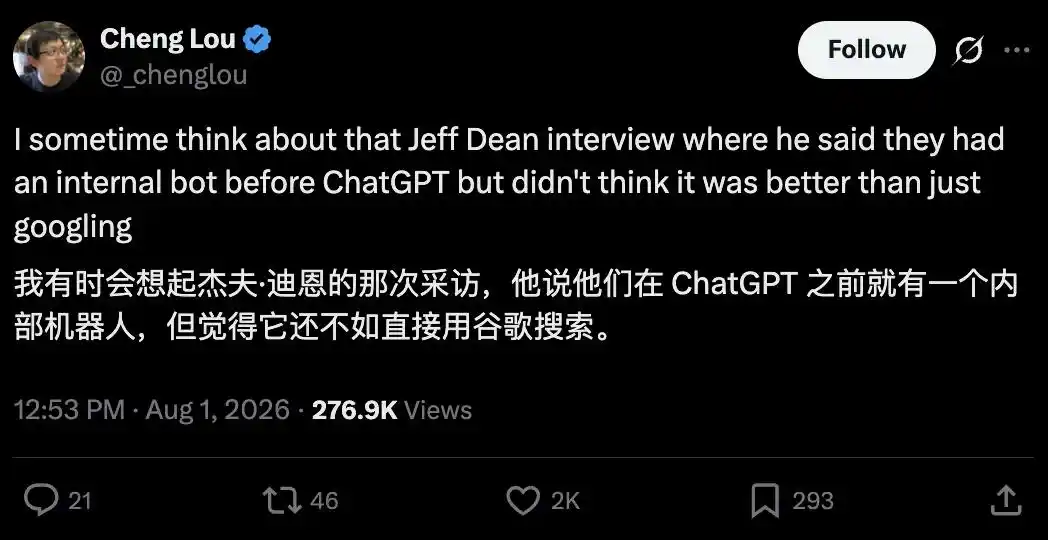
Here's how it happened. A Midjourney engineer recently dug up an old interview with former Google Brain head Jeff Dean on X:

I sometimes think about that Jeff Dean interview where he said they had an internal Chatbot before ChatGPT, but felt using it was worse than just using Google Search.
Unexpectedly, Tibo personally responded, engaging in a cross-air dialogue with Jeff Dean:

The project Jeff mentioned did exist. It was initially called LMChat and was almost exactly ChatGPT a year earlier.

As for why it wasn't released, Tibo helplessly stated that DeepMind didn't have the authority. LLMs would impact Google Search, and the bosses were too nervous to greenlight it.

After recounting this past event, Tibo left only a sigh:

Sigh, I often think about this.

Netizens were speechless upon hearing it...

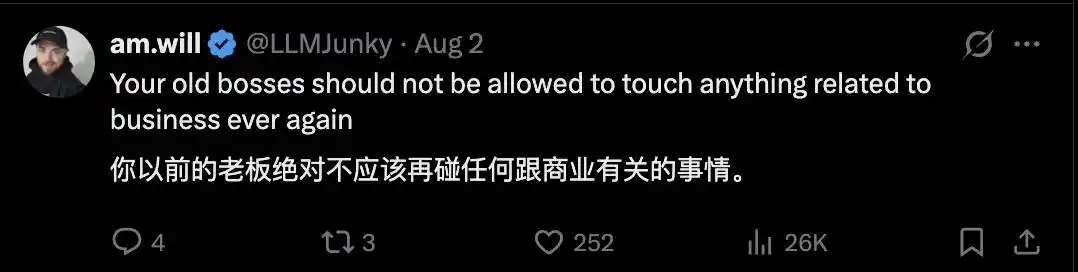
Your former boss at Google absolutely should not touch anything business-related ever again.
Coincidentally, Google's AI lead Demis Hassabis also said in a biography that OpenAI didn't do anything revolutionary. Many people at the time realized the power of LLMs, but Sam Altman had the guts to release it without considering safety at all.

But you can't really blame Google. "Google Search" set a very high bar as a benchmark. If it was just for search, Google Search was already very mature.

And what about the 2023 large models? They got almost everything wrong, full of hallucinations whenever it involved timely content.

But now, Scaling has solved everything.

"Better than Google Search" – this acceptance criteria Google set for itself ultimately cost it an unprecedented price.

The Unfinished Google Journey

Tibo, real name Thibault Sottiaux, Codex lead, possessor of Infinite Token capability, aka "Cyber Godfather".

(ps: Reset reset o(╥_╥)o, I accidentally used them all up over the weekend!!!)

In 2015, Tibo joined Google, initially working on Google Maps-related projects, then transferred to DeepMind.

At the time, DeepMind was still a fairly pure research lab, with AlphaGo, reinforcement learning, and AGI research at its peak of attention.

At DeepMind, Tibo was mainly responsible for building the AI and machine learning infrastructure used by researchers.

According to Tibo's recollection, DeepMind internally developed a chat product called LMChat, which later had another codename. Its experience was already very similar to ChatGPT.

But Google was extremely cautious, given the direct impact on existing business, and DeepMind didn't have enough authority. Ultimately, the product never truly reached the public.

November 2022, ChatGPT exploded onto the scene.

Tibo saw it and was floored.

In 2024, he ended his nearly nine-year Google career and officially joined OpenAI.

As it turned out, Tibo's choice was correct.

This kind of abortion of projects like LMChat wasn't a one-off; like Vibe Coding, it's either zero times or countless times (just kidding).

This small story ultimately became a microcosm of Google's situation throughout the AI era.

Now, falling behind in the coding battlefield is triggering an even more brutal talent exodus within Google.

June 18th, Noam Shazeer announced joining OpenAI.

This name needs no introduction. One of the core authors of the 2017 Transformer paper "Attention Is All You Need" that ignited the entire AI era. He left Google in 2021 to found Character.AI. In 2024, Google spent $2.7 billion to buy back him and his company, having him co-lead Gemini.

Result: The person bought back for $2.7 billion, didn't even stay two years.

June 19th, John Jumper announced moving to Anthropic.

DeepMind VP, a core general handpicked by Hassabis himself – tasked with leading the AlphaFold team just six months after earning his PhD.

In 2024, he and Hassabis jointly won the Nobel Prize in Chemistry for their groundbreaking work on AlphaFold in protein structure prediction.

But now, the Nobel laureate has chosen a competitor.

After these two heavy blows, Google continues to bleed talent.

June 24th, two new names appeared on Google's talent "wanted list": Jonas Adler and Alexander Pritzel.

Both are core contributors to Gemini. Adler leads Google's AI coding direction, Pritzel works on pre-training. Both were involved in AlphaFold research, colleagues of John Jumper.

Destination: also Anthropic.

One More Thing

In the comments of the post, someone asked a very interesting question:

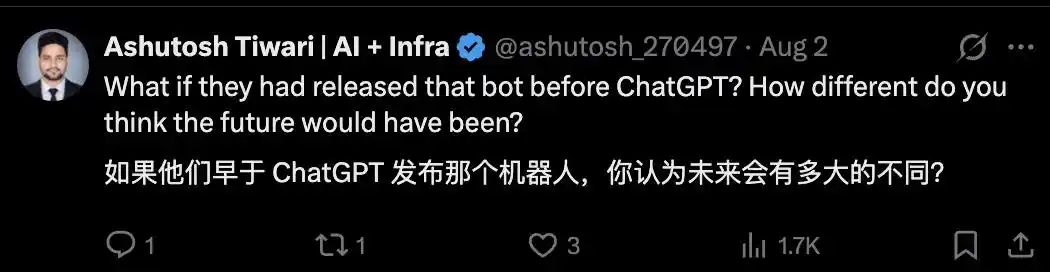
If Google had released GPT first, how would things be different now?

Unfortunately, hardly anyone replied.
But I know this one!!

Isn't this just the tech world's most classic old story.

In the 1970s, Xerox PARC developed the graphical user interface, mouse, and Ethernet. These guys basically held all the cards for the PC era, a pure royal flush.

And the result? Xerox didn't take it seriously at all.

Because Xerox sales did the math: Can this fancy interface help me sell two more toner cartridges, two more packs of A4 paper? No. Then why bother?

...

And so, Xerox watched as Steve Jobs visited, went back, created the Macintosh, and ascended to the throne.

Ever since, Xerox became Silicon Valley's "scapegoat." Every time the industry undergoes a paradigm shift, big shots drag Xerox out for a whipping:

See, this is big company disease! (piapiapia, whip sounds)

But seriously, anyone sitting in that position, looking at billions in annual printer profits, who would be willing to disrupt themselves...

Replace "toner and A4 paper" with "search and ads," replace "graphical interface" with "ChatGPT" –

That Google, which wrote Transformer in 2017 and held a full set of god-tier gear, ultimately in the AGI marathon...

Earned the title of "America's Doubao."

Reference link:[1]https://x.com/thsottiaux/status/2083596911060324570

This article is from the WeChat public account "QbitAI" (ID: QbitAI), author: Jay

Trending Cryptos

Related Questions

QWho is Tibo and what role does he play in this story about Google's early chatbot?

ATibo, whose real name is Thibault Sottiaux, is the Codex lead at OpenAI and is referred to as the 'Cyber Godfather.' He is a former Google employee who was part of the team that developed an early ChatGPT-like product called LMChat within DeepMind. He personally confirmed that Google had created this technology about a year before ChatGPT was released.

QAccording to the article, why did Google decide not to release its early chatbot, LMChat?

AAccording to Tibo's account, Google did not release its early chatbot (LMChat, and later another project) because the company was too cautious and nervous. The leadership was concerned that large language models (LLMs) would disrupt Google's core search and advertising business. Additionally, DeepMind did not have the authority to launch products that could impact Google's existing operations.

QWhat historical parallel does the article draw to explain Google's missed opportunity with AI?

AThe article draws a parallel to the 1970s when Xerox PARC invented foundational technologies like the graphical user interface, mouse, and Ethernet but failed to commercialize them effectively because they were focused on their profitable printer and copier business (selling toner and paper). Similarly, Google, with its hugely profitable search and ads business, hesitated to launch a disruptive AI product, allowing others like OpenAI to seize the initiative.

QWhich high-profile AI researchers recently left Google, as mentioned in the article?

AThe article mentions several high-profile departures from Google: Noam Shazeer, a co-author of the 'Attention Is All You Need' paper, left for OpenAI. John Jumper, a DeepMind VP and Nobel laureate for AlphaFold, left for Anthropic. Additionally, core Gemini contributors Jonas Adler and Alexander Pritzel also left for Anthropic.

QWhat was Jeff Dean's reported view on Google's internal chatbot before ChatGPT's release?

AJeff Dean, the former head of Google Brain, reportedly stated in an old interview that Google had an internal chatbot before ChatGPT but felt that using it was not better than simply using Google Search. This view reflects the high internal benchmark Google set for itself, which ultimately contributed to its hesitation to release the product.

Related Reads

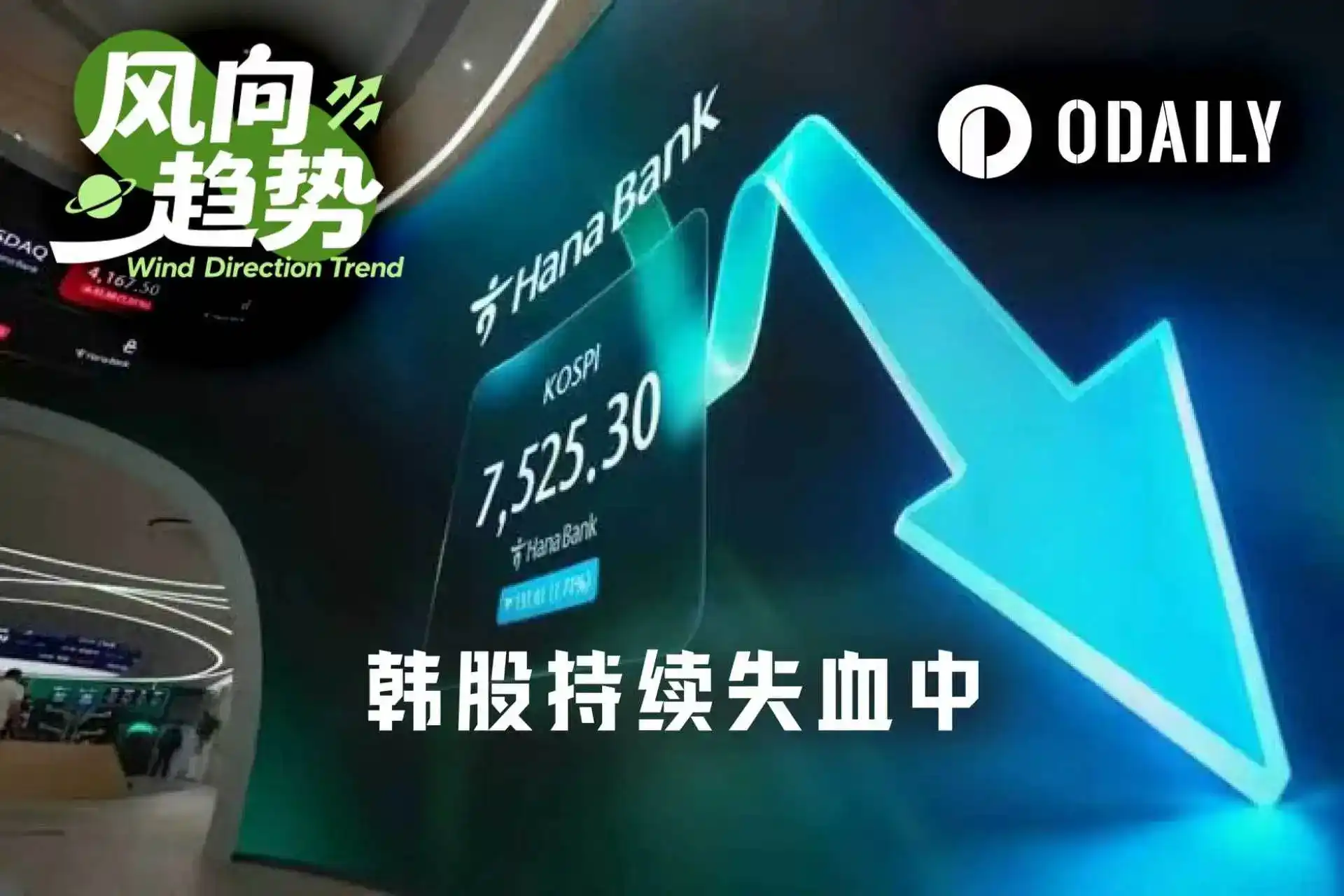
Soaring 20% Then Dropping 5%: When Will the Bottom of the Korean Stock Market Be?

"South Korean stocks face a turbulent period as the KOSPI index, after a 20% surge, fell 5% to 6257 points. The market is grappling with severe issues: over 500,000 leveraged retail accounts have been liquidated, and more than 24 trillion won has flowed from stocks into bank deposits for safety. This reflects a significant loss of market liquidity and shaken investor confidence. In response, Korean financial regulators are taking action. They have tripled the minimum保证金 (margin) requirement for single-stock leveraged ETF trades to 30 million won and are considering granting themselves "emergency intervention" powers. These could include capping leverage ratios and setting investment limits on these ETFs, seen by many as amplifying market volatility. Initial results show a 75% drop in these products' trading volume post-regulation. The market downturn has political repercussions, pushing President Yoon Suk-yeol's approval rating to a new low. Meanwhile, foreign investors made a record net purchase of 7.18 trillion won during a recent rebound, while domestic retail investors sold off massively. Morgan Stanley has upgraded South Korean stocks to "overweight," citing the ongoing "leverage unwinding" and potential for a 36% upside, with giants like Samsung Electronics and SK Hynix providing valuation support. However, analysts caution that the market's structure remains vulnerable to foreign capital flows, and the current low may not be the bottom."

marsbit4m ago

Soaring 20% Then Dropping 5%: When Will the Bottom of the Korean Stock Market Be?

marsbit4m ago

Goldman Sachs Stakes a Clear Position: This Is the Largest Capital Demand Cycle in Human History, and the Fed Is Just an Observer

Goldman Sachs argues that the world is entering the most capital-intensive investment cycle in history, driven by concurrent massive demands from AI infrastructure, reindustrialization, defense reinvestment, power grid rebuilding, supply chain realignment, and sovereign debt financing. This structural competition for capital is pushing its cost higher, fundamentally altering investment paradigms. Goldman's Mark Wilson states that the Federal Reserve is merely a "passenger, not the driver" in this shift, with rising yields rooted in these real economy demands rather than just monetary policy. While major indices appeared calm in July, underlying market movements were historic, featuring extreme stock dispersion and a severe momentum factor crash, leading to significant de-risking by fund managers. Wilson cautions against expecting a quick reversal in August, citing ongoing digestion of higher rates, disrupted risk models, and typically muted market performance ahead of US midterm elections. Corporate fundamentals remain robust with strong earnings, though growth rates are peaking in the US while accelerating in Europe. Notably, hyperscale cloud companies like Amazon and Microsoft are announcing staggering capital expenditure projections for 2027-2028, justified by explosive AI-related revenue growth and high returns. Amazon revealed its AI revenue run-rate exceeds $25 billion, growing triple-digits annually, and expressed confidence that AWS could become a trillion-dollar revenue business. The report concludes that a transitional period is underway, marked by a growing tension between aggressively investing private tech giants and increasingly capital-constrained sovereign governments. The AI super-cycle continues, with August likely being a consolidation phase.

marsbit9m ago

Goldman Sachs Stakes a Clear Position: This Is the Largest Capital Demand Cycle in Human History, and the Fed Is Just an Observer

marsbit9m ago

Outflow of Stablecoins from South Korea Continues for 18 Consecutive Months, Exceeding $360 Million in June

In June 2026, South Korea experienced a net outflow of stablecoins to overseas crypto exchanges, amounting to 560.3 billion won ($367 million). This represents approximately 78% of the net value of foreign stocks purchased by Korean investors in the same period. According to the Financial Supervisory Service (FSS), this marks the 18th consecutive month of net outflows, a trend ongoing since January 2025. The FSS reported that 2.76 trillion won ($1.8+ billion) in stablecoins were withdrawn from the country's five major exchanges to foreign platforms in June, while 2.2 trillion won ($1.4 billion) flowed back in. The second quarter of 2026 saw a significant net outflow of 1.69 trillion won (~$1.1 billion), surpassing net sales of foreign stocks in the same period. Analysts cite access to unavailable domestic financial instruments as a primary driver. Foreign platforms offer crypto derivatives, spot and futures products tied to major Korean stocks like Samsung and Hyundai, along with RWA tokenization, DeFi, staking, and leveraged products. Lawmaker Lee Jong-wook warned that the stablecoin outflows constitute capital flight, exposing investors to risks on unregulated foreign platforms. He called for accelerated regulatory reform and enhanced investor protection measures. The government is reportedly working on a digital assets law to foster the blockchain sector.

cryptonews.ru14m ago

Outflow of Stablecoins from South Korea Continues for 18 Consecutive Months, Exceeding $360 Million in June

cryptonews.ru14m ago

Trading

Spot

Hot Articles

What is DOGE M

Doge Matrix ($doge m): The New Breed of Community-Driven Cryptocurrency Introduction In the ever-evolving landscape of cryptocurrency, new projects constantly emerge, each aiming to capture the interest of investors and enthusiasts alike. One of the latest entrants to this domain is Doge Matrix, represented by the ticker symbol $doge m. This project has attracted attention thanks to its roots in the popular meme culture surrounding Dogecoin, establishing its place within the web3 space. This article aims to provide a comprehensive analysis of Doge Matrix, covering its overview, creator, investors, functionality, timeline, and notable aspects. What is Doge Matrix ($doge m)? Doge Matrix is a community-driven cryptocurrency project that seemingly builds upon the widespread appeal of Dogecoin, a digital currency known for its Shiba Inu mascot and its meme origins. While the overarching objectives of Doge Matrix are not extensively defined, it is characterised by a commitment to harnessing community involvement and support. Unlike traditional cryptocurrencies that often emphasise utility or intrinsic value through underlying technologies, Doge Matrix positions itself within a space that embraces the cultural phenomenon of cryptocurrencies, particularly appealing to those who resonate with the ethos of meme-based assets. Drawing on the strengths of the Dogecoin community, Doge Matrix operates as part of a broader ecosystem, inviting participation and engagement from users who share an interest in cryptocurrency and the digital landscape. Who is the Creator of Doge Matrix ($doge m)? The identity of the creator of Doge Matrix remains unknown. This lack of transparency is not an uncommon occurrence in the cryptocurrency space, where some projects are launched without revealing the identities of their founders. The absence of information regarding the founding team can raise questions among potential investors about the project’s accountability and direction. Who are the Investors of Doge Matrix ($doge m)? As it stands, there is no publicly available information detailing the investors or investment foundations that back Doge Matrix. The project appears to rely primarily on community support rather than institutional investment. This model aligns with the community-driven nature of the initiative, fostering an environment where the direction of the project is shaped by its participants rather than being dictated by a select few financial backers. How Does Doge Matrix ($doge m) Work? The specifics regarding the operational mechanisms of Doge Matrix are somewhat vague, reflecting a broader trend of projects in the meme coin space where innovative functionalities are not always clearly articulated. Nonetheless, Doge Matrix seems designed to tap into the existing cryptocurrency ecosystem by encouraging user participation while tapping into the familiar cultural references associated with Dogecoin. Its potentially unique characteristics derive from community interactions rather than technological advancements, emphasising shared experiences and collaboration among token holders. While the exact innovations have not been explicitly outlined, the project appears to create a space where community members can engage, share ideas, and propel the project's potential forward. Timeline of Doge Matrix ($doge m) Reflecting on the project’s timeline reveals notable events that have defined its journey thus far: November 25, 2024: Doge Matrix reached its all-time high value, marking a significant milestone in its early history. January 1, 2025: Conversely, Doge Matrix hit its all-time low value, illustrating the volatility often associated with cryptocurrencies, especially in the early stages of a project's lifecycle. Ongoing: The project continues to be actively traded and supported by its community, although specific future milestones or objectives have yet to be disclosed. Key Points About Doge Matrix ($doge m) Community Focus At the heart of Doge Matrix is a commitment to community engagement. The project thrives on the premise of collaboration and shared objectives among its members, emphasising the importance of collective effort. Unlike centralised projects that often have a defined leadership structure, Doge Matrix at present showcases a more fluid approach to governance, where every community member's voice matters. Volatility The cryptocurrency market is notorious for its volatility, and Doge Matrix is no exception. Its price history reflects significant fluctuations between high and low values, which is typical of many new cryptocurrencies but underscores the risks associated with investment in emerging tokens. Lack of Detailed Information One of the most striking features about Doge Matrix is the scarcity of detailed information regarding its technological underpinnings and operational mechanisms. This ambiguity necessitates that potential investors conduct thorough due diligence before engaging with the project. Conclusion In summary, Doge Matrix ($doge m) illustrates a new wave of cryptocurrency projects that lean heavily on community engagement and cultural relevance. While lacking in certain specifics—such as clear leadership, defined objectives, and detailed functionality—the project has managed to generate interest within the crypto community, leveraging the established appeal of meme culture. As with any investment in the cryptocurrency space, understanding the inherent risks and conducting comprehensive research is essential for potential participants. Doge Matrix stands as a reminder of the dynamic, sometimes unpredictable nature of the crypto industry, marked by constant evolution and enthusiasm for community-driven initiatives.

594 Total ViewsPublished 2025.02.03Updated 2025.02.03

What is DOGE M

What is $M

Understanding Mantis ($M): A New Era in Cross-Chain Interoperability In the continually evolving landscape of Web3 and cryptocurrency, new projects strive to offer innovative solutions aimed at enhancing the user experience and expanding functional possibilities within the decentralised financial ecosystem. One such project garnering attention is Mantis ($M), a pioneering protocol founded on the principles of cross-chain interoperability and intent-based settlements. This article delves into the essential aspects of Mantis, including its core functionality, creators, investment backing, innovative features, and critical milestones. What is Mantis ($M)? Mantis is described as a multi-domain intent settlement protocol that simplifies cross-chain interactions, enabling users to execute complex financial transactions across various blockchain platforms seamlessly. The protocol operates through three primary layers: Intent Expression: Users can articulate their transaction goals using natural language facilitated by the DISE LLM, an advanced AI language model. For instance, a user might express a desire to swap Ethereum (ETH) for Solana (SOL) with a specific slippage tolerance of 1%. Execution: This layer employs a network of solvers that compete to fulfil user intents. Transactions are executed using mechanisms such as Coincidence of Wants (CoWs) and Order Flow Auctions (OFAs), which ensure that user demands are met optimally. Settlement: Leveraging the Inter-Blockchain Communication (IBC) protocol, Mantis enables atomic cross-chain transactions, allowing users to operate across various supported chains, including Ethereum, Solana, and Cosmos. Mantis is engineered to introduce native yield generation for idle assets, employing cryptographic proofs to maintain the integrity of transactions throughout the entire process. Creators & Development Team Mantis was conceived by the Composable Foundation, a research-driven organisation notable for its emphasis on blockchain interoperability solutions. This foundation collaborates with esteemed academic institutions, including Harvard University and the University of Lisbon, contributing to extensive research and development efforts that inform Mantis's architecture and functionality. The Composable Foundation’s commitment to fostering innovation in the blockchain space positions Mantis as a robust solution for the growing demand for interoperability among multiple blockchain networks. Investors & Backing While specific details about individual investors have not been publicly disclosed, Mantis enjoys substantial backing from various entities, including: Ecosystem grants from IBC-enabled chains, which support the protocol's growth and integration within decentralised finance ecosystems. Strategic partnerships with infrastructure providers that enhance Mantis's network capabilities and deployment strategies. Funding through the Composable Foundation's treasury, ensuring sustained financial support for ongoing development and operational costs. These collaborative efforts reflect a consensus among stakeholders about the importance of enhancing cross-chain functionality and the potential utility of Mantis's infrastructural innovations. Key Innovations Mantis sets itself apart through several pioneering innovations that enhance its functionality and utility: Chain-Agnostic Intents: Users can initiate transactions from any supported chain while settling on another. This flexibility empowers users, driving increased interaction among different platforms. AI-Powered Interface: The integration of DISE LLM allows users to conduct complex DeFi operations using natural language, thereby simplifying interactions and making blockchain technology accessible to a broader audience. Cross-Domain MEV Capture: Mantis creates an internal market for maximal extractable value (MEV) through competitions among solvers. This innovative approach allows for greater efficiency and value extraction in complex transactions. Modular Settlement Layer: The protocol supports various verification methods, including zero-knowledge proofs and optimistic rollups, providing a versatile framework that can adapt to emerging blockchain technologies. Historical Timeline Mantis's development is marked by several critical milestones that chart its trajectory and growth: | Year | Milestone | |————|————————————————————————-| | 2022 | Initial concept development within the Composable Foundation's research division. | | Q3 2024 | Launch of the testnet with bridging capabilities between Solana and Ethereum. | | Q1 2025 | Anticipated Token Generation Event (TGE) alongside the mainnet launch. | | Q2 2025 | Expected integration of DISE LLM and expansion of cross-chain capabilities. | | 2025 H2 | Planned support for over 15 chains through further IBC upgrades. | This timeline outlines Mantis's evolution, from conceptual discussions to active implementation and future growth phases. Ecosystem Growth Strategy Mantis's strategy for ecosystem growth includes several initiatives designed to encourage user participation and developer engagement: Credits System: Users can earn protocol credits by providing liquidity and engaging in referral programmes. These credits are redeemable for incentives in the future, fostering a robust user community. Modular Software Development Kit (SDK): This toolkit empowers developers to create applications based on intent-driven models utilising Mantis's infrastructure, thus promoting innovation within its ecosystem. Governance Model: As the protocol matures, $M token holders will have a voice in protocol governance, allowing them to vote on proposed upgrades and changes, thereby enhancing community engagement and decentralisation. Mantis represents a significant advancement in the realm of cross-chain architecture. By seamlessly integrating advanced AI algorithms with a robust settlement framework, Mantis seeks to tackle the problems of fragmentation within multi-chain ecosystems. Its innovative approach prioritises improved user experiences while adhering to the foundational principles of decentralisation and security, setting a new standard for the future interoperability of blockchain technologies. As Mantis continues its journey of growth and implementation, it promises to be a project to watch closely in the competitive landscape of Web3 and decentralised finance. With its focus on crossing boundaries and elevating user engagement, Mantis is poised to be an integral part of the future developments in the cryptocurrency space.

107 Total ViewsPublished 2025.03.18Updated 2025.03.18

What is $M

Discussions

Welcome to the HTX Community. Here, you can stay informed about the latest platform developments and gain access to professional market insights. Users' opinions on the price of M (M) are presented below.

活动图片