CryptoQuant Points Out Accumulation of Bitcoin, Ethereum, and XRP by Whales

cryptonews.ruPublished on 2026-08-06Last updated on 2026-08-06

Abstract

Analysts at CryptoQuant have noted that large holders, or "whales," of Bitcoin, Ethereum, and XRP are accumulating these assets amid price pressure. Julio Moreno, head of research, stated that major holder groups are increasing their reserves while prices trade near or below their realized price. This behavior reduces selling pressure and resembles a final bear market phase. Bitcoin whale balances (excluding exchanges and mining pools) have risen to approximately 3.06 million BTC from a low of around 2.87 million in December 2025. The 30-day increase in whale balances has remained positive for most of 2026, with accumulation accelerating in June when Bitcoin's price approached $60,000. For Ethereum, the trend is mixed. Wallets holding 10,000 to 100,000 ETH have accumulated to a record 19.6 million ETH, while those with 1,000 to 10,000 ETH have reduced holdings from 15.6 million to 12.9 million ETH this year. Wallets with over 100,000 ETH increased their balance from 2.6 million to 4.6 million ETH. Moreno described this as capital concentration during a bear market. XRP whale activity is less direct, with large spot orders present in the $1-$1.2 range, but cumulative volume delta appears neutral, suggesting accumulation through absorbing supply rather than aggressive buying. Key current prices versus realized prices are: Bitcoin at ~$64,640 (realized $52,900), Ethereum at $1,900 (realized $2,450), and XRP at $1.1 (realized $0.75). Moreno noted the risk-reward ratio has dec...

Major holders of Bitcoin, Ethereum, and $XRP are increasing their positions amid price pressure. Analysts at CryptoQuant stated this, as reported by The Block.

Head of Research Julio Moreno noted that the largest groups of cryptocurrency holders are increasing their reserves while quotes are hovering near or below the realized price. According to his assessment, such behavior reduces seller pressure and appears more like the final phase of a bear market.

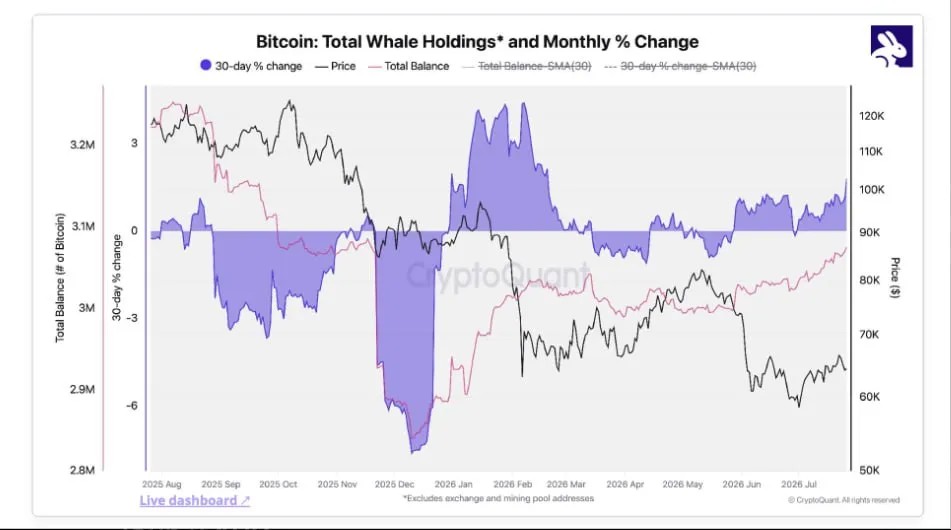
The balance of Bitcoin whales (excluding exchanges and mining pools) increased to approximately 3.06 million $BTC after a low of around 2.87 million $BTC in December 2025. However, this figure is still below the bull market peak of that period—around 3.23 million $BTC.

According to CryptoQuant, for most of 2026, the 30-day increase in whale balances remained positive. Accumulation accelerated in June when the price of digital gold dipped towards $60,000.
Source: CryptoQuant.

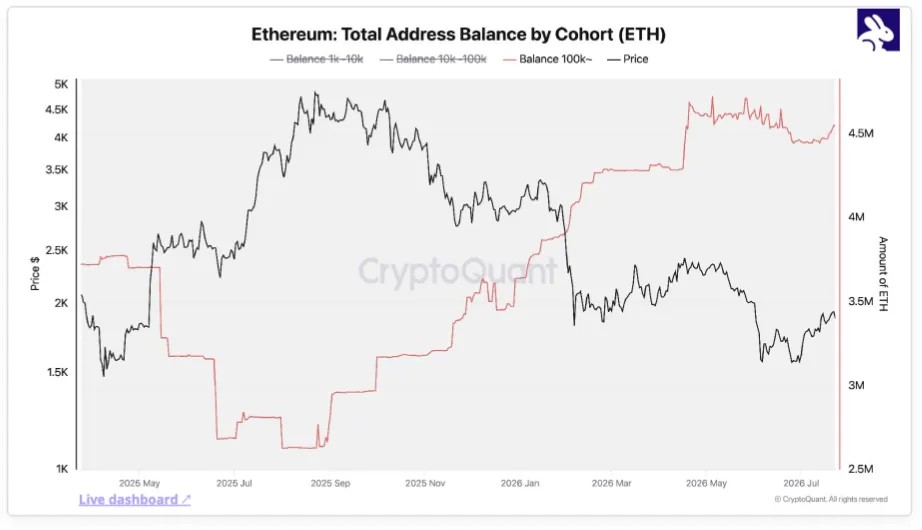
For Ethereum, CryptoQuant recorded mixed dynamics. Wallets holding 10,000-100,000 $ETH accumulated the asset and brought the balance to a record 19.6 million $ETH (compared to 14 million $ETH in mid-2025).

The group holding 1,000-10,000 $ETH, on the contrary, reduced reserves from 15.6 million at the beginning of the current year to 12.9 million $ETH. Wallets with more than 100,000 $ETH increased their aggregate balance from 2.6 million to 4.6 million $ETH.
Source: CryptoQuant.

"This is what capital accumulation in a bear market looks like: strong holders absorbing the weak. Concentration in the hands of large holders narrows the available supply and is a positive factor for $ETH once demand recovers—even if the price is below its cost basis," emphasized Moreno.

Regarding $XRP, large players are acting less straightforwardly, CryptoQuant indicated. Spot order sizes remain in the "large whale" zone while the price holds in the $1-1.2 range. Meanwhile, the cumulative volume delta has moved into the neutral zone—this looks more like accumulation through absorbing supply rather than through aggressive buying.

Separately, analysts compared market quotes with the realized price of the coins:

  • Bitcoin is trading around $64,640 with a realized price of $52,900;
  • Ethereum—$1,900 against $2,450;
  • $XRP—$1.1 against $0.75.

Moreno added that the risk-reward ratio has noticeably decreased since the beginning of the bear market, but the model for further movement allows for another wave of decline before confirming a bottom.

Recall that in August, Glassnode analysts recorded a record-long capitulation phase for Bitcoin.

Trending Cryptos

Related Questions

QWhat did CryptoQuant analysts report about the behavior of major holders of Bitcoin, Ethereum, and XRP?

ACryptoQuant analysts reported that major holders (whales) of Bitcoin, Ethereum, and XRP are accumulating their positions amid price pressure, which resembles the final phase of a bear market.

QAccording to Julio Moreno, what does the accumulation behavior of major cryptocurrency holders indicate?

AAccording to Julio Moreno, the accumulation behavior of major holders reduces selling pressure and looks more like the final phase of a bear market, where strong holders are absorbing weak ones.

QWhat was the trend in the 30-day balance growth of Bitcoin whales for most of 2026?

AFor most of 2026, the 30-day balance growth of Bitcoin whales remained positive, with accumulation accelerating in June as Bitcoin's price approached $60,000.

QHow did the holdings of different Ethereum wallet groups change, as per the article?

AWallets holding 10,000-100,000 ETH accumulated to a record 19.6 million ETH. Wallets with 1,000-10,000 ETH reduced holdings from 15.6 million to 12.9 million ETH. Wallets with over 100,000 ETH increased their aggregate balance from 2.6 million to 4.6 million ETH.

QWhat are the current market prices versus the realized prices for Bitcoin, Ethereum, and XRP mentioned in the article?

ABitcoin trades around $64,640 with a realized price of $52,900. Ethereum trades at $1,900 versus a realized price of $2,450. XRP trades at $1.1 against a realized price of $0.75.

Related Reads

Just 3.5 Months After Its Founding, It Started Making External Investments: The Embodied AI Sector Is Collectively 'Investing While Fundraising'

A counterintuitive trend is emerging in China's embodied AI sector: numerous startups that are still actively raising capital themselves are now making strategic investments in other companies. An analysis of 29 such enterprises reveals a pattern of "fundraising while investing," where companies, often still in early funding rounds, rapidly deploy capital into the ecosystem. These 29 investment entities, primarily based in the Pearl River Delta and Yangtze River Delta regions, have executed over 125 investment deals. Notably, 17 of them (59%) are humanoid robot manufacturers, making them the most active investors. The trend shows that newer companies are investing faster; firms founded after 2023 made their first external investment in an average of just 22.8 months, with one company, Poke Robotics, doing so within 3.8 months of its founding. Zhiyuan Robot (智元机器人) stands out as the most active corporate venture capital (CVC) player, completing 37 investments in 23 months. A more complex, networked investment structure is also forming, where companies like Lingchu Intelligent (灵初智能) and Lingxin Qiaoshou (灵心巧手), which received investments from larger players, have themselves become active investors, extending the strategic reach of capital down the supply chain. This collective shift from a few large players to widespread participation signals a strategic move to use capital as a lever to accelerate industry consolidation. Companies are seeking to quickly integrate critical supply chain elements—such as dexterous hands, joint motors, and AI data platforms—into their ecosystems to gain a competitive edge in a rapidly evolving, highly contested market window. The strategy aims to compress the decade-long process of traditional supply chain integration into just a few years, though it carries risks related to technology bets and ongoing capital burn. As the sector's IPO pipeline grows, this "fundraise and invest" model may soon become a standard industry practice.

marsbit2m ago

Just 3.5 Months After Its Founding, It Started Making External Investments: The Embodied AI Sector Is Collectively 'Investing While Fundraising'

marsbit2m ago

Trading

Spot

Hot Articles

What is $BITCOIN

DIGITAL GOLD ($BITCOIN): A Comprehensive Analysis Introduction to DIGITAL GOLD ($BITCOIN) DIGITAL GOLD ($BITCOIN) is a blockchain-based project operating on the Solana network, which aims to combine the characteristics of traditional precious metals with the innovation of decentralized technologies. While it shares a name with Bitcoin, often referred to as “digital gold” due to its perception as a store of value, DIGITAL GOLD is a separate token designed to create a unique ecosystem within the Web3 landscape. Its goal is to position itself as a viable alternative digital asset, although specifics regarding its applications and functionalities are still developing. What is DIGITAL GOLD ($BITCOIN)? DIGITAL GOLD ($BITCOIN) is a cryptocurrency token explicitly designed for use on the Solana blockchain. In contrast to Bitcoin, which provides a widely recognized value storage role, this token appears to focus on broader applications and characteristics. Notable aspects include: Blockchain Infrastructure: The token is built on the Solana blockchain, known for its capacity to handle high-speed and low-cost transactions. Supply Dynamics: DIGITAL GOLD has a maximum supply capped at 100 quadrillion tokens (100P $BITCOIN), although details regarding its circulating supply are currently undisclosed. Utility: While precise functionalities are not explicitly outlined, there are indications that the token could be utilized for various applications, potentially involving decentralized applications (dApps) or asset tokenization strategies. Who is the Creator of DIGITAL GOLD ($BITCOIN)? At present, the identity of the creators and development team behind DIGITAL GOLD ($BITCOIN) remains unknown. This situation is typical among many innovative projects within the blockchain space, particularly those aligning with decentralized finance and meme coin phenomena. While such anonymity may foster a community-driven culture, it intensifies concerns about governance and accountability. Who are the Investors of DIGITAL GOLD ($BITCOIN)? The available information indicates that DIGITAL GOLD ($BITCOIN) does not have any known institutional backers or prominent venture capital investments. The project seems to operate on a peer-to-peer model focused on community support and adoption rather than traditional funding routes. Its activity and liquidity are primarily situated on decentralized exchanges (DEXs), such as PumpSwap, rather than established centralized trading platforms, further highlighting its grassroots approach. How DIGITAL GOLD ($BITCOIN) Works The operational mechanics of DIGITAL GOLD ($BITCOIN) can be elaborated on based on its blockchain design and network attributes: Consensus Mechanism: By leveraging Solana’s unique proof-of-history (PoH) combined with a proof-of-stake (PoS) model, the project ensures efficient transaction validation contributing to the network's high performance. Tokenomics: While specific deflationary mechanisms have not been extensively detailed, the vast maximum token supply implies that it may cater to microtransactions or niche use cases that are still to be defined. Interoperability: There exists the potential for integration with Solana’s broader ecosystem, including various decentralized finance (DeFi) platforms. However, the details regarding specific integrations remain unspecified. Timeline of Key Events Here is a timeline that highlights significant milestones concerning DIGITAL GOLD ($BITCOIN): 2023: The initial deployment of the token occurs on the Solana blockchain, marked by its contract address. 2024: DIGITAL GOLD gains visibility as it becomes available for trading on decentralized exchanges like PumpSwap, allowing users to trade it against SOL. 2025: The project witnesses sporadic trading activity and potential interest in community-led engagements, although no noteworthy partnerships or technical advancements have been documented as of yet. Critical Analysis Strengths Scalability: The underlying Solana infrastructure supports high transaction volumes, which could enhance the utility of $BITCOIN in various transaction scenarios. Accessibility: The potential low trading price per token could attract retail investors, facilitating wider participation due to fractional ownership opportunities. Risks Lack of Transparency: The absence of publicly known backers, developers, or an audit process may yield skepticism regarding the project's sustainability and trustworthiness. Market Volatility: The trading activity is heavily reliant on speculative behavior, which can result in significant price volatility and uncertainty for investors. Conclusion DIGITAL GOLD ($BITCOIN) emerges as an intriguing yet ambiguous project within the rapidly evolving Solana ecosystem. While it attempts to leverage the “digital gold” narrative, its departure from Bitcoin's established role as a store of value underscores the need for a clearer differentiation of its intended utility and governance structure. Future acceptance and adoption will likely depend on addressing the current opacity and defining its operational and economic strategies more explicitly. Note: This report encompasses synthesised information available as of October 2023, and developments may have transpired beyond the research period.

1.5k Total ViewsPublished 2025.05.13Updated 2025.05.13

What is $BITCOIN

Discussions

Welcome to the HTX Community. Here, you can stay informed about the latest platform developments and gain access to professional market insights. Users' opinions on the price of BTC (BTC) are presented below.

活动图片