Crypto.com cuts 12% workforce as CEO warns AI shift is ‘do or die’

ambcryptoPublished on 2026-03-19Last updated on 2026-03-19

Abstract

Crypto.com has cut roughly 12% of its workforce as part of a strategic shift toward enterprise-wide AI integration, with CEO Kris Marszalek warning that companies slow to adopt AI risk failure. The layoffs target roles incompatible with an AI-focused direction, following the company's acquisition of AI.com for $70 million. This reflects a broader industry trend where crypto firms are combining cost-cutting with AI-driven efficiency, moving beyond purely market-driven layoffs to structural resets. Similarly, Algorand Foundation reduced its workforce by 25%, citing market pressures, though its cuts appear more reactive than strategic. The trend indicates that crypto layoffs are increasingly tied to technological realignment, with AI integration becoming a key competitive factor.

Crypto.com has reduced its workforce by roughly 12% as part of a broader push to integrate artificial intelligence across its operations, with CEO Kris Marszalek warning that companies slow to adopt AI risk being left behind.

In a statement, Marszalek said the firm is moving toward “enterprise-wide AI,” arguing that companies that fail to pivot “will fail,” while those that move quickly could achieve “a level of scale and precision that was previously impossible.”

The layoffs affect roles deemed incompatible with the company’s new AI-focused direction. Affected employees have been notified and are receiving transition support, according to the announcement.

The move follows Crypto.com’s earlier acquisition of the premium domain AI.com, reportedly for $70m, signaling a deeper strategic commitment to artificial intelligence.

AI pivot meets cost discipline

Crypto.com’s decision reflects a growing shift across the crypto industry, where firms are increasingly combining cost-cutting measures with long-term bets on automation and AI-driven efficiency.

Rather than purely reacting to market conditions, the company framed its layoffs as a structural reset — replacing traditional roles with AI-augmented workflows.

This marks a notable evolution from previous crypto downturns, where layoffs were largely tied to collapsing prices and liquidity crises. Now, workforce reductions are also being driven by technological realignment.

Algorand cuts 25% amid market pressure

The trend is not isolated.

On 18 March, the Algorand Foundation confirmed a 25% workforce reduction, citing macroeconomic uncertainty and continued weakness in crypto markets.

The Foundation described the decision as a move to better align resources with long-term priorities, including protocol development and ecosystem growth.

Unlike Crypto.com’s AI-led restructuring, Algorand’s layoffs appear more directly linked to external pressures, including market downturns and funding constraints.


Final Summary

  • Crypto layoffs are increasingly tied to AI-driven restructuring rather than just market downturns, signaling a shift toward leaner, automated operations.
  • Firms that successfully integrate AI while maintaining execution speed may gain a lasting competitive edge in the next market cycle.


Trending Cryptos

Related Questions

QWhat percentage of its workforce did Crypto.com cut as part of its AI integration push?

ACrypto.com cut roughly 12% of its workforce.

QWhat did Crypto.com's CEO, Kris Marszalek, say about companies that are slow to adopt AI?

AKris Marszalek warned that companies that fail to pivot to AI 'will fail', while those that move quickly could achieve 'a level of scale and precision that was previously impossible'.

QWhat significant acquisition did Crypto.com make to signal its strategic focus on AI, and how much did it reportedly cost?

ACrypto.com acquired the premium domain AI.com, reportedly for $70 million.

QHow do the recent layoffs at Crypto.com differ from those in previous crypto downturns, according to the article?

AUnlike previous downturns where layoffs were largely tied to collapsing prices and liquidity crises, the current workforce reductions are also being driven by a technological realignment and a shift towards AI-augmented workflows.

QWhich other crypto organization announced significant layoffs, and what was the percentage of its workforce reduction?

AThe Algorand Foundation confirmed a 25% workforce reduction on 18 March.

Related Reads

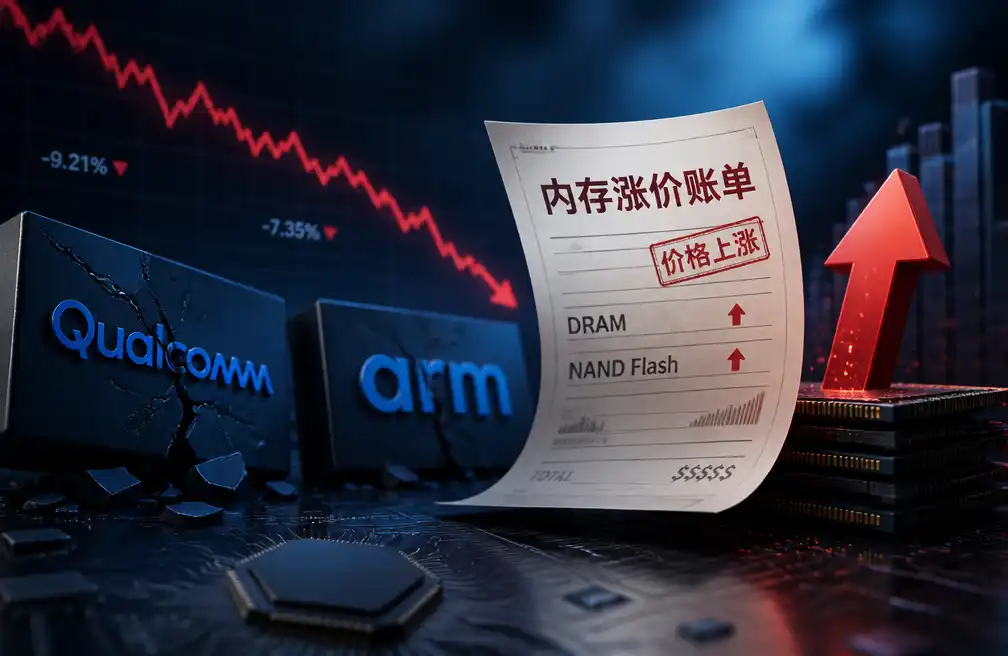
Qualcomm and Arm Fall Together: The Bill for Memory Price Hikes Finally Arrives at Mobile Chip Companies

After posting Q2 FY2026 results, Qualcomm and Arm both saw their shares decline, reflecting the impact of memory price increases on the smartphone chip sector. Qualcomm's revenue of $9.95B slightly beat expectations, but EPS of $2.21 fell short. More concerning was its guidance for next quarter, with EPS projections below analyst estimates. The company directly attributed a >$1.50 per share annual EPS headwind to rising memory costs and supply constraints in Android phones, prompting planned price hikes. While automotive revenue grew 61% and is approaching one-third of phone revenue, the mobile segment declined 20%. Qualcomm also confirmed a significant reduction in its modem share for the upcoming iPhone and outlined a plan for data center revenue to replace all Apple-related income by FY2027. Arm's results surpassed expectations with revenue of $1.29B and EPS of $0.45, and its guidance was also strong. However, its stock fell. Key concerns included royalty revenue failing to set a new record and a downward revision to full-year royalty growth guidance from ~20% to the high-teens, citing weak smartphone demand and high memory prices. Despite robust growth in its data center business, Arm's premium valuation (over 100x forward P/E) means even beating expectations isn't enough to push the stock higher, as any sign of uncertainty is magnified. Ongoing global antitrust investigations add another risk factor. The situation highlights a broader shift. Memory price surges, which boosted Samsung's profits, are now pressuring chip designers. Meanwhile, the semiconductor sector saw significant corrections in July, with the hardest-hit stocks often being those with the biggest AI-driven gains year-to-date. Qualcomm, lacking such a premium, was an exception.

marsbit18m ago

Qualcomm and Arm Fall Together: The Bill for Memory Price Hikes Finally Arrives at Mobile Chip Companies

marsbit18m ago

13 Business Lines Surpass $100 Million in Annualized Revenue, Robinhood Moves Toward a 'Super Financial App'

Robinhood Q2 2026 Earnings: Record Revenue and a Push Towards a "Super Financial App" Robinhood (HOOD) reported strong Q2 2026 results, with net revenue reaching $1.308 billion, up 32% year-over-year, and net income hitting $561 million, a 45% increase. The company now has 13 distinct business lines each generating over $100 million in annualized revenue. Key drivers included a 44% surge in transaction-based revenue to $776 million, led by a more than 10x growth in "event contracts" (prediction markets) and strong performance in stocks and options. User metrics also grew, with funded accounts rising to 28.4 million and total assets under custody reaching $369 billion. The Robinhood Gold subscription service hit a record 4.8 million users. The report highlights a strategic shift for Robinhood. Moving beyond its core as a zero-commission trading platform for retail investors, it is actively building a broader financial ecosystem. This includes expanding into wealth management (Robinhood Strategies), payments (Robinhood Credit Card), and next-generation infrastructure like AI-powered "Agentic Trading" and its own Ethereum Layer 2 blockchain, Robinhood Chain. The company's goal is to evolve from a trading app into a comprehensive "super financial app," offering a one-stop shop for investing, cash management, and future on-chain finance.

Odaily星球日报48m ago

13 Business Lines Surpass $100 Million in Annualized Revenue, Robinhood Moves Toward a 'Super Financial App'

Odaily星球日报48m ago

13 Business Lines Surpass $100 Million in Annualized Revenue, Robinhood Advances Toward a 'Super Financial App'

On July 30th, Robinhood (HOOD) reported its Q2 2026 financial results, showcasing significant growth with record revenue and profits. The company achieved a net revenue of $1.308 billion, a 32% year-over-year (YoY) increase, and a net income of $561 million, up 45% YoY. This strong performance was driven by robust trading activity and expansion into new financial services. A key highlight was the surge in transaction-based revenue, which rose 44% YoY to $776 million. Notably, income from event contracts (prediction markets) skyrocketed over 10x to $156 million, emerging as a major new growth driver alongside strong gains in stock and options trading. However, crypto trading revenue declined by 38%. Beyond trading, Robinhood is successfully diversifying its revenue streams. User assets grew 32% to $369 billion, and the subscription service Robinhood Gold reached a record 4.8 million users. The company revealed that 13 of its business lines now generate over $100 million in annualized revenue, including its new credit card, prediction markets, and Gold subscriptions. Looking forward, Robinhood is strategically investing in AI and blockchain to build a comprehensive financial ecosystem. It has launched AI-powered "Agentic Trading" and the "Robinhood Chain," a layer-2 blockchain network. The company's vision is evolving from a retail trading platform into a "super financial app" that integrates trading, wealth management, payments, and next-generation digital asset services, though regulatory hurdles remain for some new ventures.

marsbit48m ago

13 Business Lines Surpass $100 Million in Annualized Revenue, Robinhood Advances Toward a 'Super Financial App'

marsbit48m ago

Trading

Spot

Hot Articles

How to Buy PUSH

Welcome to HTX.com! We've made purchasing Push Protocol (PUSH) simple and convenient. Follow our step-by-step guide to embark on your crypto journey.Step 1: Create Your HTX AccountUse your email or phone number to sign up for a free account on HTX. Experience a hassle-free registration journey and unlock all features.Get My AccountStep 2: Go to Buy Crypto and Choose Your Payment MethodCredit/Debit Card: Use your Visa or Mastercard to buy Push Protocol (PUSH) instantly.Balance: Use funds from your HTX account balance to trade seamlessly.Third Parties: We've added popular payment methods such as Google Pay and Apple Pay to enhance convenience.P2P: Trade directly with other users on HTX.Over-the-Counter (OTC): We offer tailor-made services and competitive exchange rates for traders.Step 3: Store Your Push Protocol (PUSH)After purchasing your Push Protocol (PUSH), store it in your HTX account. Alternatively, you can send it elsewhere via blockchain transfer or use it to trade other cryptocurrencies.Step 4: Trade Push Protocol (PUSH)Easily trade Push Protocol (PUSH) on HTX's spot market. Simply access your account, select your trading pair, execute your trades, and monitor in real-time. We offer a user-friendly experience for both beginners and seasoned traders.

4.1k Total ViewsPublished 2024.03.29Updated 2026.06.02

How to Buy PUSH

Discussions

Welcome to the HTX Community. Here, you can stay informed about the latest platform developments and gain access to professional market insights. Users' opinions on the price of PUSH (PUSH) are presented below.

活动图片