Crypto Morning Brief: New Virtual Currency Regulations Introduced, Major Unlocks for AVAX, APT, STRK, and Other Tokens This Week

marsbitPublished on 2026-02-09Last updated on 2026-02-09

Abstract

Cryptocurrency Daily Digest: Key regulatory and market developments occurred. China's central bank and seven other ministries jointly issued a notice explicitly banning all virtual currency transactions and Real World Asset (RWA) tokenization businesses, declaring such activities illegal financial operations. In other news, the White House will hold its next stablecoin policy meeting next Tuesday. Illinois proposed a state-operated Bitcoin reserve program. Michael Saylor hinted at potential Bitcoin purchases by MicroStrategy following his social media post. Significant token unlocks are scheduled this week: AVAX ($15.2M unlock on Feb 11), APT ($12.3M on Feb 10), STRK ($6.3M on Feb 15), among others. Additional updates include: 21Shares filed for an Ondo ETF, Bithumb announced full compensation for a major BTC distribution error, and Li Bin denied rumors about investment and token sales. The Nikkei 225 index surged 4%. Market analysts suggest potential consolidation among Solana treasury firms amid current conditions.

Author: Deep Tide TechFlow

Yesterday's Market Dynamics

Nikkei 225 Index surges 4.00% intraday, now at 56,437.40 points

Nikkei 225 Index surged 4.00% intraday, now at 56,437.40 points.

Crypto Journalist: Next White House Meeting on Stablecoin Revenue Scheduled for Next Tuesday

According to crypto journalist Eleanor Terrett, informed sources stated that the next round of White House discussions on stablecoin revenue is scheduled for next Tuesday. This meeting will still be held at the staff level, and this time bank representatives themselves will attend, along with industry association representatives.

Illinois Proposes "Community Bitcoin Reserve Act" This Week, Aims to Establish State-Operated Bitcoin Reserve Program

According to Bitcoincom News, the state of Illinois proposed the "Community Bitcoin Reserve Act" this week, aiming to establish a state-operated Bitcoin reserve program using multi-signature cold wallet custody, with the first reserve named Altgeld Bitcoin Reserve. The bill stipulates that BTC in the reserve can only be traded or sold after new legislative authorization.

Central Bank and Seven Other Departments Jointly Issue Notice: Comprehensive Ban on Virtual Currency Trading and RWA Tokenization Business

The People's Bank of China, jointly with seven other departments, issued the "Notice on Further Preventing and Disposing of Risks Related to Virtual Currency and Other Activities" (Yin Fa [2026] No. 42) today, clarifying that virtual currency does not have legal tender status and related business activities constitute illegal financial activities.

The notice prohibits virtual currency trading and Real World Asset (RWA) tokenization activities within China. Without approval from relevant departments, domestic entities are not allowed to issue virtual currency or conduct tokenization business overseas.

Financial institutions are prohibited from providing services for related activities, and internet companies are prohibited from providing online venues and promotional services. The notice requires strengthening risk monitoring and industry supervision, and cracking down on related illegal and criminal activities. This notice takes effect from the date of issuance, simultaneously repealing the 2021 relevant regulations.

Bloomberg Analyst: 21Shares Has Filed Ondo ETF Application

Bloomberg Senior ETF Analyst Eric Balchunas disclosed via a post that 21Shares has submitted an Ondo ETF application document.

ETH in Yi Lihua's On-Chain Address Completely Liquidated

According to Arkham data, the on-chain address associated with Yi Lihua transferred the final 534 ETH to Binance. The ETH in his on-chain address has been completely liquidated, currently holding only 0.165 ETH.

Bithumb: To Provide Full Compensation for Customers Affected by "Incorrectly Issuing 620,000 BTC" Incident

According to an official announcement, South Korean cryptocurrency exchange Bithumb released a comprehensive compensation plan for the "incorrect issuance of 620,000 BTC" incident that occurred on February 6th. Bithumb承诺 to provide affected customers with 110% special compensation, with estimated losses around 10 billion KRW.

The announcement stated that Bithumb will strengthen its internal control system, including upgrading the asset verification system, improving multi-level approval processes, enhancing abnormal transaction detection and automatic blocking AI systems, and conducting system audits through global security professional agencies.

Additionally, Bithumb will provide 20,000 KRW compensation to all users who logged in during the incident period, offer zero-fee trading for all users for 7 days, and establish a "Customer Protection Fund" with a scale of 100 billion KRW to ensure the security of customer assets.

Li Lin Responds to Rumors: Not an Investor in LD or Garrett Gin, Did Not Reduce BTC or ETH Holdings During This Market Cycle

Huobi founder Li Lin stated in a post, "I am not an investor in LD or Garrett Gin, and did not reduce my Bitcoin or Ethereum holdings during this market cycle. I have been resting for many years, but almost every year I still need to clarify related rumors."

FWDI CIO: If Industry Faces Funding Shortage, Will Adopt Offensive Strategy and Integrate Other SOL Treasury Companies

According to Coindesk, Ryan Navi, Chief Investment Officer of the largest Solana treasury company Forward Industries (FWDI), stated that market mispricing is creating opportunities. Forward has no debt; if the industry faces a funding shortage, it will adopt an offensive strategy and integrate other SOL treasury companies.

FWDI holds nearly 7 million SOL, making it the listed company with the largest SOL reserves, more than the sum of its next three competitors.

Ryan Navi reiterated, "A leverage-free balance sheet is the true advantage in the crypto treasury market. While others are defending, Forward Industries will maintain an overweight position. The future will also be without leverage, without debt, and we view Solana as a long-term investment in strategic infrastructure, not short-term speculation."

Michael Saylor Again Posts Bitcoin Tracker Information, May Increase Bitcoin Holdings Next Week

MicroStrategy founder and executive chairman Michael Saylor posted information related to the Bitcoin Tracker on platform X again, writing "Orange Dots Matter.".

Based on previous patterns, MicroStrategy always discloses Bitcoin acquisition information the day after related messages are posted.

Major Unlocks for AVAX, APT, STRK, and Other Tokens This Week

Token Unlocks data shows that multiple cryptocurrency projects will undergo token unlocks this week.

CONX will unlock 1.32 million tokens on February 15, worth approximately $15.6 million, 1.56% of circulating supply;

AVAX will unlock 1.67 million tokens on February 11, worth approximately $15.2 million, 0.32% of circulating supply;

APT will unlock 11.31 million tokens on February 10, worth approximately $12.3 million, 0.69% of circulating supply;

STRK will unlock 127 million tokens on February 15, worth approximately $6.3 million, 4.61% of circulating supply;

SEI will unlock 55.56 million tokens on February 15, worth approximately $4.2 million, 1.03% of circulating supply;

MOVE will unlock 164 million tokens on February 9, worth approximately $3.8 million, 5.46% of circulating supply;

ME will unlock approximately 1.48 million tokens on February 9, worth approximately $1.48 million, 2.32% of circulating supply;

LINEA will unlock approximately 4.38 million tokens on February 10, worth approximately $4.38 million, 5.96% of circulating supply.

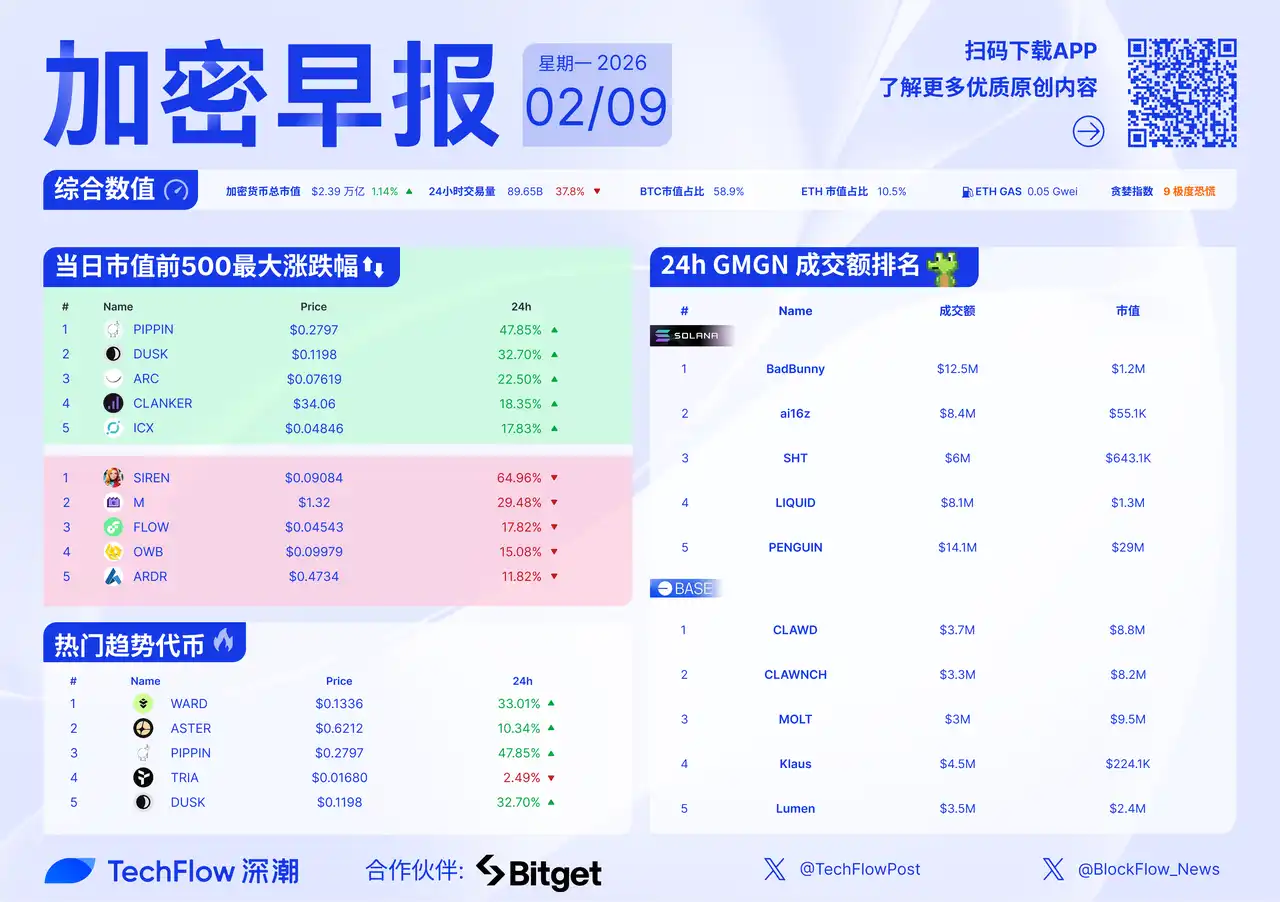
Market Dynamics
Recommended Reading

Dialogue with Jeff Park: We Are in a Bear Market, Quantitative Easing No Longer Effective, Silver Will Crash Like Altcoins

This article explores the current changing trends in the Bitcoin market, fluctuations in the precious metals market, and the future direction of the Federal Reserve and fiscal policy. Through a dialogue format, it provides an in-depth analysis of the relationship between Bitcoin and the global economic environment, and introduces the concept of "positive correlation Bitcoin." The article also discusses the potential of Kevin Warsh as Fed Chair and the current situation and future of the silver market.

Interpreting MicroStrategy's Latest Earnings Report: After a $12.4 Billion Loss, How Long Can the Bitcoin Flywheel Keep Spinning?

This article analyzes the close relationship between MicroStrategy and Bitcoin. The earnings report shows its operating condition heavily relies on Bitcoin price fluctuations. Although its capital operations perform excellently, in the long run, a continuous decline in Bitcoin price may threaten its operational model.

Forbes Editorial, The Most Accurate Short Signal in Crypto?

This article explores the relationship between the cryptocurrency market and Forbes magazine cover figures, pointing out that market frenzies often peak when mainstream media pays attention. It analyzes the logic behind this phenomenon through multiple cases, including the experiences of crypto figures like CZ, SBF, and Michael Saylor.

Bloodbath in US Stocks, Bitcoin, and Silver: A Bizarre Global Asset Massacre

This article discusses the "liquidity black hole" style asset massacre experienced by global markets on February 6th, where multiple asset classes including US stocks, silver, and cryptocurrencies fell sharply simultaneously. Despite no obvious external black swan event, a liquidity crisis became the core reason for this market crash. The article analyzes the causes of this global market turmoil in detail from the perspectives of changes in US stocks, silver, cryptocurrencies, and the Japanese government bond market.

Darkest Hour for Crypto, Real Vision Founder: Hold Firmly, Buy the Dip Boldly

This article describes the current market being in a低迷 state, with investors普遍 feeling panic and confusion, but the author emphasizes holding firmly and buying the dip boldly. It highlights the advantages of long-term holding and分批加仓, pointing out that high market volatility is a price that must be accepted. The author is optimistic about the future market, believing the current market低迷 is a panic sell-off within a bull market, and plans to continue buying the dip on crypto assets.


Related Questions

QWhat is the key content of the new virtual currency regulation issued by the People's Bank of China and seven other departments?

AThe new regulation explicitly states that virtual currencies do not have legal tender status and related business activities are illegal financial activities. It prohibits virtual currency trading and Real World Asset (RWA) tokenization activities within China. It also mandates that domestic entities cannot issue virtual currencies or conduct tokenization business overseas without approval from relevant departments.

QWhich tokens are scheduled for significant unlocks this week according to the article?

AAccording to the article, the tokens scheduled for significant unlocks this week are: CONX, AVAX, APT, STRK, SEI, MOVE, ME, and LINEA.

QWhat did the US state of Illinois propose regarding Bitcoin this week?

AThe US state of Illinois proposed the 'Community Bitcoin Reserve Act', which aims to establish a state-operated Bitcoin reserve program. The plan involves using multi-signature cold wallets for custody, with the first reserve named the Altgeld Bitcoin Reserve. The legislation stipulates that BTC in the reserve can only be traded or sold after new legislative authorization.

QWhat action did Michael Saylor hint at with his post 'Orange Dots Matter.'?

ABased on previous patterns, Michael Saylor's post 'Orange Dots Matter.' on the X platform, which included Bitcoin Tracker information, is a hint that his company, MicroStrategy, is likely to announce another purchase of Bitcoin the following day.

QWhat was Bithumb's response to the 'misissuance of 620,000 BTC' incident?

ABithumb announced a comprehensive compensation plan for customers affected by the incident. They promised to provide 110% special compensation to affected clients, estimated at a loss of about 10 billion KRW. Additionally, they will offer 20,000 KRW to all users who logged in during the incident period, provide zero-fee trading for all users for 7 days, and establish a 'Customer Protection Fund' with a scale of 100 billion KRW to ensure the safety of customer assets.

Related Reads

Jensen Huang 'Saves' South Korean Stock Market: Locks In SK Hynix Memory, Chip Shortage to Continue

On June 5th, South Korea's stock market experienced a sharp decline, with major chipmakers like Samsung and SK Hynix dropping nearly 10%. Amidst the turmoil, NVIDIA CEO Jensen Huang's visit to Seoul played a dramatic role in boosting market sentiment. Following a dinner meeting with SK Group Chairman Chey Tae-won and SK Hynix CEO Kwak Noh-Jung, Huang confirmed that NVIDIA's new Vera CPU will utilize SK Hynix DRAM. The companies announced a multi-year technical partnership to co-develop next-generation memory for NVIDIA's AI infrastructure, covering products from data centers to personal AI and robotics. This collaboration extends beyond memory supply. SK Hynix is integrating NVIDIA's AI and Omniverse platform into its own semiconductor design and manufacturing processes, including computational lithography and creating digital twins of its fabrication plants for autonomous operation. While strengthening ties with SK Hynix, NVIDIA is diversifying its supply chain for the upcoming HBM4 memory, with Samsung, SK Hynix, and Micron all certified as suppliers for its Vera Rubin platform. Despite this, Huang warned that the global chip shortage, driven by relentless demand from AI factory construction, is expected to persist for several years across the entire supply chain. His visit underscores NVIDIA's systematic effort to deepen integration with South Korea's broader tech industry.

marsbit24m ago

Jensen Huang 'Saves' South Korean Stock Market: Locks In SK Hynix Memory, Chip Shortage to Continue

marsbit24m ago

Nasdaq Plunges 4.2% in a Single Day: Does "Black Friday" Burst the U.S. Stock Market Bubble?

The Nasdaq plunged 4.18% on June 5, 2026, its worst single-day drop in over a year, as a much stronger-than-expected US jobs report triggered fears of economic overheating and delayed Federal Reserve interest rate cuts. The selloff, centered on high-valuation tech and AI stocks like Nvidia and Broadcom, spread across major indices. The article examines whether this signals a market top. The strong May non-farm payrolls data, nearly double expectations, pushed bond yields higher, directly hurting rate-sensitive tech stocks. This exposed vulnerabilities in the crowded AI trade, where valuations had soared on narratives of infinite growth, despite emerging signs of slowing order momentum and corporate AI monetization challenges. Prior to the drop, market indicators flashed warning signs: historically high valuations (e.g., Shiller CAPE ratio near 39.5), extreme bullish sentiment, and high levels of leverage. Technical charts showed key support levels being breached. Wall Street is divided on the outlook. Bears, citing risks of "stagflation" and AI bubble comparisons to the dot-com era, warn of a potential significant correction. Bulls view the drop as a healthy correction within a bull market, underpinned by a strong economy and expected corporate earnings growth of around 7% in 2026. The immediate future hinges on upcoming key events: the May CPI inflation data and the mid-June FOMC meeting. Their outcomes will critically shape market expectations for the Fed's rate path. The article concludes that conditions for a major market top are aligning, marking a fragile transition from narrative-driven gains to a phase demanding validation from macroeconomic data and corporate fundamentals. Caution is advised.

marsbit28m ago

Nasdaq Plunges 4.2% in a Single Day: Does "Black Friday" Burst the U.S. Stock Market Bubble?

marsbit28m ago

Nasdaq Plunges 4.2% in a Single Day, Did 'Black Friday' Pop the U.S. Stock Bubble?

The Nasdaq Composite plummeted 4.18% on June 5, its biggest single-day drop since April 2025, triggering widespread debate over whether the U.S. stock market has peaked. The sell-off was sparked by a stronger-than-expected U.S. non-farm payrolls report, which fueled fears of economic overheating and pushed back market expectations for Federal Reserve rate cuts, leading to a sharp rise in Treasury yields. The AI sector, the primary driver of the recent bull market, suffered severe losses, with the Philadelphia Semiconductor Index crashing over 10%. Stocks like Nvidia, Broadcom, and Micron led the decline. Concerns are mounting about the sustainability of AI capital expenditures and high valuations, with signs of order cuts for next-generation chips emerging. Analyses point to several warning signs: historically high market valuations (e.g., elevated Shiller CAPE ratio, Buffett Indicator), extreme bullish sentiment indicators, and significant insider selling. The sell-off also caused a key technical breakdown, with the S&P 500 breaking below its short-term moving average and testing its 200-day moving average. Wall Street is divided on the outlook. Bears warn this could be the start of a bubble deflation or a "stagflation" scenario, while bulls view it as a healthy, overdue correction within a bull market driven by solid corporate earnings growth. A more moderate view suggests the easy liquidity-driven rally is over, and markets are entering a phase of fundamental stock-picking with potential for consolidation. The immediate future hinges on key upcoming events: the May CPI report and the mid-June FOMC meeting. Their outcomes will be critical in determining whether this is a temporary pullback or the beginning of a more significant trend reversal. The consensus is that the era of one-directional market gains may be ending, requiring increased investor caution.

Odaily星球日报34m ago

Nasdaq Plunges 4.2% in a Single Day, Did 'Black Friday' Pop the U.S. Stock Bubble?

Odaily星球日报34m ago

The First Case on AI Agents: What Was Adjudicated?

"The First 'Agent' Ruling: What Was Decided?" On April 30, the Guangzhou Internet Court issued a ruling—China's first behavior preservation order in the intelligent agent (AI agent) field. The defendant, an open-source AI agent software, was ordered to stop downloads, cease actions that bypassed a platform's technical protection measures, and delete related tutorials and data. The core issue: the software used the operating system's "accessibility service" permissions to automate user interactions within other apps without those platforms' authorization. This mirrors a recent US case where Amazon sued Perplexity for similar reasons—bypassing Amazon's API to directly scrape and interact with its pages—and won a preliminary injunction. Both rulings establish a crucial legal boundary for the AI agent era: agents cannot operate unchecked. The article argues the fundamental legal principle emerging is one of **dual authorization**. An AI agent requires both **user consent** AND **platform consent** to operate legitimately within that platform's ecosystem. Bypassing platform rules through system-level permissions, even with user permission, undermines platform responsibilities for content moderation, data security, and user privacy, creating liability issues. The piece uses the evolution of "Doubao Phone" (an AI-integrated smartphone) as a case study. Its initial, aggressive version that bypassed platform controls faced roadblocks. Its upcoming 2.0 version is reportedly pivoting to negotiate API access and authorization deals with major platforms (like Alibaba's ecosystem), seen as a strategic adaptation to the new regulatory reality. A global trend is identified: the era of unregulated, "wild west" growth for AI agents is ending, replaced by a **compliance race**. This raises barriers to entry, as securing platform authorizations becomes a new cost. Open-source status is also not a legal shield if the code facilitates bypassing technical protections. In conclusion, these first rulings target not the largest, but the most **aggressive and representative** cases. By setting precedent with them, regulators are efficiently steering the entire industry towards a new, more regulated operating paradigm defined by dual authorization and platform cooperation.

marsbit38m ago

The First Case on AI Agents: What Was Adjudicated?

marsbit38m ago

Fired by Google Over a 14-Page Paper, Over 4,000 Rallied for Her. 6 Years Later: She Almost Predicted the Entire AI Era Back Then.

In late 2020, Google AI researcher Timnit Gebru was effectively dismissed following a conflict over a 14-page, unpublished research paper she co-authored titled "On the Dangers of Stochastic Parrots." The paper, which has since been cited over 14,000 times, raised critical early warnings about the risks of large language models (LLMs). It argued that these models, trained on vast, biased internet data, are essentially "stochastic parrots" that mimic language without true understanding, potentially amplifying societal biases, generating plausible but false information (later termed "AI hallucination"), consuming massive energy, and obscuring their training data contents. Gebru's stance led to a clash with Google management, who requested the paper's withdrawal. Her subsequent internal criticism of the company's diversity efforts and handling of the matter culminated in her termination, which sparked protests from over 4,000 Google employees and researchers. Six years later, the paper's predictions have proven remarkably prescient. Issues like AI hallucination, embedded bias (evident in resume screening and healthcare algorithms), soaring energy consumption from AI data centers, unvetted training data containing harmful content, and the risk of "model collapse" from AI-generated internet content have become central industry challenges. The incident also highlighted concerns about AI development being driven primarily by commercial competition within a handful of powerful tech companies, often at the expense of ethical considerations. After leaving Google, Gebru founded the Distributed AI Research Institute (DAIR) to explore these issues independently. The controversy underscores how her early, critical insights into the fundamental limitations and societal impacts of LLMs anticipated many of the most pressing dilemmas in today's AI era.

marsbit40m ago

Fired by Google Over a 14-Page Paper, Over 4,000 Rallied for Her. 6 Years Later: She Almost Predicted the Entire AI Era Back Then.

marsbit40m ago

Trading

Spot
Futures

Hot Articles

How to Buy APT

Welcome to HTX.com! We've made purchasing Aptos (APT) simple and convenient. Follow our step-by-step guide to embark on your crypto journey.Step 1: Create Your HTX AccountUse your email or phone number to sign up for a free account on HTX. Experience a hassle-free registration journey and unlock all features.Get My AccountStep 2: Go to Buy Crypto and Choose Your Payment MethodCredit/Debit Card: Use your Visa or Mastercard to buy Aptos (APT) instantly.Balance: Use funds from your HTX account balance to trade seamlessly.Third Parties: We've added popular payment methods such as Google Pay and Apple Pay to enhance convenience.P2P: Trade directly with other users on HTX.Over-the-Counter (OTC): We offer tailor-made services and competitive exchange rates for traders.Step 3: Store Your Aptos (APT)After purchasing your Aptos (APT), store it in your HTX account. Alternatively, you can send it elsewhere via blockchain transfer or use it to trade other cryptocurrencies.Step 4: Trade Aptos (APT)Easily trade Aptos (APT) on HTX's spot market. Simply access your account, select your trading pair, execute your trades, and monitor in real-time. We offer a user-friendly experience for both beginners and seasoned traders.

2.3k Total ViewsPublished 2024.03.29Updated 2026.06.02

How to Buy APT

Discussions

Welcome to the HTX Community. Here, you can stay informed about the latest platform developments and gain access to professional market insights. Users' opinions on the price of APT (APT) are presented below.

活动图片












