Crypto Market Structure Bill Paused: Senate Banking Cancels Markup

bitcoinistPublished on 2026-01-15Last updated on 2026-01-15

Abstract

The Senate Banking Committee has postponed the markup of a crypto market structure bill following opposition from Coinbase CEO Brian Armstrong, who argued the current draft is "materially worse than the status quo" and would effectively ban tokenized equities, restrict DeFi, and stifle innovation. Committee Chairman Tim Scott described the delay as a tactical pause to continue bipartisan negotiations, emphasizing the goal of establishing clear rules to protect consumers and national security. The move has split the crypto industry, with firms like a16z, Circle, and Ripple expressing support for the legislative effort, while others, including Bitwise Asset Management, sided with Coinbase's stance that "no bill is better than a bad bill." Despite the setback, key figures like Galaxy Digital's Mike Novogratz remain optimistic about a eventual compromise, noting ongoing good-faith discussions among lawmakers. The total crypto market cap was $3.22 trillion at the time of reporting.

The Senate Banking Committee has pulled the scheduled Thursday markup of its crypto asset market structure bill after a late-stage flare-up with Coinbase, freezing what had looked like a tightening path toward action. The pause lands at a sensitive moment for Washington’s crypto negotiations: industry heavyweights are publicly splitting over the Senate draft even as lawmakers insist bipartisan talks are still alive.

Senate Banking Committee Chairman Tim Scott (R-S.C.) said Wednesday the committee will postpone the markup “as bipartisan negotiations continue,” framing the delay as tactical rather than terminal. “I’ve spoken with leaders across the crypto industry, the financial sector, and my Democratic and Republican colleagues, and everyone remains at the table working in good faith,” Scott wrote on X. “As we take a brief pause before moving to a markup, this market structure bill reflects months of serious bipartisan negotiations and real input from innovators, investors, and law enforcement.”

Scott positioned the bill as a foundational framework rather than a narrow industry carveout. “The goal is to deliver clear rules of the road that protect consumers, strengthen our national security, and ensure the future of finance is built in the United States,” he added.

Coinbase Breaks Ranks Late

The immediate catalyst was Coinbase CEO Brian Armstrong, who said the exchange “can’t support the bill as written” after reviewing “the Senate Banking draft text over the last 48hrs.”

Armstrong argued the draft contains multiple provisions he says would be “materially worse than the current status quo,” contending that it amounts to “a defacto ban on tokenized equities,” includes “DeFi prohibitions” that expand government access to financial records and erode privacy, and would “stifl[e] innovation” by weakening the CFTC relative to the SEC.

He also pointed to “draft amendments” he said “would kill rewards on stablecoins,” warning the changes could allow banks to “ban their competition.” Armstrong’s bottom line was blunt: “We’d rather have no bill than a bad bill.” Still, he struck a conciliatory note about process and odds of a compromise, adding he was “quite optimistic” that continued work could produce “the right outcome.”

That posture split the difference between hard opposition to the text and support for continued negotiations,an important distinction as the markup process is typically where senators offer and vote amendments.

Crypto Industry Split

Coinbase’s stance quickly triggered a counter-response from other major crypto firms and advocacy groups backing the Senate Banking GOP’s push. Support was voiced by a16z, Circle, Kraken, The Digital Chamber, Ripple, and Coin Center, coalescing into a public front aimed at keeping momentum intact despite the delay.

Ripple CEO Brad Garlinghouse cast the bill as overdue but directionally positive. “While long-overdue, this move by @SenatorTimScott and @BankingGOP on market structure is a massive step forward in providing workable frameworks for crypto, while continuing to protect consumers,” he wrote. He said Ripple would remain engaged, adding: “We are at the table and will continue to move forward with fair debate. I remain optimistic that issues can be resolved through the mark-up process.”

Meanwhile, Tim Draper said Armstrong’s opposition is justified, arguing the Senate compromise “is worse than no bill at all” and suggesting that “the banks have been meddling.”

Ryan Rasmussen, Head of Research at Bitwise Asset Management , called the current CLARITY Act draft broadly harmful, listing tokenization, stablecoins, DeFi, privacy, builders, users, investors, and innovation, and concluded that the industry would “rather have no bill than a bad bill.”

White House Crypto Czar David Sacks urged the industry to treat the delay as a narrow window to align rather than an opening to splinter. “Passage of market structure legislation remains as close as it’s ever been,” Sacks wrote. “The crypto industry should use this pause to resolve any remaining differences. Now is the time to set the rules of the road and secure the future of this industry.”

Galaxy Digitall’s CEO Mike Novogratz struck a more optimistic tone, saying: “While the crypto bill might be delayed to keep working on it, I am very confident that a bill will get done soon. I have spoken to over 10 senators on both sides of the aisle in the past 24 hrs and I believe they all are working in good faith to get something done. Always gets tense at the end.”

At press time, the total crypto market cap stood at $3.22 trillion.
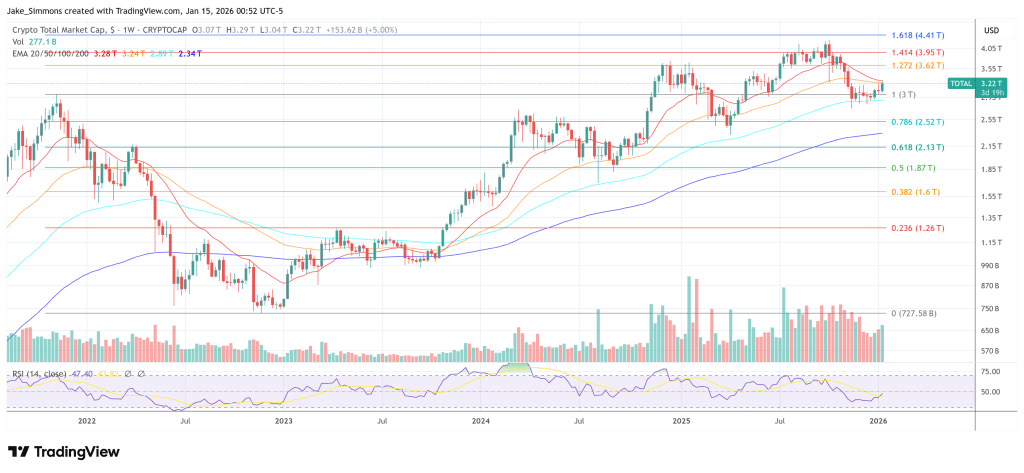
Total crypto market cap needs to overcome the 20-and 50-week EMAs, 1-week chart | Source: TOTAL on TradingView.com

Related Questions

QWhy did the Senate Banking Committee postpone the markup of the crypto market structure bill?

AThe Senate Banking Committee postponed the markup to allow more time for bipartisan negotiations to continue, as stated by Chairman Tim Scott, who framed the delay as tactical rather than terminal.

QWhat were Coinbase CEO Brian Armstrong's main objections to the draft bill?

ABrian Armstrong argued the draft bill contained provisions that would be 'materially worse than the current status quo,' including a de facto ban on tokenized equities, DeFi prohibitions that expand government access to financial records, and measures that would stifle innovation by weakening the CFTC relative to the SEC.

QWhich major crypto firms and advocacy groups publicly supported the Senate Banking GOP's push for the bill?

ASupport for the bill was voiced by a16z, Circle, Kraken, The Digital Chamber, Ripple, and Coin Center.

QWhat was the overall sentiment of Ripple CEO Brad Garlinghouse regarding the bill?

ABrad Garlinghouse viewed the bill as a long-overdue but massive step forward, calling it a positive framework for crypto that protects consumers, and he remained optimistic that issues could be resolved through the mark-up process.

QHow did White House Crypto Czar David Sacks advise the crypto industry to respond to the delay?

ADavid Sacks urged the industry to use the pause as a narrow window to resolve remaining differences and align, rather than splinter, emphasizing that this is the time to set the rules of the road and secure the industry's future.

Related Reads

380,000 Apps Exposed, 2,000+ Apps Leaked Secrets: AI Programming Turns 'Intranet' into Public Internet

Israeli cybersecurity firm RedAccess uncovered a severe data exposure trend linked to "vibe coding" or AI-powered software development tools. Their research found approximately 38,000 publicly accessible web applications built with platforms like Lovable, Base44, Netlify, and Replit. Of these, an estimated 2,000 apps exposed sensitive corporate and personal data, including medical records, financial information, internal strategic documents, and customer chat logs. In some cases, access even granted administrative privileges. The core issue stems from default privacy settings that make applications public by default, combined with a lack of built-in security controls (like authentication) in the AI-generated code. This allows employees without security expertise—"citizen developers"—to easily create and deploy applications that bypass standard corporate security reviews. The exposed apps, often indexed by search engines, are trivially discoverable. While some platform providers (Replit, Lovable, Wix/Base44) argue that security configuration is the user's responsibility and question the validity of some findings, security researchers confirm the widespread reality of such exposures. This pattern, also noted in prior studies, highlights a critical security gap as AI democratizes app creation, potentially leading to massive, unintentional data leaks.

marsbit34m ago

380,000 Apps Exposed, 2,000+ Apps Leaked Secrets: AI Programming Turns 'Intranet' into Public Internet

marsbit34m ago

Attracting Global Capital, Asia's New 'Super Cycle' Is Unfolding

Investors are turning to Asia as the next frontier for global equity growth, with a new "super cycle" unfolding across the region. Driven by the AI revolution, Asian markets, particularly South Korea, have seen significant rallies. According to Morgan Stanley analysis, the underlying drivers of Asia's industrial cycle are shifting from traditional sectors like real estate and manufacturing to massive investments in AI infrastructure, energy security and transition, and supply chain resilience. Fixed asset investment in Asia is projected to grow from around $11 trillion in 2025 to $16 trillion by 2030, with a 7% annual growth rate from 2026-2030. The AI wave is a primary catalyst, driving immense capital expenditure for chips, servers, data centers, and power systems. Asia is central to this hardware supply chain. In China, AI investment is focused on building a full-system domestic capability, with the local AI chip market potentially reaching $86 billion by 2030. Beyond AI, China's export story is expanding from EVs and batteries to robotics. The country already captures about half of new global industrial robot demand and over 90% of humanoid robot shipments. This growth phase mirrors the early stages of China's EV export boom. Simultaneously, energy security investments, spurred by AI's massive power needs, are rising, with China benefiting from its leadership in solar, batteries, and EVs. Regional defense spending is also increasing structurally, supporting demand for advanced manufacturing. The main beneficiaries are China, South Korea, and Japan, positioned in core supply chain areas. However, risks remain, including potential overcapacity, profit margin pressures from competition, persistent technological restrictions, geopolitical friction, and workforce displacement due to AI-driven automation. Market volatility is also expected to increase as investor expectations diverge on the realization of these capital investment and export themes.

marsbit35m ago

Attracting Global Capital, Asia's New 'Super Cycle' Is Unfolding

marsbit35m ago

Funding Weekly Report | 14 Public Funding Events, Kalshi Completes $10B New Funding Round at $220B Valuation Led by Coatue Management

Weekly Funding Roundup: 14 Deals and $10.49B+ in Total Funding, Led by Kalshi's $1B Round Last week (5.4-5.10) saw 14 notable funding events in the global blockchain ecosystem, raising over $10.49 billion in total. Key highlights include Kalshi, a prediction market platform, securing a $1 billion round led by Coatue Management, reaching a $22 billion valuation. The platform now boasts ~2 million MAUs and $178B in annualized trading volume. In DeFi, regulated on-chain reinsurer OnRe raised $5 million in Series A funding, and Bitcoin-backed credit protocol Saturn Credit completed a $2 million seed round. For Infrastructure & Tools, OpenTrade raised $17 million to expand its stablecoin yield infrastructure, and RWA platform Balcony secured $12.7 million to deploy its property settlement service in the US. Centralized Finance saw one deal: AI-driven trading platform Stockcoin.ai completed a seed round led by Amber Group. In the prediction market sector alongside Kalshi, AI-powered platform Elastics raised $2 million. Other notable deals include SC Ventures' strategic investment in crypto market maker GSR and Centrifuge securing a "seven-figure" investment from Coinbase to become a core RWA partner for Base. On the investor side, Haun Ventures raised a new $1 billion fund targeting crypto and AI, and Multi Investment raised ~$616 million to focus on blockchain and Web3 investments.

marsbit1h ago

Funding Weekly Report | 14 Public Funding Events, Kalshi Completes $10B New Funding Round at $220B Valuation Led by Coatue Management

marsbit1h ago

Trading

Spot
Futures
活动图片