Crypto Dream Turns Nightmare As SafeMoon CEO Gets 100 Months In Jail

bitcoinistPublished on 2026-02-11Last updated on 2026-02-11

Abstract

SafeMoon CEO Braden John Karony has been sentenced to 100 months in US federal prison after being convicted on charges of securities fraud, wire fraud, and money laundering. Prosecutors proved that Karony and others misled investors by falsely claiming that SafeMoon’s liquidity pools were locked, while secretly diverting over $9 million for personal use, including luxury homes and vehicles. The fraud severely impacted small investors, including military veterans and hard-working Americans. The court has ordered forfeiture of approximately $7.5 million, with restitution proceedings ongoing to return funds. The case highlights continued law enforcement focus on prosecuting crypto-related fraud.

Braden John Karony, the one-time CEO of SafeMoon, has been sentenced to 100 months in US federal prison after a jury found him guilty of multiple fraud counts.

According to courtroom records and Justice Department statements, he was convicted on charges that included securities fraud, wire fraud, and money laundering.

Reports say prosecutors proved that investors were told liquidity was secure when it was not, and that insiders were able to move funds for personal gain.

“Not only did Braden John Karony abuse his position as CEO, but he also betrayed his investors’ trust by stealing over $9 million in crypto from his company to fund his lavish lifestyle,” James C. Barnacle, Jr., FBI assistant director, said.

SafeMoon: False Locks And Hidden Transfers

Reports note that Karony and others told buyers that SafeMoon’s liquidity pools were “locked,” a claim that calmed many who put money into the token. Instead, prosecutors showed how more than $9 million was diverted from those pools.

He used some of the money to buy high-end homes and vehicles. The FBI described the moves as deliberate. Victims included small investors and people on modest incomes. Some lost savings. It left trust badly shaken.

According to US Attorney Joseph Nocella, Jr. Karony “lied to investors from all walks of life — including military veterans and hard-working Americans.”

The Trial And Conviction

The trial ran for three weeks in May 2025. A jury returned guilty verdicts across the board. Based on reports, sentencing was handled by US District Judge Eric Komitee in the Eastern District of New York.

The Justice Department sought a stiff term, and the court obliged. One former executive, Thomas Smith, has pleaded guilty and faces his own punishment.

Other co-founders are still under scrutiny. Reports say authorities will press to recover funds through forfeiture and restitution orders.

BTCUSD trading at $66,546 on the 24-hour chart: TradingView

Ruined Lives & Lost Money

People who backed SafeMoon often did so because they believed in the project or wanted a new way to invest. Many found out the hard way that promises in promo posts and social feeds can hide real dangers.

Some investors watched balances drop. Others tried to follow the paper trail and grew alarmed when transfers led to private bank accounts and luxury purchases. The case exposed how quickly trust can evaporate when controls fail.

Restitution And Future Cases

The court ordered forfeiture of about $7.5 million, but the full scale of losses is still being worked out in follow-up hearings. Restitution proceedings will aim to return money to victims, but such processes can take time.

Law enforcement in the US has signaled a steady interest in crypto fraud prosecutions. That means more investigations and, likely, more court dates for those accused of similar schemes.

Featured image from John Karony – Medium, chart from TradingView

Trending Cryptos

Related Questions

QWhat was the sentence given to SafeMoon CEO Braden John Karony and for what crimes?

ABraden John Karony was sentenced to 100 months in US federal prison after being found guilty of securities fraud, wire fraud, and money laundering.

QHow much money did the FBI state that Karony stole from the company and for what purpose?

AThe FBI stated that Karony stole over $9 million in crypto from his company to fund his lavish lifestyle, which included buying high-end homes and vehicles.

QWhat specific false claim did Karony and others make to SafeMoon investors about the project's liquidity?

AKarony and others falsely told investors that SafeMoon's liquidity pools were 'locked' to create a sense of security, when in reality, funds were being diverted from them.

QWhat are the two main legal processes mentioned that will be used to attempt to return funds to the victims?

AThe two main legal processes mentioned are forfeiture, with the court ordering the forfeiture of about $7.5 million, and restitution proceedings, which aim to return money to victims.

QAccording to the article, what does the case against Karony signal about US law enforcement's approach to the crypto industry?

AThe case signals that law enforcement in the US has a steady interest in crypto fraud prosecutions, indicating that there will likely be more investigations and court cases for those accused of similar schemes.

Related Reads

Stablecoins Finally Find Real Yield: An In-Depth Look at On-Chain Reinsurance Re | A Conversation with Re Founder Karan Saroya

Stablecoin Real Yield Found: A Deep Dive into On-Chain Reinsurance with Re's Karan Saroya As stablecoin supply exceeds $170 billion, the search for sustainable, non-speculative yield intensifies. Re, an on-chain reinsurance platform, provides an answer: connecting stablecoin capital to the trillion-dollar traditional reinsurance market. Re operates as a regulated reinsurer, accepting stablecoin deposits as collateral to back US insurance companies. These insurers pay premiums, generating yield that flows back to on-chain depositors. Currently supporting 35 insurers and underwriting $500 million, Re projects scaling to over $1 billion soon. Key insights from a Bankless podcast with founder Karan Saroya and investor Avichal of Electric Capital: 1. **Uncorrelated, Real-World Yield:** Re offers stablecoin holders access to reinsurance returns (targeting 12-14%+), an asset class entirely separate from crypto or equity markets. 2. **Operational Efficiency via Smart Contracts:** Re replaces traditional, labor-intensive capital fundraising with smart contracts, allowing a ~12-person team to compete with industry giants. 3. **Regulatory Leverage:** For every $1 of collateral, regulations allow backing $5-7 in written premiums. This leverage amplifies returns from the underlying risk-free rate. 4. **DeFi Integration:** Depositors receive receipt tokens, which can be used in protocols like Morpho for "looping," potentially pushing yields to 18-20%+. 5. **The "DeFi Mullet" Model:** A compliant front-end (regulated reinsurer) paired with a decentralized back-end (smart contracts, DeFi capital markets). 6. **RE Governance Token:** Modeled on Lloyd's of London, the token governs the central capital pool's allocation, counterparty acceptance, and parameters. 7. **Real Economic Impact:** Capital funds real-world productivity (factories, clinics, businesses) via insurance, moving beyond crypto's internal loops. The discussion highlights a pivotal moment: DeFi's supply-side infrastructure is now met by real demand for productive yield, potentially kickstarting a flywheel where vast on-chain stablecoin capital seeks these real-world returns.

链捕手32m ago

Stablecoins Finally Find Real Yield: An In-Depth Look at On-Chain Reinsurance Re | A Conversation with Re Founder Karan Saroya

链捕手32m ago

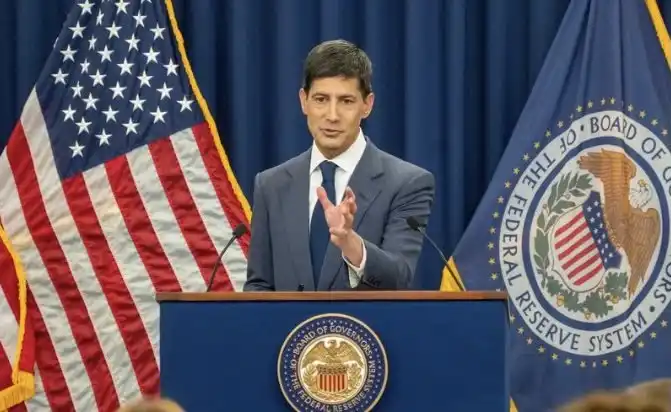
1996 or 1999? Walsh's First Test is 'How to View AI'

"1996 or 1999? Wall's First Big Test Is 'How to View AI'" Federal Reserve Chairman Wall's initial challenge is not whether to raise or cut rates, but a more fundamental judgment: what kind of boom is the current AI boom? This will determine the Fed's policy path and define his legacy. Economics is split between two opposing views, according to reporter Nick Timiraos. One sees imminent productivity gains that will increase supply and cool inflation, allowing the Fed to hold steady. The other argues that while productivity benefits are distant, demand shocks are here now, and waiting for data confirmation risks missing the intervention window, forcing sharper rate hikes later. Wall has signaled a leaning toward the first view, echoing 1996-era Alan Greenspan, who embraced strong, productivity-driven growth without fear of inflation. However, Wall faces a different macro environment than Greenspan did, with tariff pressures, expanding fiscal deficits, and diminishing globalization benefits, which could force more significant inflation pressures even if AI benefits materialize. Wall's logic, expressed before taking office, is that AI-driven productivity gains won't show in official data for years. If the Fed waits for confirmation, it might mistakenly tighten policy and choke off the very growth that could suppress inflation. This argues for using forward-looking narratives over lagging data. Chicago Fed President Austan Goolsbee presents a key counter-argument. He distinguishes between expected and unexpected productivity booms. A widely anticipated boom, like the current AI wave, can cause people to spend future wealth gains in advance, overheating the economy before productivity actually rises, thus requiring preemptive rate hikes. He cites rising costs for AI data centers as evidence of such overheating. Fed Governor Christopher Waller offers a rebuttal to Goolsbee, noting the "expected spending" mechanism only works if people can borrow against future income, which many households cannot do due to borrowing constraints. Wall also faces a paradox related to his desire to reduce the Fed's use of "forward guidance" (pre-announcing policy moves). This practice was established in 1999 when Greenspan began signaling hikes to avoid market shocks. If the economy follows a less optimistic path, Wall may be forced to choose between using the guidance he wants to abolish or risking market volatility by staying silent. The ultimate question defining Wall's first major test remains: Is this 1996 or 1999?

marsbit1h ago

1996 or 1999? Walsh's First Test is 'How to View AI'

marsbit1h ago

Ethereum Q1 2026 Report: Fees Decline, Users and Transaction Volume Hit New Highs

Ethereum Q1 2026 Report: Fees Down, Users & Transactions Hit New Highs Token Terminal's Q1 2026 report on Ethereum presents a pivotal development: the network achieved record highs in monthly active users (13.2M, +85.9% YoY), total transactions (200.4M, +81.5% YoY), and throughput (25.78 TPS), while transaction fees on the mainnet plummeted by 47.9% quarter-over-quarter. This shift is attributed to the network's strategic move into a "low fees for scale" phase, exemplified by the Fusaka upgrade which increased data capacity and lowered block space costs, releasing pent-up demand (a manifestation of Jevons's Paradox). The report highlights a core narrative shift for Ethereum: from a DeFi-centric blockchain to a global financial settlement layer. It maintains a dominant position in tokenized assets, holding majority market shares among top chains in stablecoins (61.8%), tokenized funds (73.0%), and tokenized commodities (84.0%). Growth in tokenized funds (+73.1% YoY) and commodities (+325.9% YoY) was particularly strong, driven by institutions like BlackRock and JPMorgan entering the space. Contrasting these usage gains, several USD-denominated value metrics declined in Q1: fully diluted market cap fell 30.3% QoQ, total value locked (TVL) dropped 11.0%, and ecosystem transaction volume decreased 24.0%. The report interprets this as Ethereum prioritizing long-term network expansion and cementing its role as the default settlement layer for finance over short-term fee capture. The commentary from Etherealize argues that, much like the early internet, Ethereum's open, permissionless model is poised to win over closed alternatives as institutional tokenization accelerates.

marsbit3h ago

Ethereum Q1 2026 Report: Fees Decline, Users and Transaction Volume Hit New Highs

marsbit3h ago

He Just Raised 2.7 Billion, and Li Fei-Fei Also Invested

Pete Florence, a former senior research scientist at Google DeepMind and a key contributor to the Vision-Language-Action (VLA) model architecture, is deliberately distancing his startup, Generalist AI, from the trendy "world model" label. He argues that the industry should prioritize concrete goals over buzzwords. His goal is to create robots that can perform a vast range of unseen tasks with high speed and success rates, without needing task-specific training data. Recently, his company raised $400 million (¥2.7 billion) at a $2 billion valuation. Notable investors include NVIDIA's NVentures, Bezos Expeditions, NFDG, as well as Xiaomi co-founder Lin Bin, Zoom founder Eric Yuan, and renowned AI scientist Fei-Fei Li. Florence's approach stems from his academic background at MIT under Professor Russ Tedrake, focusing on understanding the physical world. After joining DeepMind, he developed models like Transporter Network and co-created the VLA framework. He left in 2025 to found Generalist AI. The company has launched two models: GEN-0, which demonstrated that scaling laws apply to physical motion, and GEN-1. GEN-1 was trained on over 500,000 hours of physical interaction data collected via a specialized wearable device. It achieves a 99% success rate on precise mechanical tasks like folding boxes and maintains performance three times faster than its predecessor. Florence believes GEN-1 is reaching a commercial utility threshold similar to the GPT-3 inflection point. The substantial funding round, following GEN-1's release, signifies strong investor confidence in Generalist AI's practical, goal-driven path to creating versatile, useful robots, regardless of the "world model" terminology.

marsbit3h ago

He Just Raised 2.7 Billion, and Li Fei-Fei Also Invested

marsbit3h ago

Trading

Spot
Futures

Hot Articles

How to Buy ONE

Welcome to HTX.com! We've made purchasing Harmony (ONE) simple and convenient. Follow our step-by-step guide to embark on your crypto journey.Step 1: Create Your HTX AccountUse your email or phone number to sign up for a free account on HTX. Experience a hassle-free registration journey and unlock all features.Get My AccountStep 2: Go to Buy Crypto and Choose Your Payment MethodCredit/Debit Card: Use your Visa or Mastercard to buy Harmony (ONE) instantly.Balance: Use funds from your HTX account balance to trade seamlessly.Third Parties: We've added popular payment methods such as Google Pay and Apple Pay to enhance convenience.P2P: Trade directly with other users on HTX.Over-the-Counter (OTC): We offer tailor-made services and competitive exchange rates for traders.Step 3: Store Your Harmony (ONE)After purchasing your Harmony (ONE), store it in your HTX account. Alternatively, you can send it elsewhere via blockchain transfer or use it to trade other cryptocurrencies.Step 4: Trade Harmony (ONE)Easily trade Harmony (ONE) on HTX's spot market. Simply access your account, select your trading pair, execute your trades, and monitor in real-time. We offer a user-friendly experience for both beginners and seasoned traders.

3.9k Total ViewsPublished 2024.03.29Updated 2026.06.02

How to Buy ONE

Discussions

Welcome to the HTX Community. Here, you can stay informed about the latest platform developments and gain access to professional market insights. Users' opinions on the price of ONE (ONE) are presented below.

活动图片