Crypto Community Reacts as U.S. Strategy Push AI While Leaving Digital Assets Undefined

bitcoinistPublished on 2025-12-09Last updated on 2025-12-09

Abstract

The United States' new national security strategy, released by the Trump administration, has sparked debate in the crypto community by omitting any direct reference to digital assets or blockchain technology. The 33-page document instead prioritizes artificial intelligence, biotechnology, and quantum computing as core to the nation's technological ambitions. This silence on crypto contrasts with recent pro-crypto political statements and market momentum, creating policy uncertainty. While the strategy includes a vague reference to strengthening U.S. leadership in "digital finance," analysts see it as a broad gesture rather than concrete policy. The omission comes despite significant crypto-related actions this year, such as the GENIUS Act for stablecoins and the establishment of a national Bitcoin reserve. Following the release, Bitcoin's price briefly fell below $90,000, amid broader macroeconomic pressures. The industry is left navigating a familiar gap between political rhetoric and the lack of a comprehensive regulatory framework.

The United States’ new national security strategy has renewed debate across the crypto community after omitting any direct reference to digital assets or blockchain technology.

Released by the Trump administration, the document outlines the nation’s long-term security priorities and technological ambitions, yet its silence on crypto stands in contrast with both market momentum and recent political statements.

As global financial systems increasingly integrate digital assets, many observers see the absence as a signal of policy uncertainty at a time when regulatory clarity is becoming more important for industry growth.
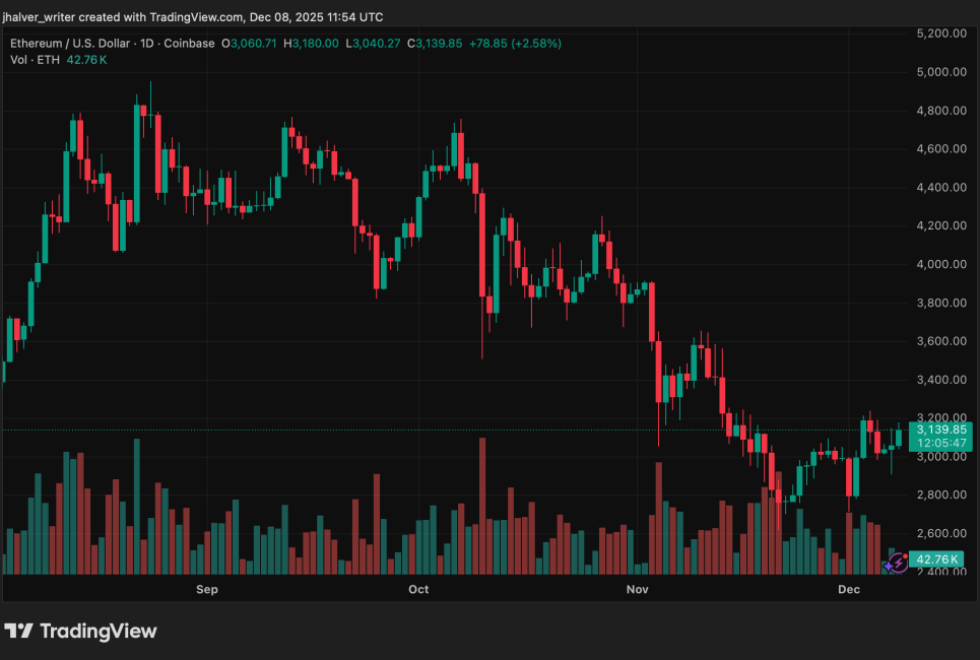
ETH's price records small profits on the daily chart. Source: ETHUSD on Tradingview

Why Has AI Taken the Spotlight

Across its 33 pages, the strategy places artificial intelligence, biotechnology, and quantum computing at the center of America’s next-generation competition.

The administration states that U.S. technology and standards must “drive the world forward,” underscoring a focus on advanced computing rather than decentralized finance. Digital assets, which had gained prominence through previous remarks from officials, receive no explicit mention.

This stands at odds with comments from President Trump in recent months. In a CBS 60 Minutes interview, he warned that China should not become the global leader in virtual assets and insisted that Bitcoin mining should remain within U.S. borders.

A Subtle Reference, but No Clear Policy

While crypto is not named in the strategy, the document does reference strengthening American “leadership in digital finance and innovation.”

Analysts view this as a broad gesture rather than a firm policy direction, but it leaves open the possibility that digital assets may still influence future regulatory or economic strategies.

This ambiguity comes despite a year of significant pro-crypto actions. Measures such as the GENIUS Act for stablecoin oversight, the formation of a crypto enforcement task force, reduced regulatory pressures on exchanges, and opposition to a central bank digital currency have all shaped expectations.

The establishment of a national Bitcoin reserve, funded through forfeited digital assets, further signals that crypto remains a strategic consideration even if not formally acknowledged in the latest blueprint.

Market Response and Broader Implications

Currently trading around $91,900, Bitcoin briefly fell below $90,000 following the release of the strategy, a move compounded by broader macroeconomic pressures and anticipation of a Federal Reserve rate decision.

The administration’s call for increased defense spending among NATO allies has also raised questions about inflation and monetary policy, factors that could influence investor appetite for digital assets.

For now, the omission leaves the industry navigating a familiar gap of strong political rhetoric, scattered policy initiatives, but no comprehensive framework. As the U.S. centers its priorities around AI and quantum computing, crypto’s position in national strategy remains undefined. Is this the end of the ‘Crypto Administration’?

Cover image from ChatGPT, ETHUSD chart from Tradingview

Trending Cryptos

Related Reads

In Jinjiang, Fujian, a Storage Super Unicorn Lies Quiet

In Fujian's Jinjiang, a city known for sportswear, lies a quiet semiconductor giant: Fujian Jinhua Integrated Circuit Co. (JHICC). Once a promising domestic DRAM manufacturer alongside Yangtze Memory and ChangXin Memory Technologies (CXMT), its journey was derailed in 2018 when the U.S. placed it on an Entity List and filed criminal charges for alleged trade secret theft. This halted production for years. A turning point came in February 2024 when a U.S. federal court found JHICC not guilty. However, it had lost crucial time. While CXMT soared to become a top-valued A-share company in 2024, JHICC, with an estimated valuation of 80 billion RMB, was just restarting. Its current output is primarily customized DDR4 chips, not the advanced DDR5/HBM demanded for AI, but it still benefits from the broader memory chip upcycle. JHICC's story is tied to Chen Zhengkun, a veteran engineer who left Micron to lead the venture. Founded in 2016 with state-backed funding, JHICC partnered with Taiwan's UMC to develop DRAM technology. Rapid progress was cut short by the U.S. actions, which Micron initiated, partly due to its heavy reliance on the Chinese market. Post-sanctions, Chen's team worked to rebuild the production line with reduced reliance on U.S. technology. According to its records, JHICC achieved small-scale production and revenue growth under immense pressure. It now focuses on the stable "niche" DRAM market (e.g., TVs, routers) with a monthly capacity of ~40,000 wafers, aiming for 60,000 by 2026. It holds over 1,000 patents but remains on the Entity List. For Jinjiang, investing in JHICC was a bold industrial leap. The local government provided unwavering financial and logistical support during the crisis, helping the company survive. JHICC has become the anchor for a growing local semiconductor cluster. Though its scale lags behind domestic peers, JHICC's persistence symbolizes a hard-won foothold in a global market long dominated by Samsung, SK Hynix, and Micron. Having missed one boom, it seeks a place in the new AI-driven memory supercycle.

marsbit24m ago

In Jinjiang, Fujian, a Storage Super Unicorn Lies Quiet

marsbit24m ago

Must-Watch Events Next Week|CLARITY Act Could Face Senate Vote; SpaceX, Circle to Report Earnings (8.3-8.9)

**Summary: Key Events and Developments to Watch (August 3-9)** The upcoming week is marked by significant financial disclosures, key legislative deadlines, and notable product updates. **Major Financial Events:** Several companies are scheduled to release their Q2 2026 earnings. American Bitcoin (ABTC) will report on August 3, followed by SpaceX and Hut 8 Mining Corp. on August 4, and Circle on August 5. Notably, a significant portion of SpaceX shares (up to 12% of total shares) will be unlocked on August 6 following their earnings release. **Key Legislative Deadline:** The U.S. Senate faces an August 7 deadline to secure 60 votes for the CLARITY Act, a bipartisan bill aiming to establish a federal regulatory framework for cryptocurrencies. The Senate may hold a full vote on the bill during the week. **Economic Data:** The U.S. July Non-Farm Payrolls report will be released on August 7, providing crucial labor market data. **Technology & Product Updates:** * **Shutdowns:** DeFi portfolio tracker Zapper and wallet app Ctrl Wallet will cease operations on August 3. * **Upgrades:** LayerZero will deprecate its v1 relayers on August 3. XRP Ledger's new version 3.3.0, featuring five new functions, is expected next week. * **AI:** Elon Musk announced that the advanced Grok 4.6 AI model is set for release around August 7. * **Bitcoin:** The BIP-110 forced signaling for a potential Bitcoin network change is scheduled to begin around August 8. **Other Notable Events:** Chinese robotics firm Unitree Tech has set its preliminary price inquiry for its IPO for August 5. South Korean exchange Upbit will delist AQT and AERGO tokens on August 3.

marsbit2h ago

Must-Watch Events Next Week|CLARITY Act Could Face Senate Vote; SpaceX, Circle to Report Earnings (8.3-8.9)

marsbit2h ago

Trading

Spot

Hot Articles

How to Buy PUSH

Welcome to HTX.com! We've made purchasing Push Protocol (PUSH) simple and convenient. Follow our step-by-step guide to embark on your crypto journey.Step 1: Create Your HTX AccountUse your email or phone number to sign up for a free account on HTX. Experience a hassle-free registration journey and unlock all features.Get My AccountStep 2: Go to Buy Crypto and Choose Your Payment MethodCredit/Debit Card: Use your Visa or Mastercard to buy Push Protocol (PUSH) instantly.Balance: Use funds from your HTX account balance to trade seamlessly.Third Parties: We've added popular payment methods such as Google Pay and Apple Pay to enhance convenience.P2P: Trade directly with other users on HTX.Over-the-Counter (OTC): We offer tailor-made services and competitive exchange rates for traders.Step 3: Store Your Push Protocol (PUSH)After purchasing your Push Protocol (PUSH), store it in your HTX account. Alternatively, you can send it elsewhere via blockchain transfer or use it to trade other cryptocurrencies.Step 4: Trade Push Protocol (PUSH)Easily trade Push Protocol (PUSH) on HTX's spot market. Simply access your account, select your trading pair, execute your trades, and monitor in real-time. We offer a user-friendly experience for both beginners and seasoned traders.

4.1k Total ViewsPublished 2024.03.29Updated 2026.06.02

How to Buy PUSH

Discussions

Welcome to the HTX Community. Here, you can stay informed about the latest platform developments and gain access to professional market insights. Users' opinions on the price of PUSH (PUSH) are presented below.

活动图片













