Crypto Coalition Urges Senate To Fast-Track CLARITY Act As US Leadership Faces Critical Moment

bitcoinistPublished on 2026-04-24Last updated on 2026-04-24

Abstract

A coalition of over 120 crypto industry organizations, including the Crypto Council for Innovation and the Blockchain Association, is urging the U.S. Senate Banking Committee to fast-track the CLARITY Act, a comprehensive market structure bill for digital assets. They argue that timely legislation is critical to ensure consumer protection, clarify regulatory roles, and maintain U.S. leadership in financial innovation, warning that delay could cede advantages to other jurisdictions. The push comes amid reports of a potential delay until mid-May due to banking sector opposition, particularly concerning restrictions on stablecoin yields. Industry leaders emphasize that May is a crucial window for action before political attention shifts to election campaigns.

Over 100 industry organizations have pressed the Senate to move forward with a markup of the crypto market structure bill to “future-proof” the industry and “cement” US leadership in financial innovation.

Crypto Groups Push Senate For Markup Date

On Thursday, the Crypto Council for Innovation (CCI) and the Blockchain Association (BA), joined by a coalition of more than 120 organizations from across the ecosystem, urged the Senate to fast-track the crypto market structure bill, also known as the CLARITY Act.

In a letter addressed to Senators Tim Scott, Cynthia Lummis, Elizabeth Warren, and Ruben Gallego, the crypto groups asked the Senate Banking Committee to notice and set a markup date for the CLARITY Act to “provide a comprehensive federal market structure framework for digital assets.”

The coalition highlighted the Committee leadership’s commitment to serve the needs of Americans, but noted that this is a “critical moment” for US leadership in digital finance and policy.
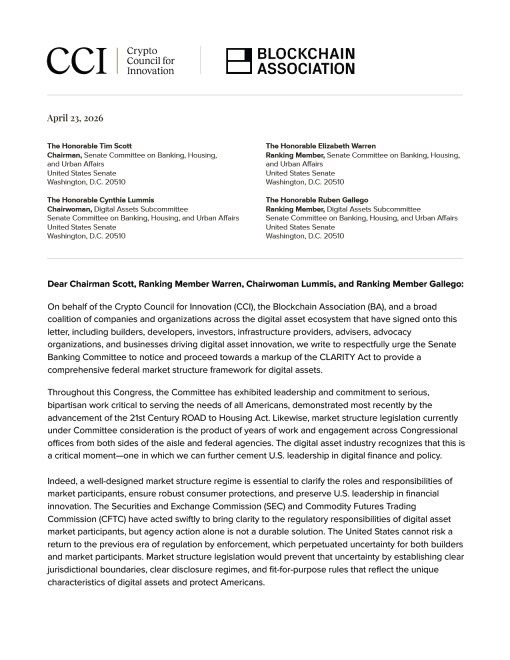
CCI and BA's letter to Senators Scott, Warren, Lummis, and Gallego. Source: Crypto Council for Innovation on X

As they explained, a well-designed market structure regime is fundamental to clarifying the roles and responsibilities of market participants, ensuring robust consumer protections, and preserving US leadership in financial innovation.

They argued that “timely action is critical,” as the absence of a comprehensive framework risks giving economic and strategic advantages to other major jurisdictions that have already implemented comparable policies.

The letter also applauded actions by the Securities and Exchange Commission (SEC) and Commodity Futures Trading Commission (CFTC) to bring clarity to digital asset market participants.

However, they stressed that “agency action alone is not a durable solution,” arguing that the US “cannot risk a return to the previous era of regulation by enforcement, which perpetuated uncertainty for both builders and market participants.”

“Our industry recognizes the importance of this moment. (...) The U.S. has long been the global leader in financial markets due to its commitment to clear rules, strong institutions, and openness to innovation. With thoughtful market structure legislation, Congress has the opportunity to extend that leadership into the next generation of financial technology. For these reasons, we strongly encourage the Committee to swiftly move forward with a markup of digital asset market structure legislation as soon as practicable,” the letter read.

CLARITY Act Risks Mid-May Delay

The crypto industry’s letter comes as news of a potential delay in the CLARITY Act’s markup emerges. As reported by Bitcoinist, the Committee has until this Friday to formally notice a markup if it intends to hold a vote on the CLARITY Act next week.

Nonetheless, pressure from the banking sector may push the long-awaited markup session, initially expected for late April, to the second week of May, when lawmakers return from recess.

According to the reports, Senator Thom Tillis’ office has faced a “targeted pressure campaign” from banking groups, which are reportedly unhappy with the stablecoin yield restrictions included in the current version of the act.

For context, the crypto and banking industries have been fighting over the potential prohibition of yield and rewards on stablecoin balances. This dispute has stalled the bill for over three months.

In late March, lawmakers shared a revised draft with the two parties to address the long-standing dispute. The latest language reportedly prohibited platforms from offering yield, directly or indirectly, for holding a stablecoin, or in a manner that resembles a bank deposit.

The draft also limits workarounds and prohibits any activity “economically or functionally equivalent” to interest. Despite the fears of a longer delay, a mid-May markup remains within the timeline multiple lawmakers and crypto industry figures have mentioned.

Paradigm’s Vice President of Regulatory Affairs, Justin Slaughter, stated that the pressure won’t start until after Memorial Day. Similarly, Ripple CEO Brad Garlinghouse has deemed May the most critical month for the bill before lawmakers shift attention toward the midterm campaign season.
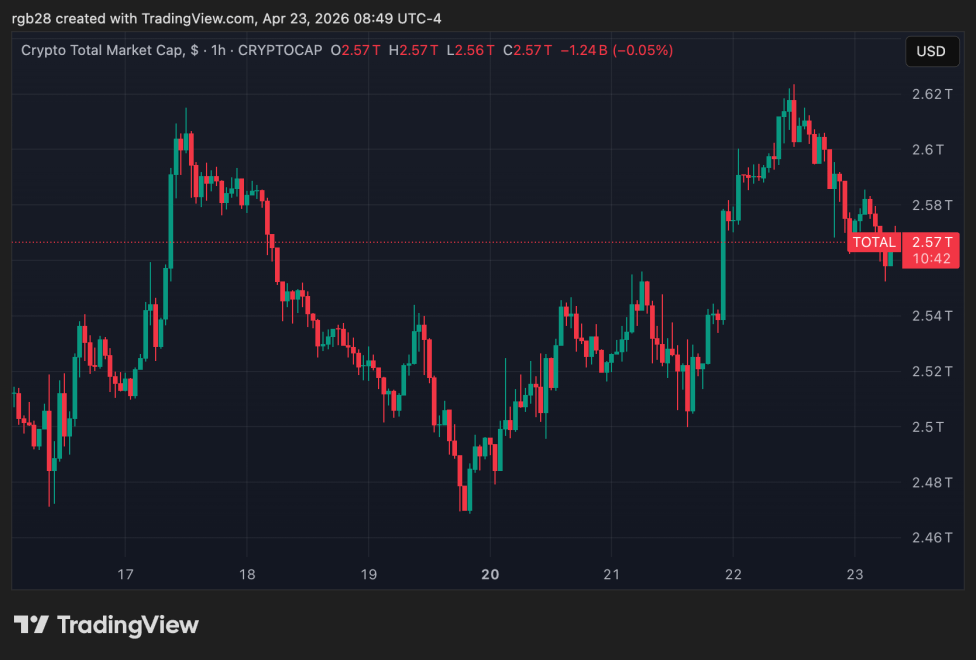
The total crypto market capitalization is at $2.57 trillion on the one-week chart. Source: TOTAL on TradingView


Related Questions

QWhat is the main purpose of the CLARITY Act according to the crypto coalition?

AThe main purpose is to provide a comprehensive federal market structure framework for digital assets, which would clarify the roles of market participants, ensure consumer protections, and preserve US leadership in financial innovation.

QWhich two major crypto organizations are leading the push for the Senate to fast-track the CLARITY Act?

AThe Crypto Council for Innovation (CCI) and the Blockchain Association (BA) are leading the push, joined by a coalition of over 120 organizations.

QWhy is there a potential delay in the markup of the CLARITY Act until mid-May?

AThe potential delay is due to pressure from banking groups who are unhappy with the stablecoin yield restrictions included in the current version of the act, causing a dispute that has stalled the bill.

QWhat specific restriction in the CLARITY Act draft is causing disagreement with banking groups?

AThe disagreement is over the prohibition of platforms offering yield, directly or indirectly, for holding a stablecoin, or in a manner that resembles a bank deposit, which limits potential revenue streams for banks.

QAccording to the letter, why is agency action by the SEC and CFTC alone not a sufficient solution for the crypto industry?

AAgency action alone is not a durable solution because it risks a return to 'regulation by enforcement,' which perpetuates uncertainty for builders and market participants, and a comprehensive legislative framework is needed for long-term clarity.

Related Reads

STRC Breaks Below $95: Why Does It Continue to Depeg? Is There Default Risk?

"STRC Falls Below $95: Why the Persistent Depegging and Is There Default Risk?" The article discusses the recent decline in the price of STRC, a perpetual preferred stock issued by Strategy (MSTR) designed to trade around a $100 par value. As of publication, STRC traded at $94.65, raising market concerns. STRC is described as a high-yield cash flow product, offering an 11.50% annual dividend paid monthly. Its "preferred" status grants it priority over common stock for dividends and in liquidation. Key reasons cited for the price depegging include: 1. **Bitcoin's Price Drop:** MSTR's assets are heavily tied to Bitcoin (BTC), which fell over 21% from its recent high, pressuring all Strategy-related products. 2. **Competitive Pressure:** Rival Strive Asset Management's similar product, SATA, offers daily dividends and has maintained its $100 par value with a ~13% yield. In response, Strategy has proposed changing STRC's dividend frequency from monthly to bi-weekly, pending shareholder vote. 3. **Technical Selling:** A break below $100 may have triggered algorithmic selling and stop-losses, exacerbating the decline. Regarding default risk, the analysis suggests it is currently low. Strategy founder Michael Saylor confirmed the June 2026 dividend rate remains at 11.50% with no cuts or suspensions. The company's massive reserve of 843,706 BTC provides a significant backstop for its obligations. Industry opinions are mixed. Some analysts view the BTC holdings as reliable support for dividends, while critics like Peter Schiff warn of potential dividend cuts leading to price crashes and lawsuits. Others highlight inflation risk and the company's ability to reduce dividends without a formal default. In summary, STRC's drop is attributed to BTC volatility, competition, and technical factors. While immediate default risk appears contained, the product faces challenges from market conditions and competitive dynamics.

marsbit1h ago

STRC Breaks Below $95: Why Does It Continue to Depeg? Is There Default Risk?

marsbit1h ago

AI Trading Cools, South Korean Stocks Plunge 1.8%, Spot Gold Rises 1%, Bitcoin Dives

A sell-off in AI-related stocks, triggered by Broadcom's disappointing earnings forecast, sent shockwaves through global markets. South Korea's KOSPI led Asia's decline, plunging 1.8% as the risks from concentrated chip stock gains and surging leveraged investments came to the fore. The tech-heavy Nasdaq 100 futures fell 0.5% following Broadcom's 14% after-hours plunge, which signaled a slower-than-expected transition to AI clients. This pullback extended Wall Street's weakness, halting the S&P 500's nine-day rally amid hawkish Fed signals and renewed Middle East tensions. South Korean authorities convened an emergency meeting, pledging "immediate measures" against market volatility and warning of record-high stock margin debt. The adjustment rippled across assets: Bitcoin fell to around $64,000, its lowest since February, while safe-haven gold rose 1% on bargain hunting. Oil prices dipped on Middle East ceasefire news. Market analysts noted the sell-off was driven by profit-taking after massive gains, particularly in chip stocks like Samsung and SK Hynix, which now dominate the KOSPI. Wall Street banks are divided on Korea's outlook, with Goldman Sachs raising its target while Citigroup and others warn of overvaluation and a potential bubble. Bridgewater's Ray Dalio noted that great technological shifts often create bubbles. Meanwhile, Fed officials' hints at potential future rate hikes added to the cautious mood ahead of key U.S. jobs data.

华尔街日报1h ago

AI Trading Cools, South Korean Stocks Plunge 1.8%, Spot Gold Rises 1%, Bitcoin Dives

华尔街日报1h ago

Trading

Spot
Futures

Hot Articles

What is DOGE M

Doge Matrix ($doge m): The New Breed of Community-Driven Cryptocurrency Introduction In the ever-evolving landscape of cryptocurrency, new projects constantly emerge, each aiming to capture the interest of investors and enthusiasts alike. One of the latest entrants to this domain is Doge Matrix, represented by the ticker symbol $doge m. This project has attracted attention thanks to its roots in the popular meme culture surrounding Dogecoin, establishing its place within the web3 space. This article aims to provide a comprehensive analysis of Doge Matrix, covering its overview, creator, investors, functionality, timeline, and notable aspects. What is Doge Matrix ($doge m)? Doge Matrix is a community-driven cryptocurrency project that seemingly builds upon the widespread appeal of Dogecoin, a digital currency known for its Shiba Inu mascot and its meme origins. While the overarching objectives of Doge Matrix are not extensively defined, it is characterised by a commitment to harnessing community involvement and support. Unlike traditional cryptocurrencies that often emphasise utility or intrinsic value through underlying technologies, Doge Matrix positions itself within a space that embraces the cultural phenomenon of cryptocurrencies, particularly appealing to those who resonate with the ethos of meme-based assets. Drawing on the strengths of the Dogecoin community, Doge Matrix operates as part of a broader ecosystem, inviting participation and engagement from users who share an interest in cryptocurrency and the digital landscape. Who is the Creator of Doge Matrix ($doge m)? The identity of the creator of Doge Matrix remains unknown. This lack of transparency is not an uncommon occurrence in the cryptocurrency space, where some projects are launched without revealing the identities of their founders. The absence of information regarding the founding team can raise questions among potential investors about the project’s accountability and direction. Who are the Investors of Doge Matrix ($doge m)? As it stands, there is no publicly available information detailing the investors or investment foundations that back Doge Matrix. The project appears to rely primarily on community support rather than institutional investment. This model aligns with the community-driven nature of the initiative, fostering an environment where the direction of the project is shaped by its participants rather than being dictated by a select few financial backers. How Does Doge Matrix ($doge m) Work? The specifics regarding the operational mechanisms of Doge Matrix are somewhat vague, reflecting a broader trend of projects in the meme coin space where innovative functionalities are not always clearly articulated. Nonetheless, Doge Matrix seems designed to tap into the existing cryptocurrency ecosystem by encouraging user participation while tapping into the familiar cultural references associated with Dogecoin. Its potentially unique characteristics derive from community interactions rather than technological advancements, emphasising shared experiences and collaboration among token holders. While the exact innovations have not been explicitly outlined, the project appears to create a space where community members can engage, share ideas, and propel the project's potential forward. Timeline of Doge Matrix ($doge m) Reflecting on the project’s timeline reveals notable events that have defined its journey thus far: November 25, 2024: Doge Matrix reached its all-time high value, marking a significant milestone in its early history. January 1, 2025: Conversely, Doge Matrix hit its all-time low value, illustrating the volatility often associated with cryptocurrencies, especially in the early stages of a project's lifecycle. Ongoing: The project continues to be actively traded and supported by its community, although specific future milestones or objectives have yet to be disclosed. Key Points About Doge Matrix ($doge m) Community Focus At the heart of Doge Matrix is a commitment to community engagement. The project thrives on the premise of collaboration and shared objectives among its members, emphasising the importance of collective effort. Unlike centralised projects that often have a defined leadership structure, Doge Matrix at present showcases a more fluid approach to governance, where every community member's voice matters. Volatility The cryptocurrency market is notorious for its volatility, and Doge Matrix is no exception. Its price history reflects significant fluctuations between high and low values, which is typical of many new cryptocurrencies but underscores the risks associated with investment in emerging tokens. Lack of Detailed Information One of the most striking features about Doge Matrix is the scarcity of detailed information regarding its technological underpinnings and operational mechanisms. This ambiguity necessitates that potential investors conduct thorough due diligence before engaging with the project. Conclusion In summary, Doge Matrix ($doge m) illustrates a new wave of cryptocurrency projects that lean heavily on community engagement and cultural relevance. While lacking in certain specifics—such as clear leadership, defined objectives, and detailed functionality—the project has managed to generate interest within the crypto community, leveraging the established appeal of meme culture. As with any investment in the cryptocurrency space, understanding the inherent risks and conducting comprehensive research is essential for potential participants. Doge Matrix stands as a reminder of the dynamic, sometimes unpredictable nature of the crypto industry, marked by constant evolution and enthusiasm for community-driven initiatives.

510 Total ViewsPublished 2025.02.03Updated 2025.02.03

What is DOGE M

What is $M

Understanding Mantis ($M): A New Era in Cross-Chain Interoperability In the continually evolving landscape of Web3 and cryptocurrency, new projects strive to offer innovative solutions aimed at enhancing the user experience and expanding functional possibilities within the decentralised financial ecosystem. One such project garnering attention is Mantis ($M), a pioneering protocol founded on the principles of cross-chain interoperability and intent-based settlements. This article delves into the essential aspects of Mantis, including its core functionality, creators, investment backing, innovative features, and critical milestones. What is Mantis ($M)? Mantis is described as a multi-domain intent settlement protocol that simplifies cross-chain interactions, enabling users to execute complex financial transactions across various blockchain platforms seamlessly. The protocol operates through three primary layers: Intent Expression: Users can articulate their transaction goals using natural language facilitated by the DISE LLM, an advanced AI language model. For instance, a user might express a desire to swap Ethereum (ETH) for Solana (SOL) with a specific slippage tolerance of 1%. Execution: This layer employs a network of solvers that compete to fulfil user intents. Transactions are executed using mechanisms such as Coincidence of Wants (CoWs) and Order Flow Auctions (OFAs), which ensure that user demands are met optimally. Settlement: Leveraging the Inter-Blockchain Communication (IBC) protocol, Mantis enables atomic cross-chain transactions, allowing users to operate across various supported chains, including Ethereum, Solana, and Cosmos. Mantis is engineered to introduce native yield generation for idle assets, employing cryptographic proofs to maintain the integrity of transactions throughout the entire process. Creators & Development Team Mantis was conceived by the Composable Foundation, a research-driven organisation notable for its emphasis on blockchain interoperability solutions. This foundation collaborates with esteemed academic institutions, including Harvard University and the University of Lisbon, contributing to extensive research and development efforts that inform Mantis's architecture and functionality. The Composable Foundation’s commitment to fostering innovation in the blockchain space positions Mantis as a robust solution for the growing demand for interoperability among multiple blockchain networks. Investors & Backing While specific details about individual investors have not been publicly disclosed, Mantis enjoys substantial backing from various entities, including: Ecosystem grants from IBC-enabled chains, which support the protocol's growth and integration within decentralised finance ecosystems. Strategic partnerships with infrastructure providers that enhance Mantis's network capabilities and deployment strategies. Funding through the Composable Foundation's treasury, ensuring sustained financial support for ongoing development and operational costs. These collaborative efforts reflect a consensus among stakeholders about the importance of enhancing cross-chain functionality and the potential utility of Mantis's infrastructural innovations. Key Innovations Mantis sets itself apart through several pioneering innovations that enhance its functionality and utility: Chain-Agnostic Intents: Users can initiate transactions from any supported chain while settling on another. This flexibility empowers users, driving increased interaction among different platforms. AI-Powered Interface: The integration of DISE LLM allows users to conduct complex DeFi operations using natural language, thereby simplifying interactions and making blockchain technology accessible to a broader audience. Cross-Domain MEV Capture: Mantis creates an internal market for maximal extractable value (MEV) through competitions among solvers. This innovative approach allows for greater efficiency and value extraction in complex transactions. Modular Settlement Layer: The protocol supports various verification methods, including zero-knowledge proofs and optimistic rollups, providing a versatile framework that can adapt to emerging blockchain technologies. Historical Timeline Mantis's development is marked by several critical milestones that chart its trajectory and growth: | Year | Milestone | |————|————————————————————————-| | 2022 | Initial concept development within the Composable Foundation's research division. | | Q3 2024 | Launch of the testnet with bridging capabilities between Solana and Ethereum. | | Q1 2025 | Anticipated Token Generation Event (TGE) alongside the mainnet launch. | | Q2 2025 | Expected integration of DISE LLM and expansion of cross-chain capabilities. | | 2025 H2 | Planned support for over 15 chains through further IBC upgrades. | This timeline outlines Mantis's evolution, from conceptual discussions to active implementation and future growth phases. Ecosystem Growth Strategy Mantis's strategy for ecosystem growth includes several initiatives designed to encourage user participation and developer engagement: Credits System: Users can earn protocol credits by providing liquidity and engaging in referral programmes. These credits are redeemable for incentives in the future, fostering a robust user community. Modular Software Development Kit (SDK): This toolkit empowers developers to create applications based on intent-driven models utilising Mantis's infrastructure, thus promoting innovation within its ecosystem. Governance Model: As the protocol matures, $M token holders will have a voice in protocol governance, allowing them to vote on proposed upgrades and changes, thereby enhancing community engagement and decentralisation. Mantis represents a significant advancement in the realm of cross-chain architecture. By seamlessly integrating advanced AI algorithms with a robust settlement framework, Mantis seeks to tackle the problems of fragmentation within multi-chain ecosystems. Its innovative approach prioritises improved user experiences while adhering to the foundational principles of decentralisation and security, setting a new standard for the future interoperability of blockchain technologies. As Mantis continues its journey of growth and implementation, it promises to be a project to watch closely in the competitive landscape of Web3 and decentralised finance. With its focus on crossing boundaries and elevating user engagement, Mantis is poised to be an integral part of the future developments in the cryptocurrency space.

41 Total ViewsPublished 2025.03.18Updated 2025.03.18

What is $M

Discussions

Welcome to the HTX Community. Here, you can stay informed about the latest platform developments and gain access to professional market insights. Users' opinions on the price of M (M) are presented below.

活动图片












