Competitors Going Public, Kimi Can't Sit Still

marsbitPublished on 2026-05-28Last updated on 2026-05-28

Abstract

Competitors Go Public, Kimi Feels the Pressure Yue Zhi An Mian (Moonshot AI), the company behind the AI assistant Kimi, has begun dismantling its VIE and red-chip structure, clearing a key obstacle for a potential Hong Kong IPO. This marks a significant shift from six months ago when founder Yang Zhilin stated the company was in "no hurry" to list. The move comes as rivals like Zhipu AI and MiniMax have successfully listed on the Hong Kong Stock Exchange in early 2026, experiencing massive surges in market value. This has reset valuation logic for AI companies, turning "going public" from an end goal into a competitive necessity. Analysts suggest Kimi is both seizing a favorable market window and responding to competitive pressure. Kimi's valuation has skyrocketed from around $3 billion at its 2023 founding to over $20 billion by May 2026. Capital is betting on its potential as a future AI platform and gateway, though some caution this "emotional valuation" depends on sustained technological leadership and successful commercialization. Traditionally focused on core model R&D over user growth, Kimi has recently pivoted strategy. While its monthly active users declined through 2025, it shifted focus to Agent development and reducing marketing spend. The release of its K2.5 model in early 2026 reportedly generated substantial revenue, with annual recurring revenue reaching $200 million by April, driven by subscriptions and API services. A $2 billion D-round financing in May ...

Recent reports indicate that Moonshot AI has notified its shareholders, officially initiating the dismantling of its VIE and red chip structure to clear obstacles for a Hong Kong IPO.

Just half a year ago, Moonshot AI founder Yang Zhilin reiterated in an internal letter that the company was "in no hurry to go public in the short term."

"This step is more like clearing structural hurdles before an IPO, meaning the company has seriously entered the IPO preparation phase. But several hurdles remain: equity structure, regulatory communication, domestic filing, security review, HKEX materials, financial audits, and market timing," said Huang Lichong, President of Huisheng International Capital. Dismantling VIE and red chip structures essentially clarifies the positions of control rights, responsible entities, and regulatory boundaries. If smooth, the window could be six months to a year; if complex due to regulations, shareholders, tax, or foreign capital arrangements, it might take longer.

Phoenix WEEKLY Finance inquired with Moonshot AI regarding the IPO, but received no reply by the time of publication.

Regarding expectations, the capital market has already given its answer in advance. When founded in 2023, Moonshot AI's valuation was approximately $3 billion; by May 2026, this figure had surpassed $20 billion.

In reality, with the successive listings of Zhipu AI and MiniMax on the Hong Kong stock market, the valuation logic of the secondary market for large model companies has suddenly been unlocked. The long-term reliance on narratives to support valuations in the primary market has become a thing of the past. "Going public" itself is also shifting from an outcome to a competitive method.

"Moonshot AI's move considers both seizing the golden window for a Hong Kong listing and is forced by industry competition prompting proactive layout," said Zhang Yi, CEO of iiMedia Consulting Group.

Perhaps for Moonshot AI, the real question is no longer "whether to go public," but rather, when other competitors have already entered the next round, Moonshot AI cannot afford to stand still.

$20 Billion Valuation May Be Tinged with Capital Market Sentiment

Since the beginning of 2026, the capital "atmosphere" in the large model industry has rapidly heated up.

Over the past three years, Chinese AI startups have undergone a transformation from being neglected to becoming darlings of capital. However, what truly turned the industry sentiment around was the successive Hong Kong listings of Zhipu AI and MiniMax earlier this year.

On January 8, 2026, Zhipu AI took the lead in listing on the HKEX with an issue price of HK$116. On its first trading day, the stock closed at HK$131.5 per share, up 13.17%, with a total market capitalization reaching HK$57.89 billion. In the following months, Zhipu AI's stock price continued to rise. As of the close on May 26, its total market capitalization had exceeded HK$599.6 billion, nearly a tenfold increase from its initial listing.

On January 9, MiniMax followed suit, listing on the HKEX with an issue price of HK$165. On its first trading day, the stock closed at HK$345 per share, a surge of 109% from the issue price, with a total market capitalization surpassing HK$106.7 billion. Currently, its total market capitalization exceeds HK$241.1 billion.

This provided the entire industry with pricing benchmarks. Since then, AI is no longer seen as just a technological story but as the next platform-level opportunity.

With such precedents, Moonshot AI's valuation also rapidly climbed.

In November 2025, Moonshot AI's valuation was $4.3 billion; by May 2026, it had exceeded $20 billion. In just half a year, its valuation nearly quadrupled, with cumulative financing exceeding $3.2 billion. Moonshot AI has also completed a rare capital leap for a domestic large model startup.

"Revenue is the foundation. Capital pricing mainly focuses on three things: first, foundational model capabilities; second, user access and developer ecosystem; third, the imaginative space for future platformization," Huang Lichong believes. For companies like Moonshot AI, capital is buying not today's profit statement, but a scarce ticket in the Chinese large model race. Whoever can become the next-generation AI gateway may gain access to new profit pools like search, office work, developer tools, enterprise services, and Agent execution.

This year, information about unofficial financing shares not from Kimi has even frequently appeared in the market.

In April, Kimi publicly refuted rumors, stating, "Recently, false financing information purporting to be from 'Moonshot AI' has appeared in the market. We hereby remind investors that all financing activities are directly handled by Moonshot AI. Any so-called 'investment shares' circulated through unofficial channels carry significant risks."
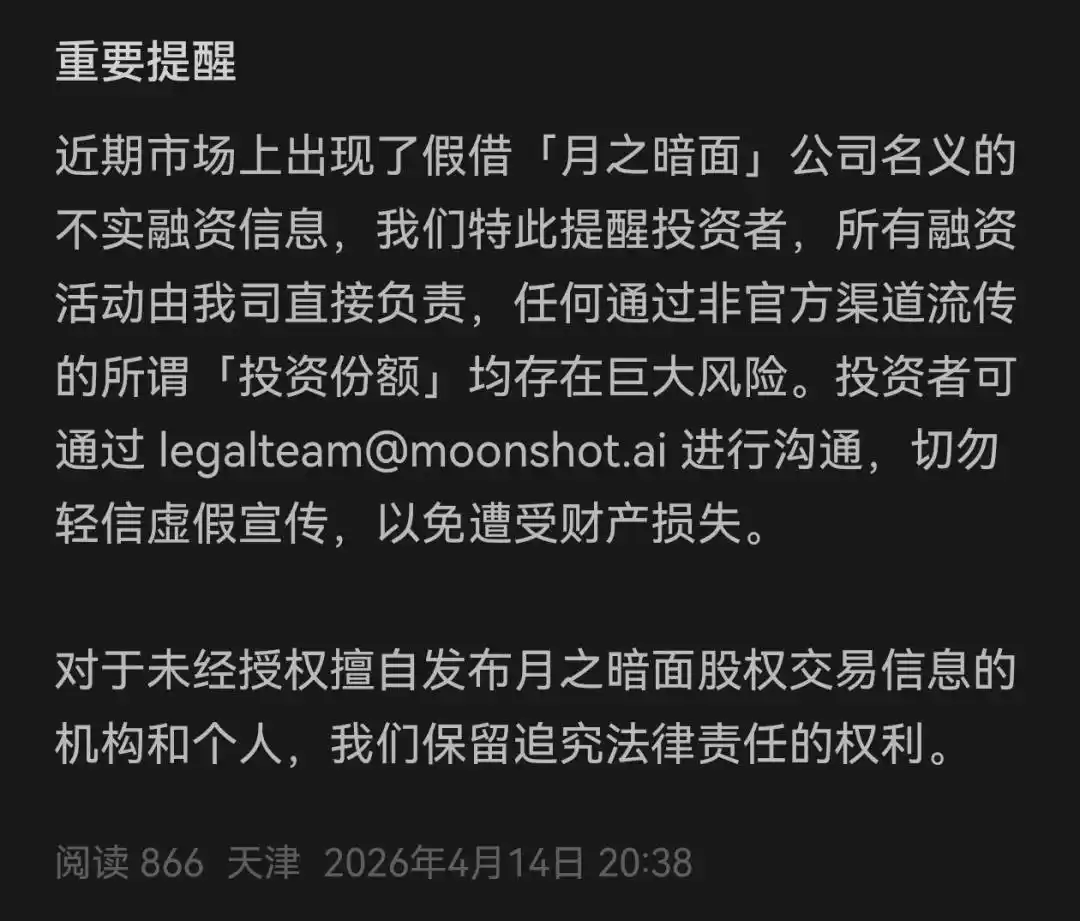
Screenshot of Kimi's response.

When capital frantically searches for the "next Zhipu AI" or "next MiniMax," it's difficult for Moonshot AI to keep capital at bay.

"A $20 billion valuation seems more like an advance payment on the future," Zhang Yi believes, attributing it to the capital market pricing in growth dividends ahead of time.

Huang Lichong stated, "This valuation only holds up if three things materialize: continued model leadership, sustained commercialization scaling, and declining unit inference costs. Otherwise, it's just sentiment-driven valuation."

R&D Pace May Be Constrained, Commercialization Moves to the Forefront

Among domestic large model startups, Moonshot AI is an "outlier."

For a long time, Yang Zhilin has been one of the most typical "tech-focused" representatives among domestic AI entrepreneurs. Compared to traffic competition and commercial expansion, he emphasizes foundational model capabilities, organizational efficiency, and long-term R&D investment. This has long positioned Moonshot AI as one of the domestic teams closest to the routes of OpenAI and Anthropic.

QuestMobile data shows that the monthly active user (MAU) count for the Kimi App dropped from 21.653 million in Q1 2025 to 9.027 million in Q4 2025.

In his year-end all-staff letter in 2025, Yang Zhilin clarified the direction of this round of adjustment: focus on Agents, not targeting absolute user numbers, persistently pursuing intelligence limits and productivity value, and significantly cutting annual advertising spending, shifting to technology-driven commercialization.

In January 2026, Kimi released its flagship model K2.5. According to multiple media reports, less than a month after the model's release, the company's revenue over nearly 20 days had already exceeded its total revenue for the entire year of 2025; as of April 2026, the company's Annual Recurring Revenue (ARR) exceeded $200 million, with paid subscriptions and API revenue gradually becoming new growth engines.

Moonshot AI is attempting to prove to the outside world that despite reduced MAU, Kimi's commercial capabilities remain intact.

Qichacha shows that in May this year, Moonshot AI completed another $2 billion Series D financing round, led by Meituan Longzhu, with participation from institutions like China Mobile and CPE, which may indicate capital's approval of Kimi's adjustments in its business model.
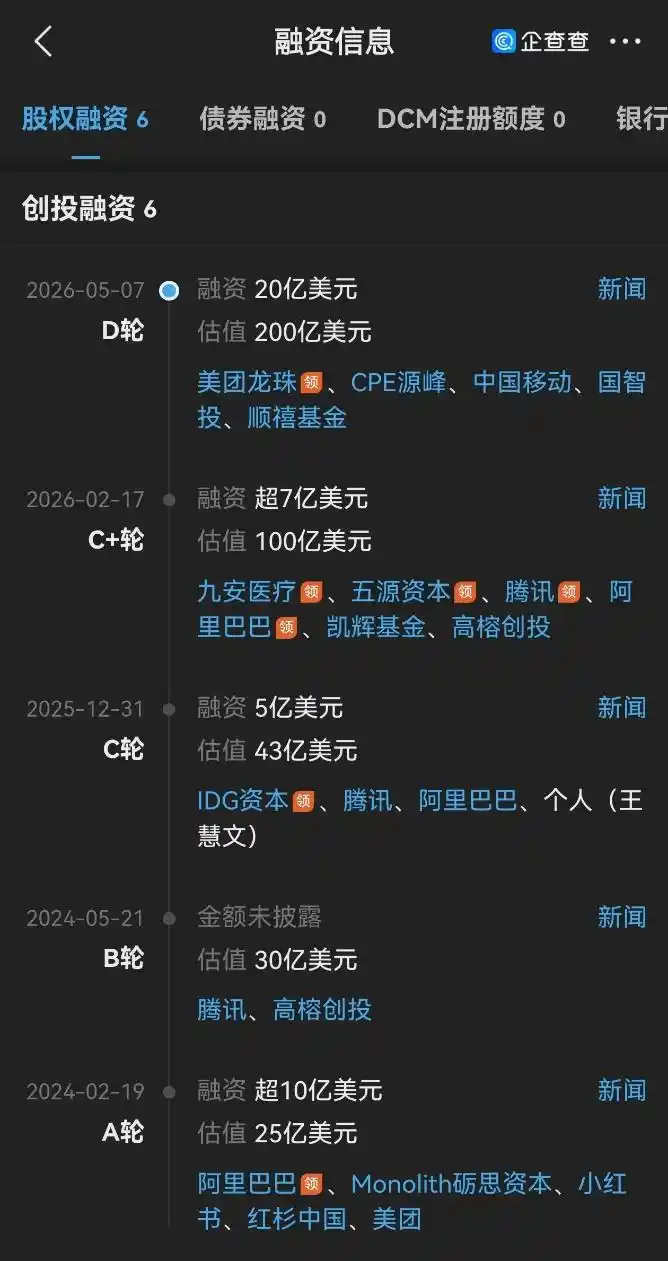
Screenshot of Moonshot AI's $2 billion Series D financing.

However, post-financing, AI companies cannot avoid the continuous investment race. Training compute, inference costs, data resources, and talent reserves all imply massive capital consumption.

If entering the secondary market, the rules begin to change. Beyond investment, investors will also demand corresponding returns.

Huang Lichong predicts significant changes for Moonshot AI post-IPO. First, the organization will become heavier. Financial disclosure, internal controls, compliance, model safety, and data governance will become institutionalized. Second, the R&D pace will be more constrained. In the past, it could focus solely on model breakthroughs; post-IPO, it must explain input-output ratios, compute expenses, loss boundaries, and commercialization paths. Third, commercialization will be brought to the forefront. Investors won't pay for "model leadership" indefinitely; they will look at subscriptions, APIs, enterprise clients, Agent revenue, and gross margins.

"Only raising funds without model leadership will eventually be disproven. Only making models without capital and commercialization won't survive to the end," in Huang Lichong's view. The real test for Moonshot AI post-IPO is whether it can transform "technological scarcity" into "sustainable revenue" and "explainable valuation."

(Image source: Moonshot AI official)

This article is from the WeChat public account "Phoenix WEEKLY Finance", author: Wang Han

Related Questions

QAccording to the article, what is the primary purpose of Kimi's parent company, Moonshot AI, dismantling its VIE and red-chip structure?

ATo clear structural obstacles for its planned IPO in Hong Kong, officially entering the IPO preparation phase.

QWhat significant change in valuation logic for large model companies does the article mention after the IPOs of Zhipu AI and MiniMax?

AThe IPOs have shifted the valuation logic from a primary market reliance on narrative to a secondary market focus on concrete financial performance, turning 'listing' itself from an end result into a competitive method.

QHow does the article characterize the $20 billion valuation of Moonshot AI as of May 2026?

AAnalysts in the article suggest the $20 billion valuation may be inflated by capital market sentiment, representing a premium paid for a 'scarce ticket' in the Chinese large model race and a pricing that anticipates future growth. Its sustainability depends on continued model leadership, commercialization scale-up, and reduced unit inference costs.

QWhat key strategic shift in Kimi's focus did founder Yang Zhilin outline in late 2025, according to the article?

AYang Zhilin outlined a shift in focus towards Agent (intelligent agent) development, prioritizing intelligence limits and productivity value over absolute user numbers. The company also significantly reduced annual advertising spending to rely more on technology-driven commercialization.

QWhat are the three major changes that capital market expert Huang Lichong predicts for Moonshot AI after its potential IPO?

AHuang Lichong predicts post-IPO changes will include: 1) A heavier organization with more formalized financial disclosure, internal controls, and compliance. 2) More constrained R&D节奏 (rhythm/pace), requiring justification for inputs, outputs, and commercialization paths. 3) Commercialization being brought to the forefront, with investors demanding to see revenue from subscriptions, APIs, enterprise clients, and agent services, along with gross margins.

Related Reads

Claude Code Introduces Dynamic Workflows: Enabling AI to Form Teams and Collaborate

Claude Code introduces dynamic workflows, enabling AI to coordinate teams of specialized agents for complex tasks. This transforms Claude from a code assistant into a programmable workbench. Workflows address key limitations of single-agent systems: agentic laziness (premature task completion), self-preferential bias (favoring own outputs), and goal drift (losing sight of original objectives). The system allows Claude to dynamically create execution frameworks using JavaScript. It can split tasks, dispatch parallel agents for isolated work (e.g., in separate worktrees), implement adversarial validation, run tournaments, and synthesize results. This multi-agent approach is valuable for tasks requiring deep research, factual verification, code migration, root cause analysis, large-scale triage, and qualitative sorting. Key patterns include: classify-and-route, fan-out-and-synthesize, adversarial verification, generate-and-filter, tournaments, and loop-until-done. While token usage is higher, workflows excel where tasks resemble programming—needing problem decomposition, isolated context, hypothesis testing, and handling many details. They extend Claude Code's utility beyond technical work to areas like business plan review, resume screening, and naming brainstorm. The feature is not a universal solution but points to a future where AI tool competitiveness depends on organizing reliable, reusable, and auditable execution flows for complex goals.

marsbit41m ago

Claude Code Introduces Dynamic Workflows: Enabling AI to Form Teams and Collaborate

marsbit41m ago

Hyperliquid, Wall Street's 24/7 Trading Convenience Store

Hyperliquid: The 24/7 Trading "Convenience Store" for Wall Street Hyperliquid, a decentralized cryptocurrency exchange, has become a go-to platform for Wall Street traders seeking to trade around the clock, especially during traditional market closures. Founded by Jeff Yan, a former quantitative trader, after the FTX collapse, the platform emphasizes user self-custody of assets. It offers a wide range of perpetual contracts—leveraged derivatives with no expiry—on assets from Bitcoin and crude oil to the S&P 500 and even pre-IPO companies like SpaceX. A notable example involves a hedge fund trader who capitalized on geopolitical news over a weekend, securing a 243% return on oil derivatives before markets reopened. The platform, run by just 11 employees, generated approximately $800 million in revenue last year, and its native token HYPE has seen significant growth. Its rise highlights the merging of traditional finance and crypto. While U.S. users are currently restricted, recent CFTC rule changes could open access. The platform is known for its transparency, having processed $10 billion in liquidations during a market crash while competitors faltered. Regulators warn of the high risks and complexity of perpetual contracts for retail investors. Key to its appeal is a strong community culture, direct engagement with founders, and a simple interface. Despite rules against VPN use, it attracts global users with its permissionless approach. Hyperliquid plans to expand into prediction markets and options, aiming to eventually host all financial activity.

marsbit41m ago

Hyperliquid, Wall Street's 24/7 Trading Convenience Store

marsbit41m ago

Who Funds the Agents?

**Summary: Who Funds AI Agents?** OpenAI recently shut down a feature allowing AI agents to shop for users, highlighting the challenge of creating a secure and regulated environment for agent-driven transactions. While payment infrastructure exists, a crucial governance layer—defining spending limits, fraud detection, tax handling, and return policies—is largely missing. The potential is enormous: AI agents already processed $73M across 176M transactions last year, with McKinsey forecasting this could grow to $3-5T in global consumer commerce by 2030. The core competition isn't just about processing payments, which can be very cheap (especially with crypto-based settlement), but about controlling the rules that govern agent spending. Key players like Stripe and Coinbase are racing to dominate this governance layer. Stripe's acquisition of wallet provider Privy allows it to set spending policies, identity checks, and human-in-the-loop approvals directly at the wallet level. Similarly, Coinbase's stack, including its x402 protocol and AgentKit, embeds governance rules. This vertical integration across settlement, wallet, and governance layers is becoming the dominant strategy. Control over the governance layer is where significant future value lies. If agents handle trillions in transactions, even a small fee for managing compliance, fraud prevention, and policy enforcement could generate billions in annual revenue. The companies that successfully integrate across the payment stack will capture value from idle agent balances, transaction fees, and governance services, positioning themselves as the foundational banks of the AI agent economy.

marsbit1h ago

Who Funds the Agents?

marsbit1h ago

Trading

Spot
Futures

Hot Articles

Discussions

Welcome to the HTX Community. Here, you can stay informed about the latest platform developments and gain access to professional market insights. Users' opinions on the price of AI (AI) are presented below.

活动图片