Coinbase Hit With Nevada Lawsuit Over Illegal Betting Claims

bitcoinistPublished on 2026-02-05Last updated on 2026-02-05

Abstract

Coinbase faces a civil lawsuit from the Nevada Gaming Control Board for offering event contracts that regulators claim constitute unlicensed sports betting. The state seeks a temporary restraining order and injunction to halt these operations, arguing they violate Nevada gaming laws. Coinbase contends that such contracts fall under federal CFTC jurisdiction, not state oversight, and has sued multiple states in response. The legal conflict highlights ongoing tension between state and federal regulators regarding prediction markets, as the CFTC considers new rules clarification. Similar enforcement actions are occurring in other states.

Coinbase is facing a civil enforcement action in Nevada after state gaming regulators said the company offered event contracts that look like wagers to local users.

Based on reports, the Nevada Gaming Control Board filed suit in state court asking a judge to stop Coinbase from offering these contracts inside Nevada and to grant a temporary restraining order and preliminary injunction.

Nevada Files Civil Enforcement Action

The complaint says Coinbase’s event contracts operate like unlicensed sports betting under Nevada law, and that the exchange did not hold the required state gaming license to offer them.
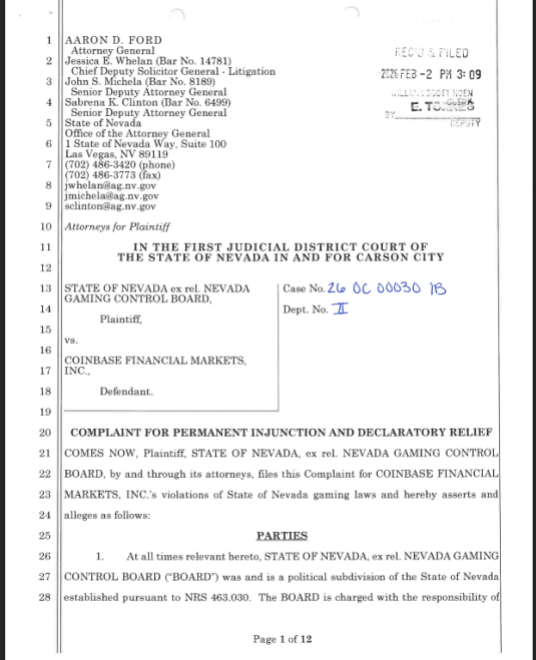
Source: Nevada Gaming Control Board

The filing seeks immediate court steps to halt the products while the state pursues its claims. Reports note the move follows similar actions against other prediction platforms and comes as the legal fight over where these products belong—state gaming law or federal derivatives law—intensifies.

Background On Prediction Markets And Coinbase’s Response

Prediction markets have grown quickly. Coinbase rolled out a prediction market product that lets customers take positions on the outcomes of sports and other real-world events, working with established market operators.

BTCUSD currently trading at $76,059. Chart: TradingView

Coinbase has pushed back by suing multiple states in federal court, arguing that event contracts are regulated by the federal Commodity Futures Trading Commission and not by individual state gaming regulators. Those federal suits targeted Connecticut, Illinois, and Michigan, among others.

Federal Regulator Signals New Rules

Reports say the CFTC’s chair has signaled a shift toward clearer federal rules for event contracts and suggested the agency may issue new guidance that affects ongoing state cases.

That announcement could change the legal balance, since a stronger federal stance would bolster exchanges that claim CFTC jurisdiction over these products. Still, state claims press on, and courts will have to sort out who has the power to regulate.

Nevada’s Push Comes As Other States Act

Nevada’s action is not isolated. A Nevada state court recently granted a temporary restraining order that barred another major prediction platform from offering event contracts in the state for a short period while the matter moved toward a hearing.

Regulators in several states have issued cease-and-desist letters or sued operators they say are offering unlicensed wagering.

Featured image from Shutterstock, chart from TradingView

Related Questions

QWhat is the main reason Nevada is taking legal action against Coinbase?

ANevada is taking legal action because state gaming regulators claim Coinbase offered event contracts that operate like unlicensed sports betting without holding the required state gaming license.

QWhat specific legal measures did the Nevada Gaming Control Board request from the court?

AThe Nevada Gaming Control Board filed a suit asking the court to stop Coinbase from offering these contracts in Nevada and to grant a temporary restraining order and preliminary injunction.

QHow has Coinbase responded to similar regulatory challenges from other states?

ACoinbase has pushed back by suing multiple states, including Connecticut, Illinois, and Michigan, in federal court, arguing that event contracts are regulated by the federal CFTC and not by state gaming regulators.

QWhat potential shift in the regulatory landscape is mentioned regarding the CFTC?

AThe CFTC's chair has signaled a shift toward clearer federal rules for event contracts and suggested the agency may issue new guidance, which could bolster exchanges' claim of CFTC jurisdiction.

QIs Nevada's action an isolated case, or are other states taking similar steps?

ANevada's action is not isolated; regulators in several states have issued cease-and-desist letters or sued operators they allege are offering unlicensed wagering.

Related Reads

Public Version of Mythos Officially Launched: Analyzing the Advantages and Limitations of AI Smart Contract Auditing

Publicly available Mythos, Anthropic's AI model, has officially launched, demonstrating both significant potential and limitations in smart contract security auditing. The article analyzes its capabilities through real-world cases. AI excels in identifying subtle, low-level vulnerabilities through pattern recognition and large-scale code screening. A key example is detecting a storage slot collision between a custom rewards mapping and a third-party library's ReentrancyGuard, a vulnerability easily missed in manual audits. In the recent Zcash incident, AI also rapidly discovered a critical soundness bug that had remained hidden for years. However, AI currently struggles with complex, interconnected scenarios. When tested on the Curve LlamaLend sDOLA exploit, which involved manipulating prices across multiple protocols (Curve pools, lending markets) to trigger liquidations, Fable 5 failed to identify the core cross-protocol attack vector. These scenarios require a deep understanding of DeFi economic models and multi-contract interactions. In conclusion, while AI tools like Mythos significantly boost efficiency in finding standardized, syntactic vulnerabilities, they cannot yet replace expert analysis for complex, business-logic, and cross-protocol attacks. An effective audit workflow combines AI's speed for initial screening with human expertise for in-depth, holistic analysis.

marsbit3m ago

Public Version of Mythos Officially Launched: Analyzing the Advantages and Limitations of AI Smart Contract Auditing

marsbit3m ago

Trade.xyz's Rebase Refusal Sparks Controversy, On-Chain Pre-IPO Market Faces Major Pricing Test

The debate surrounding Trade.xyz's refusal to adjust its SPCX (SpaceX pre-IPO) perpetual contract pricing amid updated share count revelations highlights a key challenge for on-chain pre-IPO markets. While several centralized exchanges (CEXs) paused and repriced their contracts after SpaceX's filing showed a ~10% increase in total shares, Trade.xyz maintained its market-driven pricing logic, which tracks expected per-share price sentiment rather than fundamental valuation metrics like market cap. This discrepancy triggered cross-platform arbitrage and caused leveraged long positions on Trade.xyz to suffer significant losses, as the platform's HIP-3 architecture lacks a native "Rebase" mechanism to neutrally adjust all user positions following such corporate actions. The incident underscores the difficulty for decentralized perpetual exchanges (Perp DEXs) to implement Rebase—a process CEXs handle by centrally pausing markets and adjusting ledger data. On-chain, this requires complex smart contract modifications, increasing gas costs, complexity, and potential attack surfaces. While some DEXs have managed similar adjustments, Trade.xyz's current design does not natively support it, though the team is reportedly exploring solutions for future events like stock splits. Ultimately, the controversy serves as a critical case study for the nascent on-chain pre-IPO sector, raising questions about price discovery reliability, transparent rule disclosure, and the readiness of DeFi infrastructures to handle traditional corporate actions as real-world assets (RWAs) gain traction.

marsbit11m ago

Trade.xyz's Rebase Refusal Sparks Controversy, On-Chain Pre-IPO Market Faces Major Pricing Test

marsbit11m ago

The 'Middle Eastern Prince' Swindles a Wealthy Woman: Renting Planes and Rolls-Royces, Scamming 120 Million Over Three Years

Two brothers who posed as "Middle Eastern princes" have been sentenced in the United States to 24 and 23 years in prison, respectively, and ordered to pay over $21.2 million in restitution and back taxes. Over three years, they fraudulently obtained approximately $21 million, primarily by promoting fictitious investment projects, including a non-existent cryptocurrency mining operation in a former General Electric industrial park in East Cleveland. The brothers, aged 42 and 33, created elaborate personas: one claimed to be a wealthy royal family heir and the city's "International Economic Advisor," while the other posed as a hedge fund manager with expertise from watching the TV show *Billions*. They bolstered their image by renting luxury cars and private jets and cultivating a relationship with a local mayor's chief of staff, who provided official-looking documents and government event access. A significant portion of the victims' funds, about $18 million, came from a single Chinese investor, a woman from Sichuan with experience in Bitcoin mining. The brothers also defrauded several women, including one former girlfriend. Their scheme unraveled when the primary investor discovered her $6 million worth of mining equipment had been sold off. The case highlights a trend of impostors using fabricated "Middle Eastern royal" identities to target wealthy individuals. Similar incidents include a "Dubai prince" who recently promoted a $500 million family office in Hong Kong and a Colombian man who impersonated a Saudi prince for decades in the US before being caught and sentenced in 2019.

marsbit25m ago

The 'Middle Eastern Prince' Swindles a Wealthy Woman: Renting Planes and Rolls-Royces, Scamming 120 Million Over Three Years

marsbit25m ago

a16z Partner: Being in the Flow of Capital Is the True Moat

A16z Partner: Standing in the Cash Flow is the True Moat Historically, many of the strongest companies built their moats by positioning themselves within "cash flows"—facilitating value creation and transfer in a network and taking a cut. The more value flows, the larger they grow. Crypto is the first modern technology natively built for this. With open ledgers, programmable settlement, and stablecoins enabling internet-speed global value transfer, it allows startups to inherit network effects from day one. Well-designed tokens align users, developers, and the protocol towards network growth, distributing value to contributors. This model isn't new (e.g., railroads, Visa, Google, AWS) but Crypto democratizes it. It lets entrepreneurs target areas with high inefficiency and profit extraction—like traditional finance's payments, custody, FX, and settlement—to compress costs, increase speed, and redistribute value by standing in the new flow. The opportunity extends beyond finance to emerging markets like GPU/compute, AI training data, energy, and space, where new, programmable infrastructure can be built without legacy constraints. Key questions for founders: Are you already in the cash flow? Does your revenue scale 10x with network activity? Where is profit extraction highest relative to value created in your market? The strategy is clear: compress the old cost structure, position yourself in the new value stream, and let the network compound.

marsbit53m ago

a16z Partner: Being in the Flow of Capital Is the True Moat

marsbit53m ago

Trading

Spot
Futures
活动图片





